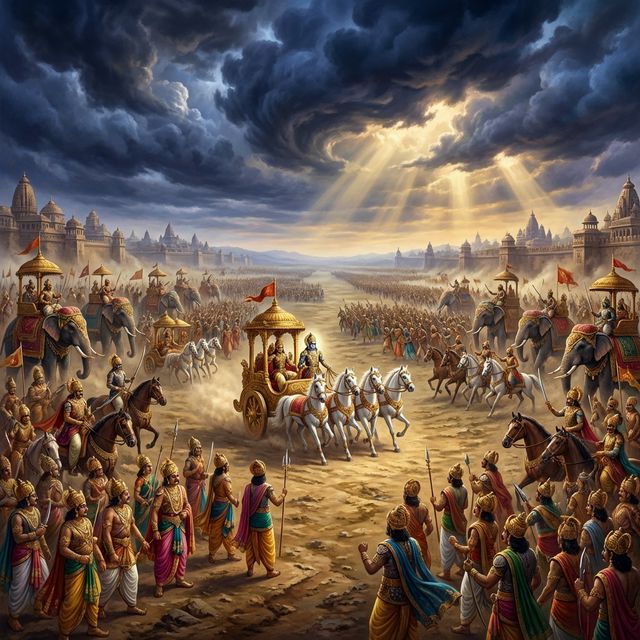
The Islands Beyond Jambudvipa
Sanjaya measures the seven islands, the world elephants and the sun
The King Asks for Measurements
Sanjaya had already told the whole of Jamvukhanda, the great island of the rose apple tree, with its mountains and its rivers and its four ages, and the blind king in the hall at Hastinapura was not satisfied. War was being fought while they talked. His son was on the field. He asked instead about the size of the world.
"Thou hast, O Sanjaya, duly described Jamvukhanda to me," Dhritarashtra said. "Tell me now its dimensions and extent truly. Tell me also of the extent of the ocean of Sakadwipa, and Kusadwipa, of Salmalidwipa and Kraunchadwipa, truly and without leaving anything, and tell me also, O son of Gavalgani, of Rahu and Soma and Surya."
Sanjaya, the suta who had been given the divine sight so that nothing on earth or above it would be hidden from him, sat down to answer the largest question he had yet been asked.
"There are, O king, many islands, over which the Earth extended," he said. "I will describe to thee, however, only seven islands, and the moon, and the sun, and the planet Rahu, also."
He began with a number, because that is what had been asked for.
"The Jamvu mountain extends over full eighteen thousand and six hundred yojanas. The extent of the salt ocean is said to be twice this."
Twice. That is the rule the whole account runs on, and it does not stop running. Every ring outward from where the Kurus were killing one another is double the ring before it, so that the field at Kurukshetra sits at the centre of a world that doubles and doubles until the arithmetic outruns the mind that is following it.
"That ocean is covered with many kingdoms," Sanjaya said, "and is adorned with gems and corals. It is, besides, decked with many mountains that are variegated with metals of diverse kinds. Thickly peopled by Siddhas and Charanas, the ocean is circular in form."
A circle of salt water with gems in it, and cities on it, and perfected beings walking about upon it. That was the first ring outward. There were six more.
The Island Where Nobody Dies
"I will now tell thee truly of Sakadwipa, O Bharata," Sanjaya said. "Listen to me, O son of Kuru's race, as I describe it to thee duly."
The figures came first again. That island is of twice the extent of Jamvudwipa, and the ocean that holds it is of twice the extent of that island, and it surrounds Sakadwipa on every side, so that the land floats in a ring of water twice as wide as itself.
Then he said the thing that must have been hard to hear in that hall.
"The kingdoms there are full of righteousness, and the men there never die."
He did not pause on it. He let it stand and went straight on, and the next sentence he spoke was a question he asked of himself and answered as though the answer were obvious.
"How can famine take place there? The people are all endued with forgiveness and great energy."
Consider where this was being said. It was being said to a king whose hunger for a kingdom had put two armies in a field, in a city that was waiting every evening to be told the number of its dead. Somewhere out past the salt water there were kingdoms full of righteousness where nobody starved and nobody died, and the reason given for both was the same, that the people there were forgiving.
"I have now, O bull of Bharata's race, given thee duly a brief description of Sakadwipa. What else, O king, dost thou wish to hear?"
It was an offer to stop. Dhritarashtra did not take it.
"Thou hast given me, O Sanjaya, a description of Sakadwipa in brief," the king said. "O thou that art possessed of great wisdom, tell me now everything in detail truly."
So the suta went back to the beginning of that island and named its mountains one by one.
Seven Mountains, and the Dark One
"In that island there are seven mountains that are decked with jewels and that are mines of gems and precious stones," Sanjaya said. "There are many rivers also in that island. Everything there, O king, is excellent and delightful."
He took them in order, going outward.
The first is called Meru, and it is the abode of the gods, the rishis and the Gandharvas. The next, stretching towards the east, is called Malaya, and Malaya is where the clouds are made; every cloud that has ever crossed a sky was generated on that mountain and dispersed from it on all sides. The third is the large mountain called Jaladhara, the water holder, and from Jaladhara Indra takes water daily, water of the best quality, and it is out of that water that the rains of the season are poured upon men.
The fourth is the high mountain called Raivataka, and over Raivataka, fixed in the firmament, the Grandsire himself has permanently placed the constellation Revati, so that the star and the peak stand one above the other and neither has moved since.
"On the north of this is the large mountain called Syama," Sanjaya said. "It hath the splendour of newly risen clouds, is very high, beautiful, and of bright body. And since the hue of those mountains is dark, the people residing there are all dark in complexion, O king."
Dhritarashtra stopped him there.
"A great doubt ariseth in my mind, O Sanjaya, from what thou hast said. Why, O Suta's son, would the people there be of dark complexion?"
The answer he got was flatter than the question and better than it.
"O great king, in all islands men may be found that are fair, and those that are dark, and those also that are produced by a union of the fair and the dark races. But because the people there are all dark, therefore is that mountain called the Dark Mountain."
The mountain is named after the men, not the men after the mountain. The blind king had assumed the hill had coloured its people, and was told that the people had named the hill.
The Tree in the Middle of Saka
There were two mountains left. After Syama comes the large mountain called Durgasaila, the fortress rock, and after Durgasaila comes Kesari, and the breezes that blow off Kesari are all charged with fragrance, so that a man knows he has come near it before he sees it.
"The measure of each of these mountains is double that of the one mentioned immediately before," Sanjaya said, and the doubling runs through the whole range, Meru to Malaya to Jaladhara to Raivataka to Syama to Durgasaila to Kesari, each one twice the last.
Between the seven mountains lie seven Varshas, seven regions, and the wise have given each of them a name. The Varsha of Meru is called Mahakasa, the great sky. That of the water giving Malaya is Kumudottara. The Varsha of Jaladhara is Sukumara. That of Raivataka is Kaumara. That of Syama is Manikanchana, which is jewel and gold. The Varsha of Kesara is Mandaki, and the region beyond it is called Mahapuman.
"In the midst of that island is a large tree called Saka," Sanjaya said. "In height and breadth the measure of that tree is equal to that of the Jamvu tree in Jamvudwipa. And the people there always adore that tree."
That is where the island got its name, as this one of ours got its own, from a tree standing at the centre of everything with people worshipping at the foot of it.
There in that island are many delightful provinces where Siva is worshipped, and thither repair the Siddhas, the Charanas and the celestials. The people are virtuous. All the four orders are devoted to their respective occupations, and no instance of theft can be seen there.
"Freed from decrepitude and death and gifted with long life," said Sanjaya, "the people there grow like rivers during the season of rains."
It is the only image in the whole passage that shows what a happy life looks like from outside, and it is not a picture of stillness. Men there increase the way water increases when the rain comes, faster and fuller and going somewhere.
The Rivers, and the Four Provinces With No King
"The rivers there are full of sacred water," Sanjaya said, "and Ganga herself, distributed as she hath been into various currents, is there."
The Ganga that the Kurus knew, the river the grandsire's mother had walked out of, was on that island too, broken into channels and running under other names. He gave the names as he had them. Sukumari, and Kumari, and Seta, and Keveraka, and Mahanadi, and the river Manijala, and Chakshus, and the river Vardhanika. These and many other rivers by thousands and by hundreds, all full of sacred water, and it is from these that Vasava draws the water he showers as rain.
"It is impossible to recount the names and lengths of rivers," he said. "All of them are foremost of rivers and sin cleansing."
Then he named the peoples, and this is the part of the account that a court at war ought to have heard twice.
In that island of Saka there are four sacred provinces, and they are called the Mrigas, the Masakas, the Manasas and the Mandagas. The Mrigas for the most part are Brahmanas devoted to the occupations of their order. Amongst the Masakas are virtuous Kshatriyas who grant to Brahmanas every wish they entertain. The Manasas live by following the duties of the Vaisya order, and having every wish of theirs gratified they are brave besides, and firmly devoted to virtue and profit. The Mandagas are all brave Sudras of virtuous behaviour.
Four orders, four countries, each keeping its own work. And then the line that finishes it.
"In these provinces, O monarch, there is no king, no punishment, no person that deserves to be punished. Conversant with the dictates of duty they are all engaged in the practice of their respective duties and protect one another."
No king. Sanjaya said it to a king, in a hall where the question of who ought to be king had already killed men by the ten thousand, and he did not linger over it and did not point at it.
"This much is capable of being said of the island called Saka," he said. "This much also should be listened to about that island endued with great energy."
The Oceans of Butter, Curds and Wine
"O Kauravya, that which is heard about the islands in the north, I will recount to thee," Sanjaya said. "Listen to me now."
Thither in the north is the ocean whose waters are clarified butter. Then is the ocean whose waters are curds. Next comes the ocean whose waters are wine, and then is another ocean of water. The islands are double in area of one another as they proceed further and further towards the north, and each of them is surrounded by one of these seas.
In the island that is in the middle there is a large mountain called Goura, made of red arsenic. On the western island is the mountain Krishna, which is the favourite abode of Narayana. There Kesava guards celestial gems in profusion, and thence, inclined to grace, he bestows happiness on creatures.
Each of the northern islands keeps one holy thing that gives it its name and takes its worship. In Kusadwipa it is the celestial clump of kusa grass. In the island of Salmalika it is the salmali tree. In the Krauncha island it is the mountain called Maha-krauncha, a mine of all kinds of gems, always adored by all the four orders of men. There too is the mountain called Gomanta, huge, consisting of all kinds of metals, whereon always resides, mingling with those that have been emancipated, the puissant Narayana, otherwise called Hari, graced with prosperity and possessed of eyes like lotus leaves.
In Kusadwipa there is another mountain variegated with corals and called after the name of the island itself, inaccessible and made of gold. There is a third mountain of great splendour called Sumida. The sixth is called Harigiri. These are the six principal mountains, and the spaces between them increase in the ratio of one to two as they go north.
The seven Varshas that lie among them are named in order. The first is Audhido, the second Venumandala, the third Suratha, the fourth Kamvala, the fifth Dhritimat, the sixth Prabhakara, the seventh Kapila.
"In these, gods and Gandharvas and other creatures of the universe sport and take delight," Sanjaya said. "In these Varshas the inhabitants never die. There are no robbers, nor any tribes of Mlecchas. All the residents are almost white in complexion, and very delicate, O king."
The Four Elephants and the Breath of the World
"As regards the rest of the islands, I will recount all that hath been heard by me," Sanjaya said.
In the Krauncha island there is a large mountain called Krauncha. Next to it is Vamanaka, and next to Vamanaka Andhakara, and after Andhakara that excellent of mountains called Mainaka, and after Mainaka that best of mountains called Govinda, and after Govinda the mountain called Nivida.
The region near Krauncha is called Kusala, that near Vamanaka is Manonuga, and after Manonuga come Ushna, then Pravaraka, then Andhakaraka, then Munidesa, then Dundubhiswana, which teems with Siddhas and Charanas. The people are almost white in complexion, and all these countries are the habitations of gods and Gandharvas.
In the island of Pushkara is a mountain called Pushkara that abounds with jewels and gems, and there always dwells the divine Prajapati himself, whom all the gods and the great rishis adore with gratifying words and worship reverently. Diverse gems from Jamvudwipa are used there.
"In all these islands," Sanjaya said, "the Brahmacharyya, the truth, and the self control of the dwellers, as also their health and their periods of life, are in the ratio of one to two as the islands are more and more remote."
Everything doubles going north, including goodness.
"The land in those islands comprises but one country, for that is said to be one country in which one religion is met with. The Supreme Prajapati himself, upraising the rod of chastisement, always dwelleth there, protecting those islands. He is the king. He is their source of bliss. He is the father and the grandfather, and he protecteth all creatures there, mobile or immobile. Cooked food cometh there of itself, and the creatures eat it daily."
Past all of it lies a habitation of the name of Sama, of a starry shape, having four corners and thirty three mandalas, and in it dwell four princely elephants adored by all: Vamana, and Airavata, and another, and also Supratika.
"O king, with rent cheeks and mouth, I do not venture to calculate the proportions of these four elephants. Their length, breadth and thickness have for ever remained unascertained."
There in those regions the winds blow irregularly from all directions. The elephants seize them with the tips of their trunks, which are of the complexion of the lotus and capable of drawing up everything in their way, and soon after seizing them they let them out again.
"The winds thus let out by those respiring elephants come over the Earth," Sanjaya said, "and in consequence thereof creatures draw breath and live."
Every man on the field at Kurukshetra was breathing out of the lungs of four animals at the edge of the world.
Rahu, the Moon and the Sun
"Thou hast told me everything about the first subject very elaborately," Dhritarashtra said. "Thou hast also indicated the positions of the islands. Tell now, O Sanjaya, about what remains."
"Indeed, O great king, the islands have all been described to thee," Sanjaya said. "Listen to what I truly say about the heavenly bodies, and about Swarbhanu, as regards its dimensions."
It is heard that the planet Swarbhanu, whom men call Rahu, is globular. Its diameter is twelve thousand yojanas, and its circumference, because it is very large, forty two thousand yojanas, as said by the learned of olden times.
The diameter of the moon is stated to be eleven thousand yojanas, and its circumference thirty eight thousand nine hundred, of that illustrious planet of cool rays.
It has been heard that the diameter of the beneficent, fast going and light giving Sun is ten thousand yojanas, and his circumference thirty five thousand eight hundred, in consequence of his largeness. These are the dimensions reckoned here, O Bharata, of Arka.
"The planet Rahu, in consequence of his greater bulk, envelops both the Sun and the Moon in due times. I tell thee this in brief."
Twelve thousand against eleven thousand against ten thousand. The eclipse is not a portent but a matter of size: the largest of the three passes in front of the other two because it is the largest, and the light goes out of the sky at the appointed hour for no other cause.
"With the eye of science, O great king, I have now told thee all that thou hadst asked. Let peace be thine. I have now told thee about the construction of the universe as indicated in the Shastras."
Then, having laid out oceans of wine and mountains of gold and four elephants breathing for the world, the charioteer came back in one sentence to the only thing he had ever been talking about.
"Therefore, O Kauravya, pacify thy son Duryodhana."
Having listened to this charming Bhumi Parva, a Kshatriya becomes endued with prosperity, obtains fruition of all his desires, and wins the approbation of the righteous. The king who listens to it on the days of the full moon or the new moon, carefully observing vows all the while, has his life, fame and energy all enhanced, and his deceased sires and grandsires become gratified.
"Thou hast now heard of all the merits that flow from this Varsha of Bharata where we now are."
The blind king had asked how large the world was. He was told, in yojanas, out to the last ocean, and then told that the whole account came down to one act he could perform before nightfall, and would not.
Dharma Lesson
Sanjaya says himself what the measuring was for: pacify thy son. He has just described islands where nobody starves, where no theft is seen, where there is no king and no punishment because every order keeps its own work and protects the others, and the man listening presides over the exact opposite of all of it. Scale is the argument. Set beside oceans of wine and mountains of gold and four beasts whose proportions cannot be reckoned, the quarrel over one kingdom in one varsha does not become unimportant; it becomes visible for what it costs.