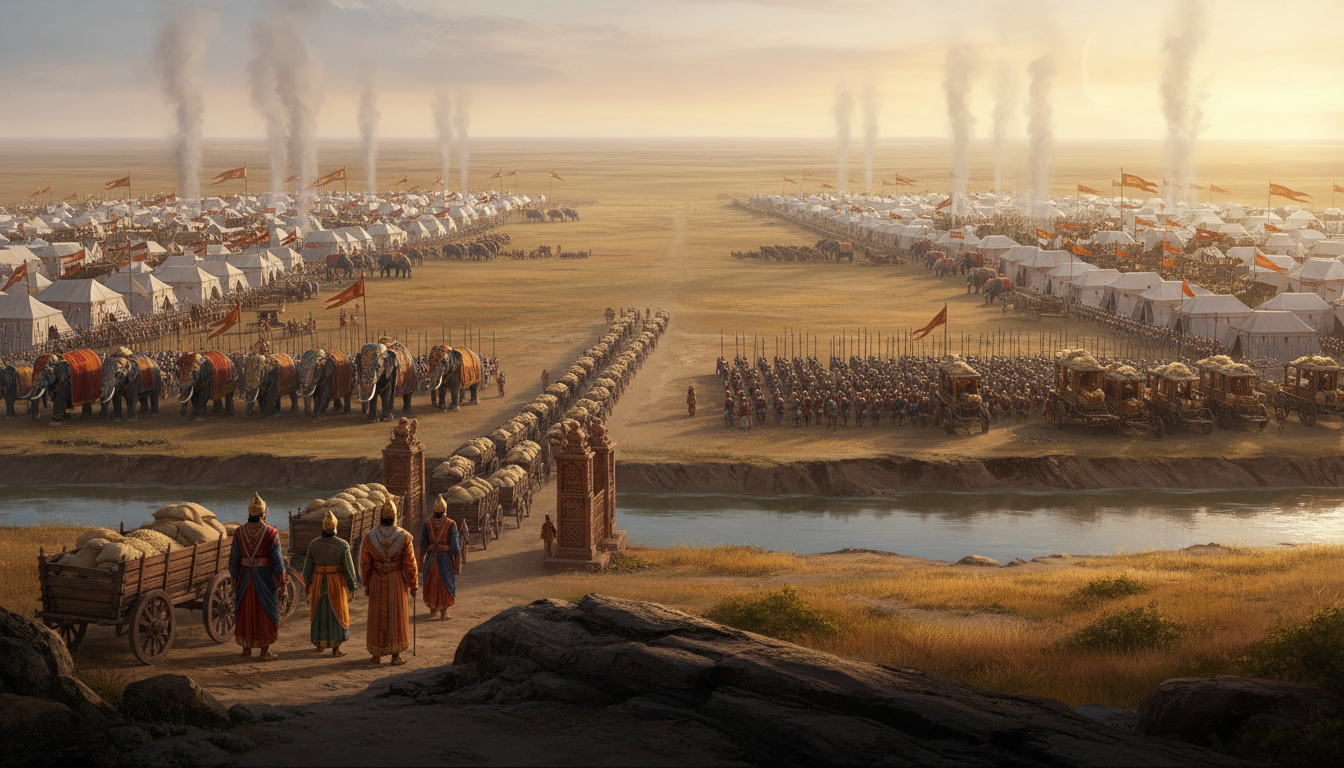
The Cities of Tents
Two capitals raised on Kurukshetra before a single arrow
Draw Up, Draw Up
When Krishna had named the commander, the shout that the delighted kings sent up was tremendous, and after the shout the camp at Upaplavya stopped being a camp and became a machine.
The troops began to move about at great speed, calling to one another, "Draw up, draw up." The neighing of steeds and the roars of elephants and the clatter of car-wheels and the blare of conchs and the sound of drums were heard everywhere at once and produced a tremendous din. Teeming with cars and foot-soldiers and steeds and elephants, that invincible host moved hither and thither, donning their coats of mail and uttering their war-cries, and looked like the impetuous current of the Ganga when it is at its full and agitated with fierce eddies and waves.
In the van of that host marched Bhimasena, and the two sons of Madri encased in their mail, and Subhadra's son, and the five sons of Draupadi, and Dhrishtadyumna of Prishata's race. Behind Bhimasena came the Prabhadrakas and the Panchalas.
The din made by the marching hosts, filled with joy, was like the roar of the deep when the tide is highest on the day of the new moon, and the tumult of it seemed to reach the very heavens.
They were capable of breaking hostile ranks, those warriors, and they marched cased in armour and filled with joy, and not one of them had yet seen the field they were going to. Thirteen years of exile and a year of hiding had ended in a message about five villages that had been refused, and now a plain three days' march away was going to have to hold all of it.
What the King Took With Him
Kunti's son marched in the middle of them, and what he took with him is the part of the day nobody sings about.
He took the cars and the other vehicles for transport. He took the food stores and the fodder. He took the tents, the carriages and the draught cattle, the cash-chests, the machines and the weapons. He took the surgeons and the physicians. He took the invalids, and all the emaciated and weak soldiers, and all the attendants and the camp followers, and he put them under his own hand rather than leaving them to trail behind and be lost.
And truthful Draupadi, the princess of Panchala, did not go.
She remained at Upaplavya with the ladies of the household about her, surrounded by servants and maids. The treasure and the women were given to bodies of soldiers to guard, and the guard was arranged in two parts: some troops placed as permanent lines of circumvallation about the place, and some ordered to move about at a distance from that line, so that nothing could come at the walls without first meeting the ones who were walking.
The woman who had said in the assembly hall that she would not bind up her hair until it was washed in Dushasana's blood stood and watched the army that was going to do it march away without her.
Then the sons of Pandu made presents of kine and of gold to the Brahmanas, who walked around them uttering blessings, and commenced the march on their cars decked with jewels.
The Order of the Column
Behind Yudhishthira, keeping him in their centre, marched the princes of Kekaya, and Dhrishtaketu, and the son of the king of the Kasis, and Srenimat, and Vasudana, and the invincible Sikhandin, all of them hale and hearty, cased in armour, armed and decked with ornaments.
In the rear came Virata, and Yajnasena's son of the Somaka race, and Susarman, and Kuntibhoja, and the sons of Dhrishtadyumna, and with them forty thousand cars, and five times as much cavalry, and infantry ten times more numerous than that, and sixty thousand elephants.
And Anadhrishti and Chekitana and Dhrishtaketu and Satyaki all marched together, surrounding Vasudeva and Dhananjaya, because everybody in that army had worked out for themselves which chariot was the one that mattered.
They reached the field of Kurukshetra with their forces in battle array, those smiters, and looked like roaring bulls; and entering the field they blew their conchs, and Vasudeva and Dhananjaya blew theirs. When the blare of the conch called Panchajanya went across the plain, resembling the roll of thunder, the warriors of that army were filled with joy, and their leonine roars mingling with the conchs and the beat of drums made the earth and the sky and the oceans resound with it.
Choosing the Ground
Yudhishthira caused his troops to encamp on a part of the field that was level, and cool, and abounding with grass and fuel.
He chose it with a care that says a good deal about him. He avoided the cemeteries. He avoided the temples, and the compounds consecrated to the deities, and the asylums of sages, and the shrines, and every other sacred plot on that plain; and he pitched his camp on a delightful and fertile and open and sacred part of the ground that belonged to nobody.
The man was about to put eighteen akshauhinis on that field and preside over the killing of most of them, and before a single tent-pole went in he walked the ground to make sure his army would not be sleeping on somebody's grave or watering horses in a hermit's yard.
Then, after the animals had been given sufficient rest, he rose and set out again, surrounded by hundreds and thousands of monarchs. And Kesava, accompanied by Partha, began to move about the country ahead of them, scattering the numerous soldiers of Dhritarashtra who had been posted there as outposts, so that when the surveyors came up there would be nobody watching them work.
Measuring on the Hiranwati
Dhrishtadyumna of Prishata's race and that mighty car-warrior Yuyudhana, who is called Satyaki, measured the ground for the encampment.
They came to the holy Hiranwati, which flows through Kurukshetra, and it was the obvious place and also the right one. The river was filled with sacred water. Its bed was free of pointed pebbles and of mire, which matters when sixty thousand elephants are going to be watered out of it twice a day for eighteen days. It was regarded as an excellent tirtha.
And there Kesava caused a moat to be excavated, and for the protection of the moat he stationed a sufficient number of troops, with proper instructions given to them.
The camp was to sit between the river and the ditch, and the ditch was to be watched by named men who had been told what they were watching for.
That is the whole of it in the record: a moat, a garrison, instructions. It is the only fortification in the story. Two of the greatest bowmen alive spent the day before the war with measuring lines, pacing out frontages for the tents of allied kings so that no man of rank would be able to complain about where he had been put; and the man who would not carry a weapon into the battle spent it standing over a ditch, telling the diggers how deep.
Tents Like Palaces, and Men on Wages
The rules that had been observed in respect of the tents of the Pandavas themselves were followed by Kesava in the matter of the tents he caused to be set up for the kings who had come as their allies, and nobody was housed worse than the sons of Pandu.
Costly tents, incapable of being attacked, standing well apart from one another, were set up by hundreds and by thousands on the surface of that plain. They looked like palatial residences. Each of them abounded with fuel, and with edibles, and with drink.
And there were assembled there hundreds upon hundreds of skilled mechanics, in receipt of regular wages.
That clause is worth stopping on. Not levied. Not commanded to attend. In receipt of regular wages, like men in a workshop, because the wheelwrights and the smiths and the leather-workers would decide how many cars came back onto the field on the second morning and Yudhishthira had evidently been told so by somebody who knew.
With them came surgeons and physicians, well versed in their own science, and furnished beforehand with every ingredient they might need. They were hired before the first arrow was cut. A king who hires that many surgeons in advance has made an estimate of the coming month, and has not told anybody what the estimate was.
The tents themselves were set apart from one another rather than crowded, which is how a camp survives a fire and how kings who dislike each other survive a fortnight of proximity. Each of the allied monarchs was given a pavilion of his own rank, provisioned before he arrived, so that no man who had brought an akshauhini across half of Bharatavarsha for another man's quarrel would have to ask for anything on his first night.
The Inventory in Every Pavilion
And king Yudhishthira caused to be placed in every pavilion, in quantities as high as hills, the following.
Bow-strings and bows. Coats of mail and weapons. Honey and clarified butter. Pounded lac. Water. Fodder for the cattle, and chaff, and coals. Heavy machines. Long shafts, lances, battleaxes, bow-staffs, breast-plates, scimitars and quivers.
Read it twice and it stops being a list and becomes a forecast. Honey and clarified butter are what you feed a wounded man. Pounded lac and coals are what you mend a chariot with at night. Chaff and fodder are what stands between sixty thousand elephants and a mutiny on the fourth day. Bowstrings are the thing that breaks first and the thing nobody thinks of.
And there were seen there innumerable elephants, cased in plates of steel with prickles set on them, huge as hills, each of them capable of fighting with hundreds and with thousands.
And when it became known that the Pandavas had encamped upon that field, their allies began to march in from every road with their forces and their animals, and many kings came who had practised the vows of Brahmacharya, and drunk the consecrated Soma, and made large presents to Brahmanas at sacrifices, and they came for the success of the sons of Pandu.
A Second Hastinapura
Next morning, under a cloudless sky, all the kings on the other side set out at Duryodhana's urging.
They had purified themselves by baths. They were decked in garlands and attired in white robes. They had poured libations on the fire and caused Brahmanas to utter benedictions upon them, and then they took up their weapons and raised their standards, and every one of them was conversant with the Vedas and had practised excellent vows, and every one of them was a grantor of other people's wishes, and they set out reposing confidence in one another.
First went Vinda and Anuvinda of Avanti, and the Kekayas, and the Vahlikas, with Bharadwaja's son at their head. Then came Aswatthaman, and Santanu's son, and Jayadratha of the Sindhu country, and the kings of the southern and the western lands and of the hilly regions, and Sakuni the ruler of the Gandharas, and the chiefs of the east and the north, and the Sakas and the Kiratas and the Yavanas, the Sivis and the Vasatis, each with his own great car-warrior at the head of his division. In the rear came Kritavarman, and the ruler of the Trigartas, and king Duryodhana surrounded by his brothers, and Sala, and Bhurisravas, and Salya, and Vrihadratha the ruler of the Kosalas.
They took up their position at the other end of Kurukshetra. And Duryodhana caused his encampment to be so adorned as to make it look like a second Hastinapura.
That is not a poet's flourish. Even those who were clever among the citizens of Hastinapura could not distinguish their own city from that camp. He caused inaccessible pavilions, similar to his own, to be erected by hundreds and thousands for the other kings of his army, and those tents were well planted upon an area measuring a full five yojanas of that field of battle, and into them the rulers of the earth entered, each according to his courage and the strength he possessed.
Bards, Traders, Spies and People Who Came to Watch
Duryodhana ordered excellent provisions to be supplied for all those high-souled kings, with their troops of infantry and elephants and horses, and with all their followers.
And then the list goes on past the soldiers, and this is the sentence that tells you what kind of thing was actually being built on that plain.
He made due provision for all those that subsisted upon the mechanical arts. For the bards, the singers and the panegyrists devoted to his cause. For the vendors and the traders. For the prostitutes. For the spies. And for the persons who had come to witness the battle.
People had travelled to Kurukshetra to watch. Not to fight, and not to serve anybody who was fighting. They were expected in sufficient numbers that a king put them on his provisioning rolls alongside his cavalry, and fed them, and found them somewhere to sleep, and no doubt sold them something.
On the other side of the plain, Yudhishthira did the same, and the record is careful to say so twice: he ordered excellent provisions of food for those high-souled kings with their infantry and elephants and horses and all their followers, and for all those who subsisted upon the mechanical arts. Then, having duly honoured all his combatants, he ordered them to march.
Two cities of cloth, then, five yojanas of one of them, facing each other across a level, cool, well-watered plain, each with its markets and its musicians and its surgeons and its ditch, and eighteen akshauhinis of men in them who would nearly all be dead within three weeks.
The Divisions, and the Slow March
Like Duryodhana, Yudhishthira ordered out his own heroic warriors headed by Dhrishtadyumna: that steady leader of the Chedis and the Kasis and the Karushas, Dhrishtaketu; and Virata, and Drupada, and Yuyudhana, and Sikhandin, and those two mighty bowmen and princes of Panchala, Yudhamanyu and Uttamauja. Cased in handsome coats of mail and decked with golden ear-rings, they blazed forth like fires on a sacrificial altar when the clarified butter is poured, and looked resplendent as the planets in the firmament.
He sent Abhimanyu and Vrihanta and the five sons of Draupadi forward with Dhrishtadyumna at their head, and despatched Bhima and Dhananjaya in the second division, and the din made by the men running about to harness their steeds and their elephants and to load the cars with the implements of battle, and the shouts of the cheerful combatants, seemed to touch the very heavens. Last of all the king marched himself, accompanied by Virata and Drupada and the other monarchs.
Then Yudhishthira, depending on his own wisdom, disposed his divisions in an order the Kauravas were not expecting, and confounded the sons of Dhritarashtra with it.
The first and irresistible division he placed under the command of Bhimasena: the five sons of Draupadi and Abhimanyu, and Nakula and Sahadeva, and all the Prabhadrakas, and ten thousand horses, and two thousand elephants, and ten thousand foot-soldiers, and five hundred cars.
In the middle division he placed Virata and Jayatsena, and those two mighty car-warriors and princes of Panchala, Yudhamanyu and Uttamauja, both armed with mace and bow. And in that middle division marched Vasudeva and Dhananjaya, with five thousand elephants and crowds of cars all round them, and foot-soldiers in thousands with bows and swords and maces walking before and behind.
In that part of the sea of troops where Yudhishthira himself was, there were stationed numerous lords of the earth, and thousands of elephants, and steeds by tens of thousands. There also marched Chekitana with his own large force, and king Dhrishtaketu the leader of the Chedis, and that mighty bowman Satyaki, foremost car-warrior of the Vrishnis, surrounded by hundreds and thousands of cars. Kshatrahan and Kshatradeva, mounted on their cars, marched behind, protecting the rear, and behind them again were the waggons and the stalls and the uniforms and the vehicles and the draft animals.
And taking all the invalids and the women, and all that were emaciated and weak, and the animals carrying his treasures, and all his granaries, with the aid of his elephant divisions, Yudhishthira marched slowly.
That is the last thing said about him before the fighting: he marched slowly, because of the granaries and the invalids. The seventy thousand elephants of his seven akshauhinis followed after him with the fluid trickling down their trunks and from their mouths, resembling showering clouds, and they came on behind the king like moving hills; and other men by hundreds and thousands and tens of thousands followed after, roaring, and beat their drums by thousands and blew their conchs by tens of thousands, and there was no arrow yet in any bow on either side of that plain.
Dharma Lesson
A war is fed before it is fought. The care a king spends on his fodder, his bowstrings and his hired surgeons is the truest measure of what he privately expects the coming month to cost. Yudhishthira walks the ground to avoid pitching on graves and shrines, and Duryodhana provisions the traders and the spectators, and both of them are telling you what they think they are building.