Twenty-Three Days on the Saraswati
Bhishma fights his own preceptor and neither man can win
The Old Man Explains Himself
Duryodhana had asked why the commander of his armies would not lift a weapon against the son of Drupada, and Bhishma, who was very old and had been asked worse questions, answered it properly, which meant beginning a long way back.
"There was a girl," he said, "the eldest of the three I carried off from the self-choice at Kasi. Amba. She told me in front of my ministers that she had chosen Salwa in her heart, and I let her go, and Salwa would not have her because I had touched her chariot with my hand. She could not go home, and she went into the forest to undertake penances instead.
"A royal sage came into that hermitage while the ascetics were still debating what to do with her: Hotravahana of the Srinjayas, who heard her out and began to tremble, because he was her mother's father. He took her onto his lap like a child and told her to go to Rama, the son of Jamadagni, on Mahendra. Name me to him, he said, and he will slay Bhishma in battle if Bhishma does not obey him. And while the old man was still speaking, Akritavrana walked in, who was Rama's dearest friend, and told them Rama would come in the morning."
He came, and heard the whole of it, and was not eager.
"Daughter of Kasi," Rama said, "I take up arms now on no account except for the sake of those who know the Vedas. Bhishma obeys me exceedingly. Say the word and he will put your feet on his head at my command."
"Slay him," Amba said. "You have promised, and it becomes you to make your promise true."
It was Akritavrana who closed the trap, gently, the way a friend reminds a friend of what he has not forgotten. "It does not become you to desert a girl who has come to you for protection. And consider the vow you made before the brahmanas after you had conquered all the kshatriyas: that you would never abandon those who came to you in fright, and that you would slay any proud warrior who had vanquished in battle all the assembled kshatriyas of the earth. Bhishma has done exactly that."
Rama sat a while with his own words being handed back to him. "If he is too proud of his battles to obey me," he said, "I will slay him. You have all seen what my arrows do. They do not stick in a body. They pass through it."
In the morning they brought the girl to Kurukshetra and camped on the Saraswati.
Take Her Back
"On the third day," Bhishma said, "he sent me a message. It said: I have come here, do what is agreeable to me.
"I went out to him with a joyful heart, because he was my master and an ocean of energy, and I took a cow at the head of my train and brahmanas behind me. He accepted the worship I offered, and then he said this.
"Bhishma, with what state of mind did you abduct the daughter of the king of Kasi at her self-choice, being yourself divested of desire, and then dismiss her afterward? By you this famous lady has been dissociated from virtue. Who can marry her now? Salwa has rejected her because you carried her off. Take her to yourself at my command, and let a king's daughter be charged with the duties of her sex. This humiliation should not be hers.
"I told him I could not give her to my brother; that she herself had said to me, I am Salwa's; and that it was my firm vow never to abandon kshatriya practice out of fear or pity or greed or lust.
"His eyes rolled with anger and he said, If you do not act on my words I will slay you this very day along with all your counsellors. He said it more than once. I begged him in sweet words and he did not cool. I bowed my head to the ground and asked him plainly why he sought battle with me, and reminded him that while I was a child it was he who instructed me in the four kinds of arms, so that I was his disciple.
"And he answered, with his eyes still red: You know me to be your preceptor, and yet you will not accept this daughter of the ruler of Kasi to please me. I cannot be gratified unless you do it. Take the girl and preserve your race. Having been abducted by you, she obtains no husband."
The Sloka of Marutta
"Then I said the thing that made the war," Bhishma told him.
"I said: This cannot be, regenerate rishi. All your labour is wasted. As for the girl, she was refused by me before, and who would admit into his house a woman whose heart is another's, and who is on that account like a snake of virulent poison? Not from fear of Vasava himself would I forsake my duty. Be gracious to me, or do at once whatever you think proper.
"And I said: This verse also is heard in the Puranas, sung by the high-souled Marutta. Renunciation of a preceptor is sanctioned by the ordinance, when that preceptor is filled with vanity, is destitute of the knowledge of right and wrong, and is treading a devious path.
"You are my preceptor, and for that I have reverenced you out of love. But you do not know the duty of a preceptor, and for that I will fight with you. I would not slay any preceptor in battle, and especially not a brahmana endued with ascetic merit; it was for that I forgave you. But it is gatherable from the scriptures that he is not guilty of slaying a brahmana who kills in battle a man of that order who has taken up weapons like a kshatriya and fights wrathfully without seeking to fly. I am a kshatriya stationed in kshatriya duty. Come to Kurukshetra, where in days gone by you propitiated your fathers with the blood of kshatriyas, and I will slay you there and propitiate the kshatriyas you slew.
"And I said one thing more, which I am not proud of. For many long years you have boasted that you single-handed vanquished all the kshatriyas of the earth. In those days no Bhishma had been born, nor any kshatriya like Bhishma. You have consumed heaps of straw. The man who will quell that pride is standing in front of you.
"And Rama laughed and said, By good luck you desire to fight with me. Come to Kurukshetra, and let your mother Jahnavi see you lying dead on that plain and eaten by crows."
All in White, and His Mother in the Way
"I went back into the city and told Satyavati everything, and she had the propitiatory rites performed and blessed me.
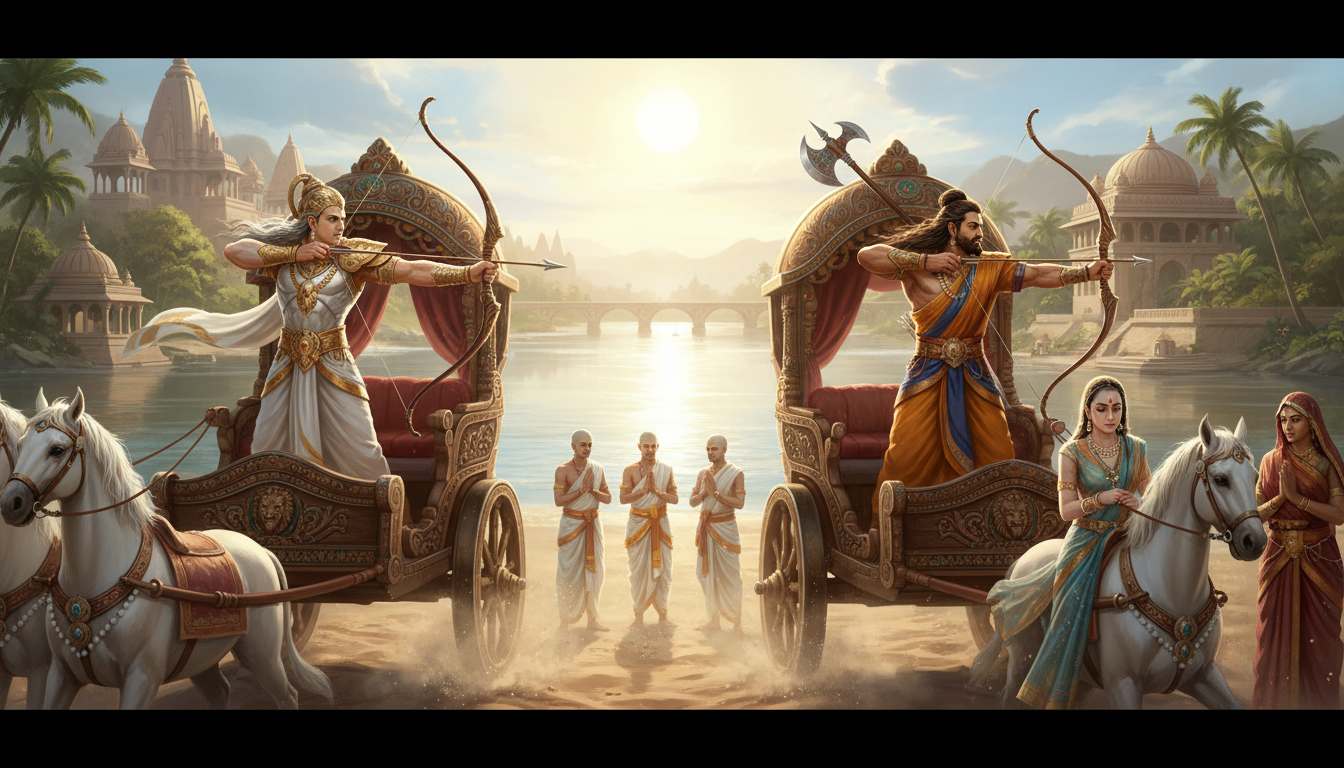
"Then I dressed for it. A car of silver, roomy, covered on all sides with tiger skin, stocked with weapons, white horses yoked to it, and a charioteer who was well born and brave and had seen many encounters. My mail was white. My bow was white. The umbrella over my head was white, and the fans, and my clothes, and my head-dress, and in that colour I went out of the city named after the elephant to the field of Kurukshetra.
"When I came in sight of him I took up my conch and blew a long blast. Brahmanas and forest ascetics had come to watch, and the gods with Indra at their head were stationed above the field, and there were celestial garlands in the air, and music, and canopies of cloud.
"And at that moment my mother appeared before me in her own form.
"What is this that you seek to do? she said. I will go to Jamadagni's son and beg him: do not fight Bhishma, who is your disciple. Being a kshatriya, do not obstinately set your heart on an encounter with a brahmana. Rama is equal in prowess to Mahadeva, and he is the exterminator of your whole order. You do not know what you are asking for.
"I saluted her and told her the whole history of the self-choice, and how I had urged Rama to desist. Then she went, that great river, and stood before the son of Bhrigu and begged him for my sake.
"Go and make Bhishma desist, Rama told her. He does not execute my wish. It is for that I have challenged him.
"So she came back to me, and I would not do her bidding either. My eyes rolled with anger and I refused my own mother, and while she was still standing there Rama appeared in my sight and challenged me to the encounter."
The Earth Is My Car
"I called out to him, smiling: Mounted on my car, I do not wish to fight a man who is on the ground. Mount a car, hero, and case your body in mail, if you wish to fight me.
"And he answered me, smiling: The Earth is my car, Bhishma. The Vedas are the good steeds that carry me. The wind is my car-driver. My coat of mail is those mothers in the Vedas, Gayatri and Savitri and Saraswati. Well covered by these in battle, I will fight.
"Then he covered me on every side with a thick shower of arrows, and while they were still falling I saw that he was standing on a car after all, created by a fiat of his will, beautiful as a town, decked with gold, bearing the device of the sun and the moon. Akritavrana, who knew the Vedas and was his dearest friend, was holding the reins. And he kept summoning me, Come, come, and it gladdened his heart.
"He poured three showers of arrows on me and curbed my horses. Then I put my bow aside and came down and walked to him on foot and worshipped him, and said: Rama, whether you are my equal or my superior, I will fight with you, my virtuous preceptor. Bless me and wish me victory.
"And he said: He who desires prosperity should act exactly so. Those who fight with warriors more eminent than themselves have this duty to perform. I would have cursed you if you had not approached me like this. Go, fight carefully. I cannot wish you victory, because I myself stand here to vanquish you. Go and fight fairly. I am pleased with your behaviour.
"I bowed and went back and blew my gold-decked conch again, and the combat began, and it lasted many days."
Fie on Battle, Fie on Kshatriya Practices
"He struck first, with nine hundred and sixty straight arrows winged with vulture feathers, and covered my four horses and my driver with them. I sat still in my mail and said to him: You have shown little regard for me, and I have fully honoured your preceptorship. The Vedas that are in your body, the status of brahmana that is in you, the ascetic merit you earned by the severest austerities: I do not strike at these. I strike at the kshatriyahood you have adopted. When a brahmana takes up weapons he becomes a kshatriya. Watch me cut your bow.
"And I cut one horn off his bow with a broad-headed shaft and dropped it on the ground, and put a hundred arrows through his body, and they came out the other side and went on through the air as though they were vomiting blood; and Rama stood covered in it and shone like Sumeru with streams of liquid metal running down its breast, or like a kinsuka tree in flower.
"He took up another bow and answered with golden-winged arrows that pierced my vitals and set me trembling. I gathered myself and put a hundred blazing shafts into him, and he lost his senses where he stood.
"And then I stopped. I was filled with pity at the sight and I stopped of my own accord and said aloud, in front of both camps: Fie on battle. Fie on kshatriya practices. Great is the sin I have committed by observing them, that I have wounded with arrows my preceptor, who is a brahmana with a virtuous soul.
"I did not strike Jamadagni's son again that day. The sun went to his chambers in the west and the fighting ended, and in the evening my charioteer drew the arrows out of my body, and out of the horses, and out of himself."
The Eight Who Held Him Up
"So it went on. Each morning the horses were bathed and watered, and each morning I got down from the car and saluted him before I fought him.
"We spent the celestial weapons on one another like men spending coin. I sent the Vayavya and he neutralised it with the Guhyaka. I applied the Agneya with its mantras and he put it out with the Varuna. He wheeled suddenly to my right one day and pierced me in the breast, and I swooned, and my driver carried me off the field, and I heard Akritavrana and the ascetics and that girl shouting for joy behind me. Another day I sent an arrow with Death sitting at the head of it, and he dropped, and the whole universe cried out as though the sun had fallen from the sky; and the ascetics knelt around him and comforted him with hands made cold by water, and he got up and fitted an arrow and said in a shaking voice, Stay, Bhishma. You are already slain.
"He threw a lance at me like a meteor with a flaming mouth, and I cut it into three pieces, and breezes charged with fragrance began to blow around me. Then he threw twelve more, blazing like the twelve suns that rise at the end of the universe, and I was afraid, and I burned them with twelve shafts. There were hours when the arrows we shot filled the sky and stayed there without falling, so that the sun could not get its rays through, and the friction of them lit a fire in the air, and they were consumed by the fire they had made and came down on us as ashes.
"On one of those days my beloved charioteer took the arrows meant for me. He swerved in his place, and a total unconsciousness came over him, and he fell on the earth and gave up his life; and while I was still lamenting for him, Rama drove a blood-drinking shaft through my breast and I fell out of the car with it.
"Rama roared like a raincloud, thinking me dead. And while I lay there I saw eight brahmanas standing round me with the effulgence of the sun or the fire, holding me up on their arms so that I did not touch the ground, sprinkling me with drops of water and saying over and over, Do not fear. Let prosperity be yours.
"I rose, and my mother Ganga was standing on my car with the reins of my horses in her hands. I worshipped her feet and the spirits of my ancestors, and with joined hands entreated her to go, and she went, and I drove myself."
The Weapon Given in a Dream
"That evening I felled him again, and he embraced the earth on his knees with his bow loosened out of his hand, and the sky answered it. Clouds covered the firmament and poured down a shower of blood. Meteors fell by hundreds. Rahu swallowed the sun at midday, the earth shook, vultures came down in joy, and drums that no hand touched sounded harshly. Then he rose again, out of his senses with anger, and took up his bow, and I resisted him, and the rishis watching us were filled with pity.
"So it went, sunrise to sunset, and it lasted three and twenty days.
"On the twenty-third night I bowed to the brahmanas and the rishis and the gods and to all the creatures that wander in the dark, and lay down alone and thought: this combat has lasted many days and I cannot vanquish him. If I am in fact able to vanquish this brahmana of mighty strength, let the gods kindly show themselves to me this night.
"And mangled with arrows as I was, lying on my right side toward morning, I saw them. Those same eight, who had held me off the ground and told me not to fear. They stood surrounding the bed and said:
"Rise, son of Ganga. You need have no fear. We will protect you, for you are our own body. Rama will never be able to vanquish you in battle; you will be the conqueror of Rama in combat. There is a beloved weapon called Praswapa, belonging to the lord of all creatures and forged by the divine artificer, and it will come back to your knowledge, for it was known to you in a former life. Neither Rama nor any person on earth is acquainted with it. Recollect it and apply it with strength; it will come to you of itself. He will not be slain outright by it, so you shall incur no sin. Afflicted by its force he will fall asleep, and having vanquished him you will wake him again with that dear weapon called Samvodhana. Asleep or dead, we reckon it the same. Rama will surely not die.
"And they vanished, all eight of them, resembling one another in form."
The Weapon Withdrawn
"I woke filled with joy, and that day's fighting was the worst of the twenty-three. He put a dart into my shoulder like Indra's thunderbolt, and my blood ran down like streams of red earth off a mountain after rain. I put a shaft into his forehead and he stood there beautiful as a crested hill. He invoked the Brahma weapon and I invoked the same, and the two met in mid-air without reaching either of us and blazed there as things blaze at the end of the age, and the earth began to tremble.
"This is the time, I thought. And the mantras for the Praswapa came into my mind of themselves.
"Then a tumult of voices came out of the sky saying, Son of Kuru's race, do not let off the Praswapa weapon. I aimed it anyway. And Narada stood in front of me and said: The gods are stationed above you and they are forbidding you today. Rama is an ascetic possessed of Brahma merit, and he is your preceptor. Never humiliate him. And while he was speaking I saw those eight again in the air, smiling, saying slowly: Do even what Narada says. That is highly beneficial to the world.
"So I withdrew it, and invoked the Brahma weapon instead, according to the ordinance. And when Rama saw the Praswapa withdrawn he was in a great huff, and cried out suddenly, Wretch that I am, I am vanquished, Bhishma.
"And there in front of him stood his father Jamadagni and his father's fathers, and they said: Never display such rashness again. To fight is the duty of a kshatriya; study and vows are the wealth of brahmanas. Let this battle be your very last. Throw your bow aside and practise austerities. Bhishma is one of the foremost of the Vasus, and it is fortunate that you are still alive. Arjuna the son of Indra has been ordained by the Self-create to be his slayer, and not you.
"And Rama answered his own ancestors: I cannot give up the combat. That is the solemn vow I made. I have never before left a field. Make Ganga's son desist, if you please. I cannot.
"Then they came to me, the ascetics with Richika at their head and Narada in their company, and said, Desist. Honour that foremost of brahmanas. And I said, for the sake of kshatriya morality: this is the vow I have taken, that I would never desist from battle turning my back, nor suffer my back to be wounded with arrows. I cannot from temptation or distress or fear abandon my eternal duty.
"So they stood in the field between us, the rishis and Narada and my mother Bhagirathi, and I stayed where I was with my bow. And they turned back to him and said, The hearts of brahmanas are made of butter. Be pacified. Bhishma cannot be slain by you, as you cannot be slain by him. And obstructing the field, the Pitris made him lay his weapons aside."
What Rama Told the Girl
"Then the eight said to me once more, out of the sky: Go to Rama, who is your preceptor. Do what is beneficial to all the worlds. Seeing that he had desisted at the word of his well-wishers, I accepted the word of mine, and mangled as I was I went to him and worshipped him.
"He smiled at me with great affection and said, There is no kshatriya equal to you on the earth. Go now, Bhishma. In this combat you have pleased me highly.
"Then he summoned the girl in front of everyone, and said this to her, sorrowfully.
"Damsel, in the very sight of all these persons I have fought according to the best of my power. Using even the very best of weapons I have not been able to obtain any advantage over Bhishma. Go wherever you wish. What other business of yours can I accomplish? Seek the protection of Bhishma himself. You have no other refuge now. Shooting mighty weapons, Bhishma has vanquished me.
"He sighed and was silent.
"And she said, It is even so as your holy self has said. This Bhishma cannot be vanquished in battle by even the gods. You have displayed energy that cannot be baffled, and weapons of every kind, and you have got nothing by it. I will not go a second time to Bhishma. I will go where I may obtain the means to slay him in battle myself."
Bhishma stopped there for a while.
"She went out with her eyes agitated by wrath," he said to Duryodhana, "and Rama went back to his mountain, and I rode home and told Satyavati everything, and she blessed me. Then I set intelligent men to follow that girl and bring me word of her, and for years they brought it, and every day I lost a little more of my heart's tenor. Narada and Vyasa both told me the same thing: do not give way to sorrow on account of the daughter of Kasi. Who would venture to baffle destiny by his own exertion?
"That is why I will not lift my bow against Drupada's son tomorrow. I fought that quarrel already for three and twenty days, against a better man than either of us, and neither of us won it."
Dharma Lesson
A vow honestly kept can put two good men on opposite sides of a field, and the only victory left is the one that refuses to be pressed to the killing stroke. Bhishma has the weapon that would end it and puts it down when the gods and his teacher's ancestors ask him to. Rama, who has never left a field, is made to lay his bow aside by his own fathers.