The Yaksha Who Lent His Manhood
Sthuna, Sikhandini, and the curse that made the loan permanent
A Son to Kill the Grandsire
"Tell me, O grandsire," Duryodhana said, "how Sikhandin, O son of Ganga, having before been born a daughter, afterwards became a man."
The old commander had just finished telling his king which of the enemy he would kill and which he would not, and the one name he would not touch had stuck in the room like a bone in the throat. So Bhishma answered him, and Sanjaya carried the whole of it back to Dhritarashtra afterwards.
"The eldest and best beloved queen of king Drupada," said Bhishma, "was childless at first. And during those years Drupada paid his adoration to the god Sankara for the sake of offspring, and he practised the austerest of penances, and he was not asking for a child. He was asking for a weapon.
"'Let a son, and not a daughter, be born unto me,' he said. 'I desire, O god, a son for revenging myself upon Bhishma.'
"And that god of gods answered him: 'Thou shalt have a child who will be a female and male. Desist, O king. It will not be otherwise.'"
Duryodhana said nothing. Bhishma went on.
"He returned to his capital and said to his wife, 'Great has been the exertion made by me. Undergoing austerities I paid my adorations to Siva, and Sambhu told me that my child, becoming a daughter first, would subsequently become a male person. And though I solicited him repeatedly, Siva only said: This is Destiny's decree. It will not be otherwise. That which is destined must take place.'"
The Queen Gives Out That It Is a Son
In due time the wife of Prishata conceived, agreeably to Destiny's decree, and she of the lotus-petal eyes carried the child; and because he was childless the mighty-armed Drupada attended out of pure affection to every comfort of that dear wife of his, so that a woman who had wanted one thing all her life had every wish gratified in those months except the one that mattered.
And the queen gave birth to a daughter of great beauty.
And the strong-minded wife of the childless king gave out that the child she had brought forth was a son.
"She kept her counsels very carefully," said Bhishma. "No other man in the city, save Prishata himself, knew the sex of that child. And Drupada, believing the words of the deity of unfading energy, concealed it too, saying, She is a son. He caused all the rites prescribed for a male child to be performed in respect of that misrepresented daughter, exactly as if she had really been one, and he bestowed upon her the name of Sikhandin.
"I alone knew the truth. I knew it through the spies I had set about Drupada, disguised as idiots and as men without the use of their eyes and ears, and I knew it from the words of Narada, having been informed already of the words of the god and of the ascetic austerities of Amba. From the beginning, O king, I have known what that child was and what that child was for."
Raised, Taught, and Then Married
Drupada bestowed great attention on everything connected with that daughter of his. She was taught writing and painting and all the arts. In arrows and in weapons the child became a disciple of Drona, and stood in the same yard as the sons of Pandu and the sons of Dhritarashtra, and nobody in that yard ever guessed.
Then the mother, when the child had attained the full development of youth, began to urge the king to find a wife for her, as if she were a son.
Drupada, who by then was quite sure of his daughter's sex, took counsel with his queen.
"This daughter of mine that so enhances my woe has attained her youth," he said. "Concealed she has hitherto been by me, at the words of the trident-bearing deity."
"That can never be untrue," the queen replied. "Why, indeed, would the Lord of the three worlds say a thing that would not occur? If it pleases you, O king, hear my words and then follow your own inclination. Let the wedding of this child with a wife be caused to be performed carefully. The words of that god will be true. This is my certain belief."
So the two of them settled that affair between them, and the royal Drupada, that lion among kings, made enquiries about the purity of descent of all the rulers of the earth, as a careful father does, and selected for his son's wife the daughter of the king of the Dasarnas.
What the Bride Found Out
The king of the Dasarnas was named Hiranyavarman, and he was a powerful monarch, incapable of being easily vanquished, incapable of being resisted, and possessed of a large army. Bhishma named all four of those things when he came to him, in the way a soldier names the weather before a march.
Hiranyavarman gave away his daughter to Sikhandin.
Some time after the wedding the daughter of Hiranyavarman attained her youth, and the daughter of Drupada had attained hers, and Sikhandin came back to Kampilya with a wife; and the bride soon came to know that the person she had been married to was a woman like herself.
She was young and she was ashamed, and she did what a frightened girl in a strange city does: she told her nurses. She represented to them, bashfully, everything about the so-called son of the king of the Panchalas.
And the nurses of the Dasarna country, filled with great grief, sent emissaries to their own king.
The Man Cased in Golden Mail
Hiranyavarman heard the news after the expiry of a few days and was much afflicted with wrath, and he sent a messenger to Drupada's abode. The messenger came alone, took the king aside, and said it in private, which was the last courtesy Drupada was to receive in the matter.
"The king of the Dasarnas, deceived by you and enraged at the insult you have offered him, has said these words to you. You have humiliated me. Without doubt it was not wisely done. You had, from folly, solicited my daughter for your daughter. O wicked one, reap now the consequence of that act of deception. I will now slay you with all your relatives and advisers. Wait a little."
"Thus addressed," said Bhishma, "king Drupada, like a thief caught in the act, could not speak."
He exerted himself greatly afterwards. He sent sweet-speeched emissaries with careful instructions to say, This is not so, and to call the other man brother, and to pacify him. Hiranyavarman ascertained once again that the child of the king of the Panchalas was really a daughter, and issued out of his city without losing any time.
He sent word to all his powerful friends about the deception practised upon his daughter. He mustered a large army. And in council with those high-souled kings it was settled among them that if Sikhandin was indeed a daughter, they should bind the ruler of the Panchalas and drag him out of his own city, and install another king over the Panchalas, and slay Drupada together with Sikhandin.
Then he sent one more envoy, with one line in it: "I will slay thee. Be calm."
The Truth Told in Front of Witnesses
"King Drupada," said Bhishma, "was not naturally courageous."
He fortified a city that was already naturally well protected. He took counsel with his ministers about the proper protection of his subjects. And then, afflicted with grief and possessed with great fright, he went to his favourite wife, the mother of Sikhandin, and asked her a question to which he already knew the answer, and asked it in the presence of others, so that the court should hear his own innocence proclaimed.
"My powerful brother, king Hiranyavarman, is coming towards me in anger with a large force. Fools that we both are, what are we now to do in respect of this our daughter? Your son Sikhandin has been suspected to be a daughter. Tell us now what is true and what is false in this. Hearing it from you first, I will settle how to act. I am endangered, and this child is endangered, and you too are threatened. Although I have been deceived by you as to the duties I owe towards a son, yet from kindness I will act towards you both in a suitable manner. Do not fear."
The queen did not defend herself for long.
"Childless as I was, O great king," she said, "from fear of my co-wives, when Sikhandini my daughter was born, I represented unto you that it was a son. For your love of me you also corroborated it, and you performed all the rites prescribed for a son in respect of this daughter of mine. Then you married her to the daughter of the king of the Dasarnas, and I approved of that too, remembering the words of the god: Born a daughter, she will become a son. I did not prevent it."
And there it stood: two frightened parents in a fortified city, an army on the road, and between them a girl who had heard every word of it.
The Forest Nobody Entered
"It is for me that these two are plunged into grief," Sikhandini said to herself.
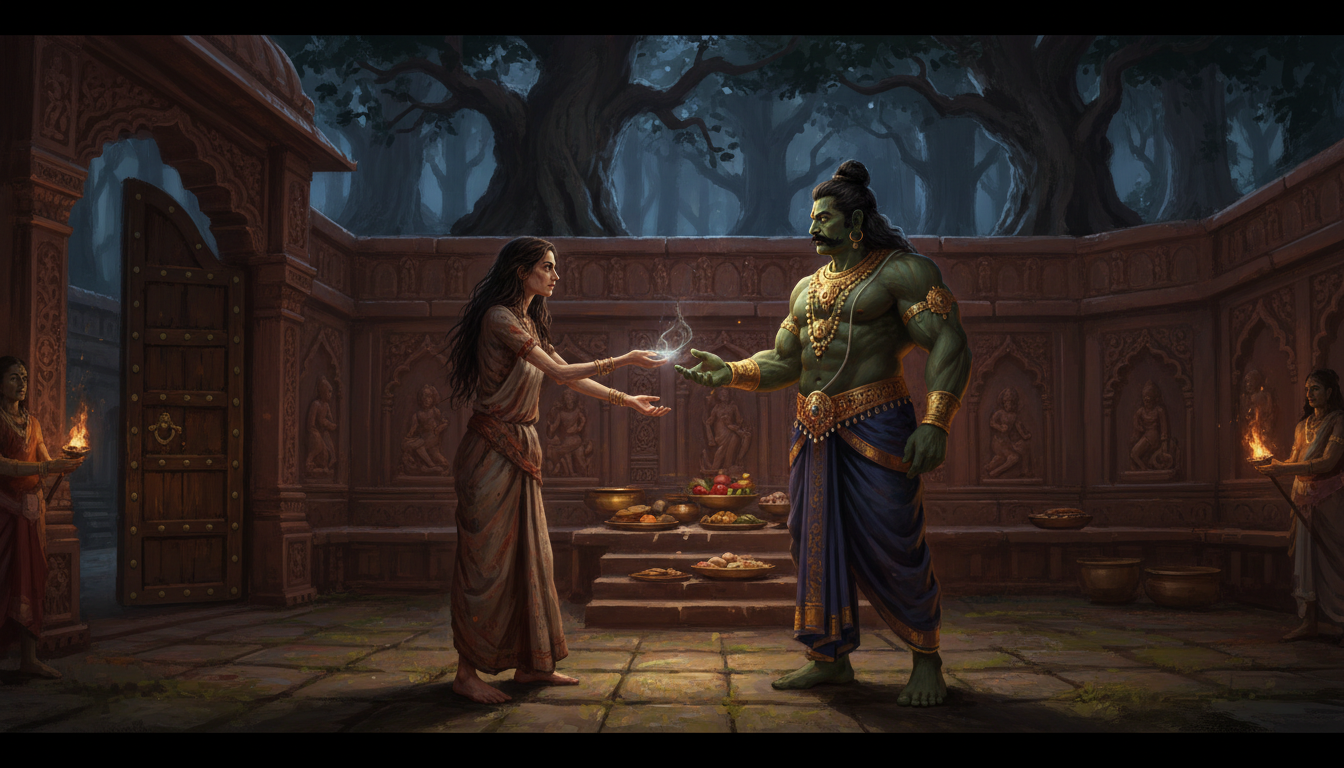
She resolved upon putting an end to her own life. Having formed that determination she left home, filled with heavy sorrow, and went into a dense and solitary forest, and she chose it deliberately, because it was the haunt of a very formidable Yaksha called Sthunakarna, and from fear of that Yaksha men never went into it. She wanted a place where nobody would come after her and nobody would talk her out of it.
Inside the forest stood a mansion with high walls and a gateway, plastered over with powdered earth, and rich with the smoke that carries the fragrance of fried paddy. Somebody lived there and lived well.
Sikhandini, the daughter of Drupada, entered that house and began to reduce herself by foregoing all food, for many days together.
And the Yaksha named Sthuna, who was endued with kindness, showed himself to her.
"For what object is this endeavour of thine?" he said. "I will accomplish it. Tell me without delay."
"Thou art unable to accomplish it," she said.
She said it again when he pressed her, and again after that.
"Accomplish it I will," said the Guhyaka, without a moment's delay. "I am a follower of the Lord of treasures. I can grant boons, O princess. I will grant thee even that which cannot be given. Tell me what thou hast to say."
The Loan and Its Term
So she told him all of it in detail, and ended with the only thing she wanted.
"My father will soon meet with destruction. The ruler of the Dasarnas marches against him in rage, and that king, cased in golden mail, is endued with great might and great courage. Therefore, O Yaksha, save me, and my mother, and my father. Thou hast already pledged thyself to relieve my distress. Through thy grace I would become a perfect man. As long as that king may not depart from my city, so long, O great Yaksha, show me grace."
The Yaksha reflected in his mind, and what he said first he said to himself.
"Indeed, it was ordained to be so. And it was ordained for my grief."
Then he spoke to her.
"O blessed lady, I will certainly do what thou wishest. Listen, however, to the condition I make. For a certain period I will give thee my manhood. Thou must come back to me in due time. Pledge thyself to do so. Possessed of immense power, I am a ranger of the skies, wandering at my pleasure and capable of accomplishing whatever I intend. Through my grace, save the city and thy kinsmen wholly. I will bear thy womanhood, O princess. Pledge thy truth to me, and I will do what is agreeable to thee."
"O holy one of excellent vows," said Sikhandini, "I will give thee back thy manhood. O wanderer of the night, bear thou my womanhood for a short time. After the ruler of the Dasarnas who is cased in golden mail has departed from my city, I will once more become a maiden and thou wilt become a man."
They made that covenant, the two of them, and imparted to each other's body their sexes. The Yaksha Sthuna became a female. Sikhandini obtained the blazing form of the Yaksha.
He knew when he said yes that it was ordained for his grief. He said yes anyway. That is the part of the story that nobody in Kampilya was ever told.
The Young Ladies Sent to Look
Sikhandin, having obtained manhood, entered his city in great joy and went to his father and represented to him everything that had happened, and Drupada was highly glad, and he and his queen recollected together the words of Maheswara. He sent a messenger at once to the ruler of the Dasarnas: "This my child is a male. Let it be believed by thee."
Hiranyavarman had by then arrived at Kampilya, filled with sorrow and grief, and he answered courtesy with a Brahmana envoy chosen from among the foremost of those conversant with the Vedas. Drupada, with Sikhandin standing beside him, offered that envoy a cow and honey.
The Brahmana would not accept the worship. He stood in the middle of the council and delivered the words he had been given.
"O thou of vile behaviour, I have been deceived by thee through thy daughter as the means. I will exterminate thee with thy counsellors and sons and kinsmen."
Drupada, assuming a mild behaviour from motives of friendship, said only that his answer would be carried to his brother by his own envoy; and he sent a Brahmana learned in the Vedas to say it.
"This my child is really a male. Let it be made clear by means of witness. Somebody has spoken falsely to thee. That should not be believed."
Then the king of the Dasarnas, having heard it, despatched a number of young ladies of great beauty to ascertain whether Sikhandin was a male or a female.
They went, and they ascertained, and they came back joyful, and they told the king of the Dasarnas that Sikhandin was a powerful person of the masculine sex.
Hearing that testimony Hiranyavarman was filled with great joy. He went to his brother Drupada and passed a few days with him in gladness and gave Sikhandin much wealth, many elephants and steeds and kine, and then he departed, having first rebuked his daughter for what she had told her nurses.
Kubera Above the Roof
Some time after the exchange of sexes had taken place, Kuvera, who is always borne on the shoulders of human beings, came in the course of a journey to the abode of Sthuna, and stayed in the air above that mansion, and looked down at it.
It was well adorned. It was hung with beautiful garlands of flowers and perfumed with fragrant roots of grass and many sweet scents. It was decked with canopies and scented incense, beautiful with standards and banners, filled with edibles and drink of every kind, garlanded with jewels and gems, well watered and well swept. Everything in it said that the master of the house knew the Lord of treasures was passing.
The master of the house did not come out.
"This mansion of Sthuna is well adorned," said the lord of the Yakshas to his followers. "Why, however, does not that wight of wicked understanding come to me? Since he knows I am here and approaches me not, some severe punishment should be inflicted on him. Even this is my intention."
And the Yakshas told him. Drupada had a daughter born to him of the name of Sikhandini; unto her, for some reason, Sthuna had given his own manhood, and having taken her womanhood upon himself he stays within his abode having become a woman; bearing a feminine form, he does not approach you in shame.
"Let the car be stopped here. Let Sthuna be brought to me. I will punish him."
So Sthuna came out in a woman's body and stood in front of him and was ashamed, and the giver of wealth cursed him in anger.
"Ye Guhyakas, let the femininity of the wretch remain as it is. Since, humiliating all the Yakshas, thou hast given away thy own sex to Sikhandini and taken from her her femininity, since thou hast done what has never been done by anybody, therefore from this day thou shalt remain a woman and she shall remain a man."
The other Yakshas began at once to soften Vaisravana for the sake of Sthunakarna, saying over and over, "Set a limit to thy curse." And he set one, from a desire of freeing that high-souled Yaksha from anxiety: after Sikhandin's death, this one will regain his own form.
When the time came, Sikhandin went back to the forest without losing a moment, as he had pledged. "I have come to thee, O holy one."
"I am pleased with thee," said Sthuna, and said it again, beholding that prince return to him without guile. Then he told him what had happened while he was away. "O son of a king, for thee I have been cursed by Vaisravana. Go now, and live happily amongst men as thou choosest. Thy coming here and the arrival of Pulastya's son were, I think, both ordained from beforehand. All this was incapable of being prevented."
"That," said Bhishma to Duryodhana, "is the story of Sikhandin's birth, as my spies brought it to me and as I have carried it since. She who was born the eldest daughter of the ruler of Kasi, celebrated by the name of Amba, was born in Drupada's line as Sikhandin. My vow is known over all the world: I will not shoot weapons upon a woman, nor upon one that was a woman before, nor upon one bearing a feminine name, nor upon one whose form resembles a woman's. If Bhishma slays a woman the righteous will all speak ill of him. Therefore I will not slay Sikhandin, though he approach me bow in hand and desirous of fight. I will not look at him even for a moment."
And Duryodhana, reflecting for a moment, thought that even that behaviour was proper for Bhishma.
Dharma Lesson
A debt taken on to save others can end by being paid by someone who never agreed to pay it. Sthuna knows as he speaks that the boon is ordained for his own grief and grants it anyway, and Kubera's curse turns a loan of a few days into the rest of a life. Destiny arranges its instruments long before they know what they are for, and it does not ask them.