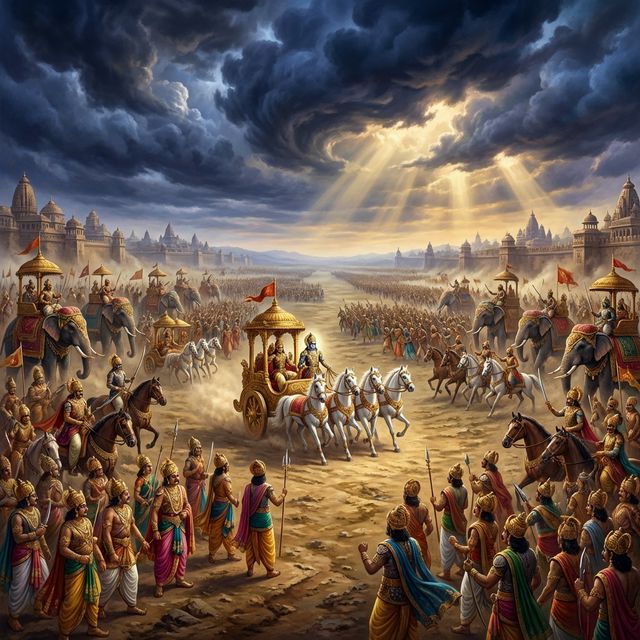
Omens and the Ten Kings Around Bhima
Drona reads the signs of Bhishma's last day and sends his son to fight
The Bow That Would Not Obey
Sanjaya said that Drona went into the Pandava ranks that morning like an infuriate elephant going into a thicket.
He had taken up the large bow, the one capable of checking an elephant in must, and he shook it in his hands as he came, and the ranks in front of him opened and did not close. This was the tenth day. Nine mornings the son of Ganga had gone out at the head of the Kaurava army and nine evenings he had come back alive, and by now every man on the field had begun to believe quietly that he always would.
Drona was a Brahmana who had made his living by arms, the preceptor who had taught both sets of princes to shoot, and he was also acquainted with every omen. That was a discipline of its own and he had it thoroughly. A man who knows the signs does not get to choose whether he reads them.
So in the middle of afflicting the hostile ranks, having penetrated into their very midst, he stopped afflicting them and looked around him at the sky and the birds and his own hands, and then he called for his son.
Ashwatthama was near, scorching the enemy on his own account. He came.
"This is that day, O son," Drona said, "on which the mighty Partha, desirous of slaying Bhishma in battle, will exert himself to the best of his might."
He did not say it as a warning that something might be done about. He said it the way a man states a thing that has already happened somewhere and has only to arrive here.
Then he began to list what he had seen. It is worth having in full, because it is the one place in the whole war where a master of weapons stands in the middle of a battle and explains, item by item, how he knows the day has already turned against him.
Everything Drona Saw
"My arrows are coming out of the quiver of their own accord," he said. "My bow seems to yawn. My weapon seems unwilling to obey my behests, and my heart also is cheerless."
He began with his own equipment and his own body, which is where a fighting man notices things first. The shafts working loose without a hand on them. The bow opening its mouth like something tired. The weapon, meaning the mantra-governed astra that had never once refused him, going slack and disobedient. And under all of it the heart of the man himself, gone flat, with no reason in the world for it that he could point to.
Then he lifted his eyes and gave the rest.
Animals and birds were uttering fearful and incessant cries. Vultures seemed to disappear beneath the feet of the Bharata troops. The Sun himself seemed to have lost hue, and the quarters were all ablaze. The Earth seemed to shriek, and to inspire fear, and to tremble everywhere. Kankas and vultures and cranes cried again and again. Jackals were uttering inauspicious and fierce yells that foreboded great danger.
Large meteors seemed to fall from the centre of the solar disc. The constellation called Parigha, with a trunkless form, appeared around the Sun. The solar and the lunar discs had both become awful, foreboding great danger to Kshatriyas about the mangling of their bodies. In the temples of the Kuru king the idols trembled and laughed and danced and wept. The illustrious Moon rose with his horns downward.
And then the omen that was not in the sky at all.
"The bodies of the kings belonging to the Kuru army all seem to be pale, and though clad in mail, are shorn of splendour."
He was looking at his own side while he said it. Armoured, mounted, in good order, and with the light gone out of them.
"The loud blare of Panchajanya and the twang of Gandiva are heard on all sides of both the armies."
That was the last item, and it was the only one that needed no interpreting at all. Krishna's conch and Arjuna's bow, and no way to tell from the sound which direction they were coming from, because they were coming from everywhere.
The Man Bhishma Would Not Shoot
"Without doubt," Drona said, "Arjuna, relying upon his great weapons and avoiding other warriors, will advance upon the grandsire."
Then he told his son what was actually wrong, and it was not the meteors.
"The pores of my body are contracting, and my heart also is depressed, thinking, O mighty-armed one, of the encounter between Bhishma and Arjuna. Keeping on his fore the Panchala prince of sinful soul and conversant with deceit, Partha is proceeding towards Bhishma for battle."
The prince was Shikhandi, son of Drupada, and the whole difficulty of the tenth day is contained in his person. Bhishma had said openly, long before, that he would not slay him. By the Creator that one had been made female, and though through chance he subsequently became a male person, the grandsire had made his ruling and would not revisit it. The son of the Ocean-going Ganga would not strike a person of what he considered inauspicious self.
So the greatest bowman alive was going to be brought down by a screen. Not by a better archer. By a man he had decided in advance not to shoot at, standing in front of one who would.
"That mighty son of Yajnasena is also an inauspicious omen by himself," Drona said, and put him in the list with the jackals and the falling stars.
Then he named the three things that were going to ruin the day, and he put himself in the middle of them.
"The wrath of Yudhishthira, an encounter between Bhishma and Arjuna in battle, and an endeavour like this of the shooting of weapons by myself. These three are certainly fraught with great harm to creatures."
He was standing in a battle he considered a calamity, holding the bow that was making it one, and counting his own hands among the causes.
And of Arjuna he would allow no comfort at all. Endued with great energy, powerful, brave, accomplished in weapons, of valour that is very active. Capable of shooting his arrows to a great distance and shooting them with force. And, Drona added, since he was speaking of omens, that man is acquainted with omens too. Endued with great might and intelligence and above fatigue, incapable of defeat by the very gods with Vasava at their head.
"Avoiding his path, go thou to battle, O thou of rigid vows."
Go, Keeping Heaven Before Thee
Having told his son to keep out of Arjuna's way, Drona told him what he would see instead.
"Today in this dreadful battle thou wilt behold a great carnage. The beautiful and costly coats of mail, decked with gold, of brave warriors will be pierced with straight shafts. And the tops of standards, and bearded javelins, and bows, and bright lances of sharp points, and darts bright with gold, and the standards on the backs of elephants, will all be cut off by Kiritin in wrath."
Then he said the hardest sentence a father says in this war.
"O son, this is not the time when dependants should take care of their lives. Go to battle, keeping heaven before thee, and for the sake of fame and victory."
Dependants was the exact word. Drona and Ashwatthama ate Duryodhana's food and had done for years, and Drona named the relation plainly rather than dress it up as loyalty.
He pointed across the field. "There, the ape-bannered one crosses on his car the river of battle that is awful and incapable of being easily crossed, and has cars, elephants and steeds for its eddies."
And then, because he was a Brahmana as well as a general, he did an extraordinary thing in the middle of giving orders. He praised the enemy king.
"Regard for Brahmanas, self-restraint, liberality, asceticism, and noble conduct are seen in Yudhishthira alone, who has for his brothers Dhananjaya and the mighty Bhimasena and the twin sons of Madri by Pandu, and who has Vasudeva of the Vrishni race for his protector. The wrath, born of grief, of that Yudhishthira, whose body has been purified by the flames of penance, directed to the wicked-souled son of Dhritarashtra, is consuming this Bharata host."
He described Yudhishthira's array as inaccessible as the interior of the sea, guarded on every side by Atirathas, with Satyaki and Abhimanyu and Dhrishtadyumna and Vrikodara and the twins around the king. And there was Abhimanyu at the head of the host, dark as the younger brother of Indra, risen like a tall Sala tree, a second Phalguna.
"Take up thy mighty weapons, and with thy large bow in hand proceed against the royal son of Prishata and against Vrikodara. As for myself, I will proceed against Yudhishthira."
Then the line he could not keep out.
"Who is there that does not wish his dear son to live for many years? Keeping the duties of a Kshatriya, however, before me, I am engaging thee to this task. So Bhishma also, in this battle, is consuming the mighty host of the Pandavas. O son, he is, in battle, equal to Yama or Varuna himself."
Ten Kings and One Man
The men who heard those words of the high-souled Drona did not go to guard Yudhishthira's flank or shield Bhishma's car. They went after Bhima.
Bhagadatta the ruler of Pragjyotisha, who had once made a pact with Arjuna out of friendship for Pandu and now rode against Pandu's sons. Kripa, Drona's own brother-in-law, the eternal preceptor. Shalya, king of Madra, who was uncle to Nakula and Sahadeva and fighting on the wrong side of that relation through a trick. Kritavarma of the Vrishnis, Krishna's kinsman, sent to Duryodhana as part of the bargain that gave Arjuna Krishna himself. Vinda and Anuvinda, the princes of Avanti. Jayadratha of the Sindhus, who was Duryodhana's brother-in-law and had once dragged Draupadi into a chariot in the forest and been let go alive. Chitrasena, Vikarna, Durmarshana, sons of Dhritarashtra.
Ten warriors of that army, supported by a large host consisting of many nationalities, all of them wanting the same thing: high renown won in the battle for Bhishma's sake.
They opened together. Shalya struck Bhima with nine arrows and Kritavarma with three and Kripa with nine. Chitrasena and Vikarna and Bhagadatta struck him with ten each. The ruler of the Sindhus struck him with three, and Vinda and Anuvinda of Avanti with five apiece. Duryodhana came up and put twenty sharp arrows into the son of Pandu.
Bhima answered them one after another, in order, as though he were going down a list.
Seven arrows into Shalya. Eight into Kritavarma. Kripa's bow he cut in the middle with the arrow still fixed on the string, and then put seven more into the man. Three each to Vinda and Anuvinda. Twenty to Durmarshana, five to Chitrasena, ten to Vikarna, five to Jayadratha. Then he came back to the ruler of the Sindhus and struck him with three more and shouted aloud, filled with joy.
That shout is the sound of a man who has just realised he is enjoying himself.
Kripa took up another bow and angrily pierced him with ten sharp shafts, and Bhima, hit like a huge elephant struck with the driver's hook, filled with wrath and turned on Gautama with many arrows in return.
The Sindhu King on Foot
Then, with the splendour of Yama himself as he appears at the end of the Yuga, Bhima took three arrows and despatched to Death's domain the steeds of the ruler of the Sindhus, and his charioteer with them.
Jayadratha came down off the dead car quickly, the way a man does when the thing under him has stopped being a chariot, and stood on the ground and shot many sharp-pointed shafts at Bhimasena.
Bhima took a pair of broad-headed arrows and cut his bow in the middle.
So there he was: his bow cut, his car gone, his steeds and his charioteer killed, the king of the Sindhus standing on the field of Kurukshetra with nothing in his hands, in the sight of both armies. He ran and mounted the car of Chitrasena and got out of it that way.
Sanjaya, telling this to a blind king who had married his daughter to that man, called it a most wonderful feat, and was precise about why. Not that Bhima had beaten Jayadratha, which anyone might do. That while piercing all those mighty car-warriors and holding every one of them in check, he had found the room to unhorse one of them completely, in the very sight of all the army.
It is worth remembering who was standing there. This was the second time Bhima had made Jayadratha look ridiculous in public. The first had been in the forest, when the man carried Draupadi off from the hermitage and the brothers ran him down and shaved his head with five tufts left on it and sent him back alive because Yudhishthira said to. He had been let go once. Nobody on that field would have given much for his chances of being let go twice.
Shalya could not brook the sight of it.
"Wait," he called out to Bhima. "Wait." And he aimed some sharp arrows well polished by the forger's hands and pierced him with them.
The Mountain Drenched With Rain
For Shalya's sake the whole ring closed again. Kripa and Kritavarma and the valiant Bhagadatta, Vinda and Anuvinda of Avanti, Chitrasena and Durmarshana and Vikarna, and the valiant ruler of the Sindhus riding another man's chariot, all quickly pierced Bhima together.
Bhima pierced each of them in return with five arrows, and then gave Shalya seventy, and then ten more.
Shalya answered with nine and then five, and with a broad-headed arrow he struck Bhima's charioteer deep in the vitals. The man's name was Visoka. He had driven that car all through the war and would drive it to the end of it, and Bhima, seeing him pierced, sent three arrows into the arms and chest of the ruler of Madras, and three straight arrows into each of the other great bowmen, and roared like a lion.
Then all of them, exerting themselves with vigour, pierced him deeply in the vitals with three arrows each.
He did not tremble. That is the line the text stops on, and it stops there deliberately. Pierced by ten car-warriors at once, in the vitals, he stood still like a mountain drenched with torrents of rain by showering clouds.
Then he went back to work. Three arrows into the ruler of the Madras. A hundred into the ruler of the Pragjyotishas. Many into Kripa. And with one keen-edged shaft, displaying great dexterity, he cut off Kritavarma's bow with the arrow still fixed on it, and Kritavarma took up another and struck Vrikodara between the eyebrows with a long arrow.
They shot at him by hundreds and thousands, with great coolness. He regarded them all as straw and coursed about the field without any anxiety.
So they stopped using arrows.
Bhagadatta hurled a dart of fierce impetuosity with a golden staff. The Sindhu king threw a lance and an axe. Kripa hurled a Sataghni, the hundred-slayer, the iron-studded engine that is thrown into a press of men to kill a hundred of them at once. Shalya sent an arrow, and the other great bowmen five apiece.
The son of the Wind-god cut the lance in two with a sharp shaft. He cut the axe with three, as if it were a sesame stalk. He cut the Sataghni into fragments with five arrows winged with the feathers of the Kanka bird. He cut off the arrow of the ruler of the Madras, and forcibly cut off Bhagadatta's dart, and the rest of the fierce shafts he cut into three pieces each, and then, proud of his feats in battle, struck every one of those great bowmen with three shafts more.
His Brother Came
Dhananjaya, in the middle of that dreadful battle, looked across and saw him.
He saw the mighty car-warrior Bhima striking the foe and battling against many with his arrows, and he came there on his car.
Then the bulls among men of Dhritarashtra's army, beholding those two high-souled sons of Pandu together in one place, gave up all hope of victory. That is Sanjaya's sentence and he does not soften it for his king. Ten of the best men in the army had spent the morning failing to kill one of the brothers, and the arrival of the second ended the argument for them before an arrow was shot.
Arjuna had not come for their sake. He was going to Bhishma and he had placed Shikhandi before him, exactly as Drona had said he would, and the road to the grandsire ran through the ten men who had Bhima surrounded. So he fell upon those fierce combatants, numbering ten, and pierced every warrior who had been battling with his brother, desirous of doing what was agreeable to Bhima.
Duryodhana saw the two of them standing together in his army and understood what it meant, and sent for a man who had sworn an oath.
"O Susharman, go thou quickly, supported by a large force. Slay those two sons of Pandu, Dhananjaya and Vrikodara."
The Trigarta king who ruled the country called Prasthala had bound himself and his brothers by vow to draw Arjuna away from the main battle whenever they were asked, and this was the asking. He rushed upon those two bowmen and surrounded them both with many thousands of cars.
So the screen that Drona had feared all morning was assembled and moving, and the men sent to stop it were the ones who could not, and Bhishma stood at the head of the army where he had stood for nine days, waiting.
Then commenced a fierce battle between Arjuna and the foe.
Dharma Lesson
Drona sees the whole shape of the day before it happens and changes nothing about it. He knows the omens, he knows Bhishma will not shoot Shikhandi, he knows his own weapons have stopped consenting, and he still lifts the bow and sends his only son into the same battle, because the duties of a Kshatriya are what he has put in front of himself. Knowledge is not the same thing as freedom. A man can be entirely right about what is coming and still be standing exactly where he was told to stand when it arrives, and the epic asks us to notice that Drona's clear sight bought him nothing except the grief of seeing early.