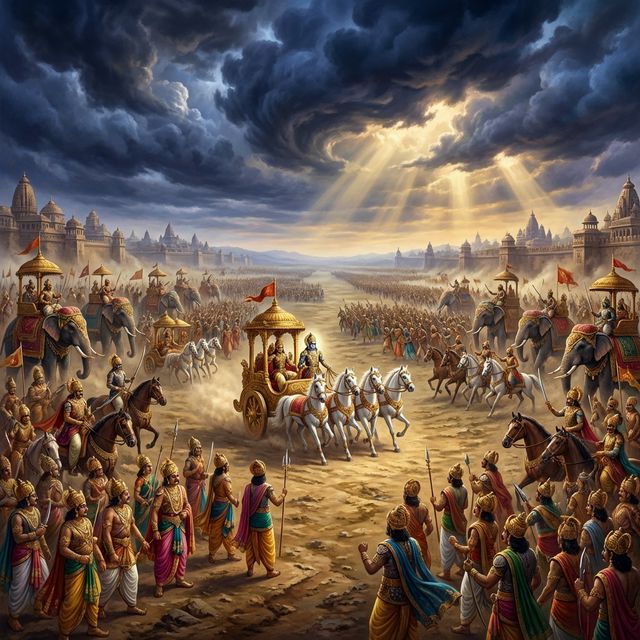
The Grandsire Chooses His Hour
Bhishma remembers Santanu's boon and refuses to die in the wrong season
The Tenth Morning
Sanjaya had been telling it for nine days by then, sitting in a hall in Hastinapur with a blind king who wanted to hear everything and could not bear any of it, and on the tenth morning he began by saying what the two armies had decided before a single arrow was loosed.
"When the combatants of both armies, strong in number, were thus disposed in battle array," he said, "all those unretreating heroes set their heart upon the region of Brahma."
That is the frame for everything that follows. Nobody on that field that morning expected to come off it. Men who have settled with themselves that they are going to die fight differently, and Sanjaya described the difference at once. In the general engagement that followed, the same class of combatants did not fight with the same class of combatants. Car-warriors did not seek out car-warriors, or foot-soldiers foot-soldiers, or horsemen horsemen, or elephant-warriors elephant-warriors. The orders of battle simply came apart. The combatants fought with one another like mad men, and where elephants and men spread themselves together over the same ground, all distinctions between them ceased.
Shalya and Kripa, Chitrasena and Dushasana and Vikarna, mounted on their bright cars, made the Pandava host tremble. Slaughtered by those high-souled warriors, the army of the sons of Pandu began to reel in diverse ways, like a boat on the waters tossed by the wind.
And in the middle of it was the old man.
"As the wintry cold cuts kine to the quick," Sanjaya said, "so did Bhishma cut the sons of Pandu to the quick."
He was the eldest living Kuru, the son of Santanu and of the river Ganga, and he had been the commander of Duryodhana's armies since the first day. Against him on the other side the son of Pandu felled elephants that looked like newly risen clouds, and huge beasts struck with long shafts by the thousand went down shrieking. The field looked beautiful, in the terrible way Sanjaya kept finding it beautiful, strewn with bodies still wearing their ornaments and heads still wearing their earrings.
Rush Ye at Ganga's Son
Dhritarashtra's sons saw the grandsire exerting himself and came up behind him with all their troops placed ahead of them, desiring to lay down their lives in battle and to make heaven itself their goal. The Pandavas came on in the same spirit, bearing in mind the many injuries of diverse kinds that had been done to them, casting off fear, eager to win the highest heavens, and cheerful about it.
Then Dhrishtadyumna gave the order of the day. He was Drupada's son, born out of a sacrificial fire to kill Drona, and he was the generalissimo of the Pandava army, and what he said to his soldiers was short.
"Ye Somakas, accompanied by the Srinjayas, rush ye at Ganga's son."
They heard him, and though they were already afflicted with showers of arrows they went. Bhishma, attacked in that way, was moved to wrath and began to fight the Srinjayas in earnest.
Here Sanjaya paused to explain where the old man's skill had come from. In days of old the intelligent Rama, that is Parashurama, the Brahmana who had fought Bhishma himself for twenty-three days at Kurukshetra and had not beaten him, had imparted to him that instruction in weapons which is so destructive of hostile ranks. Relying on that instruction, the old Kuru grandsire had been killing ten thousand warriors of the Ratha every day of the war.
On the tenth day he went beyond that. Single-handed he slew ten thousand elephants. He killed seven great car-warriors among the Matsyas and the Panchalas. Five thousand foot-soldiers, one thousand tuskers, ten thousand steeds. Having thinned the ranks of all the kings he came to Satanika, the dear brother of Virata of the Matsyas, in whose city the Pandavas had hidden through the thirteenth year, and killed him, and then felled a full thousand Kshatriyas with his broad-headed shafts.
Every Kshatriya of the Pandava army who followed Arjuna and came within reach of Bhishma went to Yama's abode. Covering the whole Pandava host from every side with showers of arrows, he stayed at the head of the Kaurava army, bow in hand, between the two forces.
None of the kings could even look at him. He resembled, Sanjaya said, the hot midday sun in the summer sky.
Krishna Points Him Out
As Sakra scorched the host of the Daityas, so did Bhishma scorch the host of the Pandavas, and Krishna, who was driving Arjuna's car and had sworn to carry no weapon in this war, watched him do it and was cheerful about what he saw.
"There, Bhishma, the son of Santanu, stayeth between the two armies," he said to Arjuna. "Slaying him by putting forth thy might, thou mayst win victory. There, at that spot, whence he breaketh our ranks, check him, putting forth thy strength. O lord, none else, save thee, ventureth to bear the arrows of Bhishma."
Thus urged, the ape-bannered Arjuna in that moment made Bhishma, with his car and steeds and standard, invisible by means of his arrows. The grandsire pierced those showers of shafts with arrowy showers of his own and came out of the cloud still shooting.
Then the whole strength of the Pandava army went at him at once. Sanjaya named them as they came, because they were worth naming: the valiant Dhrishtaketu and the king of the Panchalas, Bhimasena, Dhrishtadyumna of Prishata's race, the twins Nakula and Sahadeva, Chekitana, the five Kaikeya brothers, the mighty-armed Satyaki, Subhadra's son Abhimanyu, the Rakshasa Ghatotkacha, the five sons of Draupadi, Shikhandi, the valiant Kuntibhoja, Susarman, and Virata.
Afflicted by the shafts of Bhishma, all of them together seemed to sink in an ocean of grief. Arjuna rescued them all.
Then Shikhandi took up a mighty weapon and rushed at Bhishma alone, protected by Arjuna. He was Drupada's child, born a daughter and become a man, and he had been born for this one purpose and for nothing else, and Bhishma would not shoot at him.
Arjuna, knowing what should be done after what, killed everyone who followed Bhishma first, and then went at him himself. Satyaki and Chekitana, Dhrishtadyumna, Virata and Drupada, the twin sons of Madri, Abhimanyu and the five sons of Draupadi, all came behind that screen with their weapons upraised, and pierced the old man in every part of his body with well-aimed shafts.
He disregarded them. He went forward into the Pandava ranks and baffled all those arrows as if he were sporting, and every time he looked at the prince of the Panchalas he laughed and aimed nothing at him, recollecting his femininity. Then he killed seven great car-warriors out of Drupada's division, and among the Matsyas and Panchalas and Chedis rushing at that single man there began to be confused cries of woe.
The Fire at the End of the Yuga
They surrounded him on every side, and the Srinjayas united and struck him with everything an army carries. Sanjaya listed it the way a man lists what was done to his own father. Dreadful Sataghnis. Spiked maces. Battle-axes and mallets and short thick clubs. Bearded darts and lances and kampanas. Arrows furnished with golden wings, arrows with heads shaped like the tooth of a calf, long shafts, rockets.
His coat of mail was pierced everywhere. Though pierced in every vital part, Bhishma felt no pain.
What his enemies saw instead was not a wounded old man. He seemed to them to resemble the all-destructive fire that rises at the end of the Yuga. His bow and his arrows were its blazing flames. The flight of his weapons was its friendly breeze. The rattle of his car-wheels was its heat, and his mighty weapons its splendour. His beautiful bow was its fierce tongue, and the bodies of heroic warriors were its profuse fuel.
He was seen to roll through the middle of the crowded cars of those kings, and to come out of the press, and to course once more through the middle of it. Disregarding the king of the Panchalas and Dhrishtaketu entirely, he drove into the heart of the Pandava army and pierced six of their greatest men together, Satyaki and Bhima and Arjuna, Drupada, Virata and Dhrishtadyumna, with excellent arrows of great sharpness and dreadful whizz, capable of going through any armour that had ever been made.
Those six checked the shafts and struck him back, ten apiece.
And the arrows that Shikhandi shot, whetted on stone and winged with gold, went into Bhishma's body and stayed there, and he did not turn his head.
That was the shape of the whole day, and it was a shape nobody on either side had seen before in ten days of war. The man could not be killed. The man would not defend himself against the one person capable of killing him. Both armies were now watching a thing happen that had no precedent and no visible end, and the noise around Bhishma's car became a single noise made of orders shouted by men who were no longer in command of anything.
Every Bow He Took Up
Then Arjuna, excited with wrath and placing Shikhandi ahead of him, rushed at Bhishma and cut off his bow.
Seven great car-warriors of the Kaurava side could not brook it. Drona and Kritavarman, Jayadratha the ruler of the Sindhus, Bhurisravas, Sala, Shalya and Bhagadatta, inflamed with rage, invoked celestial weapons into existence and fell upon the son of Pandu together and covered him with arrows. The noise they made coming at his car was heard to resemble the noise of the ocean when it swells in rage at the end of the Yuga. Kill. Bring up our forces. Take. Pierce. Cut off. That was the furious uproar around Arjuna.
Seven of the Pandava side heard it and came for him: Satyaki and Bhimasena, Dhrishtadyumna, Virata and Drupada, the Rakshasa Ghatotkacha, and the wrathful boy Abhimanyu. The battle those two sevens made was fierce enough to make the hair stand on end.
Inside all of it, Shikhandi went on with his work. He pierced Bhishma with ten shafts after the bow had been cut, struck his charioteer, and took down his standard with a single arrow.
Bhishma took up another bow, tougher than the first. Arjuna cut it with three sharp shafts.
He took up another. That one went too, in the twinkling of an eye, as soon as it was lifted, cut into three fragments with three broad-headed shafts. Arjuna, who could draw the bow with either hand, cut off one after another every bow that Bhishma raised, and the old man began to run out of them.
Then Bhishma, licking the corners of his mouth, took up a dart capable of riving a hill, and hurled it at Arjuna's car in rage.
It came on like the blazing bolt of heaven. Arjuna fixed five sharp broad-headed arrows on the string of Gandiva and cut that dart into five pieces in the air, and it fell like a flash of lightning separated from a mass of cloud.
Bhishma watched it fall.
And then, in the middle of a battle, with hundreds of men shouting his name and hundreds more trying to reach him, that hero and subjugator of hostile cities began, very calmly, to reflect.
The Boon of Santanu
What he said to himself, he said in the plainest possible terms, and it is the hinge of the entire war.
"With only a single bow I could slay all the Pandavas, if the mighty Vishnu himself had not been their protector. For two reasons, however, I will not fight with the Pandavas: their unslayableness, and the femininity of Shikhandi."
Then he remembered the wedding.
"Formerly, when my sire wedded Kali, he, pleased with me, gave me two boons: that I should be incapable of being slain in battle, and that my death should depend on my own choice."
That is the whole of it, put in one sentence by the man it was given to. Long before any of this, a young prince had given up a throne and taken a vow of celibacy so that his father Santanu could marry a fisherman's daughter, and Santanu, in gratitude and in grief, had granted him that death would never take him against his will. Every man on that field had grown up hearing the story. None of them had ever seen what it meant in practice. What it meant was that the death of Bhishma was not a thing his enemies could accomplish. It was a decision he had been carrying around, unused, for a lifetime.
"I should, however, now wish my own death," he said, "this being the proper hour."
Sanjaya said that the Rishis and the Vasus were stationed in the firmament and heard the resolve as it was made. The Vasus were the eight who had been born as Ganga's sons, of whom Bhishma was the last and the only one left in the world, and they answered him as brothers.
"That which hath been resolved by thee is approved by us also, O son. Act according to thy resolution, O king. Withdraw thy heart from battle."
When they finished speaking, a fragrant and auspicious breeze charged with particles of water began to blow along its natural direction. Celestial cymbals of loud sound beat in the sky. A shower of flowers fell on Bhishma.
Not one man in either army heard any of it.
"The words spoken by the Rishis and the Vasus were not heard by any one save Bhishma himself," Sanjaya told the blind king. "I also heard them, through the power conferred on me by the Muni."
And in the firmament there was great grief among the celestials at the thought of Bhishma, that favourite of all the worlds, falling down from his car.
These Are Not Shikhandin's
Having heard the gods agree with him, Bhishma rushed out at Arjuna, still being pierced the whole way with arrows that went through every kind of armour.
Shikhandi struck him in the chest with nine sharp arrows. The grandsire did not tremble. He remained unmoved, Sanjaya said, like a mountain during an earthquake. Arjuna drew Gandiva with a laugh and put five and twenty arrows into him, and then struck him in every vital part with hundreds more, and Bhishma answered all of them and checked their shafts with his own straight arrows, and the shots Shikhandi made scarcely caused him any pain at all.
Once more Arjuna came in behind that screen and cut the bow, and pierced him with ten arrows, and took his standard with one, and struck his chariot with ten more until it shook. Bhishma took up a stronger bow. Arjuna cut it into three pieces before it was fully raised. So it went, until the son of Santanu no longer desired to fight with Arjuna at all.
He turned instead and spoke to Dushasana, who was near him, and what he said was the speech of a connoisseur.
"Behold, Partha, that great car-warrior of the Pandavas, excited with wrath in battle, pierceth me alone with many thousands of arrows. He is incapable of being vanquished in battle by the wielder of the thunderbolt himself. As regards myself also, the very gods, Danavas and Rakshasas united together, are incapable of vanquishing me. What shall I say then of mighty car-warriors among men?"
And when he was pierced again, deeply and excessively, he smiled and said the rest of it.
"These arrows coursing towards me in one continuous line, whose touch resembleth that of heaven's bolt, have been shot by Arjuna. These are not Shikhandi's. Cutting me to the quick, piercing through even my hard coat of mail, and striking me with the force of mushalas, these arrows are not Shikhandi's. Of touch as hard as that of the Brahmana's rod, and of impetus unbearable as that of the thunderbolt, these are afflicting my vital forces. These are not Shikhandi's. Of the touch of maces and spiked bludgeons, they are destroying my vital forces like messengers of Death commissioned by the grim king himself. These are not Shikhandi's. Like angry snakes of virulent poison, projecting their tongues out, these are penetrating into my vitals. These are not Shikhandi's, these that cut me to the quick like the cold of winter cutting kine to the quick. Save the heroic wielder of Gandiva, the ape-bannered Jishnu, even all other kings united together cannot cause me pain."
He was dying, and he was making sure the record was correct.
A Little Before Sunset
He hurled one more dart at Arjuna, as if to consume the Pandavas with it, and Arjuna cut it into three fragments in the air in the sight of all the Kuru heroes. Then, desirous of obtaining either death or victory, the son of Ganga took up a sword and a shield decked with gold, and before he could come down from his car Arjuna cut the shield into a hundred pieces with arrows, and even Sanjaya, watching his own side lose, called the feat exceedingly wonderful.
Then Yudhishthira urged his troops on. "Rush ye at Ganga's son. Do not entertain the slightest fear."
They came from all sides with bearded darts and lances and arrows, with axes and excellent scimitars and long shafts of great sharpness, with calf-toothed arrows and broad-headed shafts, all of them at that one warrior, and a loud shout went up from the Pandava host. Dhritarashtra's sons surrounded him and roared like lions, wanting his victory. Where the two armies met and struck each other down there was, for a short while, a vortex like the one that forms where the Ganga runs into the ocean, and the earth, wet with gore, took on a fierce form in which the even and uneven places on her surface could no longer be told apart.
Pierced in all his vital limbs, Bhishma stayed calmly in the battle. He had killed ten thousand men that day.
Then Arjuna broke the centre of the Kuru army, and the Kaurava host broke with it. Sanjaya said plainly that they fled, himself among them. The Sauviras and the Kitavas, the Easterners and Westerners and Northerners, the Malavas and Abhishahas, the Surasenas, the Sivis, the Vasatis, the Salwas, the Trigartas, the Amvashthas, the Kaikeyas, all of them afflicted with arrows and pained by their wounds, abandoned Bhishma where he stood fighting.
The Pandavas closed over him from every side. Throw down. Seize. Fight. Cut into pieces. That was the uproar in the vicinity of his car.
Having killed his enemies that day by hundreds and by thousands, there was not left in Bhishma's body a space two fingers broad that was not pierced with an arrow.
And then he fell from his car with his head to the east, a little before sunset, in the sight of Dhritarashtra's sons. Cries of alas and oh went up in the sky from the celestials and from the kings of the earth. He came down like an uprooted standard of Indra, and made the earth tremble.
His body did not touch the ground. The arrows held him up.
The Swans of the Manasa Lake
A divine nature took possession of him as he lay there on his bed of arrows. The clouds poured a cool shower over him. The earth trembled.
And while he was falling he had noticed something, and it was the sort of thing only he would have noticed while falling. The sun was in the southern solstice. It was the inauspicious half of the year, the dakshinayana, the wrong season in which to die. So he did not permit his senses to depart.
All around him in the sky he heard voices he had heard before that day.
"Why, oh why, should Ganga's son, that foremost of all warriors of weapons, yield up his life during the southern declension?"
"I am alive," said Bhishma.
Then his mother acted. Ganga, the daughter of Himavat, ascertaining what her son had resolved, sent the great Rishis to him in the form of swans. Those Rishis in swanlike forms, who lived on the Manasa lake, rose up together and came quickly to the place where he was lying, and they walked round him where he lay, and looked at the sky, and said to one another what everybody in three worlds was saying.
"Being a high-souled person, why should Bhishma pass out of the world during the southern declension?"
Having said it, the swans went away toward the south. Bhishma watched them go, reflected for a moment, and called after them the answer that would hold him on that field for fifty-eight days.
"I will never pass out of the world as long as the sun is in the southern solstice. Even this is my resolve. I will proceed to my own ancient abode when the sun reacheth the northern solstice. Ye swans, I tell you this truly. Expectant of the northern declension I will hold my life. Since I have the fullest control over the yielding up of my life, I will therefore hold life, expectant of death during the northern declension. The boon that was granted to me by my illustrious sire, to the effect that my death would depend on my own wish, O, let that boon become true."
Having said this to the swans, he continued to lie on his bed of arrows.
Both Armies Put Down Their Weapons
Behind him the war was still making its noise. The Pandavas and the Srinjayas uttered leonine shouts, and blew their conches decked with gold, and thousands of trumpets sounded, and Bhimasena slapped his armpits and roared. Duryodhana did not know what to do. Kripa and the Kurus sighed and wept and stood for a long while deprived of their senses, motionless, as if seized by the thighs, unable to go against the Pandavas at all.
Sanjaya said afterwards that when the crest of the Kuru race went down, every man in the Kaurava host understood the arithmetic of it at once. Bhishma had been regarded as unslayable, and Bhishma was slain, and therefore the destruction of the Kuru king was at hand. Vanquished by Arjuna, with their foremost heroes gone and themselves mangled with sharp arrows, they did not know what to do.
And then the strangest thing on that field in ten days happened, and it happened on both sides at once.
When the all-powerful son of Ganga was brought down, the heroic warriors of both armies laid their weapons on the ground and began to reflect. Some shrieked aloud. Some ran away. Some were deprived of their senses. Some censured the practices of the Kshatriya order, out loud, in the middle of the greatest Kshatriya battle ever fought. Some praised Bhishma. The Rishis and the Pitris applauded that man of high vows, and the deceased ancestors of the Bharatas praised him from wherever the dead of that house are kept.
And in the centre of all of it the son of Santanu, having recourse to that yoga which is taught in the great Upanishads, engaged in mental prayer, and lay quiet, expectant of his hour.
Dharma Lesson
Bhishma's boon is often told as a reward, but the story shows it as a burden he has carried unopened for a lifetime, and the moment he opens it he is not choosing to live longer but choosing when to stop. He does not use the power to escape Arjuna's arrows or to win the day for Duryodhana. He uses it to keep an appointment with a season. The last freedom the epic grants its most obedient man is the freedom to set the hour, and he spends it on waiting rather than on victory, which is what the whole of his life had already taught him to do.