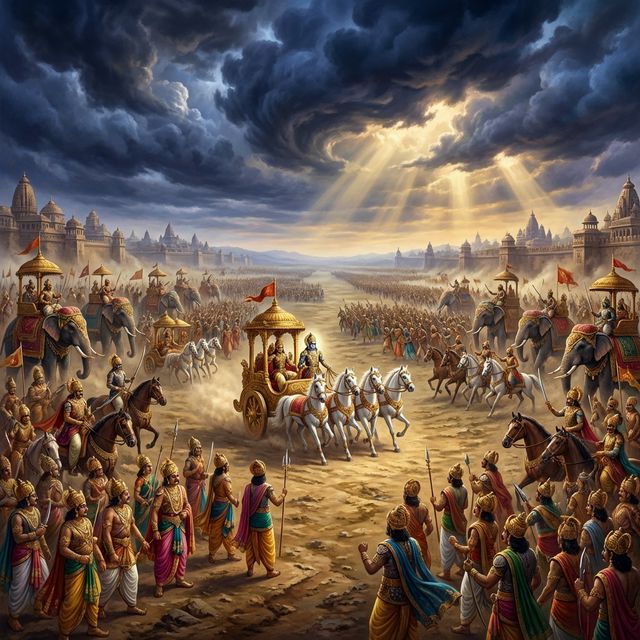
The Ten Kinsmen Against the Ten Sons
Day six: Dhrishtadyumna kills two princes, ten Pandavas duel ten Kauravas, and Bhima goes into the elephants on foot
Five Tigers and a Boy
It was the sixth day of the war, and the man telling it was Sanjaya, who sat in a hall in Hastinapura and gave the whole of the field to a king who could not see it.
Bhishma and Arjuna had found one another in the dust at the head of the two armies, and while those two shot at each other with every eye in both hosts upon them, the fighting behind them went on unwatched. That was where the boy was.
Abhimanyu was Arjuna's son by Subhadra, cased in a handsome coat of golden mail, and four warriors of the Kaurava side came at him together: Ashwatthama, the son of Drona; Bhurisravas, of the house of Somadatta; Chitrasena; and the son of Samyamani, a prince of that army whom the account never names except by his father. Shalya, the ruler of the Madras, made the fifth.
"While fighting alone with five tigers among men," Sanjaya said, "people beheld him possessed of exceeding energy, like a young lion fighting with five elephants."
And not one of the five equalled Arjuna's son in sureness of aim, in bravery, in prowess, in lightness of hand, or in knowledge of weapons. Somewhere off in the press his father heard where the boy was and set up a leonine roar.
Then the Kauravas closed on him from every side, and Abhimanyu, depending on his own prowess and might, advanced into them with an undepressed heart instead of away from them. His bow had the effulgence of the sun in it, and men on both sides saw that it was never once at rest. One shaft into the son of Drona. Five into Shalya. Eight that took the standard of Samyamani's son clean off his car.
A dart of golden staff, shaped like a snake, came at him out of the hand of Somadatta's son, and he cut it out of the air with one sharp-edged arrow.
Then, in the very sight of Shalya, he baffled hundreds of that king's terrible shafts and killed his four horses under him.
Bhurisravas and Shalya, Drona's son, Samyamani and Sala, struck with fear at the strength of arms displayed by a boy, could not stay in front of him.
Twenty-Five Thousand Around a Father and a Son
So Duryodhana sent a wall of men instead.
The Trigartas and the Madras with the Kekayas, twenty-five thousand of them, all foremost of men, all accomplished in the science of arms, all reckoned incapable of defeat in battle, went out at his word and closed around the two cars of Arjuna and his son to kill them both together.
The commander of the Pandava army saw it happen.
Dhrishtadyumna was Drupada's son and the prince of the Panchalas, the man who had come out of a sacrificial fire already grown and armoured for one purpose, and on this day the purpose in front of him was simpler than the one he had been born for. He stretched his bow in great wrath and took his own division against the Madras and the Kekayas, thousands of elephants and cars behind him and hundreds of thousands of horse and foot, and that division, protected by so renowned and firm a bowman, looked resplendent as it advanced.
He struck Saradwat's son on the shoulder-joint with three arrows as he went by, which is to say that he wounded Kripa, the teacher of both houses, and did not stop for him.
He pierced the Madrakas with ten sharp shafts. He killed the warrior whose whole office in that army was to guard the rear of Kritavarman.
And with a broad-headed shaft he killed Damana, the heir of the high-souled Paurava, a prince of the old line whose only appearance in the war is his death.
Then the son of Samyamani came at him for what the boy Abhimanyu had done to his standard, and put ten shafts into Dhrishtadyumna and ten more into his charioteer.
Severely pierced, the Panchala licked with his tongue the corners of his mouth. Then he cut his enemy's bow in half with a broad-headed shaft of excessive sharpness, afflicted him with five and twenty arrows, killed his horses, and killed the two men who protected his wings.
And Samyamani's son stood on a car that could no longer move, in the middle of a battle, with nothing left in his hands, looking across at the son of the renowned king of the Panchalas.
The Man Who Came on Foot
What he did then was the bravest thing anybody did on that part of the field.
He took up a terrible scimitar of the best kind, made of steel, and a shield, and he stepped down off the useless car, and he walked toward Drupada's son, who was standing on a moving chariot with a bow.
The Pandava soldiers watched him come. Dhrishtadyumna of Prishata's race watched him come. He was like a wave, Sanjaya said, and like a snake fallen out of the sky. He whirled the sword as he walked so that he looked like the sun, and he came on with the tread of an infuriate elephant.
He crossed the shooting distance. That was the whole of his plan, and he achieved it, because a bow is of no use to a man at arm's length.
And the prince of Panchala, excited with rage, put down the bow and took up a mace, and as soon as the man was near enough to his car he smashed his head with it.
Falling, deprived of life, the blazing scimitar and the shield loosened out of his grasp and came down on the ground with his body.
The high-souled son of the Panchala king, having slain his foe with a mace, won great renown; and when that prince, that mighty car-warrior and great bowman, was slain, loud cries of oh and alas went up out of the Kaurava troops.
Samyamani heard them. He had just watched his son walk across open ground with a sword to reach a man he could not otherwise reach, and he had watched what came of it, and he rushed impetuously at the prince of Panchala with nothing in his mind at all.
All the kings of both armies, Kuru and Pandava together, stopped to watch those two foremost of car-warriors meet.
Samyamani, excited with wrath, struck Prishata's son with three shafts, the way a driver strikes a mighty elephant with the hook. And Shalya, that ornament of assemblies, came in wrathfully from the side and struck the same man on the breast.
And then another battle commenced there.
Destiny Is Stronger Than Exertion
In the hall at Hastinapura the king interrupted his charioteer.
"I regard destiny to be superior to exertion, O Sanjaya, inasmuch as the army of my son is continually slaughtered by the army of the Pandavas. Thou always speakest, O suta, of my troops as being slaughtered, and thou always speakest of the Pandavas as both unslain and cheerful. Indeed, thou speakest of mine as deprived of manliness, felled and falling, and slaughtered, although they are battling to the best of their powers and striving hard for victory. Thou always speakest to me of the Pandavas as obtaining victory and mine as becoming weaker and weaker."
He had been listening to this for six days.
"O child, I am incessantly hearing of countless causes of unbearable and poignant grief on account of Duryodhana's doing. I do not see, O Sanjaya, the means by which the Pandavas may be weakened and sons of mine may obtain the victory in battle."
Sanjaya did not comfort him.
"This mighty evil hath proceeded from thee, O king," he said. "Listen now with patience to the great slaughter of men, elephants, steeds and car-warriors."
Shalya had put nine shafts into Dhrishtadyumna, and Dhrishtadyumna had answered with many shafts made of steel, and the prowess of Prishata's son was highly wonderful to watch, because he checked Shalya, that ornament of assemblies, and checked him quickly. The battle between them lasted only a short space of time. While they were angrily engaged, nobody saw either of them take a moment's rest.
Then Shalya cut off Dhrishtadyumna's bow with a broad-headed shaft of sharp edge and excellent temper, and covered him with a shower of arrows like rain-charged clouds pouring their drops on a mountain breast.
And while the commander of their army was being smothered like that, Abhimanyu, excited with wrath, drove straight at the car of the ruler of the Madras and put three sharp shafts into Artayani, which is Shalya's other name and the name his own kinsmen used for him.
That brought them in. Duryodhana, and Vikarna, and Dushasana, and Vivinsati, and Durmarshana, and Dussala, and Chitrasena, and Durmukha, and Satyabrata, and Purumitra took station around the car of the ruler of the Madras to protect it.
Ten of them, in a ring, in front of a boy.
Ten Against Ten
Ten came out of the Pandava line to meet them.
Bhimasena, excited with wrath. Dhrishtadyumna of Prishata's race. The five sons of Draupadi. Abhimanyu. And the twin sons of Madri and Pandu, Nakula and Sahadeva, who were going out against a ring of men that had their mother's brother standing in the middle of it.
These ten opposed those ten, shooting diverse kinds of weapons; and they approached and encountered one another desirous of slaying one another, Sanjaya said, in consequence of the king's own wicked policy. Jealous of one another, those kinsfolk united together and met wrathfully, roaring and challenging, cousins against cousins, uncles against nephews.
And the rest of that battle stopped to look. The other car-warriors of both armies, thousands of them with weapons in their hands, all stood as spectators.
What they saw first was arithmetic. Duryodhana pierced Dhrishtadyumna with four sharp shafts, and Durmarshana with twenty, and Chitrasena with five, and Durmukha with nine, and Dussaha with seven, and Vivinsati with five, and Dushasana with three.
Then that scorcher of foes, Prishata's son, pierced each one of the seven in return with five and twenty shafts apiece, displaying his lightness of hand.
Abhimanyu pierced Satyavrata and Purumitra with ten shafts each.
And the sons of Madri, those delighters of their mother, covered their uncle with showers of sharp arrows, and Sanjaya said that all this seemed wonderful, which it was, because there is no way to make it ordinary. Shalya covered his two nephews in return, wishing to counteract the feats of boys he had held as infants, and the sons of Madri wavered not.
It was Bhima who ended it, and he ended it by picking up the mace.
He had seen Duryodhana standing in that ring, and he was tired of the strife, and he stood up in his car with the mace lifted and looked, Sanjaya said, like the crested Kailasa mount.
The sons of Dhritarashtra fled away in terror.
Ten Thousand Elephants
Duryodhana, excited with wrath, would not have it end that way in front of the whole army, so he sent for the elephants.
The Magadha division was ten thousand beasts of great activity, and he put the ruler of the Magadhas at the head of it and came back toward Bhimasena with all of it behind him.
Bhima looked at ten thousand elephants advancing on him, and got down off his car.
He jumped to the ground with the mace in his hand, uttering a loud roar like a lion's, and ran at them: armed with that mighty mace endued with great weight and with the strength of adamant, he went into the division like the Destroyer himself with his mouth wide open. And he began killing elephants with it, wandering over the field like the slayer of Vritra among the host of the Danavas.
The shouting was the worst of it. His roars made the mind and the heart tremble, and the elephants crouched close to the earth and lost all power of motion, so that they could not go forward and could not run.
The rest came in behind him. The sons of Draupadi, and that mighty car-warrior the son of Subhadra, and Nakula and Sahadeva and Dhrishtadyumna, protecting Bhima's rear, rushed after him and checked everything that came near, scattering their arrowy showers like clouds pouring rain on a mountain breast.
They struck the heads off the men fighting from the backs of the elephants with well-tempered keen-edged shafts of diverse forms. Heads came down, and arms decked with ornaments, and hands with the iron hooks still gripped in them, falling fast, and Sanjaya could think of nothing to compare it to except a shower of stones. The headless trunks stayed sitting on the necks of the beasts they rode, and looked like headless trees on the summits of mountains. And they saw mighty elephants felled and falling, slain by Dhrishtadyumna, the high-souled son of Prishata.
Then the ruler of the Magadhas urged his own elephant, a beast that resembled Airavata himself, toward the car of Subhadra's son.
Abhimanyu watched it come and killed it with a single shaft.
And when the king was standing on the ground with no elephant under him, that conqueror of hostile cities struck his head off with a broad-headed shaft with silver wings.
The Trident on the Burning Ground
Bhimasena had gone all the way into the middle of the division by then, and he stayed there.
He wandered over the field crushing the beasts around him like Indra crushing mountains, and Sanjaya, who had to describe it, described the bodies rather than the man. Elephants killed with one stroke apiece, like hills riven by thunder. Elephants huge as hills with their tusks broken, or their temples, or their bones, or their backs, or their frontal globes. Others lying deprived of life with foam at the mouth. Others with the frontal globes completely smashed, vomiting large quantities of blood. And some that had simply lain down on the ground out of fear, like so many hillocks.
And smeared with the fat and blood of them and almost bathed in their marrow, Bhima went on through the middle of it, club in hand, like the Destroyer.
Whirling that mace of his, which was wet with the blood of elephants, he became terrible and awful to behold, like the wielder of Pinaka armed with Pinaka. Putting forth his strength on all sides, mace in arms, he resembled Sankara dancing at the end of the Yuga. His fierce, heavy, sounding mace resembled the club of Yama and had the sound of Indra's bolt in it, and being smeared with marrow and hair it resembled also the Pinaka of the angry Rudra while he is engaged in destroying all creatures.
And all the while, those mighty bowmen and car-warriors headed by Subhadra's son went on protecting the man with the gory mace as the celestials protect the wielder of the thunderbolt.
As a herdsman chastises his herd of cattle with a goad, so did Bhima smite that elephant division.
That was how it ended. The elephants broke. Crushed by an angry man with a club and shot at from behind him, those huge tuskers suddenly fled away, afflicted, and there was nowhere for them to go but back through the ranks that had sent them, and they went, crushing the cars of Duryodhana's own army as they ran.
Then, driving them off the field like a mighty wind driving away masses of clouds, Bhima stopped.
And he stood where he was, in the wreckage he had made, like the wielder of the trident standing on a crematorium.
Dharma Lesson
Dhritarashtra blames destiny because the alternative is to look at what he permitted, and Sanjaya refuses him the comfort in one sentence: this mighty evil hath proceeded from thee. The ten against ten is the shape of that evil made visible, cousins and uncles and nephews shooting counted arrows into one another while two whole armies stand still and watch, as though the thing had become a spectacle rather than a family destroying itself. Courage is not in short supply here. Samyamani's son walks across open ground with a sword because it is the only way left to reach his enemy, and it costs him his head. What is missing is anyone with the authority to stop it, and the man who had that authority is the one calling it fate.