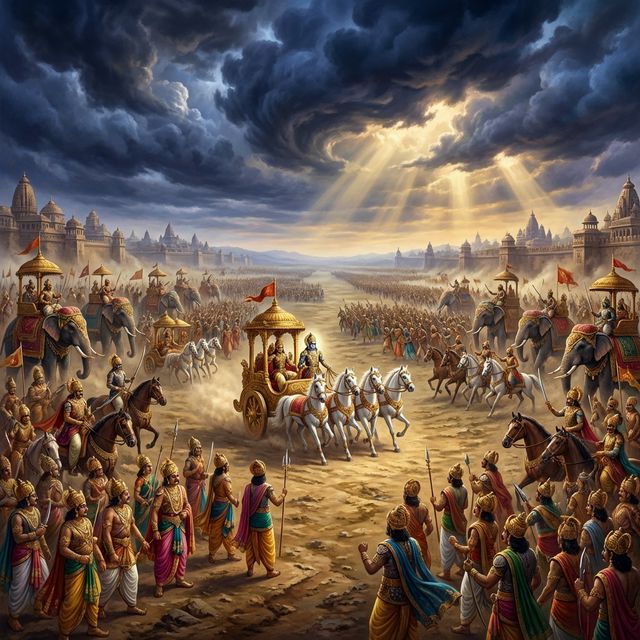
The Seventh Day After Noon
Bhima and Duryodhana wound each other twice, Sanjaya tells the blind king whose fault the war is, and Satanika kills Dushkarna
It Was Through Thy Fault
The blind king had been praising his own army.
He had gone through it piece by piece, the way a man counts over something he is afraid of losing. Soldiers neither very old nor very young, neither lean nor corpulent, free from disease, cased in mail, exercised in every kind of weapon, adepts at mounting and descending from elephants, at smiting, at marching and retreating. Men entertained on pay after examination, and not taken for the sake of lineage, nor from favour, nor from relationship. An ocean of a host, Dhritarashtra said, with vast numbers of combatants for its waters and steeds for its terrible waves, and swords and maces and darts for the oars piled upon it.
Then, having praised it, he asked the only question he ever really asked.
"That so large an army, mustered according to science, and attached to us by wealth, should yet be slaughtered in battle, alas, what can it be but the result of Destiny? O Sanjaya, all these seem to be unnatural. All these, in all its details, had been pre-arranged by Him, for that which is ordained by the Creator must happen as ordained and cannot be otherwise."
Sanjaya had the divine sight. He could see every quarter of that field from a seat in a hall in Hastinapura, and he had been sent back from it to say what he saw. He did not let the answer stand.
"Thou hast, O king, in consequence of thy own fault, been overtaken by this calamity. O bull of Bharata's race, the faults which thou, O monarch, hadst seen in that unrighteous course of conduct towards the Pandavas, were not seen by Duryodhana. It was through thy fault, O king, that the match at dice had taken place. And it is through thy fault that this battle hath taken place with the Pandavas. Having committed a sin, do thou, therefore, reap the fruit of that sin of thine. One reapeth the fruit of acts perpetrated by one's own self."
That was said by a servant to his master, in his master's own hall, while his master's sons were on the field.
"Do thou, therefore, O king, reap the fruit of thy own acts both here and hereafter. Therefore, O monarch, though overtaken by this calamity, be calm still, and listen, O sire, to the account of the battle as I recite it."
And he began at the hour when the sun stood over the middle of the field, on the seventh day, with Bhishma holding the Kaurava line.
The Mercy Shown to the Son of Drona
It opened with an old man's courtesy. Virata, king of the Matsyas, in whose kitchens and cow-pens the Pandavas had passed the thirteenth year of their exile, came up and pierced Bhishma with three shafts, and Bhishma pierced Virata's horses with three of his own, furnished with golden wings, and neither of them made anything more of it.
Further along the line, Ashwatthama found Arjuna.
He was Drona's son, a Brahmana by birth who had taken up the trade of his father, and he had learned from Drona not only every weapon but the methods of withdrawing them, which is the harder half of the science. He put six shafts into the wielder of Gandiva between the two breasts. Arjuna cut his bow in half and put five shafts deep into him in return.
Deprived of his senses by anger, unable to bear the cutting of his bow, Ashwatthama took up another bow that was tougher and shot ninety sharp shafts into Arjuna and seventy fierce arrows into Krishna, who was driving.
Then, said Sanjaya, Phalguni with his eyes red in wrath, and Krishna beside him breathing long and hot breaths, reflected for a moment.
What came out of that moment was serious. Holding the bow firmly with his left hand, Arjuna fixed on the string a number of shafts, sharp and perfectly straight and capable of taking the life, and drove them through Ashwatthama's armour, and those arrows drank his life-blood.
And Ashwatthama did not waver. He shot back arrows of the same kind and stood where he was, unperturbed, because his business there was to protect Bhishma of high vows, and the foremost warriors of the Kuru army applauded him aloud for it, since what he was doing was standing alone against the two Krishnas united together.
Then Arjuna thought about who was in front of him.
This one is the son of my preceptor. He is again the dear son of Drona. He is especially a Brahmana, and, therefore, worthy of my regard.
So he showed mercy to the son of Bharadwaja and turned away from him. And having turned away, the man with the white steeds went into the rest of that army and made a great carnage of it, displaying such quickness of arms that Sanjaya could not describe the hands, only the dead.
The Gem on Duryodhana's Breast
Duryodhana came at Bhima with ten shafts, winged with vulturine feathers, adorned with gold, whetted on stone. They were good arrows. Everything the king of the Kurus carried was good.
Bhimasena, excited with wrath, took up a tough and well-adorned bow capable of taking the life of the foe, and ten sharp shafts of his own, and aimed them steadily, and drew the bowstring back to his ear, and put all ten of them deep into the wide chest of the king of the Kurus.
There was a gem hanging on Duryodhana's breast on threads of gold. When the ten shafts stood around it in his chest, said Sanjaya, that gem looked beautiful, like the Sun in the firmament surrounded by the planets.
It is a strange thing to say about a wound, and Sanjaya said it to the wounded man's father.
Duryodhana, endued with great energy, could not bear it coolly. He was like a snake, said Sanjaya, that cannot bear the sound of a man's slap. Excited with wrath, and desirous of protecting his army, which was watching, he pierced Bhima in return with many shafts whetted on stone and endued with golden wings.
And there they stayed, struggling in battle and mangling each other fiercely, and the two of them together looked like a pair of celestials.
Neither of them finished it. That is the shape of the whole day and very nearly the shape of the whole war. These two had thirteen years and a gaming hall and a hall of assembly stacked between them, and they were both good enough with a bow to hurt each other badly and not good enough to end it with a bow, and each of them knew it. The thing between them was going to be settled one day with a mace on the bank of a lake, and until then every meeting could only be this: ten arrows, ten arrows back, blood on the gold, and other men pulling them apart.
The sun was still high. They would find each other again before it went down.
The Boy Who Danced on the Field
Abhimanyu, the son of Subhadra and Arjuna, was sixteen years old and the best thing in that army to watch.
He pierced Chitrasena with many sharp shafts, and Purumitra with seven, and Satyavrata with seventy, and then, said Sanjaya, that hero resembling Indra himself in battle began as it were to dance on the field, and caused us much pain. The three of them answered him together, ten shafts and nine and seven, and he took them and went on. Covered with his own blood, he cut off the large and beautiful bow of Chitrasena, cut through his coat of mail, and put a shaft into his breast.
Then all the princes of the Kaurava host, heroic and united and excited with wrath, turned on him at once, and Abhimanyu smote them all with keen shafts, and Sanjaya told the blind king that his sons had surrounded a boy who was consuming their army like a swelling fire of blazing flames consuming a heap of dry grass in summer.
Which is when Lakshmana came out to fight him. Duryodhana's son. Dhritarashtra's grandson, graced with auspicious marks, about the same age as the cousin he was riding at.
Abhimanyu pierced him and his charioteer with six sharp arrows. Lakshmana pierced Abhimanyu with many keen shafts, and Sanjaya, who had no reason to praise him, said that the feat seemed highly wonderful. Then Abhimanyu killed the four steeds and the charioteer and came on, and Lakshmana, standing on a car that could not move, hurled a dart at him, fierce and irresistible and resembling a snake, and Abhimanyu cut it out of the air with sharp arrows.
Kripa drove in, took Lakshmana up on his own car, and carried him out of it in the sight of all the troops.
After that the conflict became general and stopped being anybody's duel. Men rushed at one another wanting only a life. The Srinjayas fought the Kurus with their bare arms, their hair dishevelled, their mail gone, their cars gone, their bows broken. And Bhishma, mighty-armed and excited with wrath, went through the high-souled Pandavas with his celestial weapons, and the earth was covered over with fallen elephants and the men who had guided them.
Bhima Steps Down From His Car
Then Bhima broke the array.
He went through it with sharp shafts and came out among the younger brothers of Duryodhana, and Sanjaya named them for their father as they closed in: Dushasana and Durvisaha and Dussaha and Durmada and Jaya, Jayasena and Vikarna and Chitrasena and Sudarsana, Charuchitra and Suvarman and Dushkarna, and one more of them called Karna, who was not the Karna, and many other mighty car-warriors besides. All of them were sons of the man listening to the story. Bhima had penetrated into the middle of the array that Bhishma himself was protecting, and he was alone in there.
Beholding him in their midst, they said one thing to each other.
"Ye kings, let us take this one's life."
So the son of Pritha stood surrounded by his cousins, who were firmly resolved, and Sanjaya reached for the only image large enough. Bhima resembled Surya himself, of fierce splendour, surrounded by the mighty planets of evil nature at the time of the universal destruction.
Fear did not enter his heart. It had not entered Indra's either, said Sanjaya, in the old battle between the celestials and the Asuras when the Danavas had him ringed the same way.
Thousands of car-warriors armed with all weapons overwhelmed his single self with terrible shafts. He disregarded the sons of Dhritarashtra entirely and killed the foremost of the warriors around them instead, men on cars, men on elephants, men on horses, working outward from where he stood.
Then he understood what his cousins had decided about him, and set his heart on doing to them exactly what they had resolved to do to him.
And he did the thing that made the rest of the afternoon what it was. He left his car. He took up his mace, and stepped down off the wheels into the middle of the Kaurava host on foot, and began to smite that very sea of Dhartarashtra troops, and behind him, standing empty where he had left it, his chariot waited with the horses held.
Where Is Bhima?
Dhrishtadyumna, the son of Prishata, born out of a fire that had been lit to produce Drona's death, was the generalissimo of the Pandava army and was at that moment engaged with Drona himself. He broke off. He rode across the field toward the place where Shakuni was stationed, baffling countless warriors on the way, and came instead upon an empty car with a charioteer sitting in it.
The charioteer was Visoka, who drove Bhima.
Dhrishtadyumna became exceedingly cheerless and almost deprived of his senses. With his voice choked in tears, sighing as he spoke, he asked the man one question.
"Where is Bhima who is dear to me as my life itself?"
Visoka joined his hands. "The mighty son of Pandu, endued with great strength, ordering me to wait for him here, hath alone penetrated into the Dhartarashtra host that resembleth the very ocean. That tiger among men very cheerfully said unto me these words. Wait for me, O charioteer, restraining the steeds for a short space of time, that is, till I slay those that are bent upon my destruction. Beholding then the mighty Bhima rushing mace in hand, all our troops became filled with delight. Then in this fierce and terrible battle, O prince, thy friend, breaking the mighty array of the foe, hath penetrated into it."
Dhrishtadyumna heard that out, standing in the open with the battle going on around the two of them, and answered.
"What need have I today of life itself, if forgetting my affection for the Pandavas, I forsake Bhima in battle? If I return today without Bhima, what will the Kshatriyas say of me? What will they say of me when they will learn that while I was on the field Bhima penetrated alone into the hostile array making a single opening in it? The gods with Indra at their head visit him with evil who, forsaking his comrades in battle, returneth home unhurt. The mighty Bhima again is my friend and kinsman. He is devoted to me, and I also am devoted to that slayer of foes. Therefore, I will go thither, whither Bhima hath gone."
He did not have to look for the way in. There was a road already cut through the Kaurava army, opened by Bhimasena and marked along its whole length by elephants crushed with the mace, and he simply followed it.
At the end of it he found the man on foot, mangled with shafts, treading the field, vomiting the poison of his wrath, mace in hand, looking like the Destroyer himself at the hour of the universal dissolution, with the ranks closing on him from every side.
Dhrishtadyumna took him up onto his car. Then he plucked the arrows out of him, one after another, out of all his limbs, and embraced him warmly, in the very midst of the foe.
Pramohana, and the Weapon That Answered It
Duryodhana saw the two of them standing on one car together and went straight to his brothers.
"This son of Drupada of wicked soul is now united with Bhimasena. Let us all approach him together for slaying him. Let not the foe seek our ranks for battle."
They came like fierce comets at the hour of the universal dissolution, making the earth shiver with the twang of their bowstrings and the rattle of their car-wheels, and they showered Drupada's son the way clouds cover a mountain-breast with torrents of rain. He did not waver. Instead he applied a weapon called Pramohana, which does not cut and does not burn and takes only the mind.
Their senses went out of them. The princes stood in their cars with their minds and their strength afflicted, and the Kauravas around them, seeing the sons of Dhritarashtra swooning like men whose hour had come, fled away in all directions with their steeds and their elephants and their cars.
Elsewhere on the field the tide ran the other way. Drona came up against Drupada, who had been his friend once and his enemy for a long time since, and pierced him with three fierce shafts, and Drupada remembered the old hostility and left the battle. Drona blew his conch over him, and every Somaka who heard it was struck with fear.
Then Drona was told that the princes were standing senseless in the middle of the field. He left the part of the battle he had won and went to them, and took up the weapon called Prajna, which is the weapon of knowing, and neutralised the Pramohana with it, and Dhritarashtra's sons woke up in their cars and went back at Bhima and Prishata's son.
Yudhishthira, far off, was uneasy. "Let twelve brave car-warriors cased in mail and headed by Subhadra's son follow, to the utmost of their might, the track of Bhima and Prishata's son in battle. Let intelligence be had. My heart is very uneasy."
They went in when the sun had reached the meridian, disposed in the array called Suchimukha, the needle's mouth, with Abhimanyu at the point of it, and the Kaurava car-division could not hold them.
And Dhrishtadyumna, seeing his own preceptor bearing down on him, lost all interest in killing Duryodhana's brothers. He had Bhima moved onto the car of the king of the Kekayas, and turned to meet Drona.
Drona cut his bow with a broad-headed shaft. Remembering the bread he had eaten in Duryodhana's house, he sped hundreds of shafts after the man born to kill him. Dhrishtadyumna took up another bow and put seventy shafts into him. Drona cut that bow too, sent the four horses to Yama's abode, killed the charioteer, and left the general of the Pandava army standing on a wreck, from which he climbed across onto Abhimanyu's car. Then Drona made the whole Pandava host tremble in the sight of both of them, and the Kauravas shouted his name.
When the Sun Assumed a Red Hue
Then the light went red, and Duryodhana came back for Bhima.
Bhimasena saw him coming, that heroic warrior cherishing deep animosity, and was excited with great wrath, and said what he had been carrying.
"That hour hath come which I have desired for so many years. I will slay thee to-day if thou dost not abandon the battle. Slaying thee I shall today dispel the sorrows of Kunti as also of Draupadi and the woes that were ours during our exile in the woods. Filled with pride, thou hadst formerly humiliated the sons of Pandu. Behold, O son of Gandhari, the dire fruit of that sinful behaviour. Following the counsels of Karna as also of Suvala's son, and recking the Pandavas little, thou hadst formerly behaved towards them as thou hadst hinted. Thou hadst also disregarded Krishna who begged thee for peace. With a joyous heart didst thou despatch Uluka to us with thy messages. For all these, I shall slay thee to-day with all thy kinsmen, and thus avenge all those offences of thine of former days."
Then he bent his bow and stretched it repeatedly and sent thirty-six shafts at Duryodhana, whose effulgence resembled the lightning, which coursed straight with the force of the thunder-bolt.
After that he took the king of the Kurus apart in pieces. Two shafts cut the bow. Two took the charioteer. Four sent the four steeds to the regions of Yama. Two, shot with great force, cut the umbrella off that excellent car, the umbrella that is held over a king and nobody else. Three more cut off the handsome and blazing standard, and Bhima shouted aloud when it went.
Every king on that field saw it fall. The standard of the Kuru king, bearing the device of an elephant, decked with diverse gems, blazing like the sun, came down out of the air onto the earth like a flash of lightning dropping out of the clouds.
Then Bhima, smiling the while, put ten more shafts into Duryodhana himself, the way a guide pricks a mighty elephant with the hook.
Jayadratha, the king of the Sindhus, brought many brave warriors up onto Duryodhana's flank to shield him. Kripa drove in a second time that afternoon and took a son of Dhritarashtra up onto his own car, and the king of the Kurus, deeply pierced by Bhimasena and feeling great pain, sat down on the terrace of that car and stayed there.
Ten arrows at noon and ten at sunset, and between them the umbrella and the elephant on the ground. Jayadratha closed around Bhima with several thousands of cars.
The Arrows That Went Into the Earth
Dhrishtaketu came, and Abhimanyu, and the Kekaya brothers, and the sons of Draupadi, and met the sons of Dhritarashtra in front of the thousands of cars.
Abhimanyu pierced every one of them with five straight shafts that looked like the bolts of heaven, and they came back at him all together, a perfect down-pour of sharp arrows like rain-charged clouds pouring rain on the breast of Meru, and he made all of Dhritarashtra's sons tremble the way the wielder of the thunder-bolt makes the Asuras tremble.
Then he found Vikarna.
Of all the hundred, Vikarna was the one who had stood up in the hall of assembly on the day of the dice and said aloud that Draupadi had not been fairly won. He had been shouted down by his brothers, and he had stayed with them, and here he was at sunset on the seventh day with a boy shooting fourteen broad-headed shafts at him, fierce, looking like snakes of virulent poison.
They felled his standard. They killed his charioteer and his steeds. Then Abhimanyu sent after him many other arrows, well-tempered and straight-going and capable of penetrating every armour, furnished with the feathers of the kanka bird, and those arrows went through Vikarna's body and out of it and into the earth behind him like hissing snakes. Their wings and their points were decked with gold. Bathed in his blood, they seemed to be vomiting blood onto the ground.
His uterine brothers came for the boy at once, and the two lines of cousins stood on their cars piercing each other, resplendent, said Sanjaya, like so many suns.
Durmukha put five shafts into Srutakarman, who was Sahadeva's son by Draupadi, cut off his standard with one arrow, pierced his charioteer with seven, and then with half a dozen more killed the horses, fleet as the wind and cased in golden armour, and felled the driver. Srutakarman, standing on the dead car in great wrath, hurled a dart blazing like a fierce meteor, and it went through Durmukha's hard coat of mail and buried itself in the earth beyond.
Sutasoma saw his brother standing there without a car and brought his own alongside and took him up onto it, in the very sight of all the troops.
Then Srutakirti rushed at Jayatsena, wanting to kill him, and Jayatsena, smiling the while, cut Srutakirti's bow in his hands with a single sharp arrow that had a horse-shoe head, while he was still stretching it.
Wait, Wait
Satanika, son of Nakula and Draupadi, saw his brother's bow cut off in his hands.
He came at that spot roaring repeatedly like a lion. He drew his bow with great force and put ten shafts into Jayatsena and shouted like an infuriate elephant, and then with one more arrow, sharp-pointed and capable of penetrating every armour, he pierced Jayatsena deeply in the chest.
Dushkarna was near his brother. Infuriate with anger, he cut off Satanika's bow, and the arrow on it, with a single shot.
So Satanika took up another excellent bow capable of bearing a great strain, and aimed a number of sharp shafts, and said two words to Dushkarna in the presence of Jayatsena before he loosed them.
"Wait. Wait."
Then he sped at him those sharp and blazing shafts resembling so many snakes. One arrow cut Dushkarna's bow. Two killed his charioteer. Seven went into Dushkarna himself. A dozen sharp shafts killed all his steeds, which were fleet as the mind and of variegated hue, so that there was nothing left under him or in front of him. And then one broad-headed arrow, well-aimed and capable of coursing swiftly, went deep into his chest, and Dushkarna fell down on the earth like a tree struck with lightning.
Five mighty car-warriors closed around Satanika from a desire of slaying him and struck the renowned man with showers of arrows. The five Kekaya brothers came in wrath to get him out. And when Dhritarashtra's sons saw the Kekayas coming they rushed at them like elephants rushing against mighty elephants, Durmukha and Durjaya and the youthful Durmarshana and Satranjaya and Satrusha, on cars that resembled fortified towns, drawn by horses decked with ornaments, under standards of variegated hue.
That battle lasted only a short space of time, about sunset, and it increased the population of Yama's kingdom. Car-warriors and horsemen by thousands were strewn over the field around it.
Then Bhishma the son of Santanu, excited with wrath, went into the Pandava troops with his straight shafts and began sending the combatants of the Panchalas to the domains of Yama, and having broken their ranks, he withdrew his own troops and retired to his encampment, because the light was gone.
And in the Pandava camp Yudhishthira, who had spent the afternoon not knowing whether the two men he had sent twelve car-warriors after were alive, saw Dhrishtadyumna and Vrikodara walk in. He took each of their heads and smelt it, which is what a man does to a child who has come home, and being filled with joy, he retired to his tents.
Dharma Lesson
Dhritarashtra had a perfect army and an explanation ready for its destruction, and the explanation was Destiny. Sanjaya refused it to his face: the dice were yours, the war is yours, reap the fruit of your own acts. The day he then described is the argument in miniature, because nothing in it is fated and everything in it is chosen. Arjuna chooses to spare his teacher's son, Dhrishtadyumna chooses to follow a friend into a formation rather than live with what the Kshatriyas would say, and Bhima chooses to step down off his chariot alone. Men do these things; the Creator does not do them for them.