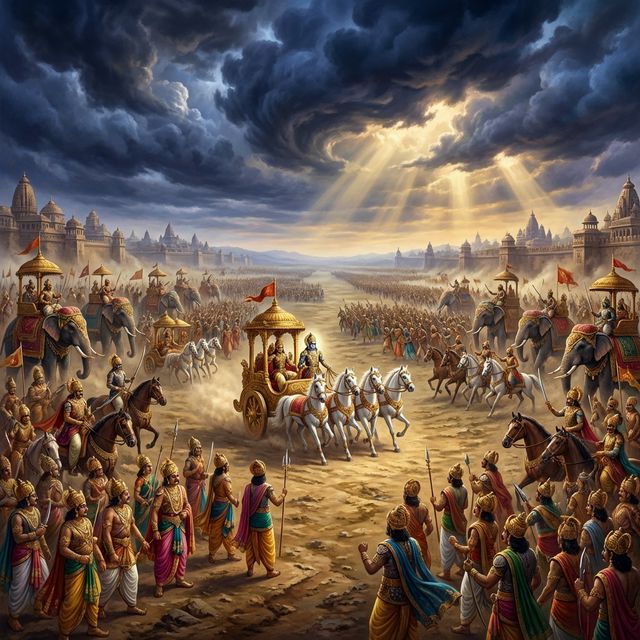
Six Duels on the Eighth Day
Shikhandi with a broken sword, Duryodhana on foot, and a mace that missed
The Mandala and the Vajra
Sanjaya had a habit, when he came back to the palace at Hastinapur in the evening, of beginning with the shape of the day rather than the dead in it.
The eighth morning opened with a clear sky. Bhishma had spent the night before telling Duryodhana who was left to him, naming them one by one, Drona and Shalya and Kritavarma of the Satwata race, Ashwatthama and Vikarna and Bhagadatta, the son of Suvala, Vinda and Anuvinda of Avanti, Valhika, the king of the Trigartas, the ruler of the Magadhas, and thousands of car-warriors with tall standards behind them. He had given the king an excellent herb for his wounds, and the wounds had closed. Then he had said the other thing, the thing he said every night.
"The Pandavas are incapable of being vanquished by the very gods with Vasava. They have Vasudeva for their ally. As regards myself, however, I shall always do thy bidding. Either I shall vanquish the Pandavas in battle, or they will vanquish me."
At dawn he arrayed the host in the Mandala, the circle bristling with weapons, seven cars near every elephant, seven horsemen near every car, seven bowmen behind every horseman and seven men with shields behind every bowman, and the whole of it turned to face the west. Duryodhana sat in his mail in the middle of that wheel, and his brothers, Chitrasena among them, guarded the grandsire while the grandsire guarded them.
Yudhishthira looked at the circle and answered it with the Vajra, the thunderbolt.
Then the pairs were made, as they were made every morning, each man going to find the man assigned to him. Drona rode at the king of the Matsyas. Ashwatthama went for Shikhandi. Duryodhana himself rushed at the son of Prishata. Bhima put himself in the way of the son of Hridika. Chekitana of the Vrishnis found Kripa. And a thousand kings closed around Arjuna.
This is the story of six of those meetings, and of what they cost the men who walked away from them.
Three Shafts Between the Brows
Shikhandi got at Drona's son early and struck him between the brows with three swiftly coursing shafts.
They stood in his forehead in a row and did not come out, and Sanjaya, who had seen a great many men shot in the head that week, said that Ashwatthama with those three arrows in him looked beautiful, like the mountain Meru with its three tall golden crests.
Then Ashwatthama became angry, and what he did next he did in less time than a wink of the eye. Charioteer, standard, steeds, weapons: he covered them with myriads of shafts and took all of them away at once, and Shikhandi found himself standing in the wreck of his own chariot with nothing to shoot from and nothing to shoot.
He did not run. He took up a sharp and polished scimitar and a shield decked with a hundred moons, and jumped down onto the field, and began to move.
He moved like a hawk. That is the word the text uses, and the point of it is that a man on foot in front of a great bowman has one advantage only, which is that he is small and quick and never twice in the same place. Ashwatthama shot at him and could not find him. Sanjaya called it highly wonderful. The son of Drona, the finest archer left alive on that side of the field after his father, stood on his car with the whole of his art in his hands and could not get an opening on a man with a sword.
So he stopped aiming and poured. Thousands of shafts went out at once, a shower rather than a shot, and Shikhandi cut the shower apart with the sword as it came down on him.
Then Ashwatthama cut the shield to pieces, the hundred moons and all, and then he cut the sword.
Shikhandi was left holding a stump of blade. He whirled the fragment, which glittered in his hand like a blazing snake, and hurled it at the man on the car. Ashwatthama, displaying the lightness of his arms, cut the broken blade out of the air, and then put arrow after arrow of iron into the body of the man who had thrown it.
Bleeding, weaponless, Shikhandi climbed onto Satyaki's chariot, and the whole field saw him do it.
The King on Foot
Meanwhile Dhrishtadyumna, the son of Drupada and the commander of the Pandava army, had covered Duryodhana with straight shafts until nothing of him could be seen.
Duryodhana was neither agitated nor struck with fear. It is worth pausing on that, because the epic is not generous to this man and does not have to be, and here it says plainly that the king stood in an arrow-storm loosed by the best general the other side possessed and was not frightened. He answered with sixty shafts and then with thirty more, one after another, quickly, and Sanjaya said that all of it seemed highly wonderful.
Then the Panchala prince lost his temper.
He cut Duryodhana's bow at the grasp. He killed the four steeds. He put seven shafts of the keenest points into the king himself, and Duryodhana was left standing on a dead chariot in the middle of his own army with a general coming for him.
What he did then was the correct thing and the reckless thing at once. He jumped down, drew a sabre, raised it, and ran on foot at Dhrishtadyumna.
Remember who these two men were to each other. Dhrishtadyumna had been born out of a sacrificial fire for one purpose, to kill Drona, and Duryodhana was the reason Drona was on the field at all. The son of Prishata had a chariot, a bow, and every advantage. The king of the Kurus had a sword and about thirty steps of open ground.
He did not get to cross them. Shakuni, devoted to the king, came at speed to that spot and took his sister's son up onto his own car in the very sight of all the troops.
It is the smallest act of the day and one of the most telling. The gambler who had won the whole kingdom at dice, who had never once done anything on that field that mattered, put his own vehicle under his nephew at the one moment when Duryodhana would otherwise have died there and the war would have ended eight days in.
Then the son of Prishata, having vanquished the king, went on into the Kaurava troops and began to slaughter them like the wielder of the thunderbolt slaughtering the Asuras.
Kritavarma Laughed At
Kritavarma was Krishna's kinsman.
He was a Vrishni of the Satwata race, an Atiratha, a man who had come to the war with the Narayana troops on Duryodhana's side while the head of his own house drove Arjuna's horses on the other. He was reckoned to excel all in might, and on the eighth day he found Bhima and covered him entirely with arrows, like a mighty mass of clouds shrouding the sun.
Bhima laughed at him.
That is the detail the text keeps, and it is not decoration. Bhima, blotted out under an Atiratha's arrows, was amused, and while laughing he sped some shafts back. Kritavarma took them and did not tremble, and pierced Bhima in return with many sharp arrows.
So Bhima stopped being amused and took the chariot apart in the order these things are taken apart. Four steeds. The charioteer. Then the beautiful standard, cut down off the car. Then the man himself, pierced with shafts of diverse kinds until, said Sanjaya, he seemed excessively mangled in every limb.
Kritavarma got down off the ruin and went across to the car of Vrishaka, and he did it in the sight of Shalya and in the sight of Duryodhana, which the narrator mentions because on that field being seen to be rescued was itself a wound.
He lived. That is the thing to hold on to about Kritavarma. He would live through the eighteen days and through the night after them, one of three men left of the whole Kaurava host, and the road that ended with him standing at the door of a sleeping camp holding a sword began with small survivals like this one, a beaten man stepping quietly onto somebody else's chariot while the fighting went on around him.
And Bhimasena, goaded to fury by the arrows still in him, went at the troops and began to slay them like the destroyer himself armed with his club.
Brackish Water
In the hall at Hastinapur the blind king interrupted.
"Many and wonderful, O Sanjaya, were the single combats I hear thee speak of, between the Pandavas and my warriors. Thou speakest not, however, of any one of my side having been cheerful on such occasions. Thou always speakest of the sons of Pandu as cheerful and never routed, and of mine as cheerless, deprived of energy, and constantly vanquished. All this, without doubt, is Destiny."
Sanjaya did not let him have it.
"Thy men exert themselves according to the measure of their might and courage, O bull of Bharata's race, and display their valour to the utmost extent of their strength. As contact with the properties of the ocean makes the sweet waters of the celestial stream Ganga brackish, so the valour of the illustrious warriors of thy army, coming in contact with the heroic sons of Pandu in battle, becomes futile. Exerting themselves according to their might, and achieving the most difficult feats, thou shouldst not find fault with thy troops.
"O monarch, this great and awful destruction of the world, swelling the population of the domains of Yama, hath arisen from thy misconduct and that of thy sons. It behoveth thee not to grieve for what hath arisen from thy own fault."
Then he added the sentence that explains why the men on that field kept getting up.
"Kings do not always in this world protect their lives. These rulers of Earth, desirous of winning by battle the regions of the righteous, daily fight, penetrating into hostile divisions, with heaven only for their aim."
Having said it, he went back to the forenoon and the carnage in it, which he said resembled the old battle between the gods and the Asuras: Iravat against the two princes of Avanti, Ghatotkacha against the elephant of Bhagadatta, Shalya against his own sister's sons, the twins, who were delighted to be fighting him and whom he was delighted to be fighting. Those are their own stories and belong to the day as a whole.
The sun climbed. When it reached the meridian, the king who had asked the questions at the dice game found a man to fight.
The Anger of Yudhishthira
Srutayush was an old king and a great bowman, and he had been assigned to Yudhishthira.
The son of Dharma urged on his steeds and struck him with nine straight shafts of keen point. Srutayush checked them and answered with seven, and those seven went through Yudhishthira's armour and drank his blood, and Sanjaya said they seemed to be sucking the very vital energies out of the body of that high-souled one.
Yudhishthira, deeply pierced, shot back into the old man's heart with an arrow shaped like a boar's ear, and with a broad-headed shaft brought his standard down onto the earth. Srutayush looked at his fallen standard and put seven more sharp arrows into the son of Pandu.
And then the eldest Pandava, who almost never does this, became angry.
Understand what the text claims for that anger, because it claims more for it than for any weapon loosed on the eighth day. He blazed up like the fire that blazes at the end of the Yuga for the consuming of creatures. The gods trembled. The Gandharvas trembled. The Rakshasas trembled. The universe became agitated, and the thought that arose in the minds of all creatures was one and the same thought: that this king, in his rage, would that day consume the three worlds. The Rishis and the celestials began to pray, not for either army, but for the peace of the world.
Yudhishthira sat in his car licking the corners of his mouth, wearing an expression the narrator compares to the sun that rises at the end of time, and every warrior in the Kaurava army who could see his face became hopeless of his life.
Then he checked that wrath with patience.
That is the whole of it, in one clause, and it is the reason he is called the son of Dharma. The man who could have burned the worlds put the fire down, took up his bow, and did the ordinary work in front of him: cut Srutayush's bow at the grasp, put a long arrow through the centre of his chest, killed his steeds, and killed his charioteer.
Srutayush left the wreck and fled. Duryodhana's troops turned their faces away. And Yudhishthira went on down the field, killing like Death with his mouth wide open, which was not the end of the world and was bad enough.
Two Men Down in the Dust
Chekitana of the Vrishnis had drawn Kripa, who is called Gautama in the account, the son of Saradwat, the teacher of the princes of both houses and the oldest surviving master of arms in the field.
Chekitana covered him with shafts in the sight of all the troops. Kripa baffled every one of them, and answered, and then went to work with the calm of a man who has taught this: one broad-headed arrow to cut the bow, another to fell the charioteer, then the steeds, then the two warriors who guarded Chekitana's chariot wheels. In the space of a few breaths the Vrishni had nothing left under him.
So he jumped down and took up a mace, and the field learned what it had not known, that Chekitana was the foremost of all wielders of the mace. With that hero-slaying club he killed Kripa's horses and felled Kripa's charioteer, and the old brahmana stepped down onto the ground beside him.
Kripa, standing on the earth, shot sixteen arrows. All sixteen went through the body of the Satwata hero and buried themselves in the ground behind him.
Chekitana, with sixteen arrows through him, hurled the mace a second time, wanting to kill Gautama the way Purandara wanted to kill Vritra. Kripa met that mass of adamant in the air with many thousands of arrows and stopped it.
Then Chekitana drew his sabre from the sheath and ran at him. And Kripa threw away his bow, took up a polished sabre, and ran at Chekitana.
They met and struck, both of them possessed of great strength, both with excellent blades, and both went down together onto the earth, that common element of all creatures. Neither was killed. They lay there side by side, motionless in a swoon, emptied by the effort they had made, two men who had spent everything they had on each other and arrived at exactly the same place.
Then Karakarsha, moved by friendship, drove out to that spot and lifted Chekitana onto his car in the sight of all the troops. And Shakuni, the king's brother-in-law, came out for the other one and took Kripa up onto his.
The two chariots turned and went back to opposite ends of the same field carrying the same defeat.
The Oath You Have Not Kept
Late in the afternoon Yudhishthira saw Shikhandi going away from the fighting with his weapon cut off, and lost his patience with him.
The words he used were harsh, and the narrator says so, and also says they were fraught with sound reason.
"Thou saidst at that time, in the presence of thy sire, unto me: Even I shall slay Bhishma of high vows with my shafts of the hue of the effulgent sun. Truly do I say this. Even this was thy oath. That oath of thine thou dost not fulfil, inasmuch as thou dost not slay Devavrata in battle. O hero, be not a person of unfulfilled vow. Take care of thy virtue, thy race, and thy fame.
"Behold Bhishma of terrible impetuosity scorching all my troops with his innumerable arrows, destroying everything in a moment like Death himself. With thy bow cut off, avoiding the battle, vanquished by the royal son of Santanu, whither dost thou go, forsaking thy kinsmen and thy brothers? This doth not become thee. Beholding Bhishma of infinite prowess, and our army routed and flying away, thou art assuredly frightened, O son of Drupada, since the colour of thy face is pale. Unknown to thee, Dhananjaya hath engaged in the dreadful battle. Celebrated over the whole world, why art thou afraid today of Bhishma?"
Shikhandi took it as good counsel. That is all the text says about what went on in him, and it is enough: the man born to end Bhishma, who had spent that morning on foot with a sword against Ashwatthama and been stripped of everything he carried, heard himself called frightened by the king he had sworn the oath to, and did not argue.
He set himself about slaying Bhishma at once, and Shalya came across to stop him with terrible weapons that were difficult to baffle, blazing like the fire at the hour of universal dissolution.
The son of Drupada was not confounded in the least. He checked those weapons with his own shafts, stood where he was without moving, and then took up the Varuna weapon, the water against the fire, and the celestials in the firmament and the kings of the earth all watched Shalya's flames go out.
Behind him, in the same hour, Bhishma cut the bow and the variegated standard of Yudhishthira in two strokes.
The Mace and the Empty Chariot
Bhima saw his brother disarmed and overwhelmed with fear, and did a strange thing. He cast aside his own bow and arrows, took up his mace, and went on foot at Jayadratha.
The ruler of the Sindhus put five hundred terrible arrows into him as he came, each of them like the rod of Death, from every side. Bhima disregarded them. He walked in through the arrows and killed all the horses of the king of the Sindhus, which had been bred in Aratta, and stood there in the open with the club in his hands.
Then Chitrasena saw him on foot.
He was one of Dhritarashtra's sons, one of those who had been assigned to guard the grandsire that morning, and he was of unrivalled prowess, and he did what a kshatriya is supposed to do when an enemy is caught without a chariot. He drove at him with his weapons raised, to finish it.
Bhima roared and came to meet him, and lifted the mace.
The Kauravas around them saw that upraised club, which the narrator says resembled the rod of Death, and forsook the brave son of their king and ran, not from Bhima but from the mace, because nobody standing near where it landed was going to survive where it landed.
Chitrasena did not lose his senses. In that fierce and awful crush of running men he watched the thing come at him, took up a bright scimitar and a shield, left the car, and jumped down onto the level ground like a lion coming off the top of a cliff.
The mace arrived a moment later. It fell on that beautiful chariot and destroyed the vehicle and the steeds and the charioteer together, and then dropped on the ground like a blazing meteor loosened from the firmament, and lay still.
And the Kaurava troops, who had just run from it, beheld the empty ground where their prince was standing alive and set up a loud shout over the whole field, and the warriors applauded the son of Dhritarashtra.
That is how the eighth day ended for those six pairs: with an army cheering a man for having got out of the way in time. Nobody had killed anybody. Every one of them would have to come back in the morning and do it again.
Dharma Lesson
A day of duels in which almost nobody dies is not a day without meaning. Each of these six combats ends with a man being carried off on somebody else's chariot, and the epic notices who does the carrying: Shakuni for the king, a friend for Chekitana, an enemy's brother-in-law for Kripa. What the eighth day measures is not killing but conduct under loss, and the highest thing in it is Yudhishthira putting down a rage that the gods believed would burn the three worlds and going back to the ordinary work of his bow.