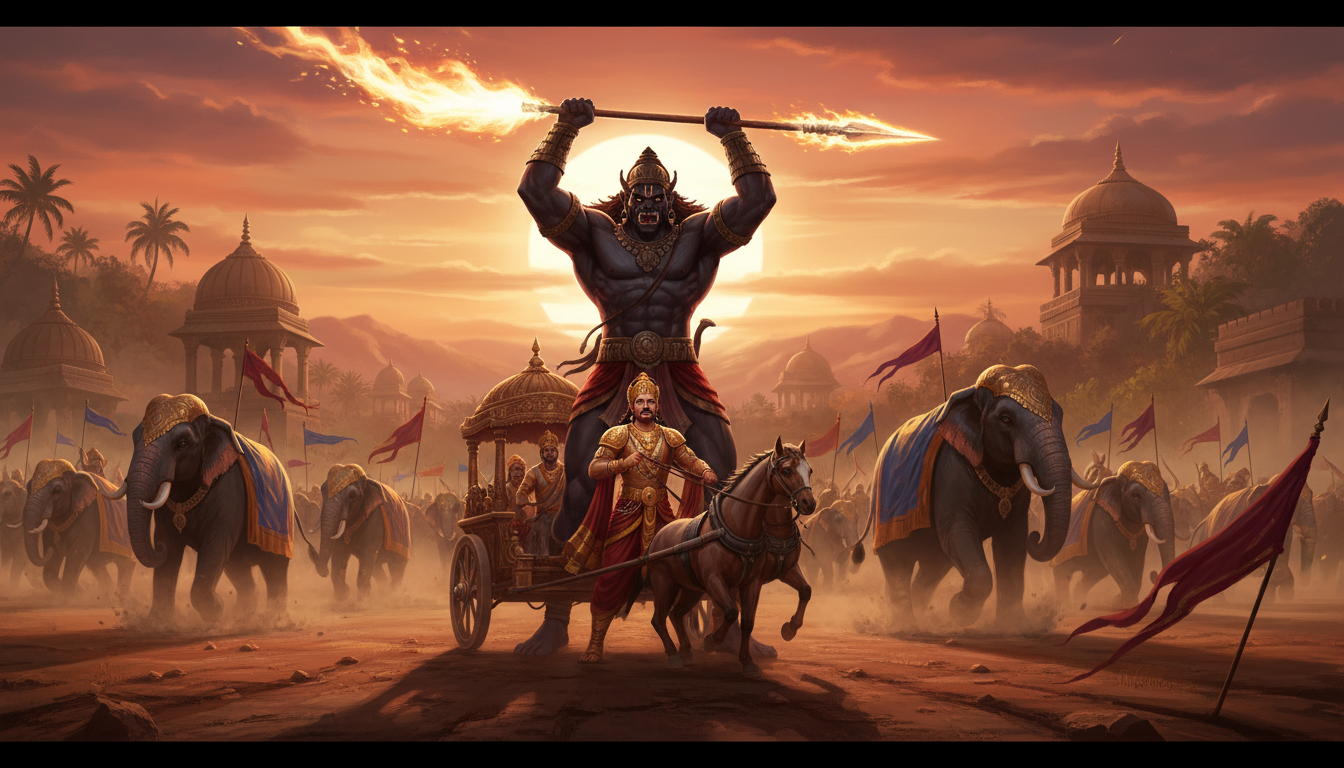
Kurukshetra Day 8: The Rakshasa's Hour
Iravan falls and Ghatotkacha answers for him
The Horned Array
They had slept well, both armies, which was the strange thing about the eighth morning. The Kauravas and the Pandavas passed the night in sound sleep and then went out again to kill one another, and when the troops moved off the uproar was like the sea.
Duryodhana formed the array himself that day, with Chitrasena and Vivinsati and Bhishma and the son of Bharadwaja over the work. Bhishma took the van with the Malavas and the men of the southern countries. Next came Drona with the Pulindas and the Paradas, then Bhagadatta of Pragjyotisha with the Magadhas and the Kalingas, then Vrihadvala king of the Kosalas, then the ruler of Prasthala with Kamvojas and Yavanas in thousands, then Drona's son roaring like a lion, then Duryodhana with his uterine brothers around him, and Kripa closing the rear.
Yudhishthira looked at that and spoke to the man he had made generalissimo.
"Behold, O great bowman, that array, already formed, resembling the ocean. Do thou also, O son of Prishata, form without delay thy counter-array."
Dhrishtadyumna formed the Sringataka, the horned array that is destructive of all hostile arrays. At the two horns he set Bhima and Satyaki with many thousands of cars and horse and foot. Next to them stood Arjuna, with his white steeds and Krishna at the reins. In the centre were Yudhishthira himself and the two sons of Madri. In the rear he placed Abhimanyu, and Virata, and the five sons of Draupadi, and the rakshasa Ghatotkacha.
Then the drums and the conches went, and the warriors looked at one another with winkless eyes and called their own names across the gap before they closed. Then the arrows fell in showers like snakes with their mouths open, and the day began.
Eight Sons Before Noon
The Pandavas could not look at Bhishma that morning. He scorched the field like the sun, cutting the heads off their car-warriors and leaving elephants standing paralysed like hills with nobody on them. One man in that army went at him and stayed there, and it was Bhima.
Bhima killed the grandsire's charioteer first, and the horses bolted off with the car behind them. Then he put a horseshoe-headed arrow through the neck of Sunabha, the king's brother.
Seven more brothers could not bear it. Adityaketu and Vahvasin, Kundadhara and Mahodara, Aparajita, Panditaka, and Visalaksha who was called invincible came out in their bright mail and pierced Bhima nine times and seventy and ninety and seven, and Bhima did not bear it either. Holding his bow in his left hand he took off Aparajita's fine-nosed head with one straight shaft and sent Kundadhara to the domain of Death. He shot Panditaka, and the arrow killed him and went on into the earth like a snake going home, and remembering his old grievances he cut off Visalaksha's head with three arrows, struck Mahodara in the chest, took Adityaketu's umbrella with one arrow and his head with the next, and sent Vahvasin after them.
That was eight sons of Dhritarashtra before the sun stood overhead, and the rest turned and ran, remembering a promise made about them in an assembly hall long ago and thinking it true.
Duryodhana went to Bhishma with his face wet.
"My heroic brothers have been slain in battle by Bhimasena, and our troops are failing. Thou seemest to disregard us, behaving as thou dost like an indifferent spectator. Alas, what course have I taken. Behold my evil destiny."
Bhishma's own eyes filled up when he heard it.
"Even this was said by me before, as also by Drona, and Vidura, and the renowned Gandhari. O son, thou didst not then comprehend it. It hath also been settled by me that neither myself nor Drona will escape with life from this battle. Those upon whom Bhima will cast his eyes in battle, he will surely slay. Therefore, O king, summoning all thy patience, fight, making heaven thy goal."
In Hastinapura the blind king could not sit still under the account of it.
"Beholding my sons slain by a single person, what did Bhishma and Drona and Kripa do in battle?"
Sanjaya did not let that stand.
"Those words of Vidura, uttered for thy good but which thou didst not then understand, have now come to be realised. Vidura had said, 'Restrain thy sons from the dice.' Like a man whose hour is come refusing the proper medicine, thou didst not listen. At midday the Pandavas split into three bodies. Dhrishtadyumna and Shikhandi and Satyaki went at Bhishma alone; Arjuna went at the kings who followed thy son; Abhimanyu and the son of Hidimba and Bhimasena went at whatever was left, and Nakula and Sahadeva rode into the cavalry until the earth was strewn with horses. A river began to run through the middle of that field whose current was blood."
Arjuna's Other Son
Into the horse fighting came a young man with a great herd of horses behind him, gold on their heads and necks, moving so fast that they looked like swans crossing deep water. His name was Iravat. He was Arjuna's son, and almost nobody in either army had heard of him.
His mother was a daughter of the king of the nagas. Her first husband had been eaten by Garuda, and Airavat gave her to Partha, and Partha took her because she came to him wanting him. His uncle among the nagas threw the boy out, and he grew up in that region under his mother's protection. When he heard that his father had gone up to the region of Indra he went there too, and stood in that court with his hands joined and introduced himself the way a stranger does.
"I am Iravat. Blessed be thou, and I am thy son, O lord."
Arjuna remembered the circumstances exactly as they had happened, and embraced him, and gave him one instruction only.
"When the battle takes place, assistance should be rendered by thee."
"Yes," the young man said, and went away, and now here he was.
His horses struck the Kaurava horses chest to chest, and both lines went down together with a sound like the swoop of Garuda. Then the six younger brothers of Suvala's son rode out on fresh chargers, Gaya and Gavaksha, Vrishava, Charmavat, Arjava and Suka, Gandhara men who were hard to beat, and broke into the cavalry of the Pandavas.
Iravat told his own men what to do about it. "Adopt such contrivances in consequence of which these Dhritarashtra warriors with their weapons and animals may all be destroyed."
They surrounded him with lances, and he pulled the lances out of his own body and struck the sons of Suvala with them. Bathed in the blood running down his chest and back he got off his horse, drew his sword, took up a shield, and went at all six of them on foot. They rode around him and could not touch him. When they came close enough to try to take him alive he cut off their arms, and the arms with the gold on them fell in the dirt. Only Vrishava got out of it.
The Hired Illusionist
Duryodhana looked at the six of them lying there and sent for a rakshasa.
He was the son of the hermit Rishyasringa, a great bowman versed in illusion, and he already hated the Pandavas on his own account for the killing of Vaka. Alambusha was his name.
"Behold, O hero," Duryodhana said, "how the mighty son of Phalguni, versed in illusion, hath done me a severe injury by destroying my forces. Thou also art capable of going everywhere at will and accomplished in all weapons of illusion. Thou cherishest animosity also for Partha. Therefore, do thou slay this one in battle."
"Yes," said the rakshasa, and went off roaring with the remnant of the Kaurava horse behind him.
He began with two thousand riders that did not exist, and Iravat's men killed all two thousand and died doing it. Then the two of them were alone in the middle of a battle, like Vritra and Vasava.
Iravat cut the rakshasa's bow with his sword and cut each of his arrows into five pieces. Alambusha went straight up into the air, and Iravat went up after him, because he could change shape too and knew where the vital parts of a body are. He cut the rakshasa's limbs off, and did it again, and did it again. The pieces were reborn young. Age and form are matters of will with them.
Then Alambusha stopped playing, took a prodigious and fierce form, and reached out to take Arjuna's son in his hands.
And a naga came to Iravat, a relation on his mother's side, and swelled up mighty as Ananta and covered the rakshasa with nagas of every kind, so that he was buried in serpents.
Alambusha reflected for a moment. Then he became Garuda, and ate them.
When his mother's kinsman had gone down that throat, Iravat stood confounded in the air with nothing left to fight with, and the rakshasa killed him with a sword. The head came down on the field with the earrings still in it and the diadem on it, and it looked, Sanjaya said, like a lotus, or like the moon.
A long way off on the same field, Arjuna, not knowing that the son of his loins was dead, was cutting down king after king of the men who protected Bhishma.
The Debt Ghatotkacha Owed
The one who answered for Iravat was not his father.
Ghatotkacha, Bhima's son by the rakshasa woman of the forest, saw the head come down and let out a roar that shook the earth with its oceans and its mountains. Men in both armies felt their thighs shaking and the sweat come out on them, and the fighting stopped all over the field, the way it stops in a herd of elephants when a lion is heard.
Then he came on with a blazing spear up and a crowd of rakshasas around him, and Duryodhana rode out to meet him personally, with the king of the Vangas behind him and ten thousand elephants behind that king, huge as hills.
The rakshasas went into the elephants with darts and mallets, and with mountain summits and whole trees, and the beasts came apart. When that division had been thinned, Duryodhana rode into the rakshasas himself and shot four of the chief ones dead, Vegavat and Maharudra, Vidyujihva and Pramathin, one arrow each.
Bhima's son came at him for that, drawing a bow that lit up like lightning, and Duryodhana did not shake. Ghatotkacha spoke to him with his eyes red and his lower lip between his teeth.
"I shall today be freed from the debt I owe to my sires, as also to my mother, they that had so long been exiled by thy cruel self. The sons of Pandu were vanquished by thee in that match at dice. Drupada's daughter Krishna also, while ill and therefore clad in a single raiment, was brought into the assembly and great trouble was given by thee in diverse ways, O thou most wicked, unto her. While dwelling also in her sylvan retreat, thy well-wisher, that wicked wight, the ruler of the Sindhus, persecuted her further, disregarding my sires. For these and other wrongs, O wretch of thy race, I shall today take vengeance if thou dost not quit the field."
Then he covered the king of the Kurus with arrows the way rain covers a mountain.
The Elephant That Stood in the Way
Duryodhana bore that shower like an elephant standing under rain out of a clear sky, then sighed like a snake and put twenty-five sharp arrows into the rakshasa, until the blood ran down him like a bull elephant with its temples split.
So Ghatotkacha decided to kill the king. He took up a dart that would go through a mountain, blazing like a large meteor, and raised it.
The king of the Vangas saw it go up. He drove his own elephant in front of Duryodhana's car and stood there, covering the car completely with the animal's body, which is the whole of what that man did in this war. Ghatotkacha's eyes went red. He threw the dart at the elephant instead, and it died of that in great agony, and the king of the Vangas jumped down and landed on his feet as it fell.
Bhishma, far off, heard the roaring and went to Drona about it.
"These fierce roars that are heard, uttered by rakshasas, without doubt indicate that Hidimva's son is battling with king Duryodhana, who cannot stand against him. Therefore, blessed be ye, go thither and protect the king. Even this is our highest duty."
It took a great many of them: Somadatta and Valhika and Jayadratha, Kripa and Bhurisravas and Salya, the princes of Avanti with Vrihadvala, Aswatthaman and Vikarna and Vivinsati, and thousands behind them.
Ghatotkacha stood up in the middle of that like the Mainaka mountain, his kinsmen around him with clubs and mallets, and went to work on the arrivals one at a time. He cut the preceptor's bow in half and brought down Somadatta's standard. He struck Vikarna at the shoulder joint and Vikarna sat down covered in his own blood. He put fifteen shafts through Bhurisravas so hard that they went through the armour and into the ground. He cut down Jayadratha's golden boar standard and then Jayadratha's bow, and pierced Vrihadvala until that king sat down in pain. Then he turned round and found Salya.
A Rout at Sunset
Yudhishthira heard the noise and read it correctly.
"The noise that we hear uttered by the fiercely-roaring rakshasa, without doubt, indicates that he is battling with the mighty car-warriors of the Dhartarashtra army. I see also that the burden has proved heavier than that bull among rakshasas is able to bear. The grandsire too, excited with rage, is ready to slaughter the Panchalas, and for protecting them Phalguni is battling with the foe. O thou of mighty arms, go and give succour to Hidimva's son."
Bhima went, frightening the kings on the road with his roaring, and behind him came Abhimanyu and the sons of Draupadi and Nila of the low countries and six thousand elephants. The dust off that advance was the colour of reddish smoke, and after it no man could tell his own side from the other.
Duryodhana turned on Bhima himself, cut his bow, and drove a shaft into his chest that left him holding his own flagstaff to stay upright. Drona shot Bhima twenty-six times; Bhima put ten arrows into Drona's left side and the old preceptor sat down in his car and lost consciousness. Bhima came off his own car with the mace up and stood like a hill, and the Kaurava host looked at him and was afraid.
Then Ghatotkacha, who had been watching his father bleed, stopped fighting like a man and used what he was.
He put one fierce and awful illusion out over the whole field, and in it every soldier of the Kaurava army saw himself lying cut down on the ground, writhing, helpless, bathed in blood. They saw Drona flying, and Duryodhana and Salya and Aswatthaman flying, and the kings killed and the horsemen cut down in thousands.
"Fight, do not fly away," Bhishma shouted at them, and Sanjaya shouted it with him at the top of his voice. "All this is rakshasa illusion in battle, applied by Ghatotkacha."
They did not believe it. Their senses were gone. The whole army of the Kurus ran for its tents at the hour of sunset with the Pandavas roaring behind it and blowing conches, and that was the eighth day settled.
Supratika, and the News for Arjuna
Duryodhana went to Ganga's son afterwards and told him the whole of it, his own defeat and the rakshasa's victory, and asked to be allowed to kill Ghatotkacha himself. Bhishma would not have it.
"One's own self, under all circumstances, should be protected in battle. Thou shouldst always battle with king Yudhishthira the Just, or with Arjuna, or with the twins, or with Bhimasena. Keeping the duty of a king before himself, a king striketh a king. Myself, and Drona, and Kripa, and Drona's son, and Kritavarman and Salya, and thy brothers headed by Dussasana, will all battle that rakshasa for thy sake. Or if thy grief be too great, let this one proceed against him."
He turned to Bhagadatta, king of Pragjyotisha, and gave him the work. "Proceed quickly, O great monarch, against that invincible warrior. Thy weapons are celestial. In days of old many have been the encounters that thou hadst with Asuras. Thou art that rakshasa's match in great battle."
Bhagadatta went out on his elephant Supratika, the juice running down the animal in seven streams, throwing arrows off its head by thousands like Indra off Airavata. The king of the Dasarnas rode an elephant of his own at him, and Supratika took the charge like a continent taking the sea; then fourteen lances went through that other elephant's golden armour and it ran screaming back through the Pandava ranks.
Ghatotkacha threw a blazing dart at him and Bhagadatta cut it in half in the air. Then he threw a golden javelin of his own, calling "Wait, wait" as it went, and the rakshasa jumped up, caught it out of the air, put it across his knee, and broke it in front of all the kings.
Bhagadatta answered by killing Bhima's horses, cutting down his lion standard and shooting his driver Visoka off the seat, and Bhima came down onto the ground again with the mace. It was at that point that a car with white horses and Krishna driving it arrived at that part of the field, and Bhima, standing in the wreckage, told Kesava and Arjuna in detail about the slaughter of Iravat.
Vidura Saw It First
Arjuna heard it and sighed like a snake, and spoke to Krishna in the middle of the battle.
"Without doubt, the high-souled Vidura of great wisdom had before seen this awful destruction of the Kurus and the Pandavas. It was for this that he forbade king Dhritarashtra. Fie upon that wealth for the sake of which such slaughter of kinsmen is being perpetrated. What, O Krishna, shall we gain by slaying our assembled kinsmen? Alas, for Duryodhana's fault, and also of Sakuni the son of Suvala, as also through the evil counsels of Karna, the Kshatriya race is being exterminated. I now understand that the king acted wisely by begging of Suyodhana only half the kingdom, or, instead, only five villages. Alas, even that was not granted. Beholding so many brave Kshatriyas lying dead on the field, I censure myself. The Kshatriyas will regard me powerless if I stop. For this alone I am battling; else this battle with kinsmen is distasteful to me. Urge the steeds on with speed. There is no time to lose in action."
Kesava urged the white horses on, and the noise out of the Kaurava army as they saw him coming was like the sea at full tide in a gale.
In the afternoon Bhima found the sons of Dhritarashtra again. He felled Vyudoroska, and Kundalin the way a lion pulls down something smaller than itself, and then, getting the rest within reach, shot with care, and Anadhriti and Kundabhedin and Virata and Dirghalochana and Dirghavahu and Suvahu and Kanykadhyaja came off their cars one after another, looking, Sanjaya said, like mango trees in blossom falling. Drona covered him with arrows the whole time and could not stop him. Nine more sons went that afternoon: seventeen in the day.
By evening the two armies had come down to nails and teeth. Men caught one another by the hair and sent one another to Yama's house without a weapon between them. Then the darkness came, and the Kurus and the Pandavas drew their armies apart and went back to their tents.
The Lamps Along the Street
Four men sat up that night: Duryodhana, Shakuni, Dushasana, and the son of the suta. The question was how the sons of Pandu could be beaten, and the king answered it first.
"Drona, Bhishma, and Kripa, and Salya and Somadatta's son do not resist the Parthas. I do not know what the cause is of such conduct of theirs. Unslain by any of these, the Pandavas are destroying my forces. Therefore, O Karna, I am becoming weaker and my weapons are being exhausted. Doubt filleth my mind as to how I shall succeed in smiting them."
"Do not grieve, O chief of the Bharatas," Karna said. "Even I will do what is agreeable to thee. Let Santanu's son Bhishma soon withdraw from the great battle. After Ganga's son has laid aside his weapons, I will slay the Partha along with all the Somakas, in the very sight of Bhishma. I pledge my truth, O king. Indeed, Bhishma every day showeth mercy towards the Pandavas. He is proud of his prowess and very fond of fight. Why will he vanquish the assembled Pandavas, for then the battle will be over? Therefore, repairing without delay to his tent, solicit that old and reverend signior to lay aside his weapons."
"See, O Dussasana," the king said to his brother, "that without delay all who walk in my train be dressed."
So they dressed him, and Dushasana held the horse for him himself. He went down the camp street in clean vestments with sandal paste of the hue of the Bhandi flower on him, his brothers behind him. Men stood along the way holding lamps of gold fed with fragrant oil, so that he rode like the moon with the planets blazing about him, and he heard the voices of men from many countries who had come there to die for him.
At Bhishma's quarters he got down, went in, saluted the old man and sat on a golden seat with a rich coverlet. Then he joined his hands, his eyes filled with water, and his voice went out of his control.
"Taking thy protection, we ventured to vanquish the very gods and the Asuras with Indra at their head. What shall I say, therefore, of the sons of Pandu? O son of Ganga, it behoveth thee to show me mercy. Slay the brave sons of Pandu like Mahendra slaying the Danavas. 'I will slay all the Somakas and the Panchalas and the Karushas along with the Kekayas' - these were thy words to me. Let them become true. If from kindness for the Pandavas, or from thy hatred of my unfortunate self, thou sparest them, then permit Karna to fight. He will vanquish the Parthas with all their friends and kinsmen."
Then he shut his lips and said nothing further, and waited for the answer, which came on the morning of the ninth day.
Dharma Lesson
A grief that is not allowed to stop for its dead will find someone else to spend itself on. Arjuna was fighting elsewhere when his son was killed and learned of it only from his brother, and the debt was paid by a nephew who had older debts of his own. What a war teaches its youngest fighters is not restraint but the arithmetic of revenge.