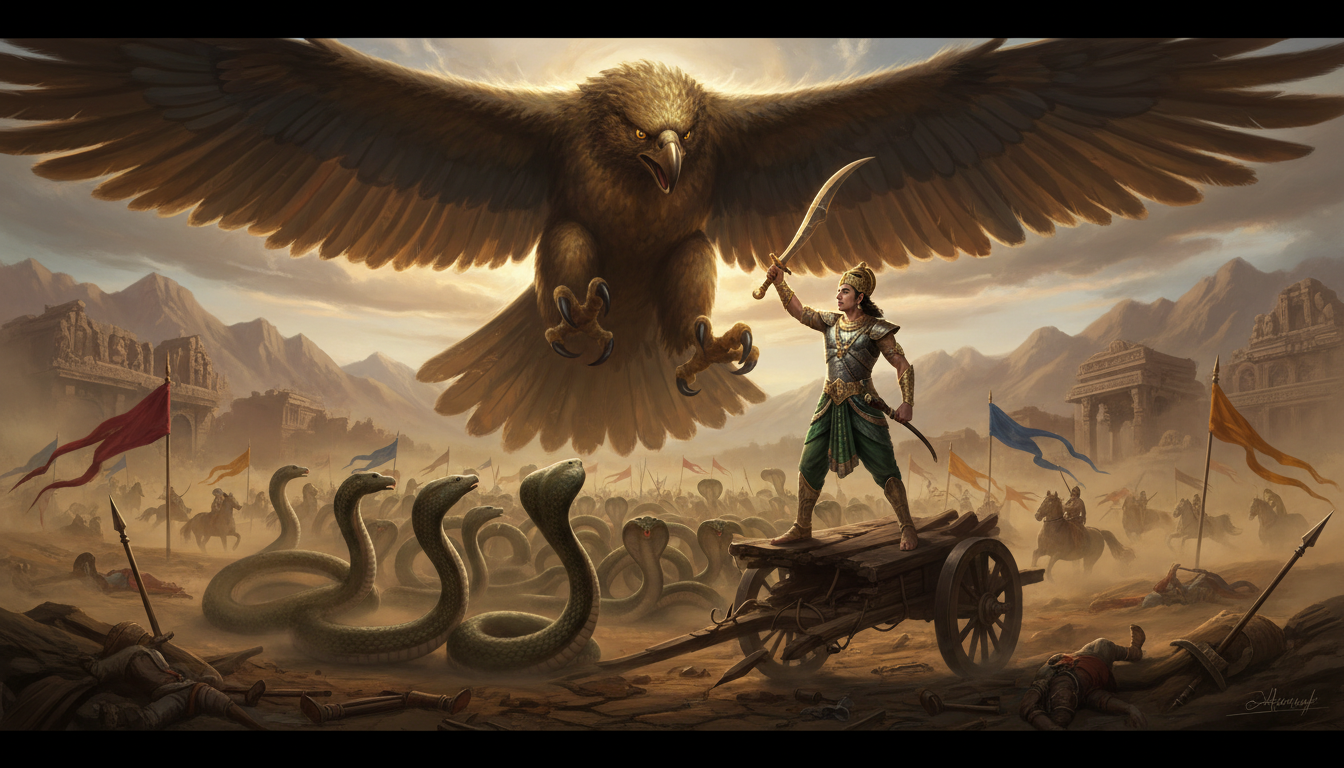
The Son of Rishyasringa
Alambusha, the illusion-fighter the Kauravas kept for the Pandava sons
Cruel Deeds Against Cruel Deeds
There was a rakshasa in the Kaurava line, and Sanjaya named him for the blind king the way he named the kings: by his father.
He was the son of Rishyasringa, the hermit with the horn on his head who had been raised in a forest without ever seeing a woman, and whose coming to Anga had brought the rain. That was the line the thing on the Kaurava right wing came out of. His name was Alambusha. He was a great bowman, he was versed in every weapon of illusion, he could go anywhere he pleased at will and wear any shape he chose while he was there, and he had a grievance of his own in this war: Bhimasena had killed Vaka, and rakshasas remember.
The Kauravas did not use him against Bhima. They kept him for other people.
He first showed what he was early in the fighting, on one of those afternoons when the whole field had broken up into private quarrels: Valhika roaring at Dhrishtaketu of the Chedis and the two of them bellowing at each other like rutting elephants, Shikhandin rushing at Drona's son and being deeply pierced for it. In the middle of that, Ghatotkacha of cruel deeds met Alambusha of cruel deeds, and Sanjaya could think of nothing to compare it to except Sakra encountering Vala. Bhima's son pierced that infuriate and powerful rakshasa with ninety keen-edged shafts, and Alambusha pierced him back in many places with straight arrows, and the two of them stood there mangled and shining like the gods and the asuras in the old war.
Neither one killed the other. Both of them were still on the field that evening, and it should have told the Kauravas something about what they had bought, that the first rakshasa they set him against was one of the enemy's and neither could win.
The Weapon Satyaki Had From Arjuna
The next man they put him in front of was Satyaki of the Satwata race, who was driving at Bhishma with horses of silvery hue and killing whoever stood in the road.
Nobody in that army could stop him. Alambusha alone managed to reach him, and pierced him with ten shafts, and Satyaki pierced him with four and drove on, which was all the notice he took.
They met properly on a later day. Shikhandin, cut about with iron arrows, had climbed onto Satyaki's car for shelter, and Satyaki, in a rage, covered the rakshasa on all sides with terrible shafts. Alambusha cut Satyaki's bow with a crescent-shaped arrow and pierced him with many shafts, and then he did the thing he was in the war to do: he created by his rakshasa powers an illusion, and covered Satyaki in a shower of arrows out of the air.
Satyaki did not show fear. He had a weapon for this. Long before, Vijaya had given him the Aindra weapon, and now he applied it with the mantras, and that weapon consumed the demoniac illusion into ashes and then covered Alambusha all over with terrible shafts, like a mass of clouds covering a mountain breast with rain.
The rakshasa fled. He got away from that part of the field avoiding Satyaki, and the grandson of Sini uttered a loud roar in the very sight of the whole Kaurava army, having vanquished a prince of rakshasas whom Maghavat himself could not vanquish. Then, with nothing left in front of him, Satyaki began to kill the troops with innumerable shafts, and they fled from him too.
It was the first demonstration of the rule that governed Alambusha's whole war, and nobody on Duryodhana's side drew the lesson from it.
The Price Duryodhana Named
On the eighth day the king found the work he had really bought him for.
Arjuna had a son that morning whom hardly anyone had heard of: Iravat, born of a naga princess, raised in the region of the nagas, come to Kurukshetra with a herd of beautiful horses because his father had once told him in Indra's own court that when the battle took place assistance should be rendered by him.
Iravat had just destroyed the cavalry of the Gandharas. He had told his own men, in the plainest terms anyone used on that field, what he wanted of them: adopt such contrivances, he said, in consequence of which these Dhritarashtra warriors with their weapons and animals may all be destroyed. The six younger brothers of Suvala's son had ridden out against him, Gaya and Gavaksha, Vrishava, Charmavat, Arjava and Suka, and he had come down off his horse and gone at all six of them on foot with a sword and a shield, and cut off their arms, and only one of them got away alive.
Duryodhana looked at what was lying on the ground and sent for the rakshasa.
"Behold, O hero, how the mighty son of Phalguni, versed in illusion, hath done me a severe injury by destroying my forces. Thou also, O sire, art capable of going everywhere at will and accomplished in all weapons of illusion. Thou cherishest animosity also for Partha. Therefore, do thou slay this one in battle."
That was the whole of the contract, spoken in front of witnesses: you hate his father, you can do what my kings cannot, go and kill the boy.
"Yes," said the rakshasa of terrible mien, and went towards that part of the field with a leonine roar, taking with him the remnant of the Kaurava horse and his own division of smiters, well mounted, skilled in battle, fighting with bright lances.
Serpents Against Garuda
He opened with two thousand accomplished smiters who did not exist, terrible rakshasas on illusive chargers, armed with spears and axes, advancing with rage. Iravat's men killed all two thousand of them and were destroyed in the doing of it. Then the two of them were alone, invincible in battle, like Vritra and Vasava.
Iravat cut his bow with a sword, and cut each of his arrows into five fragments, and Alambusha rose up into the sky, confounding the enraged boy with his illusion, because the boy was faster than he was on the ground. Iravat rose after him. He could change his own shape at will, and he had a knowledge of what the vital limbs of a body are, and he cut the rakshasa's limbs into several pieces, and then into several pieces again.
The pieces were born again as a youth. Illusion is natural with that people, and their age and their form are both dependent on their will. Iravat took a sharp axe to him and hacked him like a tree until he was pouring forth blood in torrents and roaring so that the sound deafened the men on the ground, and he grew back.
Then the son of Rishyasringa stopped losing. In the sight of all the combatants there present, he assumed a prodigious and fierce form and reached out to seize Arjuna's son with his hands.
And a naga came to Iravat then, a relation on his mother's side, and assumed a huge form mighty as Ananta himself, and covered the rakshasa with nagas of every kind until he was buried in serpents.
Alambusha, buried, reflected for a moment. Then he assumed the form of Garuda, and devoured them.
With his mother's kinsman gone down that throat Iravat stood confounded in the air, and Alambusha killed him with a sword and felled his head onto the earth, decked with earrings, graced with a diadem, looking beautiful like a lotus or like the moon.
When the heroic son of Arjuna was thus slain, the Dhartarashtra host with all the kings in it were freed from grief. Around the place where he had fallen the carnage went on being awful in both divisions, horses and elephants and foot-soldiers entangled with one another and trampled by tuskers, and nobody on either side stopped for the head with the diadem on it.
What It Bought Him
The relief lasted about as long as it took the noise to cross the field.
Ghatotkacha saw the head come down and roared until the earth with its oceans and its mountains and its forests trembled, and the thighs of the men in both armies shook under them, and the sweat came out on their faces. Then he went into the Kaurava line with a blazing spear and his kinsmen behind him. He raised a dart that would go through a mountain at Duryodhana's car, and the king of the Vangas put his own elephant in the way of it and lost the animal. By sunset he had broken ten thousand elephants of that king, driven Duryodhana's rescuers off one at a time, and thrown one illusion over the whole army in which every soldier in it saw himself lying cut down on the ground and bathed in his own blood.
Bhishma and Sanjaya shouted at them that it was rakshasa illusion applied by Ghatotkacha, and that they should fight and not fly, and nobody believed a word of it. The whole Kaurava host ran for its tents in the hour of sunset.
Duryodhana went to Bhishma that night and told him about it, sighing between the sentences. Eleven akshauhinis of celebrated troops were obedient to his command, he said, and he had still been defeated by Pandava warriors relying on a rakshasa, and it consumed his limbs like fire consuming a dry tree; and he asked leave to go and kill Ghatotkacha himself. Bhishma refused him that and sent Bhagadatta of Pragjyotisha instead, with his elephant and his celestial weapons, to do what a hired monster had not.
So the account of the eighth day came to this. Duryodhana had paid a rakshasa to kill a boy nobody had heard of, and the rakshasa had done it, and in exchange the enemy's rakshasa had emptied the field.
And far off, in another part of the fighting, Bhimasena found a car with white horses and Krishna at the reins, and told Kesava and Arjuna in detail about the slaughter of Iravat, which is how the father learned of it: at second hand, from his brother, hours after the fact, having spent that whole afternoon killing the kings who were protecting Bhishma.
Sent Against the Boy
"How, O Sanjaya, did Alamvusha resist in combat the heroic son of Arjuna, who was smiting many of our mighty car-warriors in battle? And how did the son of Subhadra fight with Rishyasringa's son? Tell me all this in detail, exactly as it happened."
On the ninth day, Sanjaya said, Abhimanyu came into the Kaurava host on tawny horses and took it apart. The death-dealing shafts he shot that morning despatched heroic Kshatriyas by the score to the regions of the king of the departed spirits. He split car-warriors with their cars, and riders with their steeds, and elephant-men with the animals under them. His bow, drawn to a circle, looked like the halo that is sometimes seen round the sun. Brave Kshatriyas watching him work concluded that the world contained two Phalgunis. The vast host of the Bharatas reeled about under him like a woman drunk with wine.
Duryodhana had one answer left and it was the same answer as before.
"This Abhimanyu singly, O thou of mighty arms, like a second Phalguni, routeth my army from rage like Vritra routing the celestial host. I do not see any other efficacious medicine for him in battle than thyself, O best of rakshasas, that art well-skilled in every science. Therefore, go speedily and slay the heroic son of Subhadra in battle. As regards ourselves, headed by Bhishma and Drona, we will slay Partha himself."
The rakshasa went, roaring like clouds in the rainy season, and the Pandava host trembled throughout like the ocean under wind, and men who heard that noise gave up dear life and fell prostrate on the earth.
He reached the five sons of Draupadi first. They came at him like five planets rushing against the sun, and Prativindhya put a shaft through his armour so that he looked like a mass of cloud pierced by rays, and for a few moments he was senseless with the pain of it.
Then he came back, swelling through rage to twice his dimensions, and cut off their arrows and their standards and their bows, and killed their horses and then their charioteers, and, as if smiling the while, struck each of the five with five arrows.
The Solar Weapon
Abhimanyu saw his brothers on foot and came for him, and the two of them, man and rakshasa, met on their cars like a god and a danava, with the car-warriors of both armies stopping to watch. Each of them saw the other, with his eyes red and his wrath up, as a fire at the end of the yuga, and the engagement was as fierce and as awful as the one between Sakra and Samvara in days of old.
Alambusha shouted at him as he came. "Wait. Wait."
Abhimanyu roared back like a lion and did not slow down. He pierced the son of Rishyasringa with three sharp shafts and then with five. Alambusha pierced him in the chest with nine, like a driver hooking an elephant, and then afflicted him with a thousand arrows. Abhimanyu answered with nine straight shafts into that wide chest, and they went through the body into the vitals, and the rakshasa with his limbs mangled looked beautiful, like a mountain overgrown with flowering kinsukas, like a mountain on fire.
The arrows they shot at each other passed through and buried themselves in the earth on the far side.
Then Abhimanyu made him turn his back on the field, the way Sakra once repulsed Maya, and Alambusha, repulsed and struck, stopped fighting like an archer and used what he was. He brought on a thick darkness, and it covered every combatant there. Abhimanyu could not be seen. No man could tell a friend from an enemy.
And the boy standing in that dark had been taught by his father. He invoked the blazing solar weapon into existence, and the universe became visible again, and the illusion of that wicked rakshasa was neutralised.
Alambusha conjured up other illusions. Abhimanyu, who was conversant with all weapons, neutralised them all, one after another, and then covered him with straight shafts.
His illusions destroyed and himself struck all over, that wanderer of the night abandoned his car where it stood and fled away in great fear, on foot, in front of both armies. And the son of Arjuna went back to grinding the Kaurava troops like a juice-blind elephant agitating a lake of lotuses, and Bhishma had to come himself, and cover Subhadra's son with a thick shower of arrows, to stop him.
The Sum of a Hired Monster
On the tenth day, with Shikhandin already moving toward Bhishma and the whole Pandava army coming behind him, they put the rakshasa in the road one last time.
Satyaki was making for the grandsire again. Alambusha resisted him, and Satyaki, smiling, pierced him with nine arrows; and the rakshasa, excited with wrath, afflicted the bull of Sini's line with nine of his own and uttered a loud shout. Then Satyaki sped a profusion of arrows at him, and Alambusha pierced him with many sharp arrows and shouted again, and Satyaki, deeply pierced, laughed at his wounds and roared louder.
Duryodhana, watching, saw only the Vrishni hero in the middle of it and gave his brothers an order about him: take such steps, ye Kauravas, that Satyaki may not escape this division of cars with his life, for if he be slain the vast host of the Pandavas may be regarded as slain also.
That was as far as the rakshasa's part of it went. Bhagadatta came up on his elephant and afflicted Satyaki with sharp arrows like a driver hooking a tusker, and Satyaki simply abandoned the rakshasa in the middle of their fight and turned his shafts on the king of Pragjyotisha, and the war went on over the top of him.
Alambusha was not killed in that book. He kept his life through the fall of Bhishma and would find another employer for it later. But the account of him in the Bhishma parva closes with a man walking away from him mid-combat to fight somebody who mattered more.
He had been bought for what nobody else in that army could do. He had beaten a naga boy in his first summer of war, been burned out of his own darkness by Satyaki's Aindra weapon, been driven off his own car by a sixteen-year-old with the solar weapon, and been left standing by the same Satyaki twice.
A monster is worth exactly what the man in front of him lacks. Duryodhana went on paying for the darkness and never once noticed that it was for hire on both sides of the field, and that the Pandavas had one of their own who fought for love.
Dharma Lesson
Hiring someone else's darkness does not make it yours, and it does not stay bought. Alambusha could beat a boy nobody had heard of and could not stand in front of a man who had been given a weapon and taught how to use it. What a purchased monster is worth is exactly what the warrior facing him lacks.