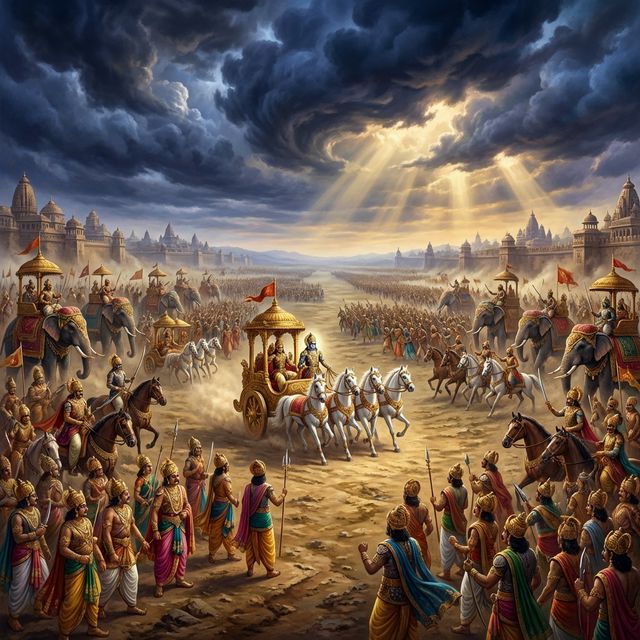
The Three Columns
At midday on the eighth day the Pandava army splits into three attacking bodies, Arjuna's son Iravan is killed, and Bhishma sends twelve warriors to pull Duryodhana out of the fire.
The Question the King Asked at Midday
The eighth day of the war was half gone when Sanjaya broke off his account, and the blind king in the hall at Hastinapur put a question to him that was not really a question about tactics.
"Beholding my sons, so many in number, O Sanjaya, slain by a single person, what did Bhishma and Drona and Kripa do in battle? Day after day, O Suta, my sons are being slain. I think that they are completely overtaken by evil destiny, inasmuch as my sons never conquer but are always vanquished."
Dhritarashtra then named the men who were supposed to prevent exactly this. Drona and Bhishma. The high-souled Kripa. Somadatta's heroic son. Bhagadatta. Ashwatthama. Other brave warriors whose names he did not trouble to say.
"When my sons, staying in the midst of those unretreating heroes, are being still slain in battle, what can it be said save the result of fate?"
Having laid the thing on fate, he laid it somewhere else in the very next breath.
"The wicked Duryodhana did not comprehend our words before, though admonished by me, O son, and by Bhishma and Vidura. Though forbidden always by Gandhari, too, from motives of doing him good, Duryodhana of wicked understanding awoke not before from folly. That conduct hath now borne fruit, inasmuch as Bhimasena, excited with wrath, despatcheth, day after day in battle, my insensate sons to the abode of Yama."
Sanjaya was the king's charioteer and reporter, and he had been listening to this king for a long time, and he did not let it stand where it had been put.
"Those excellent words of Vidura, uttered for thy good, but which thou didst not then understand, have now come to be realised. Vidura had said, restrain thy sons from the dice."
That was the whole of the charge, and it was aimed at the man who had asked the question and not at his son.
"Like a man whose hour is come refusing the proper medicine, thou didst not then listen to the words of well-wishing friends counselling thee. Those words uttered by the righteous have now been realised before thee. Indeed, the Kauravas are now being destroyed for having rejected those words, deserving of acceptance, of Vidura and Drona and Bhishma and thy other well-wishers. These very consequences happened even then, when thou declinedst to listen to those counsels."
Then he went back to the field, because that was his office and not his opinion.
"Hear now, however, to my narration of the battle exactly as it has happened."
The Army Divides in Three
At midday the battle became exceedingly awful and fraught with great carnage.
What Sanjaya had to describe from that hour was not a duel. It was an arrangement. Yudhishthira, the son of Dharma, gave one command, and the whole Pandava host moved at once, and it moved in three separate pieces, each with its own object.
The first column went at one man. Dhrishtadyumna and Shikhandi and the mighty car-warrior Satyaki, accompanied by their forces, proceeded against Bhishma alone. Virata and Drupada, with all the Somakas, rushed against Bhishma alone. The Kaikeyas, and Dhrishtaketu, and Kuntibhoja, equipped in mail and supported by their forces, rushed against Bhishma alone. The phrase is repeated three times in the account because the thing itself was repeated three times, army after army thrown at a single old archer who had been grinding them down since sunrise.
The second column went at the kings. Arjuna, and the sons of Draupadi, and Chekitana of great prowess proceeded against all the rulers fighting under Duryodhana's command, which was the largest and least glorious part of the Kaurava strength and the part that could actually be broken.
The third went at the brothers and the rest. The heroic Abhimanyu, and that mighty car-warrior the son of Hidimbi, and Bhimasena excited with wrath rushed against the other Kauravas.
Thus the Pandavas, divided into three bodies, began to slaughter the Kauravas. And similarly the Kauravas, in their turn, began to slaughter their foes.
Drona took the first column's flank. That foremost of car-warriors, excited with wrath, rushed against the Somakas and the Srinjayas, desirous of sending them to the abode of Yama, and loud cries of woe arose among the brave Srinjayas while they were being slaughtered by Bharadwaja's son with bow in hand. Large numbers of kshatriyas struck down by Drona were seen convulsing like persons writhing in the agony of disease. All over the field were continuously heard moans and shrieks and groans resembling those of persons afflicted with hunger.
And the mighty Bhimasena, excited with wrath and like unto a second Yama, caused a terrible carnage among the Kaurava troops.
There in that dreadful battle, in consequence of the warriors slaying one another, a terrible river began to flow whose billowy current consisted of blood. And that battle between the Kurus and the Pandavas, becoming fierce and awful, began to swell the population of Yama's kingdom.
The Field in Its Ornaments
Bhima went for the elephants.
He fell with great impetuosity upon the elephant division of the Kauravas and began to send many of them to the regions of Death. Struck with Bhima's shafts, some of those beasts fell down, some were paralysed, some shrieked in pain, and some ran away in all directions. Huge elephants, their trunks cut off and their limbs mangled, screaming like cranes, began to fall down upon the earth.
Nakula and Sahadeva fell upon the cavalry, and the twins did to the horses what their brother was doing to the tuskers. Many steeds with garlands of gold on their heads, their necks and breasts adorned with ornaments of gold, were seen to be slain in hundreds and thousands. The earth was strewn with fallen steeds. Some were deprived of their tongues, and some breathed hard, and some uttered low moans, and some were void of life.
Sanjaya said a strange thing then, and he said it twice. The earth looked beautiful with those steeds of such diverse kinds. At the same time she looked fiercely resplendent with a large number of kings slain by Arjuna in that battle.
Then he gave the inventory, because the beauty was in the inventory. Broken cars. Rent banners. Brilliant umbrellas. Torn chamaras and fans. Mighty weapons broken into fragments. Garlands and necklaces of gold, bracelets, heads decked with ear-rings, head-gears loosened from off heads, standards, the beautiful bottoms of cars, traces and reins.
Strewn with all of it, the earth shone as brightly as she does in spring when she is strewn with flowers.
That is the image the account leaves on the field at the height of the eighth day, and it is not offered as consolation. It is offered because a man watching from a height that afternoon would in fact have seen a plain covered in gold and colour, and would have had to come down to know what it was made of.
And the destruction ran both ways. It was thus, said Sanjaya, that the Pandava host suffered when Bhishma the son of Santanu, and Drona that foremost of car-warriors, and Ashwatthama, and Kripa, and Kritavarma were inflamed with wrath. And in the same way the Kaurava army suffered the same kind of destruction whenever the Pandava heroes were excited with rage.
Neither side, that hour, was doing anything to the other that was not being done back.
Horses Out of Every Country
Into that, on the Kaurava side, came the horsemen.
Shakuni the glorious son of Suvala rushed against the Pandavas, and so did Hridika's son Kritavarma of the Satwata race, that slayer of hostile heroes. And smiling as they came, they surrounded the Pandava army with a mass of cavalry that Sanjaya troubled to describe breed by breed, as a man describes wealth: the best of the Kamvoja stock, and those born in the country of the Rivers, and horses of Aratta and Mahi and Sindhu, and those of Vanayu that were white in hue, and lastly the horses of the hill countries, and others of the Tittri breed, exceedingly swift, fleet as the very winds.
Against that came another mass of horses, clad in mail and decked with gold, the foremost of their class, and at their head rode a young man most of that army had never seen.
His name was Iravan, and he was Arjuna's son.
The account stops the battle to say who he was, because he had not been raised among the Kurus and nobody there was likely to know him. His mother was a daughter of the king of the Nagas. Her first husband had been slain by Garuda, and she was left helpless and childless and of cheerless soul, and the high-souled Airavat bestowed her upon Arjuna, and Partha accepted her as she came to him. The boy was born of that, and his mother's wicked uncle cast him out from hatred of Partha, so he grew up in the region of the Nagas under her protection, handsome, strong, accomplished, of prowess incapable of being baffled.
When he heard that Arjuna had gone to the region of Indra, he went there. He stood before his father with joined hands and said, "I am Iravan. Blessed be thou, and I am thy son, O lord," and he reminded him of the circumstances of his meeting with his mother, and Arjuna recollected all of it exactly as it had happened and embraced him.
There was one instruction. "When the battle takes place, assistance should be rendered by thee."
"Yes," said Iravan, and went away, and now the battle had taken place, and he had come.
His horses, decked with ornaments of gold, of various colours and exceeding fleetness, coursed suddenly over the field like swans on the bosom of the vast deep.
The Sons of Suvala and a Man on Foot
The two cavalry masses met chest to chest.
Those steeds falling upon the Kaurava steeds struck their chests and noses against them, and afflicted by their own impetuous clash both sides suddenly fell down upon the earth, and the noise of it resembled what occurs at Garuda's swoop. The riders, dashing against one another, began to slay one another fiercely. Chargers escaping from the press ran wildly away over the field. Brave warriors, weakened by one another's shafts, their horses killed under them and themselves worn out with exertion, perished fast, sabring one another.
When both divisions were thinned and a remnant only survived, six younger brothers of Shakuni rode out of the Kaurava array to the van of battle. Gaya, Gavaksha, Vrishava, Charmavat, Arjava and Suka, mounted on excellent chargers that resembled the tempest itself in fleetness and in the violence of their dash, well-trained and neither old nor young. Those Gandhara warriors, clad in mail, skilled in battle, fierce in mien, desirous of heaven and longing for victory and filled with delight, broke into the Pandava cavalry and penetrated it.
Iravan watched them come in and turned to his own men, decked with diverse ornaments and weapons, and gave them the only order he is recorded as giving.
"Adopt such contrivances in consequence of which these warriors of Dhritarashtra, with their weapons and animals, may all be destroyed."
"Yes," they said, and set about it, and the sons of Suvala could not bear to watch their own men go down. They surrounded Iravan on all sides and commanded their followers to take him with lances, and swept over the field creating a great confusion.
Pierced with lances and bathed in the blood that trickled down his wounds, Iravan looked like an elephant pierced with the hook. Wounded deeply on the chest, on the back, on the flanks, one man against many, he did not swerve from his natural firmness. He tore the lances out of his own body and struck the sons of Suvala with them.
Then he unsheathed his polished sword, took up a shield, and got down off his horse to finish it on foot.
They were mounted and he was not, and still their fleet steeds could not bring them an opportunity to strike him. When they closed in to take him alive, he struck off their right and left arms with the sword and mangled their other limbs, and those arms adorned with gold fell down on the earth with the weapons still in them.
Only Vrishava, covered with wounds, got out of that alive.
The Rakshasa Who Could Be Reborn
Duryodhana looked at his uncle's brothers lying on the field and sent for a rakshasa.
Alambusha, the son of Rishyasringa, was a great bowman of terrible mien, versed in illusion, and he carried an old grudge against Bhimasena for the slaughter of Vaka. Duryodhana put the grudge to use.
"Behold, O hero, how the mighty son of Phalguni, versed in illusion, hath done me a severe injury by destroying my forces. Thou also art capable of going everywhere at will and accomplished in all weapons of illusion. Thou cherishest animosity also for Partha. Therefore, do thou slay this one in battle."
"Yes," said Alambusha, and went with a leonine roar.
He made two thousand illusive chargers ridden by terrible rakshasas armed with spears and axes, and Iravan's men killed all of them, and then the two were left facing each other with their forces gone, like Vritra and Vasava. Iravan cut the rakshasa's bow with his sword and cut each of his arrows into five pieces. Alambusha rose into the sky. Iravan, who could assume any form at will and knew where the vital parts of a body are, rose after him and cut his limbs into several pieces, again and again, and each time the rakshasa was reborn young, because with them illusion is natural and age and form are matters of will. Mangled with the axe, he poured forth blood in torrents and roared until the roars became deafening.
Then Alambusha assumed a prodigious and fierce form and reached out to seize the son of Arjuna, and Iravan called on his mother's people. A Naga of his mother's line came to him and assumed a huge form mighty as Ananta himself and covered the rakshasa in serpents.
Alambusha took the shape of Garuda and ate them.
That was all. With the Naga of his mother's line devoured through illusion, Iravan was confounded, and while he stood in that state Alambusha killed him with the sword and felled his head to the earth, the head decked with ear-rings and graced with a diadem, looking beautiful like a lotus or the moon.
The whole Kaurava host, said Sanjaya, was freed from grief.
Arjuna, somewhere in the second column, killing kings who were protecting Bhishma, did not know that the son of his loins had been slaughtered.
The Roar That Made the Earth Tremble
Ghatotkacha found out first.
He was Bhima's son by Hidimbi, a rakshasa on his mother's side and a Pandava on his father's, fighting in the third column with Abhimanyu, and when he saw Iravan slain he uttered a shout. The earth, with the ocean for her robes and with her mountains and her forests, began to tremble violently. The sky trembled and the quarters trembled, cardinal and subsidiary. The thighs and other limbs of the troops began to shake at the sound of it, and sweat came out on them, and every combatant on the Kaurava side became cheerless of heart. All over the field warriors stood still, like an elephant that has heard a lion.
Then he came on, roaring like thunder, in a terrible form, with a blazing spear upraised in his hand, surrounded by many bulls among rakshasas of fierce forms armed with diverse weapons, resembling the Destroyer himself at the end of the Yuga.
Duryodhana rode out to meet him.
That should be said plainly, because it is not the way he is usually remembered. His own troops were running from the rakshasa, and the king took up his bow with an arrow fixed on the string and went at Ghatotkacha, roaring like a lion himself. Behind him came the ruler of the Vangas with ten thousand elephants huge as hills, each with the juice of rut trickling down.
Ghatotkacha saw the elephant division rise on the field like a cloud and was highly inflamed with rage, and his rakshasas rushed at it, weapons in hand, uttering diverse roars like clouds charged with lightning. With arrows and darts and swords and long shafts, with spears and mallets and battle-axes and short arrows, and with mountain summits and large trees, they began to smite down that elephant host. Some of the beasts had their frontal globes smashed, some were bathed in blood, some had their limbs broken or cut through.
When the elephant host was broken and thinned, Duryodhana did not withdraw. He rushed upon the rakshasas under the influence of rage and became reckless of his very life, and sped clouds of sharp shafts at them, and slew many of their foremost warriors. With four shafts he killed four of the principal rakshasas, Vegavat and Maharudra and Vidyujihva and Pramathin, and then loosed showers of arrows on the rest that could with difficulty be resisted.
Beholding that feat of the king's, the mighty son of Bhimasena blazed up.
The Debt I Owe to My Sires
He drew his large bow, effulgent as the lightning, and rushed impetuously at Duryodhana like Death commissioned by the Destroyer, and the king did not shake at all.
With his eyes red in anger, Ghatotkacha spoke first, and what he said was not about the day's fighting.
"I shall today be freed from the debt I owe to my sires, as also to my mother, they that had so long been exiled by thy cruel self. The sons of Pandu were vanquished by thee in that match at dice. Drupada's daughter Krishna also, while ill and therefore clad in a single raiment, was brought into the assembly, and great trouble was given by thee in diverse ways, O thou most wicked, unto her. While dwelling also in her sylvan retreat, thy well-wisher, that wicked wight the ruler of the Sindhus, persecuted her further, disregarding my sires. For these and other wrongs, O wretch of thy race, I shall today take vengeance if thou dost not quit the field."
Then he drew his gigantic bow, biting his lower lip with his teeth and licking the corners of his mouth, and covered Duryodhana with a profuse shower, like a mass of clouds covering the breast of a mountain with torrents of rain in the rainy season.
The king bore it, said Sanjaya, as a gigantic elephant bears a shower out of the blue. Then, filled with anger and sighing like a snake, placed in a position of great danger, he shot five and twenty sharp arrows of keen point, and they fell on that bull among rakshasas like angry snakes of virulent poison on the breast of Gandhamadana. Blood trickled down Ghatotkacha's body and he looked like an elephant with rent temples.
Thereupon the cannibal set his heart upon the destruction of the Kuru king and took up a huge dart capable of piercing even a mountain, blazing with light, effulgent as a large meteor, flaming with radiance like the lightning itself, and raised it.
The ruler of the Vangas saw the dart go up. Bhagadatta drove his hill-sized elephant across the front of Duryodhana's car and shrouded the car completely with the animal's body.
Ghatotkacha's eyes went red, and he threw the dart at the elephant instead. Struck with it, the beast fell down covered with blood and in great agony and died, and the king of the Vangas jumped clear and landed on his feet.
Duryodhana looked at the dead prince of elephants and at his own troops giving way, and was filled with anguish. From regard for a kshatriya's duty, and from his own pride, though defeated, he stood firm like a hill.
Go Thither and Protect the King
He aimed a sharp arrow that resembled the Yuga fire in its energy and sped it at that wanderer of the night. Ghatotkacha, seeing it come blazing like Indra's bolt, baffled it by the sheer celerity of his movements, and then with his eyes red in wrath he shouted again.
Bhishma heard it from where he stood and went to Drona.
"These fierce roars that are heard, uttered by rakshasas, without doubt indicate that Hidimbi's son is battling with king Duryodhana. That rakshasa is incapable of being vanquished in battle by any creature. Therefore, blessed be ye, go thither and protect the king. The blessed Duryodhana hath been attacked by the high-souled rakshasa. Therefore, ye chastisers of foes, even this is our highest duty."
They went at once, and the list of who went is the measure of what one half-rakshasa was worth that afternoon. Somadatta. Valhika. Jayadratha. Kripa. Bhurisravas. Shalya. The two princes of Avanti with Vrihadvala. Ashwatthama and Vikarna. Chitrasena and Vivinsati. Drona himself, and many thousands of car-warriors behind them, all to rescue one man who had been hotly pressed.
Ghatotkacha watched that invincible division come and stood firm like the Mainaka mountain, a huge bow in his hand, his kinsmen around him with clubs and mallets and other weapons.
Then the battle began that made the hair stand on end. The twanging of bows was heard on all sides like the noise of burning bamboos, and the lances hurled by heroic arms looked, as they coursed through the sky, like darting snakes.
He took them in order.
With a crescent-shaped arrow he cut the preceptor's bow. With a broad-headed shaft he overthrew Somadatta's standard, and yelled. Three shafts into Valhika's chest, one into Kripa, three into Chitrasena. One arrow into Vikarna at the shoulder-joint, and Vikarna sat down on the terrace of his car covered with gore. Fifteen shafts at Bhurisravas that went through his armour and into the earth behind him. The chariots of Vivinsati and Ashwatthama struck so that both men fell forward and let go the reins. Jayadratha's standard with its device of a boar decked with gold cut down with one crescent-shaped shaft, and his bow cut with the next. Four shafts for the four horses of the king of Avanti. One well-tempered arrow into Vrihadvala, who sat down on his car deeply pierced.
Then, filled with great wrath, the prince of the rakshasas shot many bright arrows of keen point that resembled snakes of virulent poison, and those arrows succeeded in piercing Shalya, accomplished in battle as he was.
Twelve of the greatest warriors on earth had been sent to save Duryodhana, and every one of them was busy saving himself.
Dharma Lesson
Dhritarashtra asks what his commanders were doing, and Sanjaya answers by naming a conversation about dice that happened years before anyone drew a bow. The eighth day is the shape of that refusal working itself out: an army so pressed that it must be split three ways, a boy killed on a flank his father never reaches, and twelve of the finest warriors alive pulled off their own fights to keep one king breathing. Duryodhana stands firm like a hill when his elephants are broken, and the courage is real, and it is spent entirely on holding a position that should never have been taken.