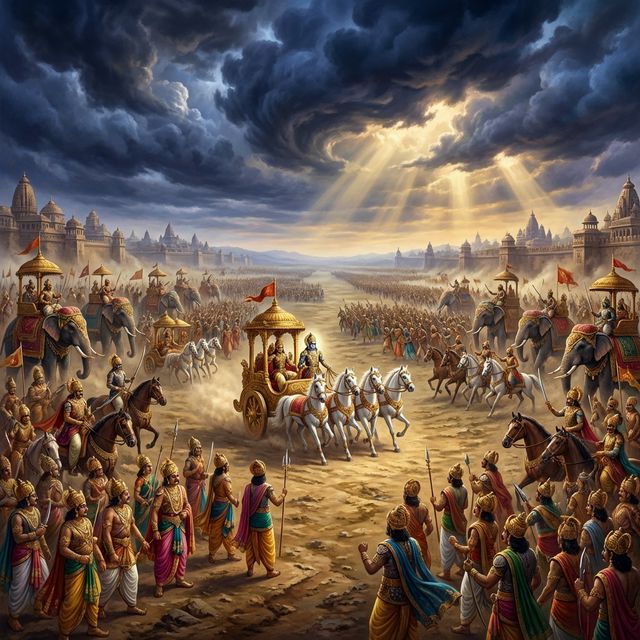
Ghatotkacha and the Javelin of Bhagadatta
Duryodhana asks to kill a Rakshasa, and a Rakshasa breaks a javelin on his knee
The King Comes to the Grandsire
Sanjaya said: the eighth day of the war ended badly for us, O king. Towards the hour of sunset your whole army broke and ran, routed by Ghatotkacha, and neither Bhishma nor I could hold them, though we both cried out at the top of our voices that what they were seeing was only Rakshasa illusion. They gave no credit to our words. They fled to their tents in all directions, and behind them the Pandavas blew their conches and beat their drums and reckoned the victory theirs.
When it was over, king Duryodhana went to Ganga's son. He approached him with humility and saluted him, and then he began to narrate everything that had happened, the victory won by Ghatotkacha and his own defeat, and while he told it he sighed again and again like a man who cannot get his breath.
"O lord," he said, "relying upon thee as Vasudeva has been relied upon by the foe, a fierce war has been commenced by me with the Pandavas. These eleven akshauhinis of celebrated troops that I have are, with myself, obedient to thy command, O chastiser of foes. O tiger among the Bharatas, though thus situated, I have been defeated in battle by the Pandava warriors headed by Bhimasena, relying upon Ghatotkacha. It is this that consumes my limbs like fire consuming a dry tree.
"O blessed one, I therefore desire, through thy grace, O grandsire, to slay Ghatotkacha myself, that worst of Rakshasas, relying upon thy invincible self. It behoves thee to see that this wish of mine may be fulfilled."
The Rakshasa he was asking permission to kill was his own cousin's son. Ghatotkacha was born to Bhimasena of the Rakshasa woman Hidimbi in the years of the forest, and he had come to Kurukshetra with his kinsmen to fight for his father, and on the eighth day he had emptied a Kaurava field by making every man on it believe he was already dead.
A King Striketh a King
Bhishma heard the request out, and what he said in answer was not about the Rakshasa at all. It was about where a king belongs in a battle.
"Listen, O king, to these words of mine that I say unto thee, O thou of Kuru's race, about the way in which thou shouldst always behave. One's own self, under all circumstances, should be protected in battle, O repressor of foes. Thou shouldst always, O sinless one, battle with king Yudhishthira the Just, or with Arjuna, or with the twins, or with Bhimasena. Keeping the duty of a king before himself, a king striketh a king."
That was the whole of the correction, and it was a rebuke wrapped in a rule. Duryodhana had asked to spend himself on the son of a Rakshasa woman. The grandsire told him that his own rank had a match on the other side of the field and that he had no business seeking any other.
Then he told him who would do the work instead.
"Myself, and Drona, and Kripa, and Drona's son, and Kritavarma of the Satwata race, and Shalya, and Somadatta's son, and that mighty car-warrior Vikarna, and thy heroic brothers headed by Dushasana, will all, for thy sake, battle against that mighty Rakshasa. Or if thy grief on account of that fierce prince of the Rakshasas be too great, let this one proceed in battle against that wicked warrior, that is to say, king Bhagadatta, who is equal unto Purandara himself in fight."
Bhagadatta was standing there. He was the ruler of the Pragjyotishas, an old king out of the eastern country, and he rode into battle on an elephant named Supratika. The grandsire, who was skilled in speech, turned and addressed him in the presence of the king, so that the charge was given where everybody could hear it.
"Proceed quickly, O great monarch, against that invincible warrior, the son of Hidimbi. Resist in battle, with care, and in view of all the bowmen, that Rakshasa of cruel deeds, like Indra in days of old resisting Taraka. Thy weapons are celestial. Thy prowess also is great. In days of old many have been the encounters that thou hadst with Asuras, O tiger among kings. Thou art that Rakshasa's match in great battle. Strongly supported by thy own troops, slay, O king, that bull among Rakshasas."
Bhagadatta set out with a leonine roar, facing the ranks of the foe.
The Elephant That Bore the Sea
They saw him coming like a mass of roaring clouds, and the great car-warriors of the Pandava army came out to meet him inflamed with wrath: Bhimasena, and Abhimanyu, and the Rakshasa Ghatotkacha, and the five sons of Draupadi, and Satyadhriti, and Kshatradeva, and the rulers of the Chedis, and Vasudana, and the king of the Dasarnas. Bhagadatta on Supratika rushed straight into the middle of them.
What followed increased the population of Yama's kingdom. Shafts shot from cars fell on elephants and on other cars. Huge elephants with rent temples, blind with the juice trickling down their bodies, came together fearlessly and drove their tusks into one another like men fighting with bludgeons. Horses with excellent tails, ridden by men with lances, went into one another at full gallop. Foot-soldiers went down by hundreds and thousands under darts and lances.
Bhagadatta came at Bhimasena through it, scattering thousands of arrows from the head of Supratika like Purandara himself on Airavata. The elephant had juice running down him in seven currents, so that he looked like a mountain with as many rillets flowing down its breast after a shower. The arrows fell on Bhima the way clouds fall on a mountain breast at the end of summer.
Bhima answered by killing the men. More than a hundred of them, the picked guards who protected the flanks and the rear of the elephant, went down under his arrowy showers, and Bhagadatta, seeing them lying there, urged his prince of elephants at Bhima's car, and the animal went like an arrow leaving a bowstring.
Then the ruler of the Dasarnas rode out to stop it on an elephant that was itself the size of a mountain, and Supratika took that charge and stood, the way the continent bears the rush of the surging sea. The Pandava troops applauded their own man's beast and cried out, "Excellent, excellent."
The king of the Pragjyotishas sped fourteen lances at it. They went through the excellent armour, decked with gold, that covered the animal, and entered its body like snakes entering anthills. Its fury quelled, that elephant turned with great force and fled shrieking, and crushed the Pandava ranks as it went, like a tempest going through trees.
The Javelin Broken on a Knee
They came back at him anyway, with Bhima at their head, shouting, throwing every kind of weapon they had. Bhagadatta was perfectly fearless. He urged his elephant with the hook and the toe, and the animal took on the form of the Samvarta fire that appears at the end of the yuga. It crushed crowds of cars, and other elephants, and steeds with their riders, and turned this way and that, and killed foot-soldiers by hundreds and thousands. That great force of the Pandavas shrank in dimensions, said Sanjaya, like a piece of leather held to the heat of a fire.
It was then that Ghatotkacha saw the array his father was standing in come apart, and rushed at Bhagadatta with his face blazing and his eyes red as fire.
He assumed a terrible form. He took up a bright dart capable of riving the very hills, and he hurled it with all his strength, and it went out flaming from every part of it, meant for the elephant.
Bhagadatta did not move his beast an inch. He sped one beautiful arrow with a crescent head at the thing coming toward him, and cut it in two in the air, and the dart, decked with gold, dropped in halves on the ground like the bolt of heaven flashing down through the welkin.
Then the old king took up a large javelin with a golden staff, bright as a flame of fire, and hurled it at the Rakshasa, and called out to him as he threw.
"Wait. Wait."
Ghatotkacha saw it coming at him like the bolt of heaven through the sky, and he did not cut it and he did not avoid it. He jumped up and caught it out of the air with his hands and gave one loud shout with it held over his head. Then he set it against his knee and broke it, in the very sight of all the kings.
All this seemed exceedingly wonderful. The celestials in the firmament, with the Gandharvas and the Munis, were filled with wonder at the sight of it, and the Pandava warriors headed by Bhimasena filled the earth with cries of "Excellent, excellent."
The javelin lay in two pieces on the field, and the man who had thrown it had to stand there and listen to them.
What the Old King Did With His Bow
Bhagadatta could not bear those shouts coolly. He drew his large bow, whose effulgence resembled that of Indra's bolt, and roared back at the car-warriors of the Pandava army, and while he roared he shot.
He pierced Bhima with one arrow and the Rakshasa with nine. He pierced Abhimanyu with three and the Kekaya brothers with five. With one straight arrow shot from a bow drawn to its fullest stretch he pierced the right arm of Kshatradeva, and the bow with the arrow already fixed on the string dropped out of that man's hand. He struck the five sons of Draupadi with five arrows. Then, from wrath, he killed the steeds of Bhimasena. With three shafts winged with feathers he cut down Bhima's standard, which bore the device of a lion. With three others he pierced Bhima's charioteer, and Visoka, who had driven that car since the war began, was so pained that he sat down on its terrace.
So Bhima, foremost of car-warriors, had no car. He jumped down from the useless vehicle and took up his mace and stood with it raised, looking like a crested hill, and all your troops, O Bharata, were filled with great fear at the sight.
That was the moment when the son of Pandu who had Krishna for his charioteer came up out of the fighting, killing the foe on all sides as he came, and found the place where father and son, Bhimasena and Ghatotkacha, those two tigers among men, were engaged with the ruler of the Pragjyotishas. Arjuna saw his brothers in that position and began at once to fight, scattering his shafts.
Duryodhana urged a whole division of cars and elephants toward him, and Arjuna of the white steeds went into it. Bhagadatta, still crushing the Pandava ranks on his elephant, turned and drove at Yudhishthira, and a fierce battle began between him and the Panchalas and the Srinjayas and the Kekayas with their weapons upraised.
And in the middle of all that, Bhimasena told Kesava and Arjuna in detail about the slaughter of Iravan, which had happened earlier that day, and which Arjuna had not yet heard.
Fie Upon That Wealth
Iravan was Arjuna's son by the Naga princess Ulupi, and he had been killed that morning by the Rakshasa Alambusha. Hearing of it, Dhananjaya was filled with great grief and sighed like a snake, and in the middle of the battle he spoke to Vasava's son of Vasudeva's line, who was holding his reins.
"Without doubt the high-souled Vidura of great wisdom had before seen with his mind's eye this awful destruction of the Kurus and the Pandavas. It was for this that he forbade king Dhritarashtra. In this battle, O slayer of Madhu, many heroes have been slain by the Kauravas, and many amongst the Kauravas have been slain by ourselves. O best of men, for the sake of wealth vile acts are being done. Fie upon that wealth for the sake of which such slaughter of kinsmen is being perpetrated. For him that has no wealth, even death would be better than the acquisition of wealth by the slaughter of kinsmen. What, O Krishna, shall we gain by slaying our assembled kinsmen?
"Alas, for Duryodhana's fault, and Shakuni's, and through the evil counsels of Karna, the Kshatriya race is being exterminated. I now understand that the king acted wisely when he begged of Suyodhana only half the kingdom, or, instead, only five villages. Alas, even that was not granted by that wicked-souled wight. Beholding so many brave Kshatriyas lying dead on the field of battle, I censure myself, saying fie upon the profession of a Kshatriya.
"The Kshatriyas will regard me powerless in battle. For this alone I am battling. Else, O slayer of Madhu, this battle with kinsmen is distasteful to me. Urge the steeds on with speed towards the Dhartarashtra army. I will, with my two arms, reach the other shore of this ocean of battle that is so difficult to cross. There is no time, O Madhava, to lose in action."
Kesava urged the white steeds on. The noise that rose then among your troops, O king, was like the noise of the ocean at full tide when the tempest is on it.
So the afternoon began, and the warriors paired off. Bhishma and Kripa and Bhagadatta and Susharma all went toward Dhananjaya. Kritavarma and Valhika rushed at Satyaki. Your sons surrounded Drona and went against Bhimasena. And king Amvashta placed himself in front of Abhimanyu.
The Wolf Among the Sons
Bhimasena, seeing your sons come, blazed up with wrath like fire that has been given clarified butter. They covered him with arrows from every side, the way clouds drench a mountain breast in the rains, and that hero, possessed of the activity of a tiger, licked the corners of his mouth.
Then he began.
He felled Vyudoroska with a sharp horse-shoe-headed arrow, and that son of yours was deprived of life. With another broad-headed shaft, well tempered and sharp, he felled Kundalin as a lion overthrows a smaller animal. Then, getting the rest of them within reach, he took up a number of well-tempered shafts and shot them with careful aim, and they carried your sons out of their cars: Anadhriti, and Kundabhedin, and Virata, and Dirghalochana, and Dirghavahu, and Suvahu, and Kanykadhyaja. Falling from their vehicles, said Sanjaya, those heroes looked like mango trees in the spring, variegated with blossoms, coming down.
Your other sons fled, regarding the mighty Bhimasena as Death himself.
Drona came in over the top of it and covered the man who was consuming your children with arrows from every side, pouring on him as clouds pour on a mountain. The prowess of Kunti's son that we beheld then was exceedingly wonderful, for though held in check by Drona he still went on killing your sons. As a bull bears a shower of rain falling from above, so Bhima cheerfully bore that shower of arrows shot by the preceptor.
Wonderful, O monarch, was the feat that Vrikodara achieved there. He slew your sons in that battle and resisted Drona the while.
The elder brother of Arjuna sported among those heroic sons of yours like a mighty tiger among a herd of deer. As a wolf standing in the middle of a herd will chase the deer and frighten them and not need to hurry, so did Vrikodara in that battle chase your sons and frighten them.
Meanwhile Ganga's son, and Bhagadatta, and Gautama, that mighty car-warrior, were holding Arjuna, and that Atiratha, baffling their weapons with his own, was sending the prominent heroes of your army to the abode of Death.
The Sword That Amvashta Threw
Abhimanyu was sixteen years old, and the king who had placed himself in front of him was a seasoned man, the ruler of the Amvashthas, reckoned among the renowned and foremost car-warriors of your army.
Subhadra's son took his car away from him with arrows. He cut it out from under him piece by piece until there was nothing left to stand on, and the king came down.
Deprived of his car and about to be slain by the celebrated son of Subhadra, that monarch jumped down in shame. He had lost his vehicle in front of the whole field, to a boy, and what he did with the shame was draw his sword and hurl it at the high-souled Abhimanyu. Then, being conversant with all the movements of battle, he ran and got up on the car of Hridika's son, Kritavarma, so that he was covered before the sword had finished its flight.
Abhimanyu saw the blade coursing towards him and baffled it by the sheer celerity of his own movements. He did not cut it and he did not shield himself. He was simply not where it arrived.
Loud cries of "well done, well done" were heard among the troops.
After that the battle stopped being anything that could be described in single combats. Dhrishtadyumna and the others went in against your troops, and your troops went in against theirs, and the engagement was fierce, and the combatants achieved the most difficult feats. Brave men seized one another by the hair and fought with their nails and teeth, with fists and knees and palms and swords and their well-proportioned arms. Seizing one another, they despatched one another to the abode of Yama. Sire slew son, and son slew sire.
Bows with golden staves lay loosened from the grasp of slain warriors. Shafts washed with oil and winged with pure gold and silver lay scattered like snakes that had cast off their slough. Swords with ivory handles, shields variegated with gold, bearded darts and axes and coats of mail, elephants' housings and yak tails and fans lay on the ground together, and men lay among them who looked alive though the breath of life had gone out of them.
Then the combatants were fatigued and routed and crushed, and dark night set in, and the battle could no longer be seen. Both the Kurus and the Pandavas withdrew their armies into that awful night of pitchy darkness and retired to their tents.
Lamps of Gold on the Way to a Tent
In the camp, king Duryodhana and Shakuni the son of Suvala and your son Dushasana and the invincible son of the Suta met and consulted together on one question: how could the sons of Pandu, with their followers, be vanquished in battle?
"Drona, Bhishma, and Kripa, and Shalya, and Somadatta's son do not resist the Parthas," Duryodhana said. "I do not know what the cause is of such conduct of theirs. Unslain by any of these, the Pandavas are destroying my forces. Therefore, O Karna, I am becoming weaker in strength, and my weapons also are being exhausted. Doubt fills my mind as to how I shall succeed in smiting them in battle."
Karna had an answer ready, and it was the answer of a man who had been waiting a week to give it.
"Do not grieve, O chief of the Bharatas. Even I will do what is agreeable to thee. Let Santanu's son Bhishma soon withdraw from the great battle. After Ganga's son will have withdrawn from the fight and laid aside his weapons, I will slay the Partha along with all the Somakas, in the very sight of Bhishma. I pledge my truth, O king. Indeed, Bhishma every day shows mercy towards the Pandavas. He is besides incapable of vanquishing those mighty car-warriors. Bhishma is proud of showing his prowess in battle. He is again very fond of fight. Why then will he vanquish the assembled Pandavas? Repair without delay to the tent of Bhishma and solicit that old and reverend signior to lay aside his weapons. After that, think the Pandavas as already slain, by myself alone."
Duryodhana told Dushasana to have everyone who walked in his train dressed without delay, and Dushasana set that tiger among kings upon his horse. Smeared with fragrant sandal-paste of the hue of the Bhandi flower, bright as burnished gold, in clean vestments, with a diadem on his head and bracelets on his arms, Duryodhana went along the streets of the camp with the sportive gait of a lion, and looked like the sun in the firmament.
His brothers walked behind him like the celestials walking behind Vasava. Men on horses and on elephants and on cars surrounded him. Attendants with head-gear decked with gold, carrying canes and Jhariharas, softly made the crowd give way. High-souled persons stood around him holding lighted lamps of gold fed with fragrant oil, so that the king moving among them looked like the moon attended by the blazing planets.
Bards praised him as he went, and he returned their regards with his right arm raised, and so he came to the quarters of the son of Ganga and got down off his horse.
Wordy Daggers, and the Guard at Dawn
He saluted the grandsire and sat down on an excellent seat of gold overlaid with a rich coverlet, and then, with his hands joined and his eyes bathed in tears and his voice choked, he said what he had come to say.
"Taking thy protection, O slayer of foes, we ventured to vanquish the very gods and the Asuras with Indra at their head. What shall I say, therefore, of the sons of Pandu? Therefore, O son of Ganga, it behoves thee to show me mercy. Slay the brave sons of Pandu like Mahendra slaying the Danavas. I will slay all the Somakas and the Panchalas and the Karushas along with the Kekayas, O Bharata, these were thy words to me. Let these words become true. If from kindness for the Pandavas, O king, or from thy hatred of my unfortunate self, thou sparest them, then permit Karna, that ornament of battle, to fight. He will vanquish the Parthas with all their friends and kinsmen."
Then he shut his lips and said nothing more.
Bhishma, deeply pierced with those wordy daggers, was filled with great grief, and did not say a single disagreeable word in reply. He sighed like a snake and reflected in silence for a long while. Then he raised his eyes, and looked as though he would consume the world with the celestials and the Asuras and the Gandharvas in his wrath, and spoke tranquilly.
"Why, O Duryodhana, dost thou pierce me thus with thy wordy daggers? I always endeavour to the utmost of my might to achieve what is for thy good. From desire of doing what is agreeable to thee, I am prepared to cast away my life in battle. The Pandavas are really invincible. When the son of Pandu gratified Agni in the forest of Khandava, having vanquished Sakra himself in battle, that is a sufficient indication. When the same son of Pandu rescued thee while thou wert being led away a captive by the Gandharvas, and thy brave brothers had all fled, and Radha's son with them, that is a sufficient indication. In Virata's city, alone he fell upon all of us united together. That is a sufficient indication. Vanquishing both Drona and myself excited with rage, he took away our robes. That is a sufficient indication. He defeated the Nivatakavachas, who were incapable of defeat by Vasava himself. That is a sufficient indication. Who is capable of vanquishing him who has for his protector the Protector of the Universe?
"In consequence of thy folly, O Suyodhana, thou knowest not what should be said and what should not.
The Wall of Chariots at Dawn
The man on the point of death beholds all trees to be made of gold. So thou also seest everything inverted. Having provoked fierce hostilities, fight now thyself. Let us see thee act like a man. As for me, I will slay all the Somakas and the Panchalas assembled together, avoiding Shikhandi alone. He was born in Drupada's palace as a female at first, and became a male by the grant of a boon, and after all he is Shikhandini. Him I will not slay even if I have to lose my life. Pass the night in happy sleep, O son of Gandhari. Tomorrow I will fight a fierce battle about which men will speak as long as the world lasts."
Duryodhana bowed his head and went back to his own tent and passed the night there. But he had heard what was inside the promise, and lying awake he understood from the signs that Ganga's son was thinking of an encounter with Arjuna, and had begun to speak like a man deprecating the status of a servant.
When the night dawned he ordered the forces drawn up, and he called Dushasana.
"Let cars be quickly appointed for protecting Bhishma. Let all the two and twenty divisions be urged on. In this matter I think the protection of Bhishma is our foremost duty. Protected by us, he will protect us and slay the Parthas in battle. He said to me, I will not slay Shikhandini, she was a female before and should be avoided by me in battle. The very wolf may slay the lion left unprotected in the great forest. Let not Ganga's son be slain by Shikhandi like the lion slain by the wolf. Let our maternal uncle Shakuni, and Shalya, and Kripa, and Drona, and Vivingsati carefully protect the son of Ganga. If he is protected, our victory is certain. Yudhamanyu protects the left wheel of Arjuna's car, and Uttamaujas his right, and Arjuna protects Shikhandi. Adopt such steps, O Dushasana, that Shikhandi may not be able to slay Bhishma left unprotected by us."
So they surrounded Ganga's son with a large division of cars and went out to battle with him in the van, shaking the earth and the sky, and took up their positions around him as the celestials once stood round the wielder of the thunderbolt in the war with the Asuras.
Across the field, Arjuna looked at that wall of chariots closing about one old man, and spoke to the prince of Panchala.
"O prince, place that tiger among men, Shikhandi, today in front of Bhishma. I myself will be his protector."
Dharma Lesson
Bhishma tells Duryodhana that a king should strike a king, and the rule is not snobbery but a warning: a man who spends himself on the enemy he most resents has stopped fighting the war and started nursing an injury. Duryodhana cannot hear it. He goes away and asks a second time by another road, at night, with lamps and bards around him, and what he asks for is that the old man either kill everyone or step aside. The reply he gets is a list of things Arjuna has already done, and a promise to fight anyway, which is what obedience looks like when it has stopped being belief.