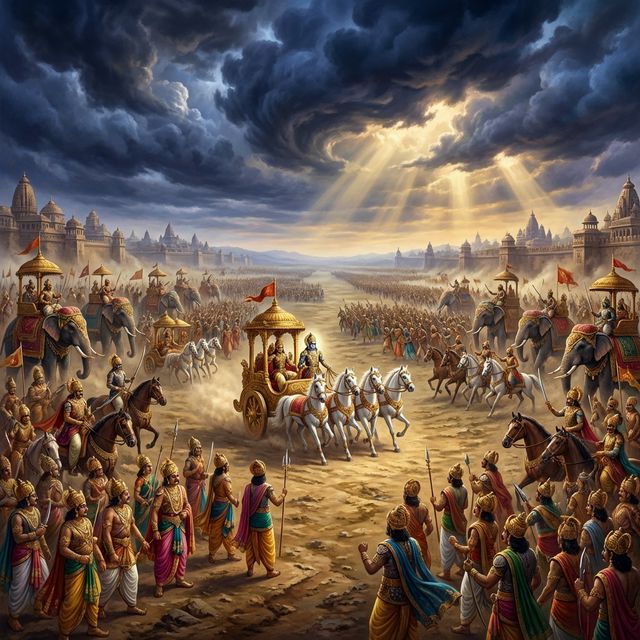
The Shield Around Bhishma
Ninth day: Satyaki trades darts with the grandsire, Abhimanyu unhorses Chitrasena, and Duryodhana orders a wall of men built round Bhishma
Sanjaya Tells the Ninth Afternoon
Sanjaya had come back from the field again, and the blind king in Hastinapura wanted the ninth day of the war told to him the way the other eight had been told, in order, with nothing left out.
"O tiger among men," Sanjaya said, "Arjuna sent those Kshatriyas that followed Susarman to the abode of the King of the Dead by means of his whetted shafts."
Susarman was the ruler of the Trigartas, the king who had sworn with his brothers to fight Arjuna until one side or the other was finished, and on that afternoon he was keeping his oath badly. He pierced Partha with his shafts. He pierced Vasudeva, who was driving, with seventy. He pierced Arjuna once more with nine. Arjuna checked all of it with his arrowy showers and then went through the Trigarta troops as Death goes through the world at the end of a yuga, and the men behind Susarman broke.
Sanjaya described the breaking carefully, because it is the same every time and the king had not seen it. Some abandoned their steeds. Some abandoned their cars. Some left their elephants standing and ran. Others took horse and elephant and car with them and fled at speed, and the foot-soldiers threw their weapons down in that dreadful battle and went off in every direction without any regard for one another. Susarman forbade them. Other foremost of kings forbade them. They did not stay.
"Beholding that host routed," said Sanjaya, "thy son Duryodhana himself, at the head of the whole army and with Bhishma ahead, attacked Dhananjaya with all his vigour, for the sake of the life of the ruler of the Trigartas."
That was the shape of the hour. Duryodhana stayed in the battle scattering diverse kinds of arrows with all his brothers behind him, and every other man on that wing had fled. And the Pandavas, clad in mail, went the other way for the sake of Phalguni, straight toward the place where Bhishma was.
They knew perfectly well what the wielder of Gandiva could do without them. They went anyway, with loud cries, and surrounded the grandsire on all sides.
The Palmyra Banner at Noon
Then the palmyra-bannered hero covered the Pandava army with his straight shafts.
The palmyra tree on a golden field was Bhishma's device, and after eight days every man on that plain could find it in the dust without being told. The sun reached the meridian while they were closing on him, and after that, Sanjaya said, the Kauravas fought with the Pandavas in one confused mass. There were no wings any longer and no formation to speak of. There were only the duels that men found in front of them.
The heroic Satyaki, of the Satwata race, pierced Kritavarma with five arrows and stayed where he was, scattering his arrows by thousands. Kritavarma was a Vrishni too, a kinsman out of the same city, and he had come to this war on the other side with the Narayana troops that Duryodhana had asked for instead of Krishna. The two of them had been at each other for eight days without a decision.
King Drupada found Drona, which surprised nobody who knew the two of them, and pierced that bull among Brahmanas with many whetted shafts, and then with seventy more, and put nine into his charioteer.
Bhimasena went for the oldest man on the field. Valhika was his great grandsire, brother of Santanu, an old king who had lived long enough to see his own house divided and had chosen the wrong half of it, and Bhima pierced him and then uttered a loud roar like a tiger in the forest, and did not sound at all like a man who regretted the arrow.
Sanjaya gave these three in a row, without comment, the way he gave everything. A Vrishni against a Vrishni. A king against the teacher who had taken half his kingdom. A grandson roaring over a great-grandfather.
And in the middle of all that, a boy of sixteen found somebody his own size.
Venus and Saturn
Chitrasena was one of Dhritarashtra's hundred, a great bowman among the brothers and a car-warrior of standing, and he had picked out Arjuna's son.
He pierced Abhimanyu with many shafts first. The son of Subhadra took them, came back, and drove three arrows deep into Chitrasena's chest, and then the two of them stood to it and would not give ground, and the men around them stopped to watch.
Engaged with each other in battle, Sanjaya said, those two foremost of men looked resplendent on the field like the planets Venus and Saturn in the firmament.
It is worth pausing on the image, because Sanjaya chose it and Sanjaya was not a man who reached for ornament. Venus is the bright one, the evening star, the planet everybody can find. Saturn is the slow one, the heavy one, the planet that men watch with unease. He is saying that these two burned steadily in one quarter of the sky while everything else on that field was smoke and running, and that anyone looking up could see them both.
The boy ended it. That slayer of foes, the son of Subhadra, slew his antagonist's steeds and his charioteer with nine arrows, and then uttered a loud shout, which is the one detail that gives away how young he was. Sixteen years old, in the ninth day of the greatest war ever fought, and he had beaten a grown prince of the Kuru house in single combat, and he shouted about it.
Chitrasena did the only sensible thing left to him. That mighty car-warrior jumped down quickly from the car whose steeds had been slain, and without delay mounted the car of Durmukha, another of his brothers, who was fighting nearby.
Then Drona, who had been looking for a way to help, pierced Durmukha's charioteer.
Two brothers on one chariot with a wounded driver, in front of Subhadra's son. That was the state of that corner of the field when the grandsire's part of the battle pulled everything back into itself.
Two Old Men Leave the Field
Drupada broke first, and the reason he broke is the oldest quarrel in the epic.
He was afflicted at the head of his own troops, with Drona in front of him and no way through, and Sanjaya says exactly what went through his mind: he retreated by the aid of his fleet steeds, recollecting the hostility that existed from days of old. That is the whole history in a clause. Two boys in an ashrama who promised to share everything. A poor Brahmana who came to a king's court to collect on the promise and was laughed out of it. A war fought to take half of Panchala away from him and give it to the teacher. A sacrificial fire lit afterwards, and a son born out of it whose only purpose was to kill Drona.
The son, Dhrishtadyumna, was somewhere else on that field commanding the army. The father, who had lit the fire, turned his horses and went, because a man may hate another man for thirty years and still know what will happen if he stays where he is standing.
Bhimasena, within a moment, deprived king Valhika of his steeds, his car and his charioteer, in the very sight of all the troops.
There was no duel in it and no exchange worth the name. One rush, and the old king was standing on a wrecked chariot with nothing under him. Fallen into a situation of great danger and with fear in his heart, Valhika, that best of men, jumped down from that vehicle and quickly mounted upon the car of Lakshmana, Duryodhana's son, who happened to be within reach.
So the oldest man in the Kuru house rode out of that quarter of the battle on the chariot of the youngest prince of it, and both of them would be dead before the war ended, and the great-nephew who had unhorsed the one and the uncle who would kill the other went on fighting without looking back.
Sanjaya reported it in two sentences and moved on, because the grandsire had begun to be dangerous again.
The Two Darts
Satyaki, having checked Kritavarma, left him and went to find Bhishma.
He fell upon the grandsire and rained on him shafts of diverse kinds, sixty whetted shafts winged with feathers, and Sanjaya says that while he was doing it he seemed to dance on his car, shaking his large bow. He was the best of the Vrishni bowmen, a pupil of Arjuna, and he fought like a man who was enjoying himself even here.
Bhishma answered him with a dart.
It was made of iron and decked with gold, endued with great velocity, and beautiful, Sanjaya said, as a daughter of the Nagas. The serpent people are described in the epic as the most beautiful of all beings and the most deadly, and that is what an old man threw at Satyaki across the ninth day of the war.
Beholding that irresistible thing coursing toward him like Death himself, the illustrious warrior of the Vrishni race baffled it by the celerity of his movements. He simply was not where it arrived. The fierce dart, unable to reach him, fell down on the earth like a large meteor of blazing splendour, and the grass burned where it landed.
Then Satyaki took up his own dart of golden effulgence with a firm hand, and hurled it at the car of the grandsire.
Hurled with the strength of Satyaki's arms, it coursed impetuously, said Sanjaya, like the fatal night coursing speedily toward a doomed man. There was no swerving from it and nothing to be done about it, and every man watching knew what was on the other end of its flight.
Bhishma cut it in twain in the air with a couple of horse-shoe-headed arrows of keen edge, and the two halves fell on the earth.
Having cut that dart, the grinder of foes, Ganga's son, excited with wrath and smiling the while, struck Satyaki in the chest with nine arrows.
The smile is the thing to keep. Then the Pandava warriors came in with their cars and elephants and steeds and surrounded Bhishma on every side, for the sake of rescuing him of Madhu's race, and the battle closed over the two of them again.
It Is Thy Duty to Protect That Illustrious One
Duryodhana had been watching from the place where the palmyra banner stood.
Bhishma was excited with wrath and surrounded on all sides by the Pandavas, and Sanjaya gave the king the picture he had made of it: like the Sun in the firmament covered by the clouds at the end of summer. The sun is not put out by them. It is only that nobody can see it, and nobody can be sure.
Duryodhana turned to Dushasana.
"This heroic and great bowman Bhishma, this slayer of heroes, hath, O bull of Bharata's race, been surrounded on all sides by the brave Pandavas. It is thy duty, O hero, to protect that illustrious one. Protected by us in battle, our grandsire Bhishma will slay all the Panchalas along with the Pandavas. The protection of Bhishma, therefore, I think, is our highest duty, for this great bowman of his vows is our protector in return. Therefore, surrounding the grandsire with all our troops, do thou protect him, who always achieveth the most difficult feats in battle."
It is the plainest speech Duryodhana makes in the whole of the Bhishma Parva, and there is no cunning anywhere in it. He had spent eight days accusing the old man of fighting softly. Now he had looked at the field and understood that the eighth of his army standing round that one chariot was the only thing between his house and the end of it, and he said so, in front of his brother, without embellishment.
Thus addressed, Dushasana surrounded Bhishma with a large force on all sides and took up his position.
Then Suvala's son Shakuni came out with hundreds and thousands of horsemen, bright spears and swords and lances in their hands, a proud, well-dressed and strong body bearing standards, mingled with excellent foot-soldiers all well-trained and skilled in battle, and he began to check Nakula and Sahadeva and Yudhishthira, surrounding those foremost of men on all sides.
The gambler was fighting. Not with dice, and not through anybody else, and his cavalry was very good.
Ten Thousand Horse, and the Sun Going Down
Then Duryodhana despatched ten thousand more brave horsemen against the Pandavas.
They rushed like so many Garudas, and the earth, struck with their hoofs, trembled and uttered a loud noise like a large forest of bamboos burning on a mountain. Dust went up to the welkin and shrouded the very Sun, and the Pandava army was agitated the way a large lake is agitated when a flight of swans suddenly comes down on its bosom, and for a time nothing could be heard over the neighing.
Three men stopped that charge.
King Yudhishthira and the two sons of Pandu by Madri checked it, Sanjaya said, like the continent bearing the force of the surging sea at full tide, swollen with the waters of the rainy season. Then those three car-warriors, with their straight shafts, cut off the heads of the horse-riders. Slain by those strong bowmen they fell on the earth like mighty elephants tumbling into mountain caves. All over the ground steeds were seen fallen or falling with their riders, deprived of life, and what was left of the ten thousand fled the way small animals flee at the sight of the lion.
The Pandavas blew their conches and beat their drums.
Duryodhana, filled with grief at the sight of his troops vanquished, went to the ruler of the Madras.
"There, the eldest son of Pandu, accompanied by the twins in battle, in thy very sight, O thou of mighty arms, routeth our troops. O mighty-armed one, resist him like the continent resisting the ocean. Thou art exceedingly well-known as possessed of might and prowess that are irresistible."
Shalya was the twins' own uncle, their mother's brother, tricked into this army on the road to the war, and he went where he was sent with a large body of cars.
Yudhishthira met that host as a shore meets a wave, and put ten shafts into the centre of Shalya's chest, and Nakula and Sahadeva struck him with seven straight shafts. Shalya struck each of the three with three arrows, then pierced Yudhishthira with sixty sharp-pointed ones, and excited with wrath put two more into each of the sons of Madri.
Bhima saw his eldest brother standing within reach of Shalya's car as if within the very jaws of Death, and went to him.
Then, when the Sun, having passed the meridian, was sinking, there commenced a fierce and terrible battle on that part of the field.
Dharma Lesson
Duryodhana spent eight days doubting whether Bhishma was fighting hard enough for him, and on the ninth he told his brother that guarding the old man was the highest duty the army had. Protection given late and out of fear is still protection, but it changes what the protected man is: Bhishma stops being the commander of this army in that moment and becomes the thing it is built around. Satyaki and Abhimanyu, meanwhile, show what the field looked like where nobody was guarded, and both of them came off better for it.