The Hand That Rose From the Grass
Bhishma's own memory of Shantanu's shraddha at the gate of Ganga
A Question About Gold
"Grandsire," said Yudhishthira, "you have discoursed to me on the gift of kine, which is fraught with great merit, and you have said that in the case of kings observant of their duties it is the most meritorious gift of all. Sovereignty is always painful. It cannot be borne by a man of uncleansed soul. In the generality of cases kings fail to reach any auspicious end, and by always making gifts of earth they succeed in cleansing themselves of what they have done."
"You are working up to something," said Bhishma.
"I am. You told me of the gifts of kine that King Nriga made in days of old. The rishi Nachiketa in ancient times discoursed upon the merit of that act. The Vedas and the Upanishads have laid it down that in all sacrifices, in fact in every kind of religious act, the dakshina should be earth, or kine, or gold. But the Srutis declare that of all dakshinas gold is superior and is indeed the best. Why?"
The old man did not answer at once.
"What is gold?" said Yudhishthira. "How did it spring up? When did it come into existence? What is its essence? Who is its presiding deity? What are its fruits? For what reason do men of wisdom applaud the gift of it above every other, and why is it held a cleanser superior even to earth and to kine? Discourse to me on all of this, grandsire."
"I will," said Bhishma. "Listen with a concentrated mind and I will recite the circumstances of the origin of gold as I understand them. But I will begin somewhere else, because I have never told this to anybody, and I find that I would like to have told it before I go. It is about my father, and a shraddha, and a hand that came up out of the ground."
The brothers looked at one another. In all the days of the teaching he had given them law, history, the duties of kings and the duties of the dying, and he had given them almost nothing of his own life.
When Shantanu Departed From This World
"When my father Shantanu of great energy departed from this world," said Bhishma, "I was the only one of his household who was fit to do anything at all.
"Satyavati was a widow with two boys, and the elder of them, Chitrangada, was not yet of an age to sit in the hall without being told when to speak. I had already given away my right to the throne and my right to a son, standing in a fisherman's boatyard, for the sake of that marriage, and the gods had rained flowers on me for it and called me Bhishma, and none of that is of the smallest use to a man in a house where somebody has just died. What is of use is knowing the order of the rites.
"So I did what the eldest son does. I saw to the burning. I saw to the ten days. And when the time came for the shraddha, the offering by which the dead man is joined to his fathers and given a body among them, I did not perform it in the city.
"I proceeded to Gangadwara, the gate of the Ganga, where the river comes down out of the hills and turns towards the plain. That is where our family goes. It is the door of my mother's house."
"You went alone?" said Bhima.
"I went as the son of Shantanu goes anywhere, with a hundred people and no company. And I will tell you what I was thinking on the road, since I am telling the rest of it. I was thinking that I had spent my whole life giving that man things. My birth, my mother, my crown, my marriage, my sons that were never born. And here was one more thing to give him, and it would be the last, and I intended to do it perfectly."
My Mother Came to Help Me
"Arrived at Gangadwara, I commenced the shraddha of my father," said Bhishma. "And my mother Jahnavi, coming there, rendered me great help."
He stopped. Nobody filled the silence.
"You may imagine what you like about that," he said. "I will tell you only what happened. The river came up the bank in the form of a woman and stood where a woman of the house stands at a shraddha, on the left of the man making the offering, and she did the things that are done. She carried water. She saw that the seats were straight. When one of the older ascetics could not lower himself easily she put her hand under his elbow.
"She had drowned seven of my brothers in that same water before I was a month old, and she had taken me away and given me back grown, and she had left my father because he spoke one word too many, and he had never stopped looking at the river as long as he lived. All of that is true, and all of it was in the air between us, and she said none of it.
"She said, 'Are the cakes made?'
"I said they were.
"She said, 'Then do not hurry. He has waited longer than this.'
"That is the whole of the conversation I had with my mother on the day I performed my father's shraddha. I have thought about it for a great many years. I think she came because a shraddha requires the family, and whatever she was, she was the family, and there was nobody else standing."
The Ascetics Seated, the Water Poured
"I invited many ascetics crowned with success," said Bhishma, "and caused them to take their seats before me.
"You have not seen a shraddha done as it should be done, and you will have to do them for me, so attend. It is not a ceremony of grief. Grief is the day before and the year after. The shraddha itself is a piece of exact work, like laying a foundation, and it is done by a man with dry eyes and clean hands or it is not done.
"The brahmanas who are fed at it stand in the place of the fathers. So you do not invite whoever is at hand. You invite men crowned with success, men whose austerities have made them fit to be sat down in a dead man's chair. I invited such men and I seated them myself, and I looked at each face as I seated it and thought, this one is my grandfather now, and this one is his father.
"Then, with a concentrated mind, I performed all the preliminary rites as they are laid down in the scriptures. Gifts of water first, poured into the hands. Then the other things in their order, the seat, the perfume, the flowers, each with the words that belong to it. Nothing was hurried and nothing was skipped, and my mother moved behind me with the vessels, and the ascetics ate.
"And then I set myself to duly offer the obsequial cake.
"For that, kusa grass is spread upon the ground. The cake is not given into any hand. It is placed upon the blades. I spread the grass myself. I remember the sound of it, that dry rustle, and the smell of the river, and the fire going quietly beside me, and I took up the cake of my father."
The Arm
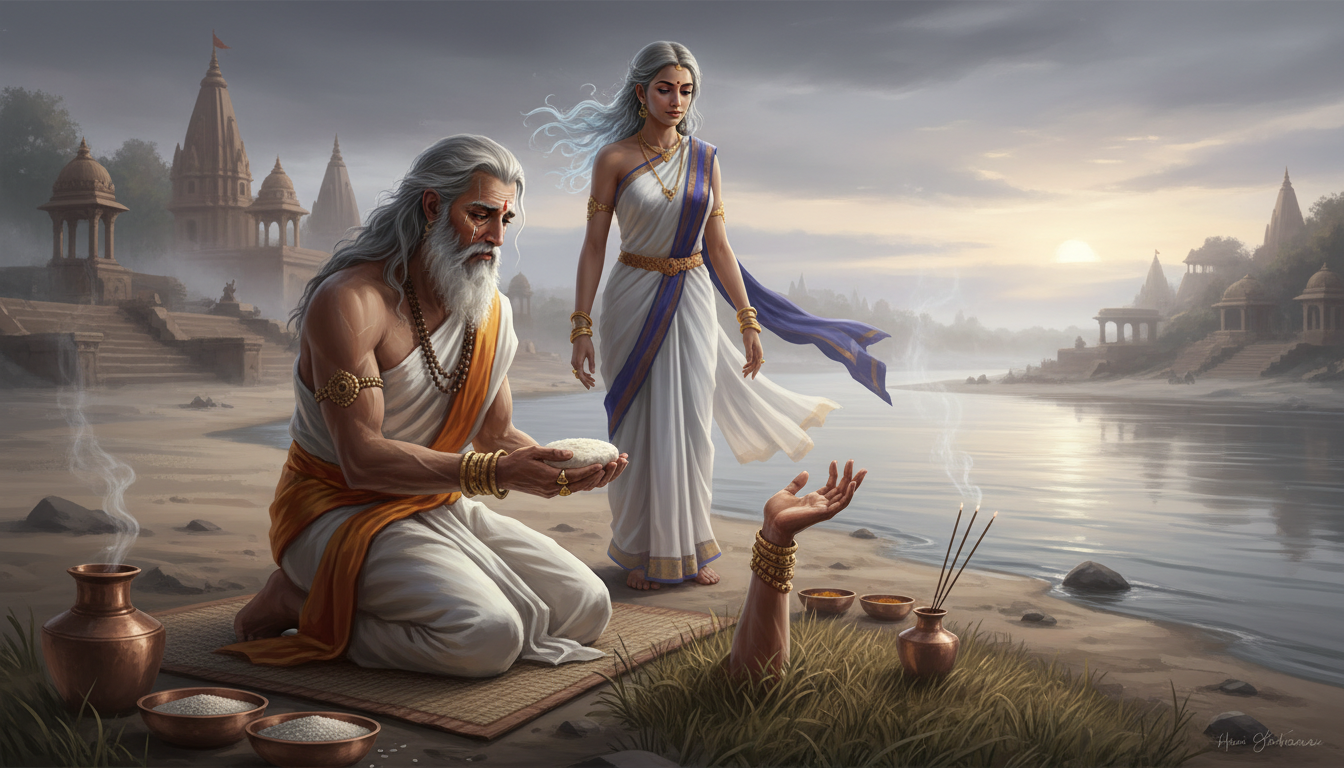
"I then saw, O king, that a handsome arm rose up out of the ground.
"It came up through the blades of kusa grass that I had spread, piercing the earth as a shoot pierces it, and it was adorned with Angadas and with other ornaments, and it was open, and it was waiting.
"I have been on a good many fields since then and I have seen a great many things that men are not supposed to see. Nothing has ever emptied me the way that arm did. Beholding it rise from the ground I became filled with wonder, and under the wonder, before any thought at all, there was a movement in me like a boy running.
"Because I knew the arm. I had watched that arm come across a table for a cup ten thousand times. I knew the two armlets on it and where he had got them and which of them he preferred. Whatever else may be doubted about that morning, this is not: it was my father's hand, and it had come up out of the earth for the cake, and it was held out to me the way a hand is held out to a son.
"Indeed, chief of Bharata's race, I thought that my father had come himself, to accept from me the cake I was about to offer."
He was quiet for a moment.
"You must understand that I wanted to give it to him," said Bhishma. "I want that recorded. I have never wanted anything so much in my life."
Reflecting by the Light of the Scriptures
"And then, standing there with the cake in my two hands and my father's arm open in front of me," said Bhishma, "I reflected by the light of the scriptures, and the conviction came upon me.
"The ordinance does occur in the Vedas that the cake should not be presented into the hand of him whose shraddha is being performed. This was the conviction that took possession of my mind, and I will state it to you as it stated itself to me, because you will all have to think it one day at the edge of a river with somebody you love in front of you. The obsequial cake should never be presented in this world by a man into the visible hand of the man whose obsequial rites are being performed. The Pitris do not come in their visible forms for taking the cake. On the other hand, the ordinance provides that it should be presented upon the blades of kusa grass spread on the earth for that purpose.
"Now weigh the two things. On one side an arm I had known since I could walk, my father, present, asking. On the other side a rule about grass.
"It is easy to say from a distance that the rule is obviously right. Stand there and see how it feels. Every good instinct a son has was pulling my hands forward. Love said, give it to him. Pity said, he has come all this way. Even piety said it, in the voice piety uses when it wants something: what is a rule beside a father?
"But I had been taught what the rule is for. The fathers are not to be fed as guests are fed. They are past hands. If the dead may take the cake from the living hand, then the shraddha is a meal and not a rite, and every man after me will look for an arm and grieve when none comes, and the ordinance by which the fathers are actually reached will be broken in the very act of appearing to succeed."
He Set It on the Grass
"So I disregarded that hand, which was an indication of my father's presence," said Bhishma, "and recollecting the true ordinance, which depends upon the authority of the scriptures, respecting the mode of presenting the cake, I offered the entire cake upon those blades of kusa grass that were spread before me.
"The entire cake. Not a portion into the hand as a courtesy and the rest on the grass. That would have been the coward's arrangement, and there were witnesses standing there who would have understood exactly what I was doing and thought better of me for it. I put all of it down on the ground, six inches from my father's open palm, and I did not touch the hand.
"Know, prince of men, that what I did was perfectly consistent with the scriptural ordinance.
"After this, the arm of my sire vanished in our very sight. It did not close. It did not withdraw the way a man withdraws a hand that has been refused. It sank back through the grass the way water goes into sand, and the blades came up again where it had been, and there was nothing there, and the smell of the river was the same, and the ascetics were watching me and none of them said a word.
"I finished the rite. I gave what remained to be given. I saw the brahmanas satisfied and sent away with what was due to them, and my mother went back down the bank into her own water without any farewell, which is her habit. And then I lay down that night believing, as steadily as I have ever believed anything, that I had refused my father at the last opportunity anyone would ever have to give him anything."
The Fathers Come in a Dream
"On that night, as I slept, the Pitris appeared to me in a dream," said Bhishma. "They were gratified with me, and they said these words.
"'We have been pleased with you, chief of Bharata's race, for the indication you have afforded today of your adherence to the ordinance. It has pleased us to see that you have not swerved from the injunctions of the scriptures. The scriptural ordinance, having been followed by you, has become more authoritative, O king. By such conduct you have honoured and maintained the authority of yourself, of the scriptures, of the auditions of the Vedas, of the Pitris and the Rishis, of the Grandsire Brahman himself, and of those seniors the Prajapatis. Adherence to the scriptures has been maintained. You have today, chief of the Bharatas, acted very properly.'
"Attend to what they say and to what they do not say. They do not say, we forgive you. They do not say, your father was disappointed but has been consoled. They say the ordinance has become more authoritative, which is the only kind of gift the dead actually receive from us. A rite is not a wire that carries food to a particular hungry man. It is a road, and every man who walks it exactly makes it a little more of a road for everyone coming after.
"Then they said the rest, and this is where your question comes back.
"'You have made gifts of earth and kine. Do you now make gifts of gold. The gift of gold is very cleansing. Know, you who are well conversant with duties, that by such acts of yours both ourselves and our forefathers will be cleansed of all our sins. Such gifts rescue both the ancestors and the descendants of the man who makes them, to the tenth degree.'"
What He Learned Standing Still
"I then awoke, O king, and became filled with wonder," said Bhishma. "And I set my heart upon making gifts of gold, and I have made them all my life, and that is the true reason you have seen so much gold go out of the Kuru treasury in my time, and not the reason the treasurers give.
"But I did not tell you the story for the gold. I told it because you are going to be a king, and a king spends his life being asked to break a good rule for a good reason by somebody he cannot bear to refuse.
"It will not usually be an arm out of the ground. It will be a brother who wants a command he is not fit for. It will be a rite shortened because the army is waiting. It will be a man you love standing in front of you with his hand out, and every decent feeling you have pushing you to put the thing into it, and the ordinance saying, on the grass.
"Love that breaks the rite serves nobody. Not the dead, not the living, not the man who breaks it. I gave my father the only thing he had come for, and what he had come for was to see whether his son would refuse him."
Yudhishthira said, after a while, "And if the dream had not come?"
"Then I would have gone the rest of my life thinking I had failed him," said Bhishma, "and I would have done exactly the same thing again. That is what it means to keep an ordinance. You do not get the dream first."
And Now, the Gold
"Now listen, monarch, to this old history," said Bhishma, "for you asked about gold and I have kept you waiting a long time for it. It is highly praiseworthy, and it extends the life of the man who listens to it.
"It was first recited to Rama, the son of Jamadagni. In former days that Rama, filled with great wrath, exterminated the kshatriyas from off the face of the earth thrice seven times. Having subjugated the entire earth, the heroic one of eyes like lotus petals began to make preparations for a horse sacrifice, which is praised by brahmanas and kshatriyas alike and is capable of granting the fruition of every wish. That sacrifice cleanses all creatures and enhances the energy and splendour of those who succeed in performing it. Endued with great energy, Rama by the performance of it became purified.
"And having performed that foremost of sacrifices, the high souled Rama found that he was not yet clean. What he did then, and what he was told about gold, and where gold came from before there was any earth to dig it out of, is the answer to the question you asked me this morning."
He shifted on the arrows, which he could still do, a little.
"Sit down properly," he said. "It is a long one, and I would rather not begin it twice."
Dharma Lesson
Love that breaks the rite serves nobody, least of all the one it means to serve. The son who kept the ordinance against his own father's outstretched hand gave the fathers the only offering they had actually come for, because a rite is not a wire carrying food to one hungry man but a road that every exact performance makes more of a road. And the ordinance must be kept before the dream comes, not after.