Where Do the Thieves Go
Yudhishthira had been quiet for some while on the field at Kurukshetra, watching the old man breathe between the arrows, and when he spoke it was not about kings or armies.
"Where do they go, chief of men?" he said. "Those foolish, wretched, sinful men who steal or misappropriate such articles as belong to brahmanas. Where do such men go?"
Bhishma did not answer with a place. "I shall recite to you in this connection, Bharata, an old narrative," he said, "of a conversation between a chandala and a low kshatriya. It is not a long story and there is not a god in it. But you asked where such men go, and this story answers you in a way that a name of a hell would not, because the chandala in it can remember going."
"He remembered his own births?"
"All of them. That is the whole of what was given to him, and he did not think it a cruelty. Listen."
The brothers settled where they sat. Somewhere behind them a horse was being watered, and the sound of it carried a long way across that emptied field. Bhishma began, and he began not with the theft but with a quarrel on a road between two men who had never met, one of them riding and one of them on foot, and covered in dust.
The Old Man Brushing His Arm
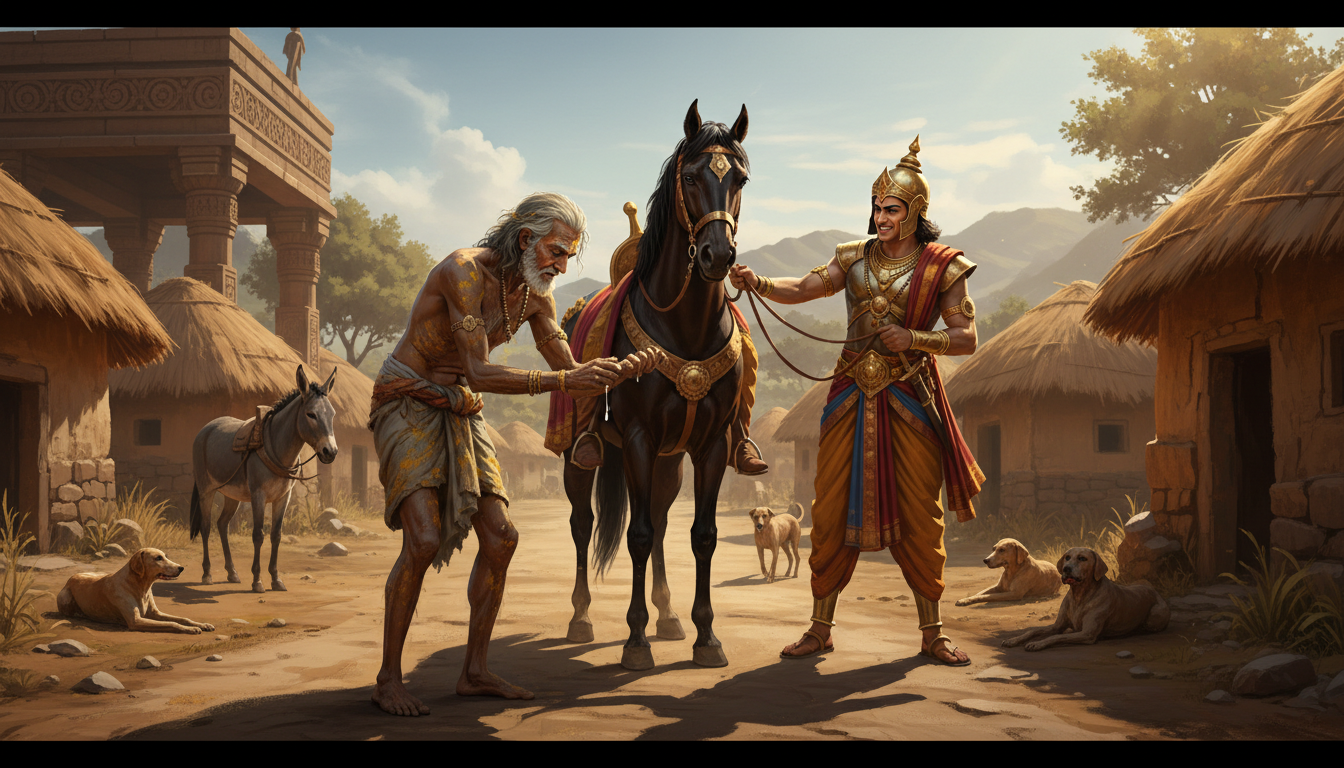
There was a man of the royal order (said Bhishma) who came upon a chandala at the side of a road, an old man, grey at the temples, standing off the track in the scrub and working at his own forearm with a handful of leaves. He was rubbing at something. He was very particular about it. And he was, from crown to heel, filthy, coated with the dust that dogs and asses raise on a highway, the dust of the work that men of his order are given.
The kshatriya watched him a while and then said what came into his head.
"You seem to be old in years, chandala, but your conduct seems to be that of a boy. Your body is besmeared all over with the dust raised by dogs and by asses, and without minding that dust at all you are anxious about a few little drops of the milk of kine that have fallen upon your skin. Look at yourself. It is plain that such acts as are censured by the pious are the acts ordained for the chandala; that is your portion and you were born to it. Why then do you take such trouble to wash off the spots of milk?"
The old man did not stop rubbing while he was spoken to. When the kshatriya had finished, he looked up, and his answer began a long way further back than the road they were standing on.
"Because I know whose milk it is," he said. "You do not. Sit down, son of the royal order, if you have the daylight to spare, and I will tell you why a man like me will let the dust of dogs lie on him all day and will scour his arm raw for one white drop."
Milk on the Soma Plants
"Formerly, O king," said the chandala, "certain kine belonging to a brahmana were stolen. That is where it begins, and everything I am going to tell you comes out of that one act, which took an evening and was thought clever at the time.
"While the cattle were being driven away, some milk from their udders fell upon a number of soma plants that were growing by the roadside. Nothing more than that. Milk from a full udder on a plant at the edge of a road, in the dark, with nobody watching. The men driving the cattle did not see it fall and would not have cared if they had.
"Those soma plants were gathered in their season, as soma plants are. The juice was pressed, and the brahmanas who officiated drank the juice of the plants that had been bedewed with that milk, and the king who performed the sacrifice in which that soma was drunk drank it too. And every one of them had to sink into hell. Understand me. Not for stealing. Not one of them stole anything. For having appropriated a thing that belonged to a brahmana, the king, with all the brahmanas who had assisted him, had to go down."
The kshatriya said that this was hard, and that a man could hardly be expected to enquire into the history of every cup he was handed at a sacrifice.
"It is hard," the chandala agreed. "I have never said otherwise, and I have never met a man who thought it fair the first time he heard it. But you asked me why I scrub my arm, and the answer is that I have seen where a drop of the wrong milk carries. It does not stop where it lands. It goes into the plant, and the plant into the cup, and the cup into the mouth of a man who never took anything from anybody, and it takes him with it."
The Kine That Took Their Revenge
"Nor did it end at the sacrifice," the chandala said. "All those men also, brahmanas and kshatriyas alike, who drank milk or ghee or curds in the palace of the king who had stolen the brahmana's kine, had to fall into hell, and most of them never knew what house the food had come out of. They ate at a rich table and were glad of the invitation.
"And the kine themselves. The stolen kine, standing in that king's byres among his own herds, shook their bodies, and with their milk they slew the sons and the grandsons of the men who had stolen them. Not the thieves. The sons and the grandsons. They slew the king with it, and they slew the queen, and I will tell you the part of it that I have never been able to put down: the queen had treated those animals with great care and with great attention. She had them fed and rubbed and their calves looked to. She did everything a good woman does in a byre, and the milk killed her all the same, because it was not her kindness that was in question. It was the ownership."
The kshatriya asked whether that was justice, and whether a woman who fed and rubbed and tended the animals in her own byre had earned the same end as the man who drove them out of somebody else's.
"It is not justice," said the chandala. "Justice is what a court gives. This is consequence, and consequence does not ask who meant well. A man drops a coal in dry grass in the evening and is a mile off and asleep before the wind gets up, and the fire does not go looking for him. It burns whatever stands in front of it. So the king who had stolen the kine belonging to a brahmana obtained an infamous end. Hence one should never steal, and never appropriate, and never accept, and never quietly enjoy anything at all that belongs to a brahmana."
The Food I Begged
"And now I will tell you where I stood in it," said the chandala, "since you have been looking at my arm and drawing conclusions about my order.
"I was living, in those days, in the observance of the vow of brahmacharya. I kept it strictly. I begged my food as one under that vow must beg it, and I begged it in the very place where those kine had been put after they had been stolen away. I did not steal them. I did not drive them. I did not know they were stolen, and if you ask me whether I could have known, I have had a long time to consider the question and I think that I could have. I noticed that the herd was new. I did not ask.
"The food I obtained by begging became sprinkled over with the milk of those kine. That is all. A few drops on a beggar's food, taken by a man under a vow, in good faith, with a clean mind. Having taken that food, O man of the royal order, I have in this life become a chandala.
"So look at me and understand what you are looking at. Behold to what state I have been reduced in consequence of having eaten food that had been sprinkled over with milk belonging to a brahmana. And then look at your own hand and consider what has been in it, and out of whose byre it came, and whether you asked."
The kshatriya, Bhishma said, had stopped being amused a good while before this.
Soma Is Not For Sale
"It is for this reason," the chandala went on, "that the soma plant becomes unsaleable in the hands of a person possessed of wisdom. A wise man will not put a price on it, because he cannot see far enough back along the road the plant has travelled to know what has fallen on it. They who sell the soma plant are censured by the wise, and they are censured for good cause.
"Indeed, my son, they who purchase soma and they who sell it both sink into the hell that is called Raurava, when, departing from this world, they repair to the region of Yama. And that man who, possessing a knowledge of the Vedas, sells soma in due and correct form, with every observance kept and no rule broken, becomes in his next life a lender of money at interest, and meets with destruction quickly. For three hundred times he has to sink into hell, and to be transformed into an animal that subsists upon human ordure.
"Three hundred, O kshatriya. I have not counted mine; I have only remembered them, one opening into the next like rooms in a house that has no door on the street. But I tell you the number because a man hearing it will say to himself that the punishment is out of all proportion to the sale, and that is exactly the thing I want him to say. It is out of all proportion. Everything in this business is out of all proportion. One drop of milk, a life in the dust. That is the news I have to give the world, and nobody on this road wants it."
The Heaviest Thing in the Balance
"Now weigh me three sins," said the chandala, "as you would weigh grain, and tell me which pan goes down. Serving a person that is vile and low. Pride. And rape upon a friend's wife. Put them in a balance against one another, all three, and it is pride that sinks, pride which transcends all restraints, pride which is the heaviest thing a man can carry and the one he never sets down at the door.
"You do not believe me. You are a man of the royal order and you have been taught that pride is a kind of straightness of the back. Then look there."
He pointed with his chin down the road, where a dog was working along the ditch, a sinful and disagreeably pale and lean animal that flinched when the men moved.
"Behold that dog," said the chandala. "He was a human being in his former life. I will not tell you his name, because his name is no longer his. It is through pride that living creatures attain to such a miserable end, and there is no other engine that does it so thoroughly. A thief may repent. A drunkard may be shamed. A proud man cannot be corrected, because correction is precisely the thing his pride exists to refuse. He hears the warning and he weighs the warner and finds him beneath answering.
"Everything else that a man does wrong, he does because he wants something. Pride is the only fault that a man commits because he wants nothing from anyone at all."
I Was Born in a Great House
"As regards myself," the chandala said, "I was born in a large family, in a former birth of mine, a house of standing, with a courtyard and a gate and men waiting at it. And I was a thorough master of all branches of knowledge and of all the sciences. There was nothing in that hall I could not answer.
"I knew the gravity of all these faults. Mark that, and do not let it go by. I did not sin in ignorance and I cannot plead it. I knew the weight of every one of them and could have set them out in order for you as I have set them out today. But influenced by pride I became blinded, and I ate the meat that is attached to the vertebral columns of animals, which a man of my birth and my learning does not eat, and which I ate because I had come to believe that the rules were written for smaller men. In consequence of such conduct and such food, I have come to this state.
"Behold the reverses that are brought about by Time. Like a person whose cloth has taken fire at one end, or who is pursued by bees, behold me, running, penetrated with fear, and smeared with dust. That is what you saw when you rode up. You thought it was a fussy old man cleaning his arm. It is a man running."
By What Road Can I Climb Back
"They that lead the domestic mode of life," the chandala said, "are rescued from all their sins by a study of the Vedas, and by gifts of other kinds, as the wise have declared; that road is open and well marked and I have watched householders walk it. And a brahmana who is sinful in conduct becomes rescued from all his sins by the study of the Vedas if he betakes himself to the forest mode of life and abstains from attachment of every kind; that road is open too, and steeper, and it also goes somewhere.
"But O chief of kshatriyas, I am in this life born in a sinful order. Neither of those roads begins where I am standing. I fail to see clearly how I may succeed in cleansing myself from all my sins, and I have been looking a long time, and I am old.
"In consequence of some meritorious act of a former life of mine, I have not lost the memory of my previous lives. I know what I did and I know what it cost and I can follow the chain link by link from a courtyard with a gate on it to this ditch, and it is not a torment to me; it is the only thing I own. A man who cannot see the chain cannot choose where to break it.
"O king, I throw myself upon your mercy. I ask you. Do you resolve my doubt. By what auspicious course of conduct should I wish to achieve my emancipation? By what means shall I succeed in getting rid of my status as a chandala?"
And the man of the royal order, who had come along that road an hour before to laugh at him, got down off his horse before he answered.
One Road Only
"Know, O chandala, the means by which you may be able to attain to emancipation," said the man of the royal order. "There is one. By casting off your life-breaths for the sake of a brahmana you may attain a desirable end. By throwing your body upon the fire of battle as a libation to the beasts and the birds of prey, for the sake of a brahmana, indeed by casting off your life-breaths in that manner, you may achieve emancipation. By no other means will you succeed in achieving it."
The chandala thanked him for it. He had asked for a road and he had been given one, and he did not ask for a second one that was easier.
"Thus addressed," said Bhishma, "that chandala, O scorcher of foes, poured his life-breaths as a libation on the fire of battle for the sake of protecting the wealth of a brahmana, and as the consequence of that act he attained to a very desirable end. He who could not be cleansed by the Vedas, because they were not his to study, and could not be cleansed by the forest, because the forest was not his to enter, was cleansed by standing in front of another man's property with nothing but his body, and being killed there.
"That is where the thieves of brahmana property go, son of Kunti, since you asked me. And that is what it takes to come back. Hence you should always protect the property of the brahmanas, and you should look hard at what is set before you and ask out of whose byre it came, if you desire, O you of mighty arms, an end that is eternal felicity."
Yudhishthira said nothing for a moment. He was thinking of the thing that Bhishma had left him to think of, which was that the chandala had not once asked to be excused, though he had a better excuse than most men living: he had been under a vow, he had begged in good faith, and he had eaten what was put in his bowl.
Then he said, "He was not sorry to remember."
"No," said Bhishma. "He was the only man on that road who knew where he was."
Dharma Lesson
Memory of what pride cost is itself a mercy, since a man who can see the whole chain can choose where to break it. Consequence does not ask who meant well: the queen who tended the stolen cattle kindly fell with the thief who drove them. And the fault that ruins most thoroughly is pride, because it is the one fault that exists precisely to refuse correction.