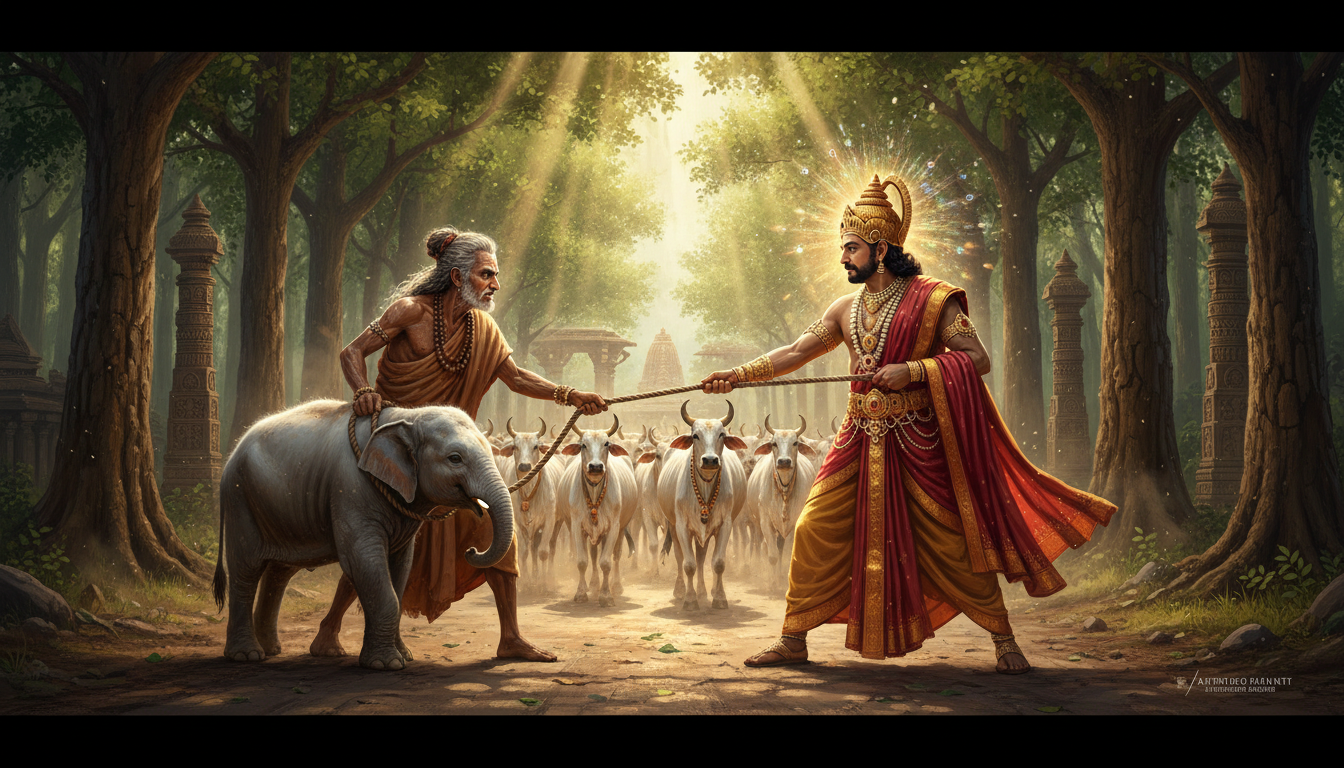
The Elephant the Sage Called Son
Gautama argues his way through every heaven for a stolen calf
Do All the Good Go to the Same Place
"O grandsire," said Yudhishthira, "it has been said that all pious men attain to the same region after death. Is it true, O Bharata, that there is difference of position or status among them?"
It is the question of a man who has buried a great many people at once. On the Kurukshetra plain the good and the bad had gone into the same fire on the same evening, and the king wanted to know whether the sorting happened afterwards.
"By different deeds, O son of Pritha, men attain to different regions," said Bhishma. "They who are righteous in conduct attain to regions of felicity, while they who are sinful attain to regions that are fraught with misery."
He could have stopped there. What he did instead was give the king the whole map, tier by tier, and he gave it in the form of a quarrel about an elephant.
"In this connection is cited the old narrative of the discourse between the ascetic Gautama and Vasava. Listen, and you will hear every heaven there is named out loud, one after another, by a man who was not interested in any of them."
Yudhishthira settled himself to listen. He had asked about the ranking of the blessed dead. He was going to be told about a Brahmana who owned nothing, a god who wanted a beast, and a young white elephant that had been raised by hand.
The Calf That Had Lost Its Mother
"A certain Brahmana of the name of Gautama," said Bhishma, "mild and self-restrained and with all his senses under complete control, beheld an infant elephant that had lost his mother and that was exceedingly cheerless on that account.
"Consider how little there is in that sentence and how much hangs on it. A man walking in the woods comes upon a calf standing where its mother is not. It is white, and it is very young, and it has stopped making any noise, which is what a young animal does when it has given up. Nobody is watching. There is no merit to be gained. The nearest witness is a tree.
"Full of compassion and steady in the observance of his vows, the ascetic nursed that infant animal.
"That is the whole of the beginning. He fed it and it lived. After a long time the little beast grew up into a large and mighty elephant, and it grew up inside the hermitage, under the eye of the man who had fed it, and it learned the work of the place as a child learns the work of a house. It carried the fuel. It carried the water. When the ascetic was away, the elephant stayed and kept the asylum. It was exceedingly docile and obedient to its instructor, mindful of doing all the offices that its preceptor commanded, mild and well-broken, and grateful.
"That last word is the one to keep hold of. Grateful. The animal had not forgotten who had come along the path that day, and neither, as it turned out, had anybody in heaven."
A King on the Forest Road
"One day," said Bhishma, "Indra, assuming the form of king Dhritarashtra, seized that mighty elephant which was as huge as a hill and from whose rent temples the juice was trickling down.
"Not our Dhritarashtra. It was a name the god put on, the way a man puts on a coat, and there was a king somewhere who had lent it without knowing. What arrived at the hermitage looked in every particular like royalty: a king, an escort, an authority that did not expect to be questioned, and a hand laid on the halter of a full-grown bull elephant in must, with the dark juice running down from its temples, which is the season when such an animal is worth the most and is hardest to hold.
"Beholding the elephant dragged away, the great ascetic Gautama of rigid vows addressed him.
"'O ungrateful Dhritarashtra, do not rob me of this elephant. It is looked upon by me as a son and I have reared it with much pain. It is said that between the righteous, friendship springs up if only they exchange seven words. You should see, O king, that the sin of injuring a friend does not touch you.
"'It behoves you not, O king, to take away by force this elephant that brings me my fuel and water, that protects my asylum when I am away, that is exceedingly docile and obedient to his instructor, that is mindful of doing all the offices that his preceptor commands, that is mild and well-broken, and that is grateful and very dear to me. Indeed, you should not bear it away, disregarding my protestations and cries.'
"Seven words," said Bhishma. "That is the price of a friendship, by the old reckoning, and the ascetic and the king had already spent more than that on each other standing in the road."
A Thousand Kine and a Hundred Maidservants
"The king made the offer that kings make," said Bhishma.
"'I shall give you a thousand kine, a hundred maid-servants, and five hundred pieces of gold. I shall also, O great Rishi, give you diverse other kinds of wealth. What use can Brahmanas have with elephants?'
"Hear the shape of it. A thousand cows is not a bribe, it is a fortune; it is the standing wealth of a small kingdom, and it was being handed to a man who lived on what the forest dropped. And with it came the argument that the offer is reasonable, which is always the more dangerous half.
"'Keep, O king, your kine and maid-servants and coins of gold and various gems and diverse other kinds of wealth,' said Gautama. 'What, O monarch, have Brahmanas to do with wealth?'
"He gave back the king's own question with the terms exchanged, and that is the hinge of the whole story. The king had asked what a Brahmana wants with an elephant, meaning that an elephant is a thing of a certain class and belongs with that class. The ascetic answered that if things belong with their classes then the gold belongs with the king, and he did not want the gold, and what he wanted had never been a thing at all.
"The king tried the point again, because it was a good point and he was used to winning with it.
"'Brahmanas have no use for elephants. Verily, O learned Brahmana, elephants are meant for persons of the royal order. In taking away an animal, this foremost of elephants, for my use as vehicle, I cannot be regarded as committing any sin. Do you cease obstructing me in this way, O Gautama.'
"And there the ascetic, who had no army, no gold, no rank and no remedy, opened the only door that was left to him, which went straight down out of the world."
To the Region of Yama, Then
"'O illustrious king,' said Gautama, 'repairing even to that region of Yama where the righteous live in joy and the sinful in grief, I shall take from you this my elephant.'
"He had begun to follow. Not to fight, not to curse, which he could have done and which every ascetic in these stories does sooner or later. To follow. The threat was that death would not end the pursuit, and the king answered it like a man declining an invitation.
"'They that are destitute of religious acts, they that have no faith and are atheists, they that are of sinful souls and are always engaged in gratifying their senses, only they have to go to the region of Yama and endure the misery he inflicts. Dhritarashtra shall go to a higher region, and not thither.'
"'The region of Yama is such that men are there controlled,' said Gautama. 'No untruth can be told there. Only truth prevails in that place. There the weak persecute the strong. Repairing thither I shall force you to yield up this elephant to me.'
"That is why he named Yama first, son of Pandu. It is the one court in the universe where a man with nothing may prevail against a man with an army, and he wanted the case heard there.
"'Only those persons that, intoxicated with pride, conduct themselves towards their eldest sister and father and mother as towards foes, have to repair to such a region,' said the king. 'I shall repair to a higher region. Indeed, Dhritarashtra shall not have to go thither.'
"'The region called Mandakini, of king Vaisravana, is attained by those highly blessed persons for whom are every joy and comfort. There Gandharvas and Yakshas and Apsaras live. Repairing even thither, O king, I shall force you to yield up this elephant to me.'
"'Those persons who regard hospitality to guests as a vow, who give shelter to Brahmanas, and who eat what remains after distribution among all those that are dependent upon them, adorn the Mandakini of Kuvera. A higher region is reserved for me.'"
Meru, and the Woods That Belong to Narada
"So it went, rung by rung, and neither of them raised his voice," said Bhishma. "The ascetic named a heaven and said he would come there for his elephant. The king described the men who earn that heaven, agreed that they were fine men, and said he was going higher.
"'If you repair to those delightful woods decked with flowers, that stand on the summit of Meru, that echo with the melodious voice of Kinnaris, and that are graced with beautiful Jamvus of wide-spreading branches, I shall proceed even thither and force you to yield up this elephant to me.'
"'Those Brahmanas that are endued with mild dispositions, that are devoted to truth, that are possessed of great learning in the scriptures, that are compassionate unto all creatures, that study the Puranas with all the histories, that pour libations on the sacred fire and make gifts of honey unto the Brahmanas, repair to such regions. I shall repair to a region that is higher. If you are acquainted with any other well-known region of felicity, speak, for I shall repair even thither.'
"Mark that last line. The king was now helping. He had begun to enjoy it.
"'If you proceed to the woods owned by Narada and held dear by him, that are adorned with flowers and that echo with the melodious songs of the prince of Kinnaras, and that are the eternal abode of Gandharvas and Apsaras, I shall follow you thither.'
"'They who never solicit alms, they who cultivate music and dancing, and always rove about in joy, proceed to such regions. I shall repair to a region that is higher.'
"'If you go to that region where the Uttara-Kurus blaze in beauty and pass their days in gladness in the company of the very deities, where those beings that have their origin in fire, those that have their origin in water, and those having their origin in mountains reside in happiness, and where Sakra rains down the fruition of every wish, and where women live in perfect freedom, unrestrained by rules of any kind, and where there is no feeling of jealousy between the sexes, even thither shall I proceed.'
"'Those men that are freed from desire with respect to all articles of enjoyment, that abstain from meat, that never take up the rod of chastisement, that have constituted themselves the soul of all creatures, that are entirely freed from the idea of meum, that regard gain and loss as also praise and blame as equal, only those men repair to such regions. I shall repair to a higher region.'"
Soma, the Sun, and the Lord of Waters
"'Next to these blaze in beauty those eternal regions, redolent with excellent perfumes, that are free from passions of every kind and that are destitute of sorrow,' said Gautama. 'These constitute the abode of the high-souled king Soma. If you repair thither, even thither shall I proceed and force you to yield up this elephant to me.'
"'Those men that always make gifts without receiving any gift, who never accept any service from others, who own nothing which they cannot give to a deserving person, who are hospitable to all creatures, who are inclined to show grace to every one, who are endued with forgiving dispositions, who never speak ill of others, who protect all creatures by throwing over them the shroud of compassion, and who are always righteous in their behaviour, only those men proceed to such regions. Verily, Dhritarashtra shall not go there.'
"Every one of those descriptions, son of Pandu, is a portrait of the man he was talking to. He who owns nothing that he cannot give away. He who protects creatures by throwing over them the shroud of compassion. The god was reading out the ascetic's own character in the form of an excuse, and the ascetic was too busy following an elephant to notice.
"'Next to these blaze in beauty other regions that are eternal, free from passion and darkness and sorrow, and that lie at the foot of the high-souled deity of the Sun.'
"'Those men that are attentive to the study of the Vedas, that are devoted to the service of their preceptors, that are observant of penances and excellent vows, that are firm in truth, that never utter anything that smacks of disobedience or enmity to their preceptors, they repair to such regions. I shall proceed to a higher region.'
"'They constitute the abode of the high-souled king Varuna. If you proceed thither, even thither shall I go.'
"'Those who worship the deities by observing the vow called Chaturmasya, that perform a hundred and ten sacrifices, that pour libations every day on their sacred fire with devotion and faith for three years agreeably with the ordinances declared in the Vedas, that bear without flinching the burden of all duties, only they repair to such regions. Verily, Dhritarashtra shall not go thither.'"
The Region of Kine
"'Above them are the regions of Indra, free from passion and sorrow, that are difficult of access and coveted by all men,' said Gautama. 'Proceeding even to the abode of Indra himself of mighty energy, I shall, O king, force you to yield up this elephant to me.'
"He said it without any suspicion at all, and the god standing in front of him kept his face.
"'He who lives for a hundred years, who is endued with heroism, who studies the Vedas, and who performs sacrifices with devotion, such men proceed to the region of Sakra. I shall repair to a higher region.'
"'Above the Heavens are the regions of the Prajapatis of superior felicity, belonging to those puissant ones from whom the creation has sprung.'
"'Those kings that have bathed upon the completion of the Rajasuya sacrifice, that are endued with righteous souls, that have protected their subjects properly, and that have washed their limbs with sanctified water upon the completion of the horse-sacrifice, repair to such regions. Verily, Dhritarashtra shall not go there.'
"'Next to those blaze in beauty those eternal regions, redolent with delicious perfumes, free from passion, and transcending all sorrow. Those are the regions of kine, difficult of attainment, where oppression can never be.'
"And here the king, who had answered ten questions in ten sentences, suddenly could not stop talking.
"'He who, owning a thousand kine, gives away a hundred kine every year, or owning a hundred kine gives away ten every year to the best of his might, or owning only ten or even five kine gives away therefrom one cow, and they who attain to a mature old age practising the vows of Brahmacharya all their days, who obey the declarations of the Vedas, and who betake themselves to pilgrimages to sacred waters and shrines, dwell in felicity in the region of kine. They who repair to Prabhasa and Manasa, the lakes of Pushkara, the large lake called Mahatsara, the sacred woods of Naimisha, Vahuda, Karatoya, Ganga, Gayasiras, Vipasa, Sthulavaluka, Krishna, the five rivers, the extensive lake called Mahahrada, Gomati, Kausiki, Champa, Saraswati, Drisadwati, and Yamuna, indeed, those illustrious Brahmanas, steady in the observance of vows, who go to these sacred waters, repair to the regions of which you speak. Endued with celestial bodies and adorned with celestial garlands, those blessed individuals, always emitting the most delightful perfumes, repair to those regions of joy and gladness. Verily, Dhritarashtra shall not go there.'
"A god who is holding a stolen elephant," said Bhishma, "had just recited the whole pilgrim road of the world from memory, in order, without being asked."
Where There Is Neither Righteousness Nor Sin
"There was one place left," said Bhishma, "and the ascetic named it.
"'Next to these are regions where there is no fear of the least cold or heat, no hunger, no thirst, no pain, no sorrow, no joy, no one that is agreeable or disagreeable, no friend, and no enemy: where decrepitude and death are not, and where there is neither righteousness nor sin. Proceeding even to that region which is freed from passion, which abounds with equable happiness, and where there is wisdom, proceeding to even that sacred abode of the self-born Brahman, I shall force you to yield up this elephant to me.'
"Hear what he was saying. He would go to the last place there is, where there is no pleasure and no pain and no right and no wrong and nothing left of a man that could want anything, and there he would still want his elephant back. It is either the most foolish sentence in the whole of the Anusasana or the truest thing ever said about love, and I have lain here a long time and I have not decided.
"'They who are freed from all attachments, who are possessed of cleansed souls, who are steady in the observance of the foremost vows, who are devoted to the Yoga that depends on tranquillising the mind, those persons wedded to the attribute of Sattwa attain to the sacred region of Brahman. O great ascetic, you shall not be able to discover Dhritarashtra there.'
"And with that the ladder was finished. Every region had been named. There was nowhere above the abode of Brahman to which a thief could withdraw, and the ascetic, who had been climbing all this while with his eyes on the elephant, at last looked at the man he had been climbing after.
"'There where the foremost of Rathantaras is sung, where altars are strewn with the sacred Kusa blades for the performance of Pundarika sacrifices, there where Soma-drinking Brahmanas go on vehicles drawn by excellent steeds, proceeding even thither I shall force you to yield up this elephant.
"'I think you are the slayer of Vritra, the deity that has performed a hundred sacrifices, engaged in roving through all the regions of the universe. I hope I have not, through mental weakness, committed any fault by the words I have addressed you.'"
It Sniffs Your Feet
"'Yes, I am Maghavat,' said the deity of a hundred sacrifices. 'I came to the world of human beings for seizing this elephant. I bow to you. Do you command me. I shall readily accomplish all that you may be pleased to say.'
"The god had come down to take a beast and had ended by asking a man in a bark robe for orders. And the ascetic, who had just been offered anything in the three worlds by the king of the gods, asked for the thing he had been asking for all along.
"'Do you give me, O chief of the deities, this elephant that is of white complexion and that is so young, for it is only ten years of age. I have brought it up as a child of my own. Dwelling in these woods, it has grown under my eye and has been to me a dear companion. Do you set free this my child that you have seized and wish to drag away.'
"'This elephant that has been a son to you, O foremost of Brahmanas, comes to you looking wishfully at you,' said Indra. 'Behold, it sniffs your feet with its nostrils. My salutations to you. Do you pray for my welfare.'
"That is the picture to keep, son of Pandu. Not the ladder of heavens. The trunk coming down and moving over the old man's feet, smelling him, the way an animal makes certain of a person it has been afraid of losing.
"'O chief of the deities, I do always think of your good. I always offer you worship. Do you also, O Sakra, bestow your blessings on me. Given by you, I accept this elephant.'
"'Amongst all those high-souled and foremost of Rishis that firmly adhere to truth and that have the Vedas planted in their heart, you alone have been able to recognise me. For this reason I am exceedingly pleased with you. Come with me quickly, accompanied by this your son. You deserve to attain to diverse regions of great felicity without the delay of even a single day.'
"And the wielder of the thunderbolt, taking Gautama with him and placing him in front, along with his son, that elephant, proceeded to heaven, which is difficult of attainment by even the righteous.
"You asked me whether the pious are ranked, O king. They are, and there are more shelves in that house than you would think, and I have just recited them to you in order. But note where this Brahmana was put. He did not earn a shelf. He was carried up through the whole of it in a single day with his elephant walking beside him, because he would not be bought and because he alone knew a god when one stood in the road in front of him and lied. He who would listen to this history every day, or would recite it with his senses restrained, proceeds after death to the region of Brahman, even as Gautama himself."
Dharma Lesson
A creature you have raised is not property to be priced, and no exchange of cattle or gold can settle a debt that was never made of goods. Gautama answers the king's question about what a Brahmana wants with an elephant by returning it: if things belong with their classes, then keep the gold, because what he wants was never a thing. Love that is willing to follow through every heaven turns out to be a stronger claim than any right of rank, and the god who tested it carried both sage and beast up in a single day.