At What Age Should a Man Give
Markandeya had just finished telling how the royal sage Indradyumna, dropped out of heaven when the last man alive who remembered his generosity could no longer be found, went looking across the world for one witness and got his place back.
Yudhishthira had listened to that with the particular attention of a man who has nothing left to give away, and when it was over he asked the practical question underneath it.
"O great muni, tell me in what condition should a man practise charity in order to gain admission into the regions of Indra. Is it by practising charity while leading a domestic mode of life, or in boyhood, or in youth, or in old age? Tell me about the respective merits reaped from the practice of charity in these different stages of life."
It is a young man's question and an honest one. Every man who has ever meant to be generous later has asked some version of it. There is a stage of life, it assumes, at which giving properly begins: when the household is established, when the debts are cleared, when there is something to spare.
Markandeya did not answer it in the terms it was asked. He never did. He began instead at the far end, with the accounts of men whose whole lives had been written off, and with the gifts that are handed over and land nowhere at all.
"Life that is futile," he said, "is of four kinds. Charity also that is futile is of sixteen kinds."
Four Lives That Come to Nothing
"His life is vain who has no son," said Markandeya, "and his also who is outside the pale of virtue; and his too who lives on the food of others; and, lastly, his who cooks for himself without giving therefrom to the Pitris, the gods and the guests, and who eats of it before these all."
Four, and the last two are the ones to sit with.
His life is vain who lives on the food of others. Not the guest, who is honoured, and not the ascetic, whose begging is a discipline with a rule around it. The man meant here is the one who has arranged his existence so that it is always somebody else's rice in his bowl, and who has never in his life set a pot on a fire for anybody but himself.
And his who cooks for himself without giving to the fathers, the gods and the guests, and eats before them all. This is a rule about a single moment, repeated twice a day for a lifetime: the moment when the food is ready and there is nobody watching. Something is set aside for the dead of the house. Something goes into the fire. Something is kept back in case a stranger comes to the door before the light goes. Then a man eats.
The whole doctrine of giving that follows is built on that one small act at the hearth, and Markandeya put it at the front on purpose. A man who cannot manage a handful of rice out of a full pot in his own kitchen, where it costs him nothing and nobody applauds, is not going to become generous later on when the amounts are larger.
Sixteen Gifts That Land Nowhere
Then he counted out the wasted gifts, and it is a strange and useful list, because almost every item on it is a gift somebody was proud of making.
"The gift to one that has fallen away from the practice of virtuous vows, as also the gift of wealth that has been earned wrongly, are both in vain."
There is the first and the hardest. It does not matter to whom the money goes if the money should not have been yours. A gift is not a wash. Wealth got by a crooked measure stays crooked in the hand that receives it, and the giver has bought nothing at all.
"The gift to a fallen brahmana, that to a thief, that also to a preceptor that is false, is in vain. The gift to an untruthful man, to a person that is sinful, to one that is ungrateful, to one that officiates at sacrifices performed by all classes of people residing in a village, to one that sells the Vedas, to a brahmana that cooks for a Sudra, to one that is by birth a brahmana but is destitute of the occupations of his order, is in vain. The gift to one that has married a girl after the accession of puberty, to females, to one that sports with snakes, and to one that is employed in menial offices, is also in vain. These sixteen kinds of gifts are productive of no merit."
The common thread, where there is one, is the state of the vessel. A gift is not a thing thrown; it is a thing poured, and it takes the shape of what it is poured into.
"That man who, with mind clouded with darkness, gives away from fear or from anger, enjoys the merit of such gift while he is in the womb of his mother."
Which is to say: it is spent before he is born, and he arrives owning nothing of it. Frightened giving and angry giving are transactions, and they settle immediately, and there is no balance left over.
"The man who under other circumstances makes gifts to the brahmanas enjoys the fruit thereof in old age. Therefore, O king, the man who wishes to win the way of heaven should under all conditions make gifts of everything that he wishes to give away."
The Boat Made of Vedas
"By what means," asked Yudhishthira, "do brahmanas, who accept gifts from all the four orders, save others as well as themselves?"
It was a fair objection and he put it fairly. If a gift takes the shape of the vessel, then the vessel is carrying whatever was poured into it, and a man who spends his life accepting from everybody is taking on the freight of everybody.
"By japa, and mantras, and homa, and the study of the Vedas," said Markandeya, "the brahmanas construct a Vedic boat, wherewith they save both others and themselves."
That is the answer and it is worth taking literally. The recitation is not decoration on the transaction. It is the hull. A man who takes gifts and has built nothing sinks with what he has taken, and takes the giver down with him, which is why the sixteen were listed first.
"He that knows all the Vedas should give only to that able brahmana who is competent to rescue both the giver and himself; for he indeed is to be regarded as able who can rescue both."
Then he came to the guest, and his voice changed as it always did when he came to the guest.
"O son of Pritha, the sacred fires do not receive such gratification from libations of clarified butter, from offerings of flowers and sandal and other perfumed pastes, as from the entertainment of guests. Therefore do you strive to entertain guests, O son of Pandu. They that give unto guests water to wash their feet, butter to rub over their tired legs, light during the hours of darkness, food, and shelter, have not to go before Yama."
Water, oil for the legs, a lamp, food, a roof. Five plain things, none of them expensive, and Markandeya set them above the whole apparatus of the fire.
There Is Nothing Superior to Food
"O son of Bharata, one should give to a person of good lineage and conversant with the Vedas; to a person that is poor; to one leading a domestic mode of life but burdened with wife and children; to one that daily adores the sacred fire; and to one that has done you no service. You should always give to such persons, but not to them that are in affluence. What merit is there, O foremost of the Bharata race, in giving to one that is affluent?"
To one that has done you no service. That clause is the knife in the passage. The gift that is returned for a favour is a payment, and payments are settled and gone; the only gift that is a gift is the one made to a man who is in no position to have earned it and no position to repay it.
He gave them the measures. One cow must be given to one brahmana; a single cow must not be given to many, for if the cow so given away be sold, the giver's family is lost for three generations. He who gives eighty ratis of pure gold earns the merit of giving a hundred pieces of gold for ever. He that gives away a strong bull, capable also of drawing the plough, is certainly rescued from all difficulties. He that gives land to a learned brahmana has all his desires fulfilled.
And then, above all of them, he set food.
"The tired traveller, with weakened limbs and feet besmeared with the dust of the high road, asks for the name of him that may give him food. There are men who answer him by telling him the name. That wise man who informs these toil-worn ones of the name of the person who may give them food is, without doubt, regarded as equal in merit to the giver himself of food."
Equal. The man who fed nobody, who merely stood in the road and pointed and said, try that house, is counted level with the householder who cooked.
"Therefore, abstaining from other kinds of gift, give you food. There is no merit that is so great as that of giving food. There is nothing superior to food. It has been said that food itself is Prajapati. And Prajapati is regarded as the Year. And the Year is sacrifice. And everything is established in sacrifice, for it is from sacrifice that all creatures, mobile and immobile, take their origin."
Eighty-Six Thousand Yojanas
The brothers had been listening, and curiosity got the better of them all at once. It was Yudhishthira who put it, but they had been working it out among themselves.
"O great muni, what is the distance of Yama's region from that of men? What is its measurement? How also do men pass it over? And by what means? O, tell me all this."
Markandeya did not brush it off as a child's question, and he did not enjoy it either.
"O king, O foremost of virtuous men, this question of yours appertains to a great mystery. It is sacred and much applauded by the rishis. Appertaining as it does to virtue, I will speak of it to you."
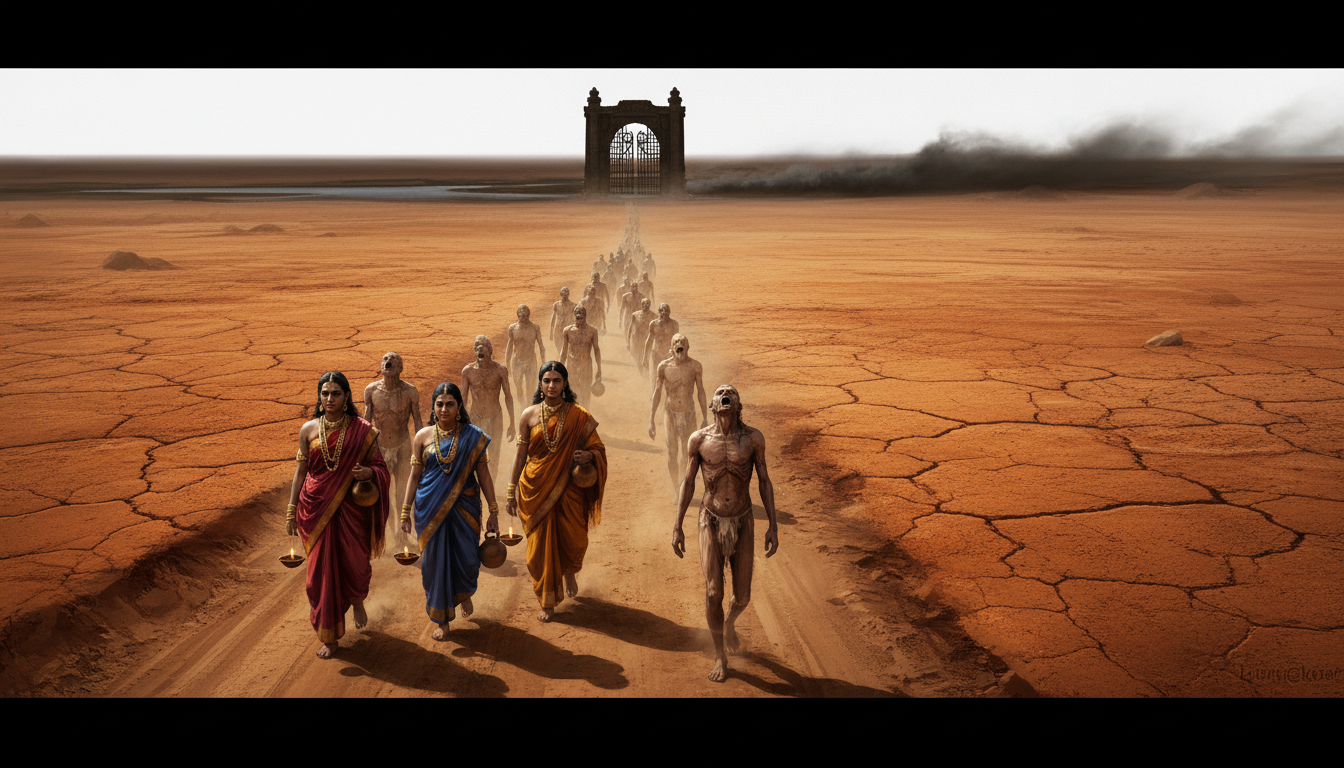
"The distance of Yama's region from the abode of men is, O king, eighty-six thousand yojanas."
They let the number sit. It is not a number for the imagination; it is a number for the legs.
"The way is over space, without water, and very terrible to behold. Nowhere on that road is the shade of a tree; nowhere any water; and nowhere any resting place in which the traveller, when fatigued, may rest for some moments."
No shade. No water. Nowhere to sit down. And the crossing is not optional and not negotiable and admits of no exemption whatever.
"And men and women, and all on earth that have life, are forcibly led along this way by the messengers of Yama."
Forcibly. Kings and ploughmen, the strong-armed and the sick, the ones who were ready and the ones who were in the middle of something. Every person the Pandavas had ever known or fought or lost was somewhere on that road, and would be walking it whether they had prepared for it or not.
What Each Gift Becomes on the Walk
"Those creatures that obey the mandates of the grim king, and they that have given horses and other good conveyances to brahmanas, proceed along this way on those animals and vehicles."
And that is the whole system, disclosed in one sentence. Nothing else you owned makes the journey. What a man gave away, and only that, is waiting for him on the road in the form he gave it.
"And they that have given umbrellas proceed along this way with umbrellas warding off the sun's rays."
"And they that have given food proceed without hunger, while they that have not given food proceed afflicted with hunger."
"And they that have given robes proceed attired in robes, while they that have given none proceed naked."
Naked, on a road eighty-six thousand yojanas long, in the sun, in company. Markandeya did not linger on it. He did not have to.
"And they that have given gold proceed in happiness, themselves decked in ornaments. And they that have given land proceed with every desire completely gratified. And they that have given grain proceed without being afflicted with any want. And they that have given houses proceed happily on cars. And those men that have given something to drink proceed with cheerful hearts, unafflicted with thirst. And they that have given lights proceed happily, lighting the way before them."
Lighting the way before them. It is the tenderest line in the passage: the lamps a man set out for other people at dusk, going on ahead of him in the dark of that country, still burning.
"And they that have given kine proceed along the way happily, freed from all their sins. And they that have fasted for a month proceed on cars drawn by swans. And they who have fasted for six nights proceed on cars drawn by peacocks. And, O son of Pandu, he that fasts three nights upon only one meal, without a second during this period, goes into a region free from disease and anxiety."
The River Pushpodaka
"And water has this excellent property, that it produces happiness in the region of Yama."
Of all the gifts, this is the one that costs least and carries furthest, and Markandeya gave it its own river.
"And they that give water find for themselves a river there of the name of Pushpodaka. And the givers of water on the earth drink cool and ambrosial draughts from that stream."
A jar left in the shade at the edge of a road. A cup handed up to a man on a cart. The trouble of walking down to the well twice instead of once because somebody was standing in the yard looking thirsty and would not ask. That, on the far side of eighty-six thousand yojanas of waterless country, is a river with flowers on it, and a man may drink from it as long as he likes.
"And they that are of evil deeds have pus ordained for them."
Seven words, and the sage went straight on past them.
"Thus, O great king, that river serves all purposes."
One stream. It is not that the cruel are sent to some separate place of punishment; they arrive at the same water as everybody else, and what they find in it is what they have been handing out. The river does not judge. It reflects.
"Therefore, O king, adore duly these brahmanas that are with you. Weak in limbs owing to the way he has walked, and besmeared with the dust of the high road, the traveller enquires for the name of him who gives food, and comes in hope to his house. Adore him with reverent attention, for he indeed is a guest, and he is a brahmana. The gods, with Indra at their head, follow him as he proceeds. And if he is adored, the gods with Indra become gratified; and if he is not adored, the celestials with their chief become cheerless."
Matted Hair and a Hard Heart
"O you of great wisdom," said Yudhishthira, "what purification is there by which a man may always keep himself pure?"
He was sitting in deerskin with matted locks when he asked it. So were his brothers. So was every man in that camp. They had been living the outward life of ascetics for years now, not by choice, and it would have been an easy moment for a sage to praise them for it.
"There are three kinds of purity," said Markandeya. "Purity in speech, purity in deed, and purity achieved by the use of water. He that has recourse to these three attains, without doubt, to heaven."
And then he took the whole visible apparatus of holiness apart, item by item, and he began with the very things his listeners were wearing.
"The carrying of three staffs, the vow of silence, matted hair on the head, the shaving of the crown, the covering of one's person with barks and deerskins, the practice of vows, ablutions, the worship of fire, abode in the woods, the emaciating of the body: all these are useless if the heart be not pure."
Nobody moved.
"Those high-souled persons that do not commit sins in word, deed, heart and soul are said to undergo ascetic austerities, and not they that suffer their bodies to be wasted by fasts and penances. He that has no feeling of kindness for relatives cannot be free from sin, even if his body be pure. That hard-heartedness of his is the enemy of his asceticism."
The enemy of his asceticism. Not a blemish on it. Not a deduction from it. The thing that is eating it from the inside while he fasts.
"Asceticism is not mere abstinence from the pleasures of the world. He that is always pure and decked with virtue, he that practises kindness all his life, is a muni even though he may lead a domestic life. Fasts and other penances cannot destroy sins, however much they may weaken and dry up the body that is made of flesh and blood. The man whose heart is without holiness suffers torture only by undergoing penances in ignorance of their meaning. The fire he worships does not consume his sins."
Nothing So Eternal as a Gift
"O master," said Yudhishthira, "I desire to listen to the rules about that charity which is meritorious."
He had been told, in the space of one evening, that his bark clothes were worth nothing, that his fasts were worth nothing, and that the fire he tended twice a day would not burn off a single fault of his if his heart were hard; and his response was to ask how to give properly. Markandeya, who had been watching men receive instruction for several ages, seems to have liked him for it.
"The rules about charity which you wish to hear from me are always highly regarded by me. He that founds a dharmasala, and establishes there a person to look after all comers, is crowned with the merits of all the sacrifices. The guest that comes to one's house for food is none other than Indra himself. If he is entertained with food, Indra himself confers the best merit, that is inexhaustible. As men cross seas by vessels, so are the givers saved from all their sins."
He gave the calendar of it too, because he was thorough: a gift on particular lunations twice what it is on other days, a gift in a particular season ten times, in a particular year a hundred times; gifts at the solstices, at the eclipses of the moon and the sun, on the last day of the last month of the year, producing merit that knows no diminution.
"O king, no one can enjoy landed possessions unless he gives away land, and no one can go on cars and vehicles unless he gives these away. Gold has sprung from Fire; the Earth from Vishnu; and the cows from the Sun. He, therefore, that gives away gold, land and kine attains all the regions of Agni, Vishnu and the Sun. There is nothing so eternal as a gift. Where, therefore, in the three worlds is anything that is more auspicious? It is for this, O king, that they who have great intelligence say that there is nothing higher and greater in the three worlds than gift."
The fire had gone down. Out beyond it the brahmanas of the camp were settling, the men who had followed a landless king into a forest and were fed every day out of what five exiles could find. Yudhishthira had asked at what stage of life a man ought to begin giving, and had been answered with a road eighty-six thousand yojanas long on which the only baggage a man carries is what he handed away, and with the news that the lamps he lights for other people go on ahead of him into the dark. He got up, and went to see that his guests had eaten.
Dharma Lesson
What a person gave away is the only luggage that follows him, and no amount of visible penance substitutes for having been kind while it was inconvenient. Matted hair, bark clothes, fasts and the daily fire are all useless if the heart is hard, because hard-heartedness is not a blemish on asceticism but its enemy. The lamp a man sets out for somebody else is the one that lights his own way through the dark country.