After the Greatness of Brahmanas
Markandeya had just finished telling them how Indra himself once went to the ascetic Vaka Dalbhya and asked what the sorrows of the deathless were, and what their joys; and how Vaka had answered that the sorrow is to live long enough to watch families lose their dignity and fools prosper and the learned suffer, and that the joy is a little food cooked in one's own house, earned by one's own hands, shared first with a guest.
The fire had burned down while he spoke. The sons of Pandu sat around it in the Kamyaka woods, five men with no revenue and no city, and when the sage stopped there was a silence in which each of them was doing his own arithmetic.
"You have told us of the greatness of Brahmanas," they said at last. "We desire now to hear of the greatness of the royal Kshatriyas."
Markandeya understood what was being asked. It was not really a question about kings in general. It was a question from a man who had ruled and did not rule, who had once poured out gifts at a great sacrifice before an assembly of the whole earth, and who now had nothing in his hands to give anybody.
"Listen, then, to the greatness of the royal Kshatriyas," the great Rishi said. "I will not give you a battle. I will give you three small things that happened to three kings, and each of them turns on the same hinge. A road too narrow for two chariots. A question nobody had ever thought to ask at an audience. And a beggar who was struck with a whip. Judge for yourselves, afterwards, what the greatness of a Kshatriya consists of."
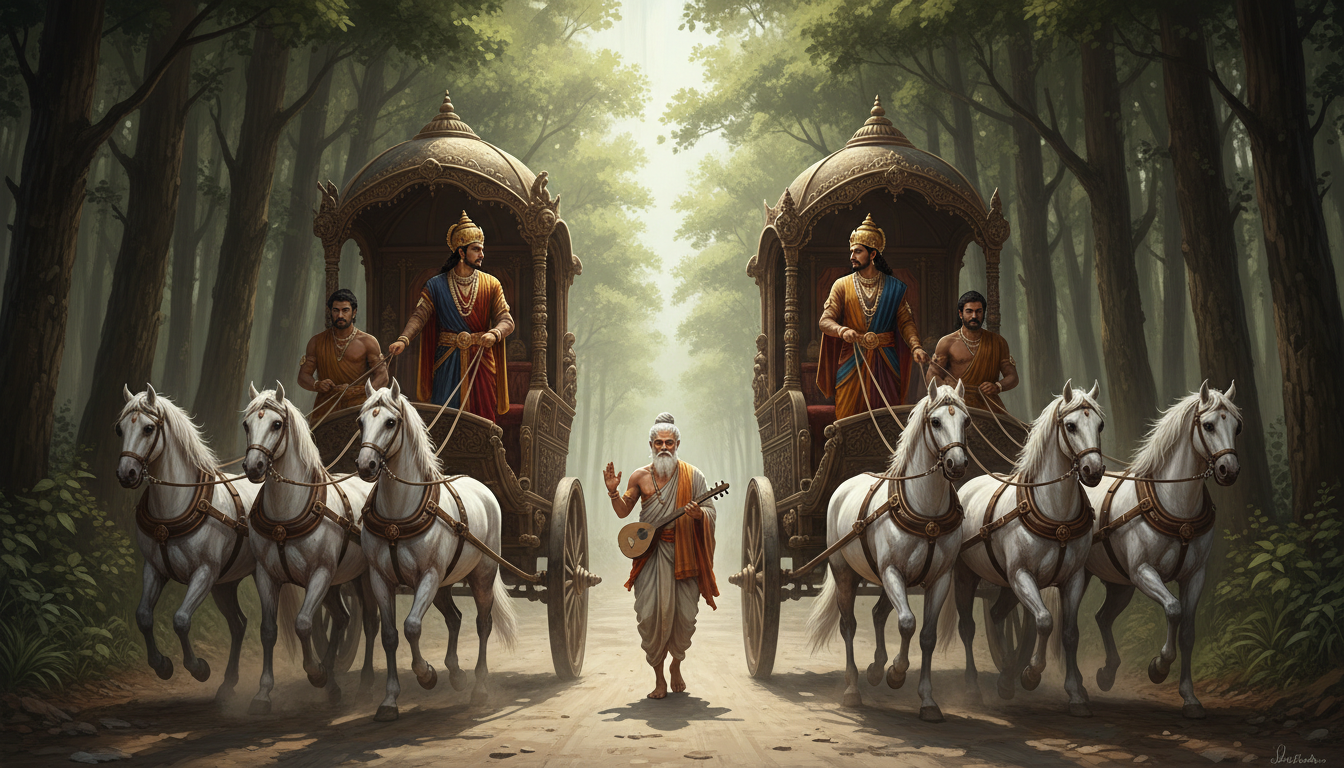
Two Cars on One Road
There was a king of the Kuru race named Suhotra (said Markandeya) who went out on a visit to the great Rishis, and stayed with them as long as it pleased him, and was returning home along the road in his car.
And coming the other way, seated on his own car, was king Sivi, the son of Usinara.
The road at that place would not take two chariots abreast. Each came in sight of the other and each drew rein, and when they were near enough for speech each saluted the other exactly as befitted his age, without a word out of place, with the whole courtesy of two houses that had never quarrelled. Then they sat where they were.
Neither man moved his horses aside.
It is worth understanding what was in the balance, because it was not vanity, or not only vanity. The road belongs by the old rule to the better man, and to yield it is to say aloud, in front of both retinues and both drivers, that the other is your superior. Suhotra had a lineage that ran back into the Kuru line and deeds behind him that men recited. Sivi's name was already a byword in the west for a man who gave. Each of them looked across at the other and saw, with perfect clarity, his own equal.
So the horses stood and shook their heads, and the wheels did not turn, and the sun moved on and the shadows of the two cars swung slowly round on the dust, and neither king would insult the other by suggesting that either of them ought to give way.
Why Do You Stand Blocking Each Other
At that juncture Narada came along the road, as Narada does, having business somewhere else.
The celestial Rishi looked at the two cars nose to nose and the two kings sitting in them with their reins in their hands, and he asked the plain question. "Why is it that you both stand here blocking each other's way?"
Both of them answered him together, and neither was ashamed of the answer.
"O holy one, do not speak so," they said. "There is nothing disorderly here. The sages of old have declared the rule, and the rule is that the way should be given to one who is superior, or to him that is abler. That is the whole of the law of the road, and we are keeping it. But we who stand blocking each other's way are equal to each other in every respect. Judged properly, there is no superiority amongst us. We are not refusing to yield out of pride. We are unable to yield without telling a lie."
It was, Markandeya observed, a very fine difficulty, and it could only have arisen between two good men. Two bad men would have fought over the road. One bad man and one good man would have settled it in a moment, because the bad one would have taken it. It took two men of quality to bring the traffic of a whole kingdom to a stop.
Narada considered them. Then he did not give a judgment. He recited three verses.
Three Slokas in the Dust
"O thou of the Kuru race," said Narada, "he that is wicked behaves wickedly even unto him that is humble. And he that is humble behaves with humility and honestly unto him that is wicked.
"He that is honest behaves honestly even towards the dishonest. Why, then, should he not behave honestly towards him that is honest?
"And he that is honest regards the service that is done to him as if it were a hundred times greater than it is. Is this not current amongst the gods themselves?"
He let them turn the verses over. The rule of the road had asked which man was superior, and neither king could find a measure that separated them: not birth, not conquest, not sacrifice, not the number of brahmanas fed at their gates. Narada had quietly changed the measure. He was not weighing what the two men had done. He was weighing what each of them did with a kindness he received. And on that scale a difference showed at once, because one of these two kings had a known habit of counting a small service done to him as a hundredfold debt, and paying it back at that rate.
"Certainly it is the royal son of Usinara," said Narada, "who is possessed of goodness that is greater than thine."
He was not finished. "One should conquer the mean by charity; the untruthful by truth; the man of wicked deeds by forgiveness; and the dishonest by honesty. Both of you are large-hearted men. Let one amongst you stand aside, according to the indication of these slokas."
And having said that, Narada became silent. He named no penalty and gave no order. He had simply put the correct question into the road, where both of them could see it.
The Yielding
Suhotra got down from his car.
He did not argue with the verdict, and he did not sulk into it either, which is the commoner way of accepting a judgment one has lost. He walked the full circle round Sivi's chariot from left to right, the round that men walk about a shrine or a teacher, and while he walked he spoke aloud the achievements of the son of Usinara, one after another, so that his own drivers and his own men and Sivi's men all heard the list from his mouth and not from the mouth of a herald.
Then he gave him the way, and mounted, and went on in his course.
"It was even thus," said Markandeya, "that Narada described the high blessedness of the royal Kshatriyas."
Yudhishthira said nothing, and Bhima, who had been listening with his chin on his fist, said, "He came off better than the one who won."
"He did," the sage agreed. "Consider what it cost him. He had lost nothing but a road, and the road was going to be his again in an hour when the other car had passed. What he was asked to give up was the pleasure of thinking himself first, in public, in front of men who served him. Kings have gone to war rather than pay that. He paid it in the time it takes to walk once round a chariot, and he paid it with interest, praising the man he had been beaten by."
"And Sivi?" said Yudhishthira. "What did Sivi do?"
"Sivi drove on," said Markandeya. "That is the part men forget when they tell it. He was given the road by the ruling of a celestial Rishi, in the open, before witnesses, and there was nothing whatever for him to do with the victory except take it and go. A man who has just been declared the better of two good kings is standing in the most slippery place there is. Sivi did not make a speech. He did not send after Suhotra with gifts to soften it, which would have been a second insult wearing the dress of courtesy. He accepted what he had been judged to be worth, and drove home, and that was the last anybody heard of the matter until Narada told it."
The Brahmana Who Asked for a Feeling
Listen now to another story (said Markandeya).
One day king Yayati, the son of Nahusha, was sitting on his throne with the citizens all about him, hearing whatever the day brought, and there came before him a Brahmana who was collecting wealth for his preceptor's fee.
"O king," he said, "I beg of thee wealth for my preceptor, according to my covenant."
Yayati had heard men beg in every form the language allowed. He had not heard that one. "O Holy One," he said, "tell me what thy covenant is."
And the Brahmana said, "O king, in this world, when men are asked for alms, they entertain contempt for him that asks. The thing is given and the giver's face has already said what he thinks of me. So I have made a rule for my begging. I ask thee, O king, with what feelings thou wilt give me what I ask, and upon which I have set my heart."
There was no precedent for this. He had not asked how much. He had not asked for cattle or land or gold. He had asked to be told, before anything changed hands, what would be going on behind the king's eyes while it did; and he had made the answer to that question the condition of taking the gift at all.
The court waited to see whether the king would be angry.
Yayati's Four Answers
The king answered him the way a man answers who has thought about the thing before and not only now.
"Having given away a thing, I never boast of it," said Yayati. "I never listen to solicitations for things that cannot be given. I do listen to prayers for things that can be given, and giving them away, I always become happy. The Brahmana that asks me for a gift is always dear to me. I am never angry with the person that begs of me, and I am never sorry for having given away a thing.
"I will give thee a thousand kine."
So the Brahmana obtained his thousand cattle from the king, and went away.
Markandeya let that one sit for a moment before he opened it. "Count what he said, son of Kunti. Four things, and only the last of them is about the cows. He does not boast afterwards, which means the gift is not a purchase of reputation. He does not entertain requests that cannot be met, which means he will not flatter a man with a hope he intends to disappoint. He is glad while he gives, which means the beggar is not being made to pay in humiliation for what he receives in kine. And he is never sorry afterwards, which means the thing is truly gone out of him and not merely out of his treasury.
"The Brahmana had come a long way for a preceptor's fee, and he could have got cattle from a worse man than Yayati. What he would not take from a worse man was the look on his face. That is the whole of the covenant. A gift is measured not by what leaves the giver's hand but by what is in his face while it goes."
The Vow That Was Never Spoken
There were two kings once (said Markandeya) named Vrishadarbha and Seduka, and both of them were conversant with morals and with the weapons of attack and defence, and each knew the other well.
And Seduka knew one thing about Vrishadarbha that the world did not know, because Vrishadarbha had never said it out loud. From his boyhood the man had held to an unuttered vow: that he would give brahmanas no other metal save gold and silver. Nothing baser than those two would go out of his hand to a brahmana, ever, on any pretext. He had never announced it. A vow that is announced is half spent already in the announcing.
Now a Brahmana who had completed his study of the Vedas came to Seduka, and uttered a benediction upon him, and begged of him wealth for his preceptor.
"Give me a thousand steeds," he said.
Seduka looked at him and did his own arithmetic. "It is not possible for me to give thee this for thy preceptor," he said. "Therefore go thou unto king Vrishadarbha. He is a highly virtuous king. Go and beg of him and he will grant thy request. Even this is his unuttered vow."
Mark the shape of that. Seduka could not or would not find a thousand horses. But he knew a man who had sworn never to hand a brahmana anything but gold and silver, and he sent a brahmana to that man to ask for horses. He was not being generous with a friend's purse. He was setting a trap between two things his rival could not both keep: the vow, and the rule that a brahmana who asks must not be sent away empty. And he did it at no cost to himself, with a blessing on his head from the man he was using as the tool.
The Whip and the Day's Revenue
So the Brahmana went to Vrishadarbha, and stood before him, and begged of him a thousand steeds.
And the king, thus solicited, struck the Brahmana with a whip.
"Innocent as I am," cried the Brahmana, "why dost thou attack me thus?" And he drew breath, and he was on the very point of pronouncing a curse, which is the one weapon a penniless man carries and the reason kings are careful with beggars.
The king spoke first, and what he said was not an apology. "O Brahmana, dost thou curse him that does not give thee what thou askest? Or is this behaviour proper for a Brahmana?"
The curse stayed unspoken. "O king of kings," the Brahmana said, "sent unto thee by Seduka, I come before thee for this."
And there it was, the whole design of it, laid out on the floor of the hall in one sentence: the rival, the errand, the impossible ask, and the man who had walked into the middle of it for a preceptor's fee and had been whipped for his pains.
Vrishadarbha did not curse Seduka, and he did not send for the horses he had sworn he would never give.
"I will give thee now whatever tribute may come to me before the morning expires," he said. "How, indeed, can I send away empty-handed the man who has been whipped by me?"
And having said this he gave that Brahmana the entire proceeds of that day, and it was more than the value of a thousand horses.
The vow held. The brahmana went home richer than his errand. And the only man who lost anything in the transaction was the king who had never lifted a hand at all.
The Measure of the Three
"Three kings," said Markandeya, "and not a battle among them.
"One was asked to give up a road, and gave it up, and walked round the man he had conceded to, praising him aloud so that nobody could mistake the concession for a defeat. One was asked what his face would be doing while his hand was open, and answered so exactly that the answer is worth more than the thousand cows that followed it. And one struck a beggar in the temper of the moment, and then would not let the blow stand as the last thing between them, and emptied a day's revenue of a kingdom to cover a stroke of a whip.
"Not one of them was measured by what he owned. Suhotra had a road, Yayati had cattle, Vrishadarbha had gold and silver and a day's tribute. What was weighed in every case was the thing they did with the moment when it would have cost them nothing to be a little smaller."
Yudhishthira sat with his hands on his knees and did not answer at once. He had given away more than any of the three of them, once, at a sacrifice where the earth's kings had queued to bring him tribute, and none of it was in his hands any more.
"Then a man with nothing may still be measured," he said.
"He is measured more closely than the others," said Markandeya. "And of that son of Usinara who would not lie about his own worth on the road, there is one thing more to tell. The gods in heaven heard how good he was, and did not believe it, and came down in the shape of two birds to find out."
But that story he kept for the next evening.
Dharma Lesson
A gift is measured not by what leaves the giver's hand but by what is in his face while it goes. The road, the thousand cows and the day's revenue all cost their owners something, but what was actually weighed in each case was the moment when it would have been free to be a little smaller.