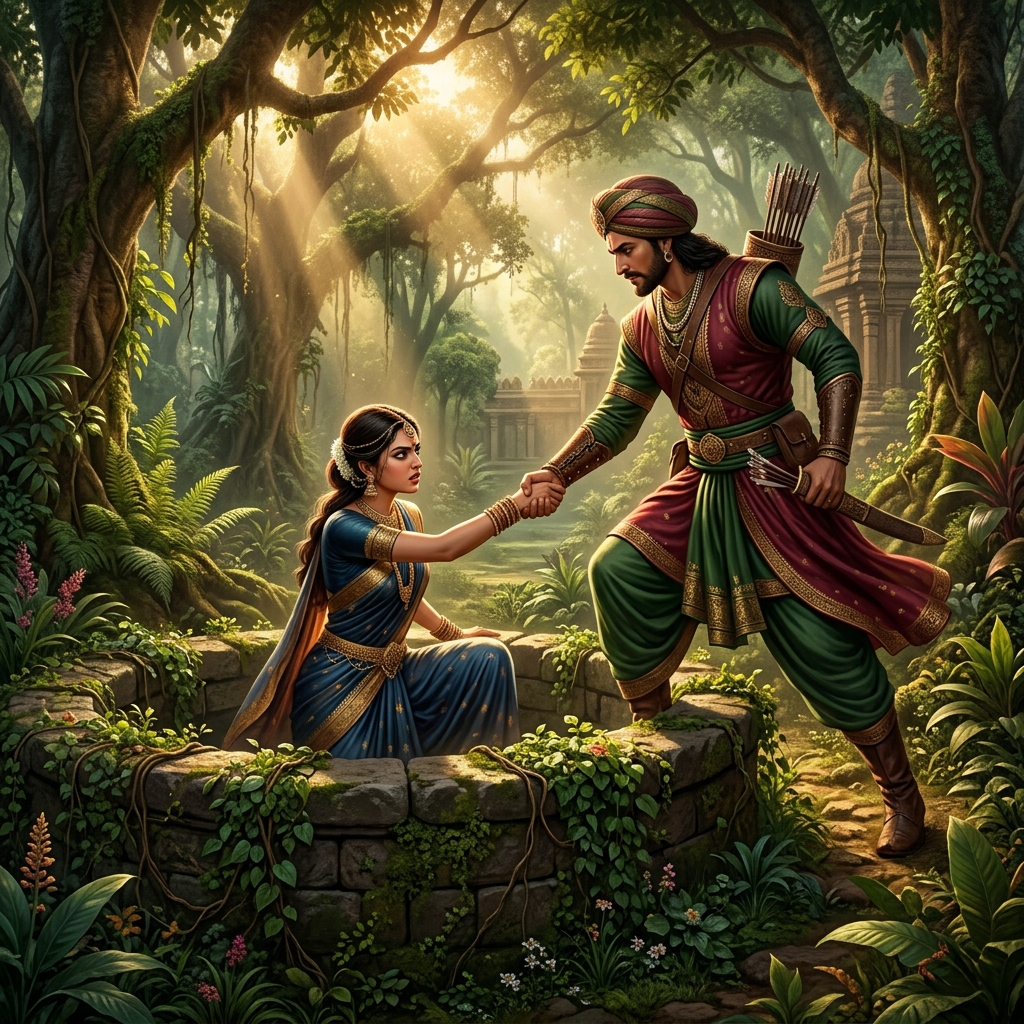
A Tale Told at Upaplavya
At Upaplavya, on the eve of a war that neither side any longer pretended could be avoided, Yudhishthira sat late into the night with Krishna, turning over the old question of what a king truly owns of his own greatness. Krishna, who answered such questions less often with argument than with story, told him this: that it was not the earthly tale of Yayati that mattered here, the young king restored by his son's borrowed youth after Shukra's curse, a story already known in every hall of the Kurus, but its sequel, the story of what befell Yayati afterward, in heaven itself, when the borrowed years had run their course and his own thousand years of penance had finally earned him a seat among the gods.
Even heaven, Krishna said, has tested kings more searchingly than the earth ever could, for the earth punishes a man's failures and heaven tempts him with his successes, and the second test is by far the harder to pass. Listen to what happened to Yayati once he had won the very thing every king labors a lifetime to reach, and see whether the winning of it was the end of his trial or only its beginning.
Yudhishthira, who had spent the day counting the men he would soon lead to their deaths, found in the question a strange comfort, that even a king who reached heaven itself was not free of dharma's audit, and he settled to hear how the tale went, for he suspected, rightly, that Krishna rarely told a story without meaning it also for the listener before him.
The Question of Indra
Yayati's thousand years of virtue, austerity, and just rule came at last to their appointed end, and he ascended to heaven in a chariot of light, received among the gods as few mortals ever are, given a seat near Indra's own and years of glory that made his long earthly reign look, in memory, like a single bright morning. He walked among the celestial groves, was honored by sages and gandharvas alike, and for age upon age wanted for nothing that heaven could give a soul that had earned its place there fairly.
It happened, as it happens even in heaven, that a day came when Indra, lord of that realm, turned to Yayati in the hearing of the assembled gods and sages, and asked him, with what seemed like simple curiosity, a question that carried more weight than its words let on. King, he said, tell us truly: among all the beings you have known, in this world or any other, whose austerity, whose learning, whose glory stands equal to your own?
Yayati answered without pause, for the question found him at the one moment in a very long life when he had stopped watching his own heart. No one's, he said. None among gods or men has matched what I have done, and none is likely to. The gods around him fell silent, not in awe but in something closer to grief, for they had heard, in that single sentence, the sound of a fortune ending.
A thousand years of penance, of rule without cruelty, of gifts given and vows kept, had built a merit vast enough to raise a man among the stars, and every measure of it dissolved in the instant he claimed it as a possession beyond comparison. Heaven does not hold what praises itself, an old voice among the assembly murmured, for the moment merit is counted aloud, it is already spent.
The Fall
Indra spoke the sentence that heaven itself required of him, not from anger but from a law older than his own throne: Yayati, your merit is exhausted by the very words that claimed it, and you must fall from this place, for heaven cannot hold a heart that has begun to worship itself. The light that had carried Yayati upward now let him go, and he felt his glorious years unravel from around him like a garment pulled loose, and began to fall, trailing brightness behind him the way a comet trails fire, down through the layered worlds toward the earth he had left so long ago.
In his falling, stripped of the pride that had cost him everything, something in Yayati woke that the thousand comfortable years in heaven had let sleep. He did not rage against the gods, for he knew the justice of the fall even as he suffered it, but he did cry out one plea into the rushing dark: that if he must fall, he might fall among the good, and not be wasted on barren ground where his landing would mean nothing to anyone.
The plea was heard, or the world simply arranged itself to answer it, for as Yayati fell he saw below him a sacrificial ground bright with fire and chanting, where four kings, unknown to him, were engaged in a great rite together, their virtue rising like smoke to meet his own falling light halfway. He came down among them not as a stranger crashing into a stranger's ceremony, but as a spent star drawn, almost gently, toward the one fire in that whole falling world still burning clean enough to receive him.
Kinsmen Unknown
The four kings at the sacrifice, Ashtaka and his brothers Pratardana, Vasumanas, and Shivi, broke off their rite at the sight of a falling stranger of such evident former glory landing amid their fires, and asked him at once who he was and what misfortune had brought so bright a being down to their ground. Yayati told them plainly: a king once, a soul who had earned heaven and lost it in a single sentence of pride, falling now to whatever earth or worse would take him.
Ashtaka, the eldest, pressed him further, and in the telling Yayati named his own lineage, and the four kings looked at one another with a recognition that struck them harder than the fall itself had struck him: they were his own daughter's sons, the offspring of Madhavi, born of a line they had known only in fragments of family memory, meeting for the first time the grandfather whose blood ran in them without ever having stood in his presence.
We will not let you fall further, Ashtaka said, and each of the four kings, moved by a kinship that owed nothing to acquaintance and everything to blood and reverence, offered Yayati the whole of his own hard-earned merit, the accumulated fruit of his own rites and rule and years of just governance, freely, without condition, to lift their grandfather back to the place his one boast had cost him.
Yayati refused at first, as a proud man refuses even the gift that will save him, protesting that he would not take alms he had not earned, that a king does not live on another's virtue. But the brothers insisted, and their insistence was itself a teaching he had not expected to receive from strangers who were also his own blood: that what is given between kinsmen freely is not alms at all, and that refusing a family's grace out of a lingering pride would only repeat the very fault that had brought him down.
Merit Given, Heaven Regained
Yayati, humbled now in a way his thousand years of penance had never quite managed to humble him, accepted at last what his grandsons offered, and felt his fallen light begin to gather itself again, not from any virtue reclaimed by his own effort but from four gifts freely given by kings who owed him nothing but blood and chose to give everything anyway. He rose from that sacrificial ground the way he had fallen from heaven, trailing brightness, but this time the brightness was not entirely his own, and he seemed, those who watched him said, more radiant for knowing it.
He returned to heaven a second time, not as the king who had climbed there alone on the strength of his own thousand years, but as a man carried upward on merit lent by kinsmen he had met only in his own undoing, and he kept, this time, a very different silence about what he had earned and what he had been given.
Krishna finished the tale and let it sit a moment in the quiet of the Upaplavya night before he spoke again. Consider it well, Yudhishthira, he said. It is not misfortune that unseats the great, but the boast that counts their own greatness aloud, for the instant a virtue is claimed as a private possession it ceases to be a virtue at all. And consider too what saved him: not his own recovered humility alone, but kinsmen willing to give away their own hard-won merit for a grandfather they had never known, which is to say that even a fallen king does not rise again by his own strength only. No one climbs back to heaven alone, and the house that will not lend its merit to a kinsman in his fall is poorer than it knows.
Yudhishthira sat with the story long after Krishna had finished, thinking less of Yayati's fall than of his rescue, and of what it might mean, in the days of war now so close upon them, to be a king surrounded by brothers willing to give away what they had earned.
Dharma Lesson
Merit is not lost by misfortune but spent by the boast that counts it, for the moment a virtue is claimed as one's own possession it stops being a virtue. Humility is the vessel every other quality is carried in, and no one, however great, rises or stays risen alone.