The Camp That Emptied
"After all the Kaurava troops had been killed by the sons of Pandu," said Dhritarashtra, "what did the survivors of my army do? Kritavarma, and Kripa, and the valiant son of Drona. And what did my son do?"
"The ladies had gone first," Sanjaya said. "That is the part you will not have been told. When the high-souled Kshatriyas were dead, their women went out of the camp, and after they had gone the camp was entirely empty. It was evening. The three of them stood in the middle of that emptiness and heard the shouts of the victorious sons of Pandu coming across the field, and they could not stay where they were and they could not go back out onto the field, and so they became filled with anxiety."
Eighteen days of war had come down to three men and their horses and a row of tents that nobody would sleep in. There were still fires burning where the cooks had left them. There were standards planted in the ground in front of tents whose owners were lying out on the field with their faces turned up.
"They could not stay on the field," Sanjaya said, "because the Pandavas were on it. They could not stay in the camp, because there was nothing in the camp to hold. So they did the only thing left, which was to go and find the king, and they had a guess where he was, because they had seen which way he went when he went. They mounted and rode for the lake."
"And my son," Dhritarashtra said. "Where was my son."
"Under the water, O king. I will come to that."
The Men With the Baskets
Bhimasena had met them earlier that day, on a track at the edge of the field, and he had recognized them because he saw them nearly every day of the war.
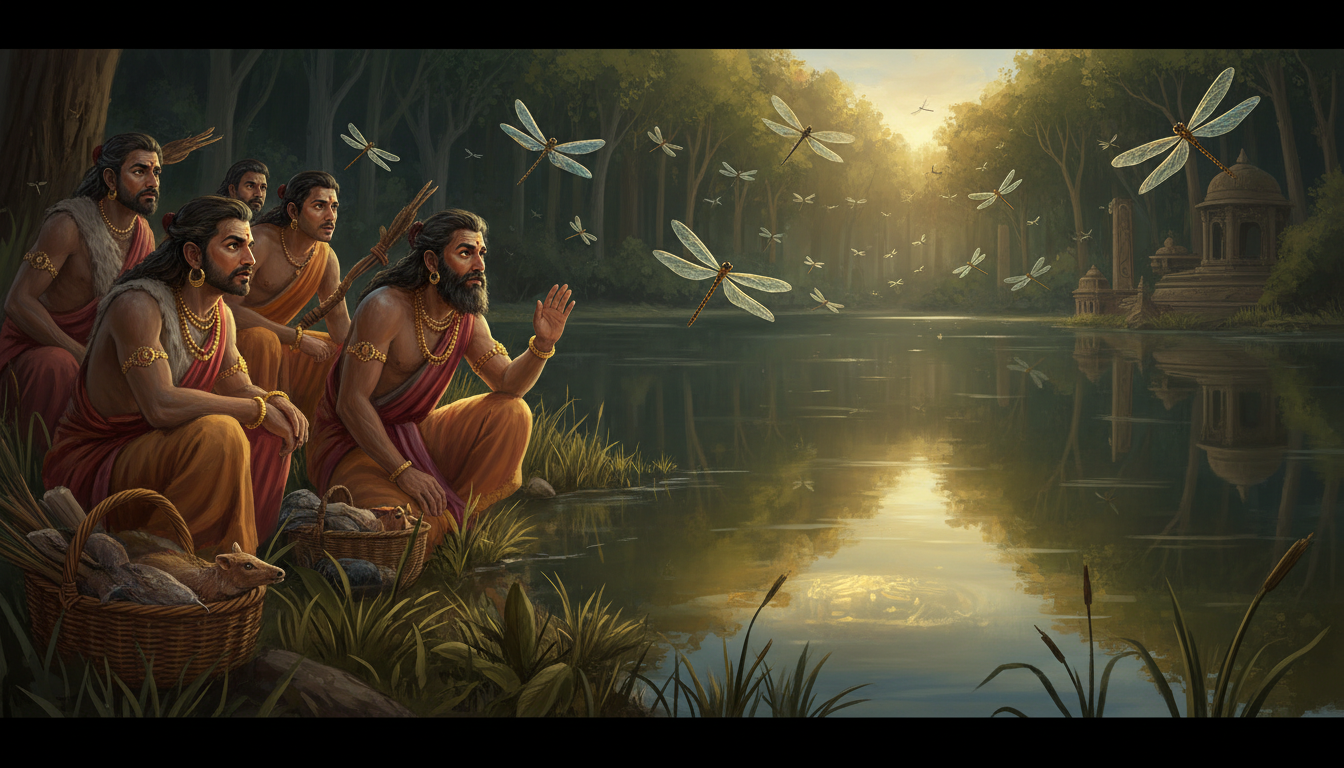
They were hunters. They carried baskets. Every day of that campaign, with great regard and without ever once failing, those men had procured a basketful of meat and brought it to Bhimasena, because a man of his appetite does not eat what the army cooks eat, and somebody has to go out into the country and kill it and carry it in.
Think about what that work was. An army of hundreds of thousands had been camped on that plain since before the first arrow, and everything that could be eaten within a morning's walk had been eaten by the fourth day. So the range got longer. They went out before it was light, and they went further each week, and they came back in the afternoon with the weight on their backs, past the picket lines, past the surgeons' fires, past the elephant lines, to one particular tent. They knew that road better than any general in either army. They knew where the water was. They knew which tracks the chariots had ruined and which ones were still good. They had walked over every part of that country while it was being fought over, and nobody had ever once asked them what they had seen, because nobody thinks to ask the man who brings the meat.
He stopped them on the track with his mace across his shoulder and blood dried on his arms up to the elbow.
"Duryodhana," he said. "Have you seen him. Anywhere. On any road."
They had not. They said so, and he let them go, and they went on with their baskets, and it did not occur to Bhimasena or to anyone else that the question had been planted in the heads of ten men who walked over more of that country in a day than the whole Pandava cavalry.
Then the Pandavas went back to the search, and it was a strange search, because the war had been won and the thing that had been won was missing.
The Field With Nothing in It
Yudhishthira of virtuous soul had felt a great joy that day, and it did not last the afternoon.
He and his brothers wandered over the field wanting to kill Duryodhana. Filled with wrath and desirous of victory, they looked for him very carefully, and they failed to discover him. He was not among the dead, which they could establish, because the dead lay where they had fallen and could be walked past and looked at, one after another, for hours. They did walk past them. That is what the searching of a battlefield is: five brothers and their attendants going along the windrows in the late light, turning over men in gold armour with a foot or a spear butt to see whose face was underneath, and finding a hundred kings and not the one. Bhima knew the shape of those shoulders better than he knew his own brothers'. He had been waiting thirteen years to stand over them. He was not among the living. He had taken his mace in his hand and gone off the field with great speed, and nobody had seen which way.
When at last their animals became very much tired, the Pandavas went back to their own camp and rested there with their soldiers.
They sent out spies in all directions across the field, wanting to reach the end of that sinful man's evil policy. All the soldiers who had been sent on that errand came back to the camp together, which is how a search reports when it has found nothing, and they told king Yudhishthira the just that no trace of king Duryodhana could be found anywhere.
Hearing the words of the returned messengers, Yudhishthira became filled with a great anxiety and began to breathe heavily. He had killed the army. He had not found the man, and until he found the man there was no end to any of it.
Water Made Solid
He was in the lake.
It was called Dvaipayana and it was wide as the ocean, agreeable to look at, its water cool and transparent, and it lay a distance off from the fighting where nothing had happened all day except birds. Duryodhana had come to it with his mace in his hand and gone down into it, and by his powers of illusion he had solidified the waters over himself and lay there at the bottom, armed, breathing, unwounded in any way that a physician would recognize.
He was the king of the Kurus and could not be vanquished by any man, and he was lying under a lake.
It is worth saying plainly what he had done, because it is easy to hear it as drowning and it was not drowning. He did not sink. He did not hide among the reeds at the edge. He made the water hard, by a wonderful method, and lay inside it the way a man lies inside a house, with the whole weight of the lake standing over him like a roof, and the surface above unbroken, so that anyone coming to that bank would see cool transparent water with the evening light on it and nothing else at all.
He meant to come out in the morning. He had told nobody that yet. He was resting, which was a thing he had not done since the first day, and there was not a man left alive on the earth who could have found him there by looking.
Three Men at the Water's Edge
Kripa and the son of Drona and Kritavarma of the Satwata race came slowly along the bank at dusk and stood over the place where the king lay, and called down into the water.
"Arise, O king, and fight with us against Yudhishthira! Either win the victory and enjoy the earth, or be killed and go to heaven! The forces of the Pandavas have all been slain by you, Duryodhana. Those of them still alive are exceedingly mangled. They will not be able to bear your impetuosity, especially when you are protected by us. Arise, therefore, Bharata!"
They had come slowly, and they had come because they could not do anything else. These were the three best-connected men in the Kaurava host, and between them they had a preceptor's son, a preceptor's brother-in-law and the last prince of the Bhojas, and no army whatever. They had ridden across a field covered with everyone they had ever fought beside to stand on a bank in the dark and shout at a lake.
The water did not move. Then the voice came up out of it, and it was perfectly calm, and that was the worst thing about it.
"By good luck I see you," Duryodhana said. "Bulls among men. Come back alive out of this destructive battle between the Pandavas and the Kauravas."
That was how he began. Not with a plan, and not with an order. With relief that three particular men were not dead.
Not Tonight
"After we have rested a while and dispelled our fatigue," the voice under the water went on, "we shall meet the enemy and conquer him. You also are tired and I myself am exceedingly mangled. The army of the Pandavas is swelling with might. For these reasons I do not like to fight now. These exhortations of yours are not at all wonderful, heroes, for your hearts are noble and your devotion to me is great. But this is not the time for prowess. Resting for this one night, I shall join you tomorrow and fight with the foe. In this there is no doubt."
He asked for a night. That was all. A man who had spent his whole life refusing to wait for anything asked his three surviving friends to let him have one night at the bottom of a lake.
The son of Drona would not have it.
"Arise, O king, blessed be you, we shall yet vanquish the foe! I swear by all my religious acts, by all the gifts I have made, by truth itself and by my silent meditations, that I shall today slay the Somakas. Let me never obtain the delight that pious men feel at the performance of sacrifices, if this night passes away without my slaying the Pandavas in battle. Without killing all the Pancalas I will not put off my armour. I tell you this truly. Believe me, ruler of men."
It was an oath sworn on the bank of a lake in the dark, to a king who did not answer it, and it would be kept, and keeping it would cost more lives than the day just ended. But the three of them were not the only people on that bank.
The Men Who Carried the Meat
While they were talking, the hunters came down to the water.
They came for no set purpose at all. They were fatigued with the weight of the meat they were carrying and they were thirsty, and this was water, and they came to it as they had come to it a hundred times that month. Then they saw the three chariots standing on the bank in the half-dark and they did what men in their trade do without needing to discuss it. They went flat on the ground among the reeds and stayed there.
And from there they heard every word.
They heard three great bowmen begging somebody to come out and fight. They heard a voice answering from under the water. They worked out, lying on their faces in the mud with their baskets beside them, that the king unwilling to fight who was staying within the waters was Duryodhana himself. Nobody had to tell them. They put the chariots and the voice and the word Bharata together and arrived at it.
Then one of them remembered the man with the mace on the track that afternoon.
They whispered it to each other, lying there, while the argument went on above them.
"We will discover Duryodhana to the Pandavas. The son of Pandu will then give us wealth. It is evident to us that the celebrated king Duryodhana is here. Let us all go to the place where king Yudhishthira is, and tell him that the vindictive Duryodhana is concealed within the waters of this lake. Let us also tell that great bowman, the intelligent Bhimasena, that the son of Dhritarashtra is concealed here. Gratified with us, he will give us much wealth."
And then the sentence that is the whole of the story, and that no bard has ever bothered to sing:
"What need is there of fatiguing ourselves day after day with procuring meat, and weakening ourselves with such toil?"
They were not avenging anything. They had no side. They were tired of carrying baskets, and there was a king in the water worth a purse.
Having said these words, filled with joy and longing for wealth, the huntsmen picked up their baskets of meat and went off toward the Pandava camp.
Paid at the Tent Door
They were forbidden at the edge of the camp, of course. Everyone is forbidden at the edge of a camp. They went in anyway, in the very sight of Bhimasena, and the sentries let it happen because the son of Pandu was standing right there and had seen them coming and had not said stop.
They approached that mighty son of Pandu and told him everything they had seen and everything they had heard, in order, leaving nothing out. The three chariots on the bank. The words the son of Drona had used. The voice that came up out of the water and asked for one night. The lake called Dvaipayana, and the road to it, and how long it took to walk.
Then Vrikodara, that scorcher of foes, gave them much wealth.
He did not make them wait for it and he did not haggle. He gave it to them standing there, and then he went to find his brother, and he was not a man who could keep his voice down when he was happy.
"Duryodhana has been discovered," he said, "by the huntsmen that supply me with meat. He for whom you grieve now lies within a lake whose waters have been solidified by him."
Hearing those agreeable words, Kunti's son Ajatasatru became filled with joy, and so did all his brothers. The whole camp knew inside a minute. The spies who had covered the entire field and come back with nothing had been beaten by ten men with baskets who had gone to the water because they were thirsty.
The Whole Army Walks Behind Ten Men
Then the king went, and Janardana went at his head, and everything that could still move went with them.
A tumultuous noise arose from the Pandavas and the Pancalas, all of them filled with joy. The warriors uttered leonine roars and shouted, and the Somakas called out again and again on every side, "The sinful son of Dhritarashtra has been found!" The noise of the cars of those impetuous warriors driving fast toward the lake became very loud and touched the heavens. Their animals were tired and they went anyway. Arjuna went, and Bhimasena, and the two sons of Madri, and the Pancala prince Dhrishtadyumna, and the unvanquished Shikhandi, and Uttamaujas, and Yudhamanyu, and the mighty car-warrior Satyaki, and the five sons of Draupadi, and every Pancala left alive, and the elephants, and the foot-soldiers by hundreds upon hundreds.
And somewhere at the front of that, walking, were the men with the empty baskets, showing them the way.
Duryodhana, lying inside the water he had made hard, heard it coming. It sounded like the roar of clouds.
The three on the bank heard it too. "Filled with joy and longing for victory, the Pandavas are coming here," they said down into the lake. "We will leave this place. Let it be known to you."
"So be it," he said, and did not move, and stayed where he was with the water solid over him.
So those car-warriors headed by Kripa, filled with grief, took their leave of the king and went away to a place far removed from that spot. When they had gone far enough they came to a banyan tree and stopped under it, greatly tired, and let their horses out of the cars, and sat down in its shade to be anxious.
"The mighty son of Dhritarashtra has solidified the waters of the lake and lies stretched at the bottom," they said to one another under that tree. "The Pandavas have reached that spot, wanting battle. How will the battle take place? What will become of the king?"
They did not know. They sat under the banyan and waited for news, three men out of eleven armies, while some way behind them the torches came down to the lake in a line that had no end to it.
And the hunters were not there for any of it. They had been paid at a tent door and had picked up their empty baskets and gone off in another direction entirely, out of the story, without waiting to see what was done with what they had sold. They never learned that the king came up out of that water in the morning, or what was said to him on the bank, or how it ended. They had what they came for. What need was there of fatiguing themselves, day after day, with procuring meat.
Dharma Lesson
Empires turn on the people nobody counted. The spies of a victorious army covered the whole field and found nothing, while ten men who fed that army found the king by accident because they were thirsty. A man who supplies an army is owed more attention than the man who commands it.