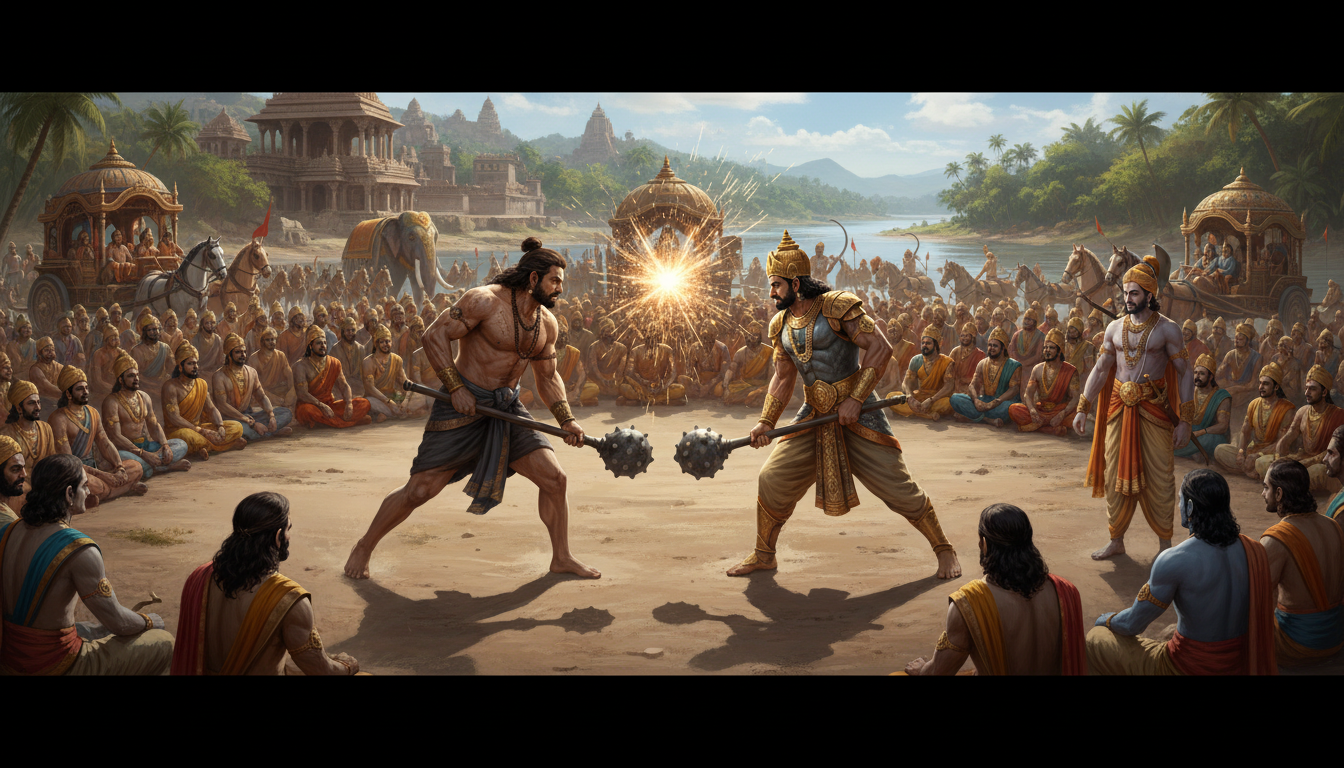
The Duel on the Southern Bank
Two pupils of one teacher settle a war with clubs
Rama Comes Out of the Crowd
The old king had been sitting with his hands flat on his knees, letting the account of the day's slaughter run past him, and then he lifted his head and stopped it.
"Rama came," Dhritarashtra said. "Balarama came to that spot with the dust of the pilgrimage still on him, just as the mace fight was about to begin. Tell me that part, Sanjaya. Tell me how my son fought Bhima."
So Sanjaya told him.
Duryodhana saw the plough-bearer first, and the sight of him filled the king with joy, because Balarama had taught them both and would know what he was watching. Yudhishthira rose and honoured him, gave him a seat, and asked after his welfare, and the elder brother of Krishna answered with words that were sweet and righteous and useful to fighting men.
"I have heard it said by the rishis, best of kings, that Kurukshetra is a holy place and a place that washes away sin, equal to heaven itself, adored by the gods and the rishis and by high-souled brahmanas. Those men who cast off their bodies while engaged in battle on this field are certain to live in heaven with Shakra himself. For that reason I shall go now to Samantapanchaka. In the world of the gods that ground is known as the northern altar of Brahma, the lord of all creatures. He who dies in battle on that eternal spot, the most sacred in the three worlds, is sure to obtain heaven."
"So be it," said Yudhishthira, and rose, and the whole assembly rose with him.
The Walk West
Duryodhana picked up his mace, which was of enormous thickness, and went with them on foot.
He had eleven divisions of troops eleven days ago. Now he walked in the middle of his enemies with a club on his shoulder, and the celestials in the sky said, "Excellent, excellent," and the Charanas, who move as fast as air, saw the Kuru king walking and were filled with delight. He did not hurry. He went with the tread of an infuriated elephant, and the conchs blared and the drums came in behind them, so that the march west had the sound of an army in it although it was only a crowd walking to watch two men. At the appointed ground they scattered out on every side.
It was an excellent tirtha on the southern bank of the Sarasvati, and the ground there was not sandy. That was the reason it was chosen, because sand takes a man's footing from under him and this was to be decided by feet as much as by hands.
Bhima put on his armour and took up his mace and stood there in the shape of Garuda. Opposite him Duryodhana fastened his head-gear, and his armour was made of gold, and he licked the corners of his mouth, and his eyes were red with wrath, and standing on that field he looked like the golden Sumeru.
Each of them lifted his mace and challenged the other, the way one elephant challenges a rival elephant. In the encounter of maces both were the pupils of one man, the intelligent son of Rohini, who was standing there watching. They were like Sunda and Upasunda, like Vali and Sugriva, like Kala and Mrityu, and each of them had waited thirteen years for this.
The Kings Sit Down in a Ring
Before it began, Duryodhana turned to Yudhishthira and said one proud thing in front of Krishna and Balarama and all the brothers.
"Protected by the Kaikeyas and the Srinjayas and the high-souled Pancalas, sit down, all of you, with all these foremost of kings, and watch this battle that is about to take place between me and Bhima."
They did exactly as he asked. That great crowd of kings sat down on the ground in a ring, and Sanjaya said it looked like a gathering of the celestials in heaven. In the middle of them sat the elder brother of Keshava, and every man near him did him honour. Balarama wore blue robes and his complexion was fair, and among those kings he looked like the full moon with thousands of stars around it.
Inside the ring the two men stood goading each other with fierce speeches, and when the bitter words ran out they simply stood, casting angry glances, like Shakra and Vritra.
In the hall at Hastinapur the blind king put his hands over his face.
"Fie on man, who has such an end," Dhritarashtra said. "My son was the lord of eleven chamus of troops. He had every king on earth under his command and he enjoyed the sovereignty of the whole world. And that is the man who went to battle on foot with a mace on his shoulder. He who had been the protector of the universe was standing there without any protection of his own. What can it be but Destiny? Great was the grief my son felt on that occasion."
And having said that, the ruler of men fell silent, and did not interrupt again for a long time.
The Bill Bhima Read Out
When Duryodhana summoned him to the encounter, the sky went wrong.
Fierce winds began to blow at intervals with a noise in them, and a shower of dust fell, and every point of the compass filled with a thick gloom. Hundreds of meteors burst out of the heavens. Rahu swallowed the sun at the wrong hour. Hot winds drove hard pebbles along the ground, and the summits of mountains fell. Jackals with blazing mouths howled everywhere. The water in the wells swelled up of its own accord, and loud sounds came from every side with no visible creature to make them.
Bhima looked at all of it and turned to his eldest brother.
"This Suyodhana of wicked soul is not competent to defeat me. Today I shall vomit out upon this ruler of the Kurus the wrath I have kept in the secret recesses of my heart for a long while, as Arjuna threw fire upon the forest of Khandava. Today I shall pull out the dart that has been sticking in your heart, and put the garland of Fame around your neck, and break his body into a hundred fragments, and he will never enter the city called after the elephant again. The snakes set on us while we slept. The poison given us with our food. Our bodies thrown into the water at Pramanakoti. The house of lac. The insult in the assembly. The robbing of everything we owned. The whole year we lived in concealment. The exile into the woods. Of all those woes, today I reach the end. In one single day I shall pay off every debt I owe him."
Then he turned and said the rest of it to Duryodhana's face.
"Recall that act of yours and your father's at Varanavata. Remember Draupadi, ill-treated in the middle of the assembly while she was in her season. Remember the king stripped by you and by Subala's son at dice. Remember the misery we bore in the forest because of you, and in Virata's city, as if we had entered the womb a second time. By good luck I see you here. It is for your sake that the son of Ganga, struck down by Yajnasena's son, sleeps on a bed of arrows. Drona has been killed. Karna has been killed. Shalya of great prowess has been killed. Subala's son Shakuni, the root of all this, has been killed. The wretched Pratikamin who took Draupadi by the hair has been killed. All your brave brothers who fought with valour have been killed. These and many other kings are dead through your fault. You too I shall kill today with this mace, and there is not the slightest doubt in it."
What Use of Bragging
Duryodhana had listened to the whole recital without moving. When it was finished he answered in a voice that carried to the outer edge of the ring.
"What use is there in such elaborate bragging? Fight me, Vrikodara. Wretch of your race, today I shall destroy your appetite for battle. Mean vermin that you are, know that Duryodhana is not a man to be frightened by the likes of you as an ordinary person might be. For a long time I have wanted this. For a long time this wish has been in my heart. By good luck the gods have brought it about at last, a mace encounter with you. What use are long speeches and empty bragging, wicked-souled one? Put those words of yours into acts. Do not tarry."
The Somakas and all the other kings sitting there applauded him loudly, because it was the answer of a man who had lost everything and had not lost his voice. Duryodhana's hair stood up on his arms with joy, and the kings cheered him again with clapping, the way men clap to excite an elephant into a fight.
Then Bhima lifted his mace and rushed at him.
The elephants tethered at the edge of the field trumpeted. The horses neighed and went on neighing. And the weapons of the Pandavas, standing where their owners had left them to sit down and watch, blazed up of their own accord.
The Circles
They came together like two bulls meeting with their horns, and the strokes of the maces made a sound like thunderbolts.
It was terrible to watch and it made the hair stand on end, and it was like the battle between Indra and Prahlada. Within a little while both of them had blood on every limb and looked like a pair of kinsuka trees in flower. Sparks came off the iron so steadily that the sky above them seemed to swarm with fire-flies.
After a time both men were tired. They stopped, rested a little while, picked up their handsome maces again and went back to warding off each other's attacks, and the gods and the gandharvas and the men watching were filled with wonder, and none of them could say which one was going to win.
Bhima performed every evolution there is. He coursed in beautiful circles, advanced and receded, took up one position after another for attack and for defence. He ran at his enemy turning now to the right and now to the left, then came straight in. He made ruses to draw him. He stood absolutely still, waiting for the moment when the other man would expose himself. He walked around his enemy and would not let his enemy walk around him. He avoided blows by bending away from them or by jumping into the air. He struck face to face and he struck backhanded while moving away.
Duryodhana matched him in all of it. They circled and seemed almost to be sporting with each other, then would suddenly come together and attack like two elephants using their tusks. Duryodhana had taken the right mandala. Bhima had taken the left. Covered in blood, in the failing light of the last day of the war, they went on and on like Vritra and Vasava.
Neither Man Would Stay Down
While Bhima was circling to the left, Duryodhana struck him a fierce blow on one flank.
Bhima began to whirl his heavy mace to return it, and the spectators said afterwards that the weapon looked as terrible as Indra's thunderbolt or the raised bludgeon of Yama. Duryodhana did not wait for it. He lifted his own weapon and struck again, and the descent of it was so quick that it made a flame of fire in the air.
Bhima hurled his mace at him. Duryodhana warded it off by sheer agility, and the mace fell on the earth baffled and made the ground shake. Then the Kuru prince took the left mandala and struck the son of Kunti on the head with all his force.
Bhima did not move. He did not stir an inch, and every warrior sitting in that ring applauded him for it.
Duryodhana adopted the manoeuvre called Kausika, jumping up again and again, marking the descent of Bhima's mace and being always somewhere else when it arrived, and then in a rage he struck Bhima on the chest. Bhima was stupefied and for a moment did not know what he was doing. The Somakas and the Pandavas went very quiet.
Then Bhima rushed him like a lion rushing at a wild elephant and struck him on the flank, and Duryodhana went down on his knees. The Srinjayas set up a shout that carried across the whole field. Hearing it, the king came up off his knees breathing like a great snake, looked at Bhima as though the look itself would burn him, and struck him on the forehead. Bhima stood like a mountain and did not move, and the blood ran down his face the way the juice runs down the temples of a rutting elephant.
So Bhima took up his hero-slaying mace of iron and struck him with everything he had, and Duryodhana fell trembling in every limb like a great sala tree in flower uprooted by a storm.
The Pandavas shouted. And Duryodhana got up out of the earth like an elephant coming up out of a lake, careered around him with great skill, and struck Bhima down, and Bhima fell with his limbs gone weak and his coat of mail split open by the blow.
A roar went up in the sky from the celestials and the apsaras, and a shower of flowers came down with a great fragrance on it. The Pandavas looked at their brother lying with his armour open and were badly afraid. Then Bhima recovered his senses, wiped the blood off his face, and stood up, steadying himself with great effort, his eyes rolling.
Who Is the Better Man
Arjuna had been watching all of it from where he sat, and he leaned over to Vasudeva.
"Between these two, who is the superior in your opinion? Which of them has what merit? Tell me this, Janardana."
"The instruction they received was equal," Krishna said. "Bhima has the greater might. The son of Dhritarashtra has the greater skill, and he has worked harder. If he fights fairly, Bhimasena will never win. If he fights unfairly he will certainly be able to kill Duryodhana. The Asuras were beaten by the gods with the help of deception, we have heard it. Virochana was beaten by Shakra with deception. The slayer of Vala took Vritra's energy from him by an act of deception. Let Bhimasena put out his prowess with deception in it.
"At the gambling match Bhima vowed that he would break Suyodhana's thighs in battle with his mace. Let him accomplish that vow. Let him kill by guile the Kuru king who is full of guile. If Bhima trusts to his strength alone and fights fair, king Yudhishthira will be in great danger.
"And I tell you again, son of Pandu, listen. It is through the fault of king Yudhishthira alone that this danger has come on us a second time. He had slain Bhishma and the other Kurus, he had won the victory and the fame, he had almost reached the end of these hostilities, and having got the victory he put himself back into doubt and peril. It was an act of great folly to make the result of the whole war depend on the victory or defeat of one single warrior.
"There is an old verse of Usanas that we have heard. 'Those among the remnant of a broken force, who were flying for their lives and who rally and come back to the fight, should always be feared, for they are firmly resolved and have only one purpose.' Shakra himself cannot stand in front of men who rush at him in fury having given up all hope of living. This Suyodhana was broken and fled. All his troops were killed. He went down into the depths of a lake, and he had wanted to go away into the woods with no hope of keeping his kingdom. What man with any wisdom in him challenges such a person to single combat?
"I do not know that Duryodhana may not take back the kingdom that had already become ours. For thirteen full years he practised with the mace and practised with great resolution. Even now, to kill Bhimasena, look how he jumps up and leaps across. If the mighty-armed Bhima does not kill him unfairly, the son of Dhritarashtra will remain king."
The Left Thigh
Arjuna heard him out. Then he slapped his own left thigh, hard, in full view of Bhimasena.
Bhima understood the sign. He began to career with his mace up, making beautiful circles and Yomaka manoeuvres and every other kind, sometimes the right mandala, sometimes the left, sometimes the motion called Gomutraka, stupefying the man in front of him. Duryodhana, who knew the mace as well as any man alive, careered as beautifully and as quickly. Their weapons had been smeared with sandal paste and perfumed unguents before the fight, and the two of them whirled that scented iron like two angry Yamas, like two Garudas after the same snake.
Both of them tired again. They rested. They lifted the maces and went back into it, and this time they mangled each other so badly that the fight lost all restraint, and covered with blood from head to foot they looked like two kinsukas on the breast of Himavat.
Then Bhima, as a ruse, seemed to leave himself open.
Duryodhana smiled a little and came forward. Bhima hurled his mace at him at once, and Duryodhana stepped off the spot and the weapon fell on the empty ground, and while Bhima was still recovering, Duryodhana struck him. The blow drew so much blood, and was so violent in itself, that Bhima was stupefied where he stood. Duryodhana never knew it. Bhima held himself upright out of pure patience, so that the king took him for a man about to strike back, and did not hit him again.
Bhima rested a moment and then went at him furiously.
Duryodhana saw him coming and set his heart on the manoeuvre called Avasthana. He meant to jump upward and let the blow pass under him. Bhima understood exactly what he intended. He rushed in with a leonine roar and hurled his mace at the thighs of the Kuru king while the king was in the air with nothing under his feet.
The mace had the force of a thunderbolt in it. It fractured both of Duryodhana's handsome thighs, and he came down, and the earth echoed with the fall.
Fierce winds began at once, with loud sounds at intervals, and showers of dust. The earth with her trees and her mountains trembled. Great meteors flashed down out of the sky, and bloody showers fell, poured down by Maghavat, upon the fall of the son of Dhritarashtra. The Yakshas and the Rakshasas and the Pisachas made a noise in the sky, and thousands of animals and birds answered it. Headless beings of frightful shape, with many legs and many arms, began to dance and to cover the ground on every side. Lakes and wells vomited blood. Rivers of rapid current flowed backwards. And in that hour women looked like men and men looked like women.
Cow, Cow
The Pandavas were filled with joy. The Somakas looked at the Kuru king lying on the earth like an infuriated elephant felled by a lion, and their hair stood on end.
Bhima walked over to him.
"Wretch," he said, "you laughed at Draupadi when she was disrobed in the middle of the assembly, and you called us 'Cow, Cow!' Bear the fruit of that insult now."
And he put his left foot on the head of that lion among kings and pressed down. Then he stood there with his eyes red and said the rest.
"They that danced at us insultingly, saying 'Cow, Cow,' we shall now dance at them, saying the same words. We have no guile, no fire in the night, no crooked match at dice, no deception. We resist our enemies and check them by the strength of our own arms."
He turned around to Yudhishthira and Keshava and Dhananjaya and the two sons of Madri, laughing, speaking slowly.
"They that dragged Draupadi into the assembly while she was ill and disrobed her there: look at those sons of Dhritarashtra lying dead on the field, killed through the ascetic penances of Yajnasena's daughter. Those wicked-hearted men who called us sesame seeds without kernel have all been killed with their relatives and their followers. Whether we go to heaven for it or fall into hell matters very little to me."
He lifted the mace back onto his shoulder and struck the head of the prostrate king with his left foot a second time.
Many of the foremost warriors among the Somakas, who were righteous men, saw the foot of the rejoicing Bhimasena on the head of that foremost one of Kuru's race, and did not approve of it.
"You have paid off your hostility and accomplished your vow, by a fair act or an unfair one," Yudhishthira said. "Stop now, Bhima. Do not crush his head with your foot. Do not act sinfully. Duryodhana is a king. He is your kinsman. He is fallen. He was the lord of eleven akshauhinis of troops. Do not touch a king and a kinsman with your foot. His friends and his counsellors are gone. His army is exterminated. His brothers are dead. His sons are dead. His funeral cake has been taken from him. He is our brother. People used to say of you, 'Bhimasena is a man of righteous behaviour.' Why then do you insult the king in this way?"
Then he went to the fallen man himself, and his voice was choked.
"You should not give way to anger, nor grieve for yourself. Without doubt the Creator ordained this sad result, that we should injure you and you should injure us. Through your own fault this calamity has come on you, out of avarice and pride and folly. You caused your brothers and your sons and your grandsons all to be killed, and now you come by your own death. You are not to be pitied. Your death is enviable. It is we who deserve to be pitied in every respect. How shall I look at the widows of my brothers and my sons, out of their senses with sorrow? You depart from this world, king, and you are sure to have your residence in heaven. We shall be reckoned as creatures of hell. The grief-stricken wives of Dhritarashtra's sons and grandsons will curse us all."
And having said that, the royal son of Dharma stood over his enemy breathing hard, and began to lament.
Dharma Lesson
When skill is on the wrong side and might on the right one, the epic does not pretend the choice is clean. Krishna weighs the two men honestly, says plainly that a fair fight loses the war, and tells Arjuna to signal for the foul blow. The victory is real, and the winner carries the stain of it for the rest of the story.