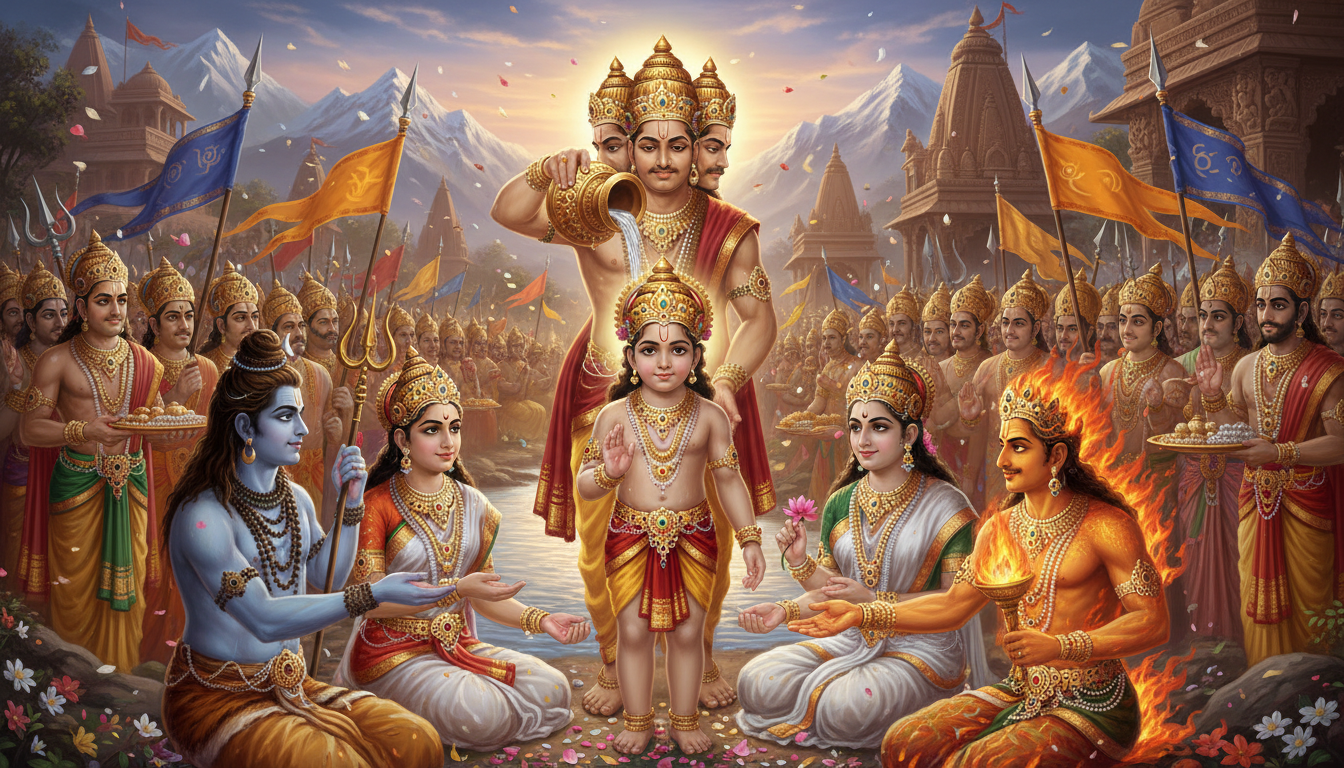
The Anointing of the War God
Every god brings a gift to a six-day-old commander
The King Asks for the Ceremony
"You have described the merits of the Sarasvati," said Janamejaya. "Now describe to me the investiture of Kumara. My curiosity is great. Tell me everything: the time when, and the place where, and the manner in which the adorable lord Skanda was invested with the command of the celestial forces. Tell me who they were that invested him, and who performed the actual rites, and how the generalissimo of heaven made his great carnage of the Daityas."
"That curiosity is worthy of your birth in Kuru's race," Vaishampayana said. "Listen, then, and I will begin where it begins, which is with a fire that could not burn something."
In the days of old the vital seed of Maheshvara came out and fell into a blazing fire. Agni, the consumer of everything, could not burn that indestructible seed. Instead the bearer of sacrificial libations became possessed by it, filled up with an energy and a splendour that were not his own, and he could not hold it inside himself either. At the command of Brahman he went to the river Ganga and threw into her that divine seed with the effulgence of the sun in it. Ganga could not hold it. She cast it out onto the beautiful breast of Himavat, that mountain which the celestials worship.
So the child of Agni began to grow on a mountainside, out of a thing that three of the greatest powers in the world had each tried to carry and had each been forced to set down.
This Child Is Mine
The six Krittikas found him first. He was lying on a clump of heath, a child of fiery splendour, and all six of those goddesses wanted a son, and all six of them cried out at once.
"This child is mine! This child is mine!"
He understood the state of their minds. So he assumed six mouths and sucked the breasts of all of them at the same moment, and that was the first thing he ever did, and it settled the question by refusing to answer it. The Krittikas, goddesses of beautiful form, stood there filled with wonder. From that day he was called Kartikeya, though before it he had been called Gangeya, after the river who had carried him as far as she could.
And because Ganga had cast that seed on the summit of Himavat, the mountain was transformed into gold. With that child growing on her, the whole earth became beautiful, and it is for this reason that mountains have produced gold ever since.
He grew there in the ordinary way and in no ordinary time, endued with self-restraint and asceticism and great energy, and became a person of highly agreeable features, like Soma himself. He lay on that excellent golden clump of heath and was adored and praised by Gandharvas and by ascetics. Celestial girls in their thousands, who knew the music and the dance of heaven, praised him and danced in front of him. Ganga waited upon him. The Earth assumed her own great beauty and held him on her lap.
The priest of the gods, Brihaspati, performed the usual rites after birth. The Vedas came to him, taking a fourfold form, and stood with their hands joined. The Science of arms came, with its four divisions, and all the weapons came, and every kind of arrow, and none of them had to be sent for.
The Company on the Mountain
One day the child saw the god of gods, the lord of Uma, sitting with the daughter of Himavat in the middle of a swarm of ghostly creatures.
Those creatures were of emaciated bodies and wonderful features. They were ugly, and their ornaments and their marks were awkward. Some had the faces of tigers and lions and bears and makaras, some of scorpions, some of elephants and camels and owls. There were faces of vultures among them and faces of jackals, and faces like cranes and pigeons. Many had bodies like dogs and porcupines and iguanas and goats. Some resembled mountains and some oceans. Some stood holding up discs and maces. Some looked like masses of antimony and some like white mountains.
And the seven Matris were there. And the Sadhyas, the Viswedevas, the Maruts, the Vasus, the Rudras, the Adityas, the Siddhas, the Danavas, the birds, and the self-born Brahman with his sons, and Vishnu, and Shakra. They had all come for the same reason, which was to look at the child.
The foremost of the celestials came, and the Gandharvas headed by Narada, and the celestial Rishis and the Siddhas headed by Brihaspati, and the fathers of the universe, and those that are called the gods of the gods, and the Yamas, and the Dharmas.
Into the middle of that assembly walked a child, going toward Mahadeva, who sat armed with the trident and the Pinaka.
Four Forms in an Instant
As he came, a thought entered the mind of Siva, and the same thought entered the mind of the daughter of Himavat, and the same thought entered the mind of Ganga, and the same thought entered the mind of Agni.
Each of them was thinking: he will come to me first.
They were four, and there was one child, and there is only one first. Between the four of them they had the god who had begotten him, the goddess who had claimed him, the river who had carried him and the fire that had held him, and every one of those four claims was a true claim, and each of them had spent the whole of that morning quietly certain that the child would honour theirs.
The child understood what each of them expected. Then, without a pause and without choosing, he had recourse to his Yoga powers and assumed four different forms at the same time.
He did it in an instant. Three forms stood out behind him, and they had names: Sakha, and Visakha, and Naigameya. All four were of similar appearance and all four were endued with great effulgence.
Then the four of him walked calmly to the four of them. The form called Skanda, of wonderful appearance, went to the place where Rudra was sitting. Visakha went to the divine daughter of Himavat. Sakha, which is the Vayu form of Kartikeya, went to Agni. And Naigameya, that child of fiery splendour, went to Ganga.
The gods and the Danavas and the Rakshasas made a loud noise at the sight of it, and the hair of everyone there stood on end. It was the first act of government he ever performed, and he had performed it before he could be asked to.
Give Him Something Suitable
Then Rudra and the goddess Uma and Agni and Ganga, all four of them satisfied and none of them slighted, went together and bowed to the Grandsire, and having bowed properly, they asked him for something on the child's behalf.
"It is right, Lord of the gods, that you should grant to this youth some kind of sovereignty suitable to him, one that he may desire. Grant it for the sake of our happiness."
Brahma, possessed of great intelligence, began to think what he could bestow.
This was the difficulty. He had already given everything away. Long before, he had handed out to the formless ones every kind of wealth and dominion there was, and the high-souled celestials held it, and the Gandharvas and the Rakshasas and the ghosts and the Yakshas and the birds and the snakes each held their portion of it, and there was nothing lying unclaimed in the three worlds that a grandfather could hand to a grandson.
So he did not make anything new. He reflected for a moment, and being always mindful of the welfare of the gods, he bestowed upon the youth the status of a generalissimo among all creatures. And then he did the thing that made the gift real, which was to order all those gods who are counted as chiefs of the celestials, and all the other formless beings, to wait upon him.
Then the gods, with Brahman at their head, took the youth with them and came to Himavat, and chose the ground for the ceremony: the bank of the sacred and divine Sarasvati, that foremost of rivers, which rises out of Himavat, and which at Samantapanchaka is celebrated over the three worlds. There, on that bank, which possesses every merit, the gods and the Gandharvas took their seats with well-pleased hearts, all their desires having been gratified.
The Water Out of Golden Jars
Brihaspati collected everything the scriptures lay down for a ceremony of investiture and poured the libations on the blazing fire himself. Himavat gave a seat adorned with many costly gems, and Kartikeya was made to sit on it. The gods brought all the auspicious articles with the rites and the mantras that are necessary.
And then everything came.
Indra came, and Vishnu, both of great energy. Surya and Candramas. Dhatri and Vidhatri. Vayu. Agni. Pushan, Bhaga, Aryaman, Ansa. Rudra of great intelligence, and Mitra, and the eleven Rudras, the eight Vasus, the twelve Adityas, the twin Ashvinis, the Viswedevas, the Maruts, the Sadhyas, the Pitris, the Gandharvas, the Apsaras, the Yakshas, the Pannagas. Celestial Rishis without number. The Vaikhanasas and the Valakhilyas, and those among the Rishis who subsist only on air, and those who subsist on the rays of the sun. The Vidyadharas, and all who were crowned with ascetic success. Pulastya came, and Pulaha, and Kasyapa, and Atri, and Marichi, and Bhrigu, and Kratu, and Manu, and Daksha.
The Seasons came, and the Planets, and all the luminaries. Every river in the world came in her embodied form. The eternal Vedas came, and the Seas, and the tirthas, and the Earth, and the Sky, and all the points of the compass, and the Trees. Aditi the mother of the gods came, and Hri and Sri and Swaha and Sarasvati and Uma and Sachi, and the Day of the new moon and the Day of the full moon, and the wives of the denizens of heaven. Himavat came, and Vindhya, and Meru of many summits, and Airavat with all his followers. The divisions of time came, Kala and Kashtha and the Fortnight and the Seasons and Night and Day. Ucchaisravas, the prince of steeds. Vasuki, the king of the snakes. Aruna. Garuda. The adorable god Dharma.
And Kala came, and Yama, and Mrityu, and the followers of Yama, because a commander of armies is not installed without them.
Then, filled with joy, the denizens of heaven made that high-souled youth the generalissimo of the celestial forces, pouring on his head the sacred water of the Sarasvati out of golden jars that held the other sacred articles too. The Grandsire poured, and Kasyapa of great energy poured, and all the others poured, named and unnamed, exactly as the gods had once poured water on the head of Varuna to make him lord of the waters.
Everyone Gives Away a Piece of What They Hold
Then the giving began, and what was given was not treasure. It was people. Every god present handed over some of his own household.
Brahman, with a gratified heart, gave him four companions of great might, swift as the wind, crowned with ascetic success and able to increase their own energy at will: Nandisena, Lohitaksha, Ghantakarna and Kumudamalin. The lord Sthanu gave one companion of great impetuosity, capable of producing a hundred illusions, a great destroyer of Asuras, who in the war between the gods and the Asuras had killed fourteen millions of Daityas of fierce deeds with his hands alone.
The gods then made over to Skanda the celestial host itself, invincible, abounding in celestial troops, capable of destroying the enemies of the gods. All of them, with Vasava at their head, and the Gandharvas and the Yakshas and the Rakshasas and the Munis and the Pitris, shouted victory to him.
Yama gave two who resembled Death, Unmatha and Pramatha. Surya gave Subhraja and Bhaswara. Soma gave Mani and Sumani, who looked like summits of Kailasa and always wore white garlands. Agni gave two grinders of hostile armies, Jwalajihba and Jyoti. Ansa gave five: Parigha, and Vata, and Bhima of terrible strength, and Dahati, and Dahana. Vasava gave two who had killed innumerable enemies of Shakra, Utkrosa armed with the thunderbolt and Panchaka with the club. Vishnu gave three, Chakra and Vikrama and Sankrama. The Ashvinis gave Vardhana and Nandana, who had mastered all the sciences. Dhatri gave five, Kunda and Kusuma and Kumuda and Damvara and Adamvara. Mitra gave Suvrata and Satyasandha, celebrated over the three worlds and able to grant boons. Pushan gave Panitraka and Kalika, endued with great powers of illusion. Vayu gave Vala and Ativala, who had very large mouths. Varuna, firmly adhering to truth, gave Ghasa and Atighasa, whose mouths were like those of whales. Himavat gave Suvarchas and Ativarchas. Meru gave Kanchana and Meghamalin. Vindhya gave Uschrita and Agnisringa, who fought with large stones. Ocean gave Sangraha and Vigraha, armed with maces. Vasuki, king of the snakes, gave two snakes, Jaya and Mahajaya.
And the Sadhyas and the Rudras and the Vasus and the Pitris and the Seas and the Rivers and the Mountains all gave commanders of forces, armed with lances and battle-axes and decked with ornaments.
Thousands upon thousands came to him after that, of every possible shape. Some had faces like tortoises and some like cocks, some like dogs and wolves and hares and owls and asses and hogs, and some had human faces. Some had mouths on their shoulders, some on their stomachs, some on their backs, some on their calves. Some had many arms and some many heads, and the arms of some resembled trees. Some were clad in rags, some in bones, some in the skins of large elephants. Some had five tufts of hair and some had seven and some were perfectly bald. They were of every colour, and they spoke every kind of language, and they were skilled in all the provincial dialects, and, being puissant, they stood about conversing with one another.
Battle was the one thing in which they took delight, and there was not a god foremost among the gods who could have beaten them. Wearing rows of tinkling bells, they danced around the boy in his gemmed seat while the ceremony went on.
The Mothers
And then the mothers came, and they came in bands.
They were Prabhavati and Vishalakshi and Palita and Gonasi and Shrimati and Bahula and Bahuputrika. Apsujata and Gopali and Brihadambalika and Jayavati and Malatika and Dhruvaratna and Bhayankari. Vasudama and Sudama and Vishoka and Nandini. Ekacuda and Mahacuda and Cakranemi and Uttejani and Kamalakshi. Bhadrakali and Samkarika and Nishkutika and Catvaravasini, whose name means the one who dwells at the crossroads. Sumangala and Svastimati and Jayapriya and Dhanada. Putana. Mandodari. Kotara. Meghavasini. Shatodari and Mahavega and Manojava. Kroshanatha, and Taditprabha whose brightness is the lightning, and Lohamekhala with her iron girdle, and Kharajangha, and Lohitakshi, and Dirghajihva, and Mahakaya, and Krishnakarni and Kshurakarni and Catushkarni and Karnapravarana who wraps herself in her own ears, and Catushpathaniketa who has her house where four roads meet, and Gokarni and Mahishanana, and Bherisvanamahasvana whose voice is the war-drum. And thousands more.
The mobile and the immobile universe is pervaded by those auspicious ones.
Their nails were long and their teeth were large and their lips protruded. They were of straight form and sweet feature, endowed with youth and decked with ornaments, and they could assume any shape they wished. Some were fair as gold, some dark as clouds, some the colour of smoke, and some had the splendour of the morning sun. Some had long tresses and white robes, some had their braids tied upward, some had eyes of a tawny hue, some green, some coppery. Some partook of the nature of Yama, and some of Rudra, and some of Kuvera, and some of Varuna, and some of Indra, and some of Agni, and some of Brahma, and some of Vishnu, and some of Surya. In voice they resembled the kokila. In splendour they resembled fire. In battle their energy was the energy of Shakra, and they were fleet as the wind.
And here is where they lived, which is the part worth remembering: on trees, and on open spots, and at the crossings of four roads. In caves. In crematoriums. On mountains and at springs. These are the places nobody builds a temple, the places a traveller hurries past at dusk, and the beings who inhabit them came in their thousands at the command of the chief of the celestials and attached themselves to the march of a six-day-old god.
The Dart, the Peacock and the Cock
Last of all came the gifts that a man can hold in his hands.
Indra, the chastiser of Paka, gave Guha a dart for the destruction of the enemies of the gods. That dart produces a loud whizzing noise, and it is adorned with many large bells, and it seemed to blaze with light. Indra gave him a banner too, effulgent as the morning sun.
Shiva gave him an army, exceedingly fierce, armed with every kind of weapon and endued with an energy begotten of ascetic penances. It was called dhananjaya. It was protected by thirty thousand warriors each of whom had might equal to Rudra himself, and it did not know how to fly from a battle.
Vishnu gave a triumphal garland that increases the might of whoever wears it. Uma gave two pieces of cloth with the effulgence of the sun in them. Ganga, with great pleasure, gave a celestial water-pot begotten of amrita, and Brihaspati gave a sacred stick. Garuda gave his own favourite son, a peacock of beautiful feathers. Aruna gave a cock with sharp talons. The royal Varuna gave a serpent of great energy and might. And Brahma gave a black deerskin, and, being the Creator of all the worlds, also gave him victory in all battles, which is the only gift on that list that nobody else could have made.
Having obtained the command of the celestial forces, Skanda looked resplendent, like a blazing fire of bright flames.
The gods with Vasava at their head praised him. The celestials and the Gandharvas sang, and the Apsaras danced, and the whole vast assemblage beat their drums and blew thousands of conchs and played on their patahas and jharjharas and krikacas and cow-horns and adambaras and gomukhas and loud-sounding dindimas.
Well pleased with all this attention, Skanda granted the gods a boon.
"I shall slay all your foes," he said.
After he had granted it, a loud sound went up from all those creatures, filling the three worlds, and the illustrious celestials regarded their enemies as already dead.
The Splitting of Kraunca
Then he took the field, and Exertion and Victory and Righteousness and Success and Prosperity and Courage and the Scriptures went in front of his army in their embodied forms, and the host behind them was armed with lances and mallets and blazing brands and maces and heavy clubs and arrows and darts and spears, and it roared like a proud lion.
The daityas and the rakshasas and the danavas looked at him coming and fled on all sides.
That was what angered him. He had been given his command that morning and his enemies would not stand and receive it. Inflamed with wrath, Skanda began to hurl the dart, and hurled it again and again, and while it was in the air meteoric flashes fell on the earth and thunderbolts came down with a tremendous noise, and everything became as frightful as it becomes on the day of universal destruction. When that terrible dart was hurled once, millions of darts issued out of it.
He killed Taraka, chief of the daityas, surrounded in that battle by a hundred thousand heroic daityas. He killed Mahisha, who was surrounded by eight padmas of them. He killed Tripada, surrounded by a thousand ajutas, and Hradodara and all his followers, surrounded by ten nikharvas. His companions filled the ten points of the compass with noise while the killing went on, and danced and laughed. Thousands were burnt with the flames from the dart. Others simply stopped breathing, terrified by his roars. Some fell at the sound of the bells.
Then Bali's son Vana got up onto the Kraunca mountain and fought the celestial host from it, and when the generalissimo came at him he went inside the mountain and hid.
So Kartikeya pierced the mountain with the dart that Agni's fire had given him.
That mountain is called Kraunca because the noise it makes has always been like the cry of a crane. It was variegated with shala trees. The apes and the elephants on it were terrified. The birds that lived on it rose up and wheeled around in the sky. The snakes darted down its sides. It rang with the cries of leopards and bears, and sharabhas and lions ran suddenly out of it. The vidyadharas who dwelt on its summits soared into the air, and the kinnaras were distracted with fear. And in that pitiable condition the mountain still assumed a very beautiful aspect.
The daityas came pouring out of the blazing mountain by hundreds and thousands, all of them clad in beautiful ornaments and garlands, and the followers of Kumara killed them as they came. Skanda killed the son of Bali and his younger brother as Indra had killed Vritra. He divided his own self into many and united his portions into one again, and pierced that mountain, and hurled the dart from his hand, and the dart came back to his hand, and he hurled it again.
When Kraunca had been split and the daityas were finished, drums were beaten and conchs were blown, and the celestial ladies rained down flowers on that lord of yogis one shower after another. Auspicious breezes blew, carrying celestial perfumes. The Gandharvas sang his praises, and so did the great rishis.
"Some speak of him as the son of the Grandsire," said Vaishampayana. "Some as the son of Maheshvara, and some as the son of Agni. Some describe him as the son of Uma, or of the Krittikas, or of Ganga. Hundreds and thousands of people call that Lord of yogis the son of one of those, or of two of those together, or of any one of the four. And that tirtha on the Sarasvati, after the enemies of the gods had been slain there, became a second heaven. Long afterwards Rama of the plough bathed in it on his pilgrimage and adored Skanda there, and gave the brahmanas gold and clothes and ornaments, and passed one night on that bank, and touched its water, and went away cheerful."
"My hair is standing on end," Janamejaya said, "and my mind has become cheerful. I deem myself cleansed by having listened to it."
Dharma Lesson
Authority is not seized but conferred, and it is conferred by everyone giving away a piece of what they hold. Brahma had nothing left to grant, so he made the gift real by ordering the chiefs of heaven to attend on the child. A commander is made by what others hand over, not by what he takes.