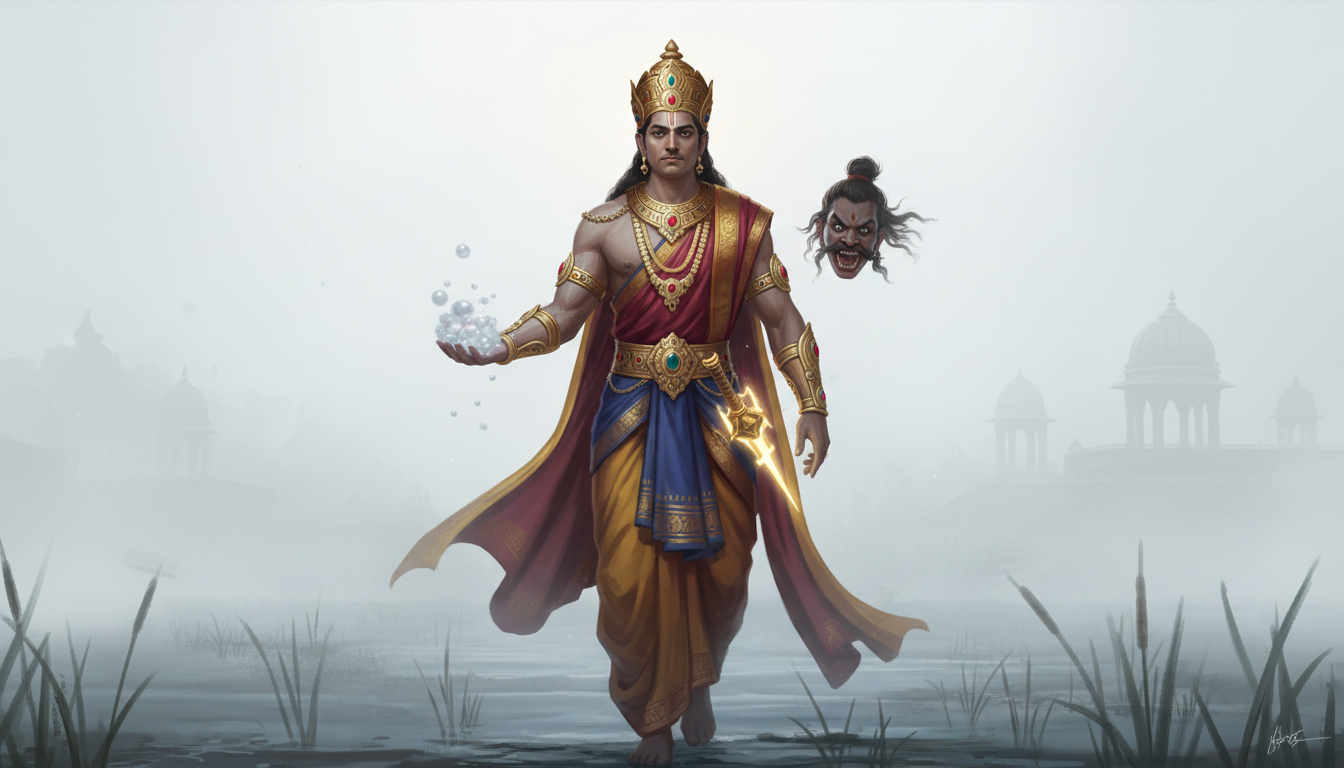
The Head That Followed Indra
A treaty kept to the letter and broken in every other way
The Water Ran Red
There was a stretch of the Sarasvati where the river came down the bank the colour of a wound.
Vishvamitra had cursed her there, in anger, in what was otherwise the most auspicious and the best of her fords, and after that curse she flowed carrying blood in her current. She did not stop flowing. That is the cruelty of it. A river cannot refuse. She went on delivering that water past the reeds and the stones and the trodden places where people had once come down to bathe, day after day, and there was nothing she could do about what was in her.
The rakshasas found it, as rakshasas find such things, and they came and they settled there and they were happy. They drank the blood out of the river and it satisfied them completely. They danced on the bank. They laughed. The account says they behaved like beings who by their own merit had attained heaven, and that is the worst line in the whole passage, because it is true of them: they had found the one place in the world that fed exactly what they were, and they were free of anxiety there, and they had no reason ever to leave.
Nobody else came near it. Word travels about a ford like that.
So it stood for a long while, one bad stretch on a holy river, drinking company and keeping it.
Then some rishis came down that way. They were men rich in the wealth of asceticism, out on a circuit of her fords, and they had bathed at all of them and were happy and wanted more merit still, and they walked into that place without knowing what was in front of them and stopped dead. The water of the Sarasvati mixed with blood. And rakshasas past counting, standing in it and drinking.
They Ask the River
Those ascetics were men of rigid vows, and their first thought was not to run and was not to fight. It was to find out.
They did not question the rakshasas. They invoked the river herself, standing there at that frightful ford and calling that foremost of streams by her own name until she attended to them, and then they said this:
"Tell us the reason, auspicious lady, why this lake in you has been afflicted with such distress. When we have heard it, we will make an effort."
She answered them, and the account gives one detail about how she answered that is worth more than a page of description. She trembled as she spoke. This is a river, and a goddess, and the mother of speech itself, and when she was asked what had happened to her she shook.
She told them everything as it had occurred. The curse. Who had laid it. What had come to live in her because of it.
The ascetics did not argue with any of it and they did not tell her she was mistaken about her own condition.
"We have heard the reason," they said. "We have heard of your curse, sinless lady. All of us shall exert ourselves."
Then they went aside and consulted with one another, and what they agreed among themselves was one sentence: all of us shall emancipate the Sarasvati from her curse.
Note where they aimed. The rakshasas were the visible problem, standing right there in the shallows, and any king with an army would have gone at the rakshasas. These men went at the curse, because the rakshasas were not the disease. They were what the disease had attracted.
The Rakshasas Come With Joined Hands
They worshipped Mahadeva for it, the lord of the universe and the protector of all creatures, and they paid for the work in the only currency they had. Penances. Vows. Fasts. Every kind of abstinence and painful observance they knew, laid down one after another on the bank of that ford for as long as it took.
And it worked. The water came clean. The Sarasvati ran as a river ought to run past that place, and the ascetics saw it happen.
So did the rakshasas. And within a day or two of that purification, the same beings who had been dancing on that bank were starving, because the one thing in the world that they could eat had just been taken out of the river by a group of holy men standing forty paces away.
Anyone would have expected them to attack. Instead they came out of the water with their hands joined, and they stood in front of those ascetics and begged, and what they said is the strangest speech in this whole part of the book.
"All of us are hungry. We have swerved from eternal virtue. That we are sinful in our behaviour is not of our own free will. Through the absence of your grace, and through our own evil acts, and through the sexual sins of our women, our demerits increased and we became Brahma-rakshasas. So it is also among the vaishyas and the shudras and the kshatriyas: those that hate and injure brahmanas become rakshasas. Best of brahmanas, make some arrangement for our relief. You are competent to relieve all the worlds."
They admitted the sin in the same breath in which they pleaded that it was not entirely theirs. They were not lying about either half. And they came to the very men who had just destroyed their livelihood, and asked them for help, because there was nobody else in the world to ask.
The ascetics were filled with compassion. That is the word the account uses about them at exactly this moment.
The Portion Set Aside, and the New River
What the rishis did next was not a miracle. It was an allotment, of the sort a householder makes when he is dividing food, and it has governed the kitchens of that country ever since.
With rapt minds they said: "The food over which one has sneezed; the food in which there are worms and insects; the food that is mixed with any leavings of dishes; the food that has hair in it; the food that has tears in it; the food that has been trodden upon: that shall form the portion of these rakshasas. The learned man, knowing this, shall carefully avoid these kinds of food. He who takes such food is to be regarded as eating the food of rakshasas."
Look at what they had done. They did not create anything new and they did not take anything from anyone. Every one of those six things was already being thrown away in every house in the world. The rishis simply named the refuse a share, assigned an owner to it, and by doing that gave a whole starving people a lawful and permanent income out of what nobody wanted. And in the same sentence they gave men a reason to keep their food clean, since a man who eats the rakshasas' portion has taken it from the mouths of those it was set aside for.
Then, having fed them, the ascetics asked the river for the last thing, which was a way out.
The Sarasvati understood what those great rishis intended. She caused her own body to take a new shape, and the new shape had a name: Aruna. It was a branch of her, a river that had not been there before.
The rakshasas went down into that new water and bathed in it, and they cast off their bodies there, and they went to heaven.
They had come to that bank as the most degraded beings on the river and they left it before the ascetics did.
Janamejaya Asks About the Chief of the Gods
"Ascertaining all this," said Vaishampayana, "the chief of the celestials, Indra of a hundred sacrifices, came and bathed in that foremost of tirthas, and was cleansed of a grievous sin."
Janamejaya stopped him there.
"For what reason was Indra tainted with the sin of brahmanicide?" the king said. "And how was he cleansed by bathing in that tirtha?"
"Listen to that history, ruler of men," Vaishampayana said. "Hear the occurrences as they happened. Hear how Vasava, in the days of old, broke his treaty with Namuchi."
There was an asura called Namuchi, and Indra wanted him dead, and Namuchi knew it. What Namuchi did about it was clever in a way that tells you a great deal about him. He did not raise an army and he did not fortify a city and he did not go underground. From fear of Vasava, he entered into a ray of the sun.
Consider that as a hiding place. Indra is the lord of the sky. The one thing in the sky that even he cannot strike at, cannot cloud, cannot bring down and cannot do without, is the sun itself. Namuchi went and stood inside a beam of it and became, in effect, unkillable, and there was nothing whatever that the king of the gods could do about it, and both of them knew that too.
So Indra changed his approach. He could not reach the asura by force, and therefore he went to him as a friend, and offered him a treaty.
Nothing Wet and Nothing Dry
These were the words of the covenant, and they are worth reading slowly, because Indra chose every one of them himself and nobody made him say any of it.
"Foremost of asuras, I shall not slay you, friend, with anything that is wet, or with anything that is dry. I shall not slay you in the night or in the day. I swear this to you by truth."
Namuchi accepted it and came out of the sun.
Think about how that oath is built. Everything in the world is either wet or it is dry. Every hour that exists is either day or it is night. A man hearing those two clauses hears one thing only, which is: I will never kill you under any circumstances, and I have covered every case so that you can be certain of it. That is why Namuchi came down. The oath was not a set of conditions. It was a promise of safety dressed up as a set of conditions, and it was sworn by truth, and it was sworn between friends.
Indra also heard something else in his own words. He heard two gaps.
He waited. The account does not say how long, and the not saying is its own comment: long enough for the friendship to look real, long enough for Namuchi to stop watching him.
Then one day the lord Indra beheld a fog.
Fog is the hour that is neither day nor night, when the light is in the sky but the sun is not, and it is water that is neither wet nor dry, being neither the river nor the air. He went down to the edge of the water and took up the foam that gathers where a current turns, which is also neither one thing nor the other, and he made a weapon of it.
And with the foam of water, in the fog, he cut off Namuchi's head.
The Head That Would Not Stay Behind
The letter of the oath was intact. Every clause of it held. Not wet, not dry, not day, not night. If the covenant had been read out in an assembly of the gods with the corpse lying in front of them, no one could have pointed to the phrase that Indra had broken.
The head did not care about the letter.
It came up off the ground and it went after him, and it stayed just behind him and just at his shoulder, near enough that every word carried, and what it said was this:
"Slayer of a friend. Wretch."
Two words. Not an argument, not a curse, not a demand. It did not accuse him of murder, which he could have answered, since he was the king of the gods and Namuchi was an asura and the two of them were at war and killing is what that means. It accused him of the one thing that was actually true and had no defence in it at all: he had made a friend of the man first, in order to be able to reach him, and then he had used the exact words of the friendship as the method.
It followed him. That is the detail that does the work. Not once, not at the moment of the killing, not in a dream. From a near point, incessantly, behind him, wherever he went. He went up to heaven and it came to heaven. He turned round and it was not in front of him, because a thing like that is never in front of you. He could not out-walk it, because it was not walking. He could not silence it, because he had already cut it off from its body and it was still speaking.
Urged on by that head without a pause, the chief of the celestials at last went to the Grandsire, and stood in front of him, and in grief told him what he had done.
The Grandsire Sends Him to the Aruna
The Supreme Lord of the universe did not tell him that the oath had technically held. He did not tell him that Namuchi had been an enemy of the gods and had it coming. He did not offer him one word of comfort about the deed at all. He gave him a set of instructions, the way a physician gives them.
"Perform a sacrifice," said Brahma, "and bathe with the due rites, chief of the celestials, in the Aruna, that tirtha which saves from the fear of sin. The water of that river, Shakra, has been made sacred by the munis. Formerly the presence of that river at its site was concealed. The divine Sarasvati went to the Aruna and flooded it with her waters. This confluence of Sarasvati and Aruna is highly sacred. Perform your sacrifice there. Give away gifts in profusion. Making your ablutions there, you will be freed from your sin."
Every part of that is the story we have already heard. The river that saves from the fear of sin is the one the Sarasvati grew out of her own body because some ascetics asked her to, so that a crowd of starving rakshasas would have somewhere to put down what they had become. The munis who made its water sacred are the same men who fasted on that bank until the blood went out of the current. Indra of a hundred sacrifices, the piercer of Vala, the lord of heaven, was being sent to wash in the bath that had been drawn for man-eaters.
So Shakra went there and performed diverse sacrifices in that abode of the Sarasvati, and gave away many gifts, and then he went down and plunged into the Aruna, and he came up free of the sin arising out of the slaughter of a brahmana. The lord of heaven then returned to heaven with a joyful heart.
And the head of Namuchi fell into that stream. It had followed him the whole way, still speaking, and at the water it stopped, and it went in, and the asura obtained many eternal regions that granted every wish.
They were both released at the same ford, by the same water, on the same day. Neither of them got there without the other.
Rama Bathes There and Goes On to Soma's Ford
Ages later, while the eighteenth day of the war was being fought a long way to the east, Baladeva came up that same bank with his plough on his shoulder and stopped at that confluence because it was on his list.
He bathed in that tirtha and gave away many kinds of gifts, and the account says he obtained great merit, and then, being a man of righteous deeds, he went on. The great tirtha of Soma was next. Soma himself had performed the Rajasuya sacrifice there in the old days, with the high-souled Atri, that foremost of brahmanas, acting as the Hotri at it. When that sacrifice ended, a great battle broke out between the gods on one side and the danavas and daityas and rakshasas on the other, and it is known by the name of the asura Taraka. Skanda killed Taraka in it, and on that occasion Mahasena received the command of the celestial forces. In that tirtha there stands a gigantic ashvattha tree, and under its shade Kartikeya, who is also called Kumara, resides in person to this day.
Balarama walked on toward it. Behind him the two waters ran together as they had run since the ascetics asked for them.
What is left in the ground at that confluence is a warning about a particular kind of cleverness. Indra swore an oath that covered every case, and he swore it in order to reach a man who was otherwise out of reach, and when he found the seam in his own wording he went through it. The wording held. It was never the wording that judged him. It was a severed head at his shoulder saying two words, and it followed the king of the gods across heaven and earth, and no rank he held and no sacrifice he had ever performed made it quieter for a single hour.
A promise kept to the letter and broken in every other way is still a broken promise. Whatever is inside a man that knows the difference will go on saying so, and it does not stop for a god.
Dharma Lesson
A promise obeyed by its wording and betrayed in its meaning is still a betrayal, and no clause covers the friendship that was offered only in order to get close enough. The oath held perfectly and nothing in it saved him. What judged Indra was a voice at his shoulder saying two words, and it did not stop for the king of the gods.