The King of Heaven and His Captive
From his bed of arrows, Bhishma turned his gaze on Yudhishthira and began a tale of a prisoner who slept easier than his captor.
In the ancient war between the gods and the asuras, no rivalry ran hotter than the one between Indra, lord of heaven, and Namuchi, a lord among the asuras whose strength had humbled armies of devas more than once. Namuchi had struck at Indra's own dominion, plundered the soma sacrifices, and mocked the thunderbolt itself, until Indra swore he would see the asura bound in chains before the gods as proof that no power stands forever unanswered.
The war that followed shook the three worlds. Indra called on Vishnu's counsel and on stratagems old and new, for it was said no weapon of wood or metal, wielded by day or night, could slay Namuchi - a boon the asura had won by his own austerities. Indra found the seam in that boon at last, and in the grey hour between night and dawn, with a weapon that was neither wet nor dry, struck Namuchi down and took him captive rather than killing him outright, choosing humiliation over annihilation.
Namuchi was bound in heavy chains and cast into a chamber apart from the court of heaven, stripped of the fortune, the armies, and the reverence that had once surrounded him. Every asura who had served him now served Indra instead. By every measure that heaven or earth uses to weigh a man's fall, Namuchi had fallen as far as a being can fall.
And yet, said Bhishma, when Indra's spies brought back word of the prisoner, they did not describe despair. They described a being at ease - sleeping without dread, eating without complaint, watching the door of his cell as calmly as a man watches rain from a dry porch. Indra, hearing this, could not let the report rest.
Why Do Your Eyes Hold No Despair
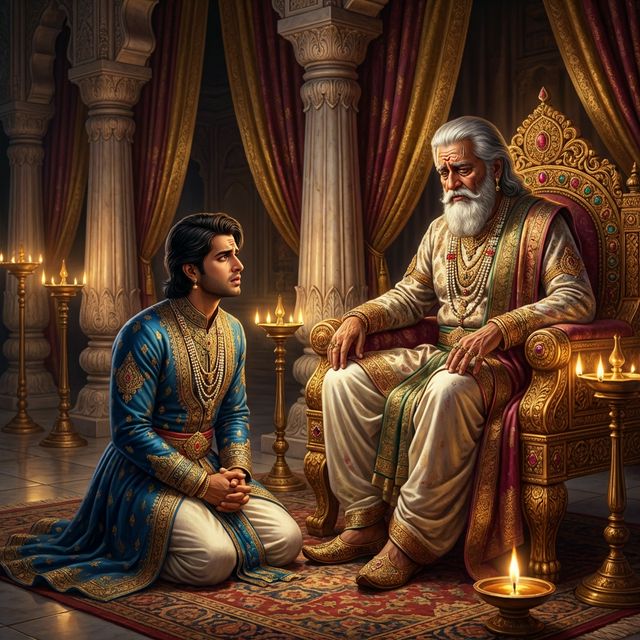
Indra could not resist the mystery gnawing at him, and so the lord of heaven went himself to the chamber where Namuchi sat bound, arriving not as a conqueror parading his trophy but as a man seeking an answer he lacked.
He stood before the asura and studied him a long while before he spoke. 'You have lost everything, Namuchi,' Indra said at last. 'Your kingdom is scattered, your armies serve me now, your fortune has passed into other hands, and iron holds your limbs where freedom once did. Any being in your place would grieve, and grieving would be no dishonor - it would be only human, or only asura, to weep at such a fall. Yet I am told you sleep without dread and eat without complaint. Tell me plainly - why do your eyes hold no despair?'
Namuchi lifted his bound wrists a little, as though weighing the chains, and answered without heat. 'You ask as though grief were owed on a fallen fortune the way tribute is owed on a conquered land. But tell me, Indra - if I wept from dawn to dusk, would one link of this chain loosen? Would my kingdom rise again because my face had grown wet with mourning? You have taken my army, my wealth, my throne. What would you have me hand over next - my composure too? That is the one possession you did not think to chain, and I will not surrender it for nothing.'
Indra frowned, for he had expected either bitterness or a plea, and had received neither. 'Every captive I have ever taken has cursed his captor or begged him,' Indra said. 'You have done neither. What manner of asura are you?'
'One who learned long ago,' Namuchi replied, 'that a man can be bound in two places at once - in his limbs, and in his mind - and that only one of those bindings is ever truly the enemy's doing.'
Boats Under Wind
Indra sat down then, unwilling to leave without understanding what he had heard, and Namuchi, seeing the god's honest curiosity, spoke on.
'Grieving over what has already happened mends nothing, Indra. It does not return a single soldier to my ranks or restore a single coin to my treasury. It only unmans the griever, hollowing out whatever strength he might still use to meet the day in front of him. Sorrow spent on the past is strength stolen from the present, and I have never seen a man made stronger by spending it.
Consider a river crossing, and all the boats upon it. Every boat moves under the same wind, whether its passengers wish it or not - some winds fill the sail kindly, some winds nearly capsize the hull, and no passenger aboard chose which wind would blow on his particular crossing. Now watch what happens on the water. The passenger who has no task but to sit stares at the wind and rages at it, as though his fury could still it. But the sailor, who has work to do, does not waste breath cursing what he cannot command. He trims the sail. He leans the tiller. He meets the wind that is actually blowing, not the wind he wished for, and he crosses.
I was thrown into this chain by a wind called Indra, and I will not pretend the wind was gentle. But raging at the wind is the passenger's madness, and I have chosen instead to be the sailor of what remains to me - my thoughts, my bearing, my dealings with the men who guard this door. Time carries every being where it carries them, gods and asuras alike, kings and captives alike. He who accepts what time brings without surrendering what conduct requires of him is free in any chains you can forge, because the only cell that truly holds a man is the one he builds for himself out of his own despair.'
The Envy of Heaven
Indra sat in silence for a long while, and something in his bearing - the bearing of a god who commanded thunder and had never once been commanded in turn - began to shift.
'I have not slept without dread since this war began,' Indra admitted at last, and the admission cost him visibly. 'I have won. My enemies are scattered, my throne secure, my name sung in every hall of heaven. And yet each night I turn over the accounts of what might still be lost - which asura plots revenge, which ally's loyalty is thinning, which boon I have not yet secured against the next challenger. I have taken your kingdom, Namuchi, and I find I have not taken your peace. If anything, I begin to suspect you sleep better bound than I do crowned.'
Namuchi allowed himself something close to a smile. 'That is the second imprisonment, Indra, and men add it to the first with their own hands. The first prison is what time and fortune actually take from us - a throne, an army, a season of ease. That much cannot always be helped. But the second prison is despair itself, the endless rehearsal of loss before it has even happened, or the endless mourning of a loss long past. That prison has no door because the prisoner built it without one. I sit in chains you forged, and I am free of it. You sit on a throne you built, and you are not free of it. Which of us, then, is truly bound?'
The lord of heaven had no ready answer, and it was said in the courts above that Indra, before he left that chamber, ordered Namuchi's bonds eased - not from pity, but from something nearer to reverence, the reverence one power owes another when it discovers the second power was never really conquered at all.
Every Crown Has Its Chains
Bhishma let the tale settle before he turned it toward the king in front of him.
'You have survived the dice hall, Yudhishthira, and the exile, and the war that has just emptied this field of nearly every warrior either of us loved. Each of those was a kind of chain, and you wore each of them without asking whether it was deserved. But do not imagine the crown you are about to take up is free of chains of its own. A throne binds a man as surely as iron does - to counsel he must weigh and sometimes reject, to grief he must carry without letting it show, to decisions whose cost will be paid by people who never voted for them. No king rules unchained; he only chooses which chains he answers to.
Remember Namuchi, then, not as an asura to be admired for his cause, but as a captive to be admired for his composure. When the crown brings you its own captivities - and it will, for no rule is without them - do not let despair be the second chain you add to the first. Grieve what must be grieved, plainly and without shame, for even Namuchi did not pretend the chains were painless. But do not rehearse the grief past its season, and do not let the wind of what has already happened blow you off the work of what remains to be done.
You are the sailor now, not the passenger. Trim the sail Time hands you. Accept what has come without surrendering what conduct still requires of you, and you will find, as Namuchi found in his cell and Indra failed to find on his throne, that freedom was never a matter of chains at all.'
Dharma Lesson
Grief over what cannot be undone drains the strength needed for what remains to be done, while despair repeated past its season becomes a second captivity a man builds for himself. True freedom lies not in the absence of chains but in meeting whatever time brings without abandoning the conduct dharma still asks of us.