The Kingdom Poured on the Fire
A sage is mocked with dead cattle and burns a realm with them
The Asylum That Was Chanting
Rama of the plough came to that asylum in the afternoon and heard it before he saw it, because the whole place was reciting.
He had come from the ford where Vishvamitra, born a Kshatriya and unwilling to remain one, had lived on water and air and the fallen leaves of trees and slept on the bare ground until the Grandsire came and gave him the one boon he wanted. Baladeva had given away milch cows there, and vehicles, and beds and ornaments and food and drink of the best kinds, to every brahmana who came to receive them, and had worshipped them duly, which was what he had been doing at every ford on the Sarasvati since he walked away from the war rather than choose between two men he had taught.
The next asylum was not far. It stood in trees on the bank, and the Vedas were being chanted in it from three directions at once.
"Whose was this?" he asked.
"Dalvya Vaka's," the ascetics said. "He practised the austerest of penances in this place. He emaciated his own body with them, and he was a virtuous rishi, and he was endued with great energy."
"And?"
"And here," they said, "he poured the kingdom of Dhritarashtra, the son of Vichitravirya, as a libation on the fire."
Janamejaya said: "Poured a kingdom? A kingdom is not a thing you can lift."
Vaishampayana said: "He did it with the flesh of dead cattle, tiger among kings, and he did it because of a sentence spoken to him in an assembly. Hear how it came about."
Twelve Years in the Naimisha Wood
The rishis who lived in the Naimisha forest had undertaken a sacrifice that extended for twelve years.
A session of that length is not an event. It is a residence. Men bring their fires there and their families and their pupils, and the ground around the enclosure wears down into paths, and children are born inside the twelve years who know nothing of the world except that the chanting starts before light. Some of the men who began that sacrifice did not see the end of it.
In the course of it a particular rite called the Viswajit was completed. The Viswajit is the all-conquering, and what the sacrificer conquers in it is his own property, because in that rite he gives away everything he owns. A man comes out of the Viswajit with the fire still burning and nothing behind him.
And a completed sacrifice has a fee. The dakshina is not a courtesy and it is not a tip. Unpaid, it hangs on the sacrifice and spoils it, and the men who performed the rite carry the debt of it. So the rishis of the Naimisha wood, having finished the Viswajit and being in consequence of it without anything at all, set out from the forest and went to the country of the Pancalas, where there was a king who had cattle.
They asked him for calves. Not for gold, and not for villages. Twenty-one calves, strong and healthy, to be given away as the fee of the sacrifice they had completed.
It is worth knowing what kind of wood that was, since men who beg from kings are usually thought poor company. The Naimisha forest is where the long sessions are held and where the old histories get recited from beginning to end, and a rishi who has sat through twelve years of one is not a vagrant. He is a man with a completed sacrifice behind him and an unpaid bill in front of him, and the two facts belong to each other.
Divide Mine Among You
The king of the Pancalas gave what he gave, and the rishis were counting it out among themselves when Vaka called them together.
He was Dalvya Vaka, of great energy, that best of brahmanas, and he had been at the twelve years from the beginning.
"Divide those animals of mine among you," he said. "Take my share and put it with yours. Giving away these to you, I shall go and solicit a great king for some."
There was no argument recorded. It was the kind of thing he did, and the rishis had lived beside him for twelve years and knew what he was. They divided his calves among themselves, so that every one of them went back toward the Naimisha wood a little better provided for than he had expected to be, and Vaka went out of the Pancala country with nothing, on a longer road, to ask a bigger man.
That is the shape of the story before anybody is insulted. A man who had just given away his entire property in one rite gave away his compensation for it in the next breath, and then walked several hundred miles to beg, because a debt owed by a sacrifice is still a debt and he had made himself responsible for the whole of it.
He went to the abode of Dhritarashtra.
The Sentence in the Assembly
The king was holding court, and the court was full, and the king was in a bad temper that morning because of his cattle.
They had begun dying. Not of murrain that anyone could name, not of drought, not of any cause a herdsman could put a finger on. They lay down in the pens and were dead by morning, and the men who kept them had no explanation, and a king with dying cattle and no reason for it is a king who has been made to look foolish in front of his own household.
Into that assembly came a brahmana off the road, thin from twelve years of vows, and asked for animals.
"I have come from the Naimisha forest," Vaka said. "We completed a sacrifice of twelve years there, and the Viswajit within it. The fee of it is unpaid. I ask you for some animals, king."
"How many?" the king said.
"Twenty-one were asked of the Pancalas. I gave my share of those away to my fellows. I am asking for mine here."
"You gave your share away and now you stand in my hall asking me for it."
"I gave it to men who had earned it as I had," Vaka said. "The debt is on the sacrifice, king, not on my appetite. I have no use for a calf."
And that best of kings, seeing in his mind the beasts that had died in his own pens without any cause, said angrily, in front of every man sitting in that hall:
"Wretch of a brahmana. Take, if you like, these animals that are dead."
It cost him nothing to say. That is worth holding on to. It was not a policy, it was not a considered refusal, and no clerk wrote it in any register. It was one bad sentence from a man who was annoyed about something else, spoken to a stranger who could not answer him, and the whole assembly heard it and nobody said anything, and the king had almost certainly forgotten it by the evening meal.
He Took the King at His Word
Vaka stood in that hall and did not answer at once.
He was conversant with duties, and what he thought, standing there, is recorded. "Alas," he thought. "Cruel are the words that have been addressed to me in the assembly."
Not cruel are the words that have been addressed to me. Cruel are the words that have been addressed to me in the assembly. The place is in the sentence. A man may be refused in private and go away hungry and think no more of it. This was done in front of the seated kingdom, and the sage of great energy, having reflected in that strain, filled with wrath, set his heart upon the destruction of king Dhritarashtra.
Then he went and took the king at his word, which was the one possibility the king had not considered when he said it.
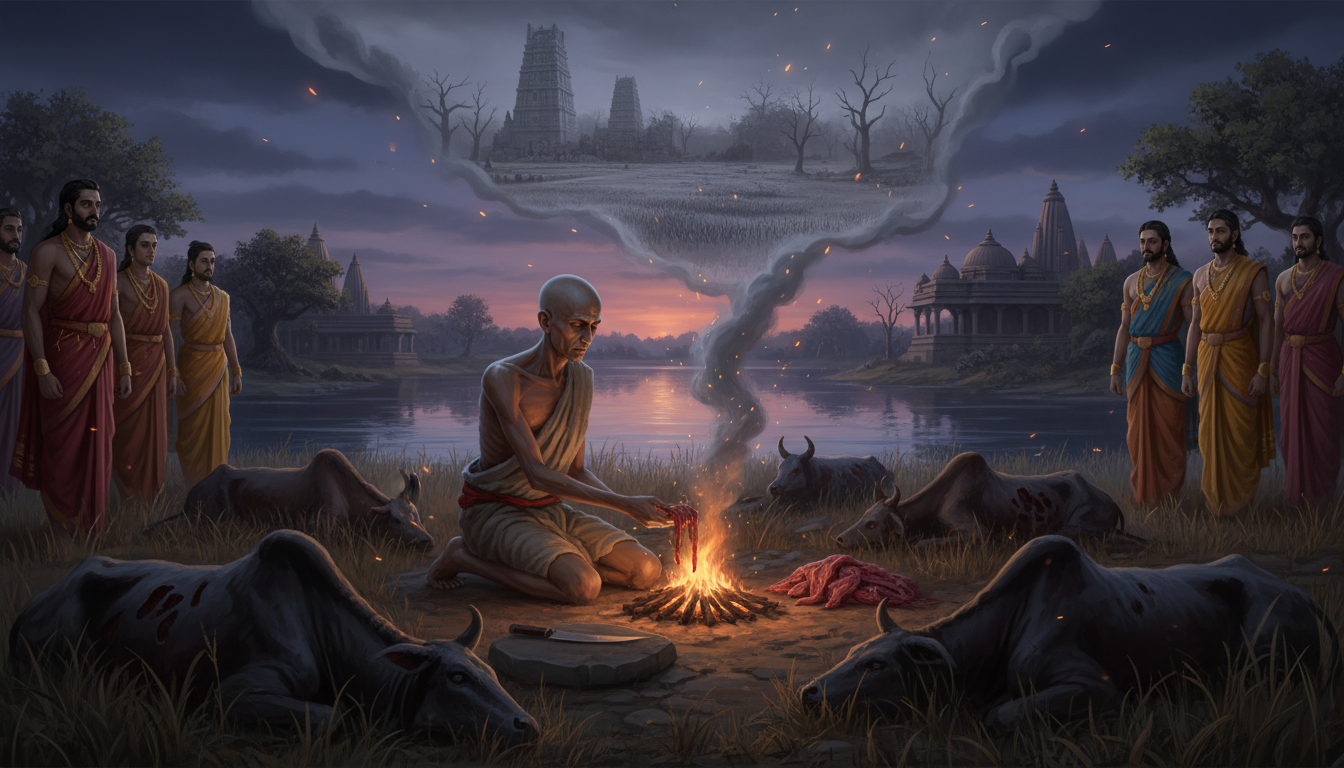
The dead beasts were where they had been dragged, outside the pens. Vaka went out to them by himself. He had asked for calves that were strong and healthy and he had been given carrion, and he accepted the gift exactly as it had been offered, and he sat down among the carcasses in the open air and cut the flesh off them with his own hand.
He was a brahmana of the Naimisha wood doing a butcher's work in a field, and he did it carefully, and he took what he needed and no more, and then he carried it north.
A gift is not completed by the giver. It is completed by the man who accepts it. Dhritarashtra had made an offer in open court in front of witnesses, meaning it as an insult and expecting it to die there in the air where insults usually die, and instead a rishi conversant with duties had said nothing, walked out, and taken delivery. Everything that follows in this story is the king's own sentence being carried out to the letter by the person he addressed it to.
The Fire at the Ford
He came to the tirtha on the Sarasvati and built his fire on the bank of it, and he did nothing hastily and nothing out of order.
He was observant of rigid vows. Every syllable was where it belonged. The ground was prepared, the fire was ignited according to the rites, and the offering was laid out beside it, and the offering was strips of meat cut from cattle that had died of themselves in another man's pen a long way to the south.
Then Dalvya Vaka poured the kingdom of Dhritarashtra as a libation upon that fire.
It is important to be exact about what went into the flames, because the text is exact. The meat went in. The meat was the aid, the instrument, the thing his hands held. What he was pouring was the kingdom. Fields, herds, granaries, revenues, the health of the men in it and the luck of the house that governed it, all of that gathered up in the mind of one furious ascetic and tipped into a fire on a riverbank six hundred miles from where any of it stood.
The fierce sacrifice commenced according to due rites, and the flames took it, and no one at the court knew that anything had happened at all.
Like a Forest Under the Axe
The kingdom of Dhritarashtra began to waste away.
It went, says the text, as a large forest begins to disappear when men proceed to cut it down with the axe, which is a description of a rate rather than of an event. Nothing collapsed. There was no invasion and no earthquake and no single morning on which anybody could have said, it began here. The trees simply stood in a wood that had fewer trees in it each season, and each year the light came further in.
Overtaken by calamities, the kingdom began to lose its prosperity and life. Herds thinned. Crops came up short and then shorter. Trade slackened, and the men who had grown rich by it went elsewhere without announcing that they were going.
Seeing his kingdom afflicted in that way, the puissant monarch became very cheerless and thoughtful, and he did what a competent king does. He consulted the brahmanas. He made great endeavours for freeing his territories. Rites were performed, and gifts were made, and the endeavours were not small ones and they were not half meant.
No good came of any of it. The kingdom continued to waste away.
The king became very cheerless. The brahmanas also became filled with grief, because a learned man knows a thing he cannot stop when he is watching one, and they had been watching one for some time.
The Counsellors Remember the Morning
When at last the king failed to save his kingdom he asked his counsellors, and they gave him the answer, and the answer was old.
The counsellors reminded him of the evil he had done in connection with the dead kine.
Somebody in that room had been sitting in the hall on the morning it was said. He had heard the sentence, and he had said nothing at the time, because nobody says anything at the time, and he had carried it in his memory ever since through every consultation and every failed rite while the king sent for astrologers.
"The sage Vaka," they said, "is pouring your kingdom as a libation on the fire, with the aid of the flesh of those animals. Thence is this great waste of your kingdom. This is the consequence of ascetic rites. Thence is this great calamity. Go, king. Go and gratify that rishi by the side of a receptacle of water on the bank of the Sarasvati."
That was the whole diagnosis, and the king had every part of it in his own possession from the first day. He had said the words. He had watched the man walk out. What he had lacked was any notion that a sentence spoken in irritation to a beggar could be an item in the accounts of a kingdom, and by the time somebody told him, half the wood was down.
The Head at the Feet
He went himself. That should be said for him, because he did not send an emissary and he did not send gold.
The king of the Kurus came to the bank of the Sarasvati and found the fire and the man tending it, and he fell down at his feet and touched them with his head, and joined his hands, and said:
"I gratify you, adorable one. Forgive my offence. I am a senseless fool. I am a wretch inspired with avarice. You are my refuge, you are my protector, and it behoves you to show me your grace."
He was overwhelmed with grief and he went on in that strain, lamenting there on the sand, a crowned man lying along the ground in front of an ascetic who owned nothing at all.
And Vaka, beholding him like that, felt compassion for him.
That is all it took, in the end. Not restitution, not a herd driven up from the south, not a decree read out in the hall where the thing had been said. The rishi became gratified with him, having dismissed his angry feelings, and then he did the only thing that could undo the work, which was to sit down at the same fire and pour libations on it again, running the whole rite the other way for the freeing of the kingdom.
The wood stopped falling. Then Vaka took many animals, and the text says he took them in grief, and that phrase is worth a moment: the cattle came to him at last, freely and in quantity, and by then he had spent his anger and knew what it had cost a whole country, and he accepted them like a man accepting a debt he no longer wanted paid. He went back to the Naimisha woods pleased at heart.
The liberal-minded king Dhritarashtra, of righteous soul, returned to his own capital with a cheerful heart, and the capital was full of prosperity again.
Note where the meeting had to happen. The counsellors did not say, send for the sage. They said, go to him, on the bank, by the water, where he is. The offence had been given in the king's hall on the king's ground with the king's men watching, and the amends were made lying in river sand with nobody watching at all, and that is the usual exchange rate between the two.
What Else Had Been Poured on That Fire
The ascetics of that asylum told Baladeva one more thing about the ford before he left it.
Vaka was not the first to use it that way. In that same tirtha, Brihaspati of great intelligence, the preceptor of the gods, had poured libations on the sacrificial fire with the aid of flesh, for the destruction of the Asuras and the prosperity of the denizens of heaven. Upon this the Asuras began to waste away, exactly as the kingdom had, and the gods, inspired with the desire of victory, destroyed them in battle.
So the rite was not a piece of private vengeance invented by an insulted brahmana in a field. It was the same instrument the teacher of heaven had used on an entire order of beings, and it worked the same way in both hands, slowly, from a distance, on a riverbank, while the party it was aimed at went on with its day.
Rama heard all of it out. Then, having with due rites given to the brahmanas steeds and elephants and vehicles with mules yoked to them, and jewels of great value, and much wealth and much corn, the illustrious and mighty-armed hero went on to the tirtha called Yayata.
There Yayati, the son of Nahusha, had sacrificed, and there the Sarasvati produced milk and clarified butter for him. He sacrificed a second time at that spot, and the river, beholding his great magnanimity of soul and his immutable devotion to herself, gave to every brahmana invited to that rite, each where he sat, whatever he had wished for only in his heart: houses, and beds, and food of the six different kinds of taste, and diverse other things besides. The brahmanas took all of it for the king's giving and praised him and blessed him. The gods and the gandharvas were pleased with the profusion. Human beings were simply filled with wonder.
Two fires on the same river. At one of them a man of subdued soul went hungry and was called a wretch in an assembly, and a kingdom came down like timber. At the other a king was open-handed, and the water itself ran butter for him and furnished houses for his guests out of the air.
Baladeva, of soul subdued and restrained and cleansed, having the palmyra on his banner, distinguished by great righteousness and ever giving away the most valuable things, went on from there to the tirtha of fierce current called Vasishthapavaha.
Dharma Lesson
An insult offered to a guest in public is a libation too, and it is poured on a fire the host cannot see. Dhritarashtra spent nothing to say it and forgot it by evening, and it cost him half his realm before anyone in his own council could remember what the cause had been. The amends had to be made lying in river sand, as far from the hall as the offence had been public in it.