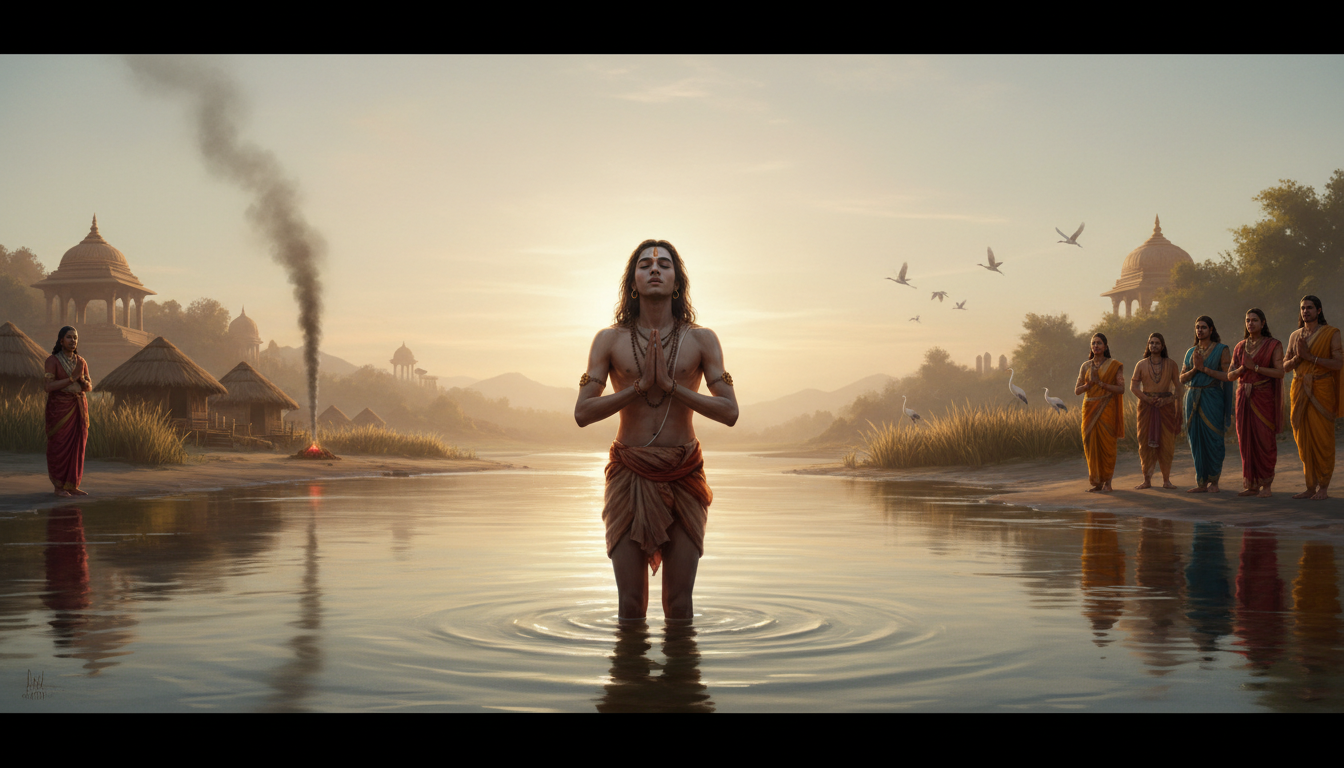
The Pupil Who Could Not Learn
Years in a teacher's house, and nothing to show for them
The Ford Where the Mountains Were Made
Rama of the plough had been walking up the Sarasvati for many days now, tirtha by tirtha, and at every one of them he did the same four things: he bathed, he honoured the brahmanas who lived on the bank, he gave away whatever he had brought to give, and he slept one night before going on.
He had come from Kapalamochana, where the head of a rakshasa struck off long ago by Rama the son of Dasaratha had fallen out of the sky onto the thigh of the sage Mahodara and stuck there, and where Mahodara, after carrying it through every river and every ford on earth, had at last stepped into that one water and felt it let go. He had stopped at the asylum of Rushangu, the old brahmana who, when he had resolved to lay down his body, asked his sons only that they carry him somewhere with water enough, and who said to them from the shallows, 'A man who casts off his body on the northern bank of the Sarasvati with the sacred words moving in his mind is never afflicted by death again.'
Now he came to a ford with no town near it and no noise about it at all. Brahmanas lived along both banks in ones and twos. The men who walked with him said that this was the place where the Grandsire had made the mountains called Lokaloka, that stand at the edge where the lighted world ends and the unlighted begins. They said something else as well. Three men had come down to this water as something other than brahmanas and had gone up from it as brahmanas: the royal sage Sindhudwipa, the ascetic Devapi, and Vishvamitra the son of Gadhi. And before any of the three, in the first age of the world, a man named Arshtishena had stood in this ford and undertaken a penance that nobody before him had attempted.
Balarama bathed there, and gave, and stayed the night.
Long after, when Vaishampayana had brought his account as far as this ford, Janamejaya stopped him.
"Why?" the king said. "Why did the adorable Arshtishena undergo the austerest of penances? And how did Sindhudwipa acquire the status of a brahmana, and how Devapi, and how Vishvamitra, best of men? Tell me all of it. My curiosity is very great."
"Then hear it from its beginning," Vaishampayana said, "and the beginning is a boy who could not learn."
The House of the Preceptor
This was in the Krita age, when the world was still whole and men lived long, and it was the custom then as it is now that a boy of the twice-born was given over to a preceptor and lived in his house until he had learned what there was to learn.
Arshtishena was such a boy. He was of good birth and good conduct, and there was nothing wrong with him that any eye could find. He rose before the light. He went out for fuel and brought it back on his shoulder. He carried water. He kept the fires fed and the vessels clean and the cattle counted, and when the household work was finished he sat down on the swept ground in front of his teacher with his hands folded and waited to be taught.
There was no book to read. There was no writing anywhere in it. The Veda passed from a mouth to an ear and lived nowhere else, and so the teaching went like this: the preceptor said a line, and the pupil said it back, with the pitches exactly where the preceptor had put them, the raised syllable raised and the fallen syllable fallen, and not one sound changed or dropped, because a syllable spoken wrongly is not a small error but a different word. Then the line again. Then the line joined to the line before it. Then the two joined to the ten before those. A boy carried what he had already taken in the way a man carries water in his hands, and every day he was given more to carry.
Arshtishena did all of it faithfully and he did it every single day. He attended to his lessons the way a man attends to a fire he is afraid of losing. He was never late and he never asked to be excused and he never once said that the work was too hard.
And nothing stayed in him.
Nothing Held
In the morning he could say back the line. By the evening it had gone soft at the edges. By the next morning he had the shape of it and not the sound, and by the day after that he had neither, and he would sit there with his mouth open on a syllable that was not the right syllable while the boy beside him carried the recitation on past him without a pause.
It was not one branch of knowledge that defeated him. It was all of them. He could not master the grammar, which is the ordering of speech. He could not master the metres, which is the counting of it. He could not hold the rules of the sacrifice, which say what is poured and when and by whom and in what direction the ladle turns. He could not hold the reckoning of the seasons and the stars. And of the Veda itself, which is the thing all the rest exists to protect, he could not keep one steady portion, not one hymn that would come back the same twice.
Boys came to that house who were younger than he was. They learned their share, took leave of the preceptor, went home, married, kindled their own household fires, and had sons of their own who were old enough to be sent away to school. And Arshtishena was still sitting on the swept ground in the morning with his hands folded.
The other pupils stopped laughing at him after the first few years, which was worse. When a boy is laughed at he is still one of them. What they gave him afterwards was a kind of gentleness, the sort people use around the sick.
His preceptor did not send him away. That must be said, because it would have been easy and it would have been permitted. He kept the young man in his house and taught him every day for as long as he stayed, and the source of this account does not say that the teacher ever spoke a hard word to him. It says only that Arshtishena resided long in the abode of his preceptor and could not acquire the mastery of any branch of knowledge or of the Vedas.
Long. That is the whole measure of it. Long enough that the word is used instead of a number.
The Day He Stopped Being a Pupil
There comes a morning in a life like that when the man understands that the thing is not going to happen, and it is not a dramatic morning. Nothing had changed. That was what told him.
He swept the ground as he had always swept it. He brought the fuel. He fed the fire. Then he went and stood in front of his preceptor and did not sit down.
"I have been in your house a long time," he said. "You have withheld nothing from me. You have said the lines to me as many times as I have asked and more times than I have asked. The fault is not in the teaching and both of us know where it is. I cannot hold what you give me. I have no branch of learning. I have no portion of the Veda. I am a man of my age with the accomplishment of a child of six, and I have been eating your food while I fail at it."
His preceptor said what a good teacher says, which was that he should stay, that some men ripen late, that the work itself is merit whether or not it comes to anything.
"That may be true," Arshtishena said. "But I have used up the years in which a man learns, and the ones I have left are the years in which a man does. So I will go and do something instead. There is one thing left that nobody has to teach me and nobody can do on my behalf, and I can do it as well as any learned man alive, because it asks nothing of the memory. It asks only that I not stop."
He took the dust of his preceptor's feet, went round him from the left, and walked out of the gate of that house with what he had come in with, which was nothing, and with what he had gained there, which was also nothing. He did not go home. A man who cannot recite has nothing to bring home.
He went north and west, toward the river.
He Chooses His Water
The Sarasvati has a great many fords, and every one of them is claimed by some story. There are fords where a god sat, fords where a curse was lifted, fords that cure one disease and no other, fords that must be entered facing east. Men walk the whole length of that river taking them in order, and the merit of the walking is itself considerable.
Arshtishena did not walk the whole length. He came to the water at the place where the Grandsire had raised the Lokaloka mountains, at the edge where the lit world stops, and something in that suited him, and he stopped there and did not go on to any other.
He had chosen his ground. Now he began.
What he undertook the account calls very austere penances, and it says of them that they were the austerest, which is a word used carefully in that book. It means he did not eat when it grew hard to fast and did not sleep when it grew hard to keep awake and did not go under a roof when the rains came and did not come out of the water when the cold came. It means he stood where he had decided to stand through a whole season and then through the season after it. It means he set himself a thing to do and the doing of it did not depend on whether it went well.
And here is why he could do it, and it is the point of the whole story. Penance is the one discipline in the world that does not test the memory. Nothing is asked of a man in penance except that he still be there tomorrow. He had spent his entire youth being told, every day, gently, that he had failed at the exercise again, and he had gone back the next day and done the exercise again, and again after that, for years, for no reward at all. There was not a learned man on the river who had practised that as long as he had.
He had been in training the whole time. He simply had not known what for.
The Veda Comes Whole
The gods notice that kind of persistence. It is a heat, and it rises, and it is felt.
What was given to him was not a kingdom and not a weapon and not long life. By his penances he acquired the mastery of the Vedas, to which there is nothing superior. He got, in one piece and without a teacher, the exact thing that twelve years and more in a good house had not been able to put into him one line at a time.
Imagine the morning of it. A man standing in a river with his hands raised, who has never in his life been able to complete a hymn, opens his mouth and the hymn is there. Not the shape of it. The sound of it, the pitches sitting where they belong, the raised syllable raised, the fallen syllable fallen, nothing dropped. And behind that hymn the next one, and behind that the whole body of it, and behind that the limbs of it too, the grammar and the metre and the ritual and the reckoning of the stars, all of it at once, all of it his, as though it had been waiting on the other side of a door in a house he had been living in for years.
He did not become a good student. He became a rishi. There is a difference, and the difference is the point. A student is a man who is being filled by degrees from outside. What happened at that ford was that the thing came from inside him, because he had made a place in himself deep enough to hold it, and he had made it with the only tool he had ever been any good with.
So that foremost of rishis was crowned with success in that tirtha. And he stood in the water he had chosen, holding at last what he had wanted since he was a boy, and instead of going straight up to heaven with it he turned round and did something for the place.
Three Boons Laid on the Water
A man who has completed such a penance may bestow boons, and what he bestows is fixed there and does not come loose again. Arshtishena bestowed three, and he did not give them to a person. He gave them to the ford.
"From this day," he said, "a man who bathes in this tirtha of the great river shall obtain the great fruit of a horse sacrifice."
That is the first, and to understand it you have to know what it is worth. The horse sacrifice is the rite of emperors. It takes a year and an army and a treasury and a herd and the assent of every king whose land the horse walks across, and no poor man will ever perform one, and no man without learning could carry out the ritual even if the wealth fell into his hands. Arshtishena had been shut out of it twice over, by his purse and by his memory. So he attached its entire fruit to the act of walking down a bank and going under the water. Anyone. Any morning.
"From this day," he said, "there will be no fear in this tirtha from snakes and from wild beasts."
That is the second, and it is a strange thing to think of a man giving away until you remember where he had been standing, motionless, hungry, alone, for season after season, at night, at the edge of the woods, in the shallows. He had been afraid. He took the fear off the place so that the next one would not have to be.
"And by small exertions," he said, "one shall attain to great result here."
That is the third, and it is his own life turned inside out and handed to strangers. He had made enormous exertions and attained, for the whole of his youth, nothing whatever. He could not give himself those years back. He could see to it that nobody standing in this particular water would ever have to work as hard as he had for as little.
Having said those words, that muni of great energy went to heaven. He left no lineage of pupils behind him and no school and no book. He left three sentences fastened to a stretch of river, and every one of them was the thing he had needed most and had never been given.
The Others This Water Made
"And that," said Vaishampayana, "is why the ford is a maker of brahmanas, and Arshtishena was not the last."
In that same tirtha, in that same Krita age, Sindhudwipa of great energy attained the high status of brahmanhood, and Devapi the great ascetic attained it likewise. And so, by austerities well directed and with his senses under control, did the son of Kusika.
His story is worth telling beside Arshtishena's because it is the same story told about a man who had everything. There was a great kshatriya named Gadhi, celebrated over the world. He had a son of great prowess called Vishvamitra. When Gadhi resolved to cast off his body and put his son on the throne, his subjects came and bowed to him and said, 'You must not go away, wise one. Protect us from a great fear.' Gadhi answered them, 'My son will become the protector of the wide universe,' and he seated Vishvamitra and went to heaven.
Vishvamitra became king. And he could not protect the earth with even his best exertions. He heard that there was a great fear of rakshasas in his kingdom, and he went out of his capital with his four kinds of forces to deal with it, and on the way his troops came to the asylum of Vasishtha and did much damage there. Vasishtha came back to his asylum and saw his woods being cut about, and he was angry, and he spoke to his homa cow and said, 'Create a number of terrible Savaras.' The cow made a swarm of men with frightful faces, and they went into the army of Vishvamitra and killed everywhere they went, and the king's troops ran.
So here was a man with a crown, an inheritance, and four kinds of forces, and he had been beaten by one brahmana and one cow, and he understood what Arshtishena had understood in a different way. He set his heart on austerities. In that same foremost of the tirthas of the Sarasvati he began to wear his own body down with vows and fasts. He made water and air and the fallen leaves of trees his food. He slept on the bare ground. The gods came at him again and again to break the vow and his heart never swerved from it, and at the end of it the son of Gadhi was like the sun himself for brightness. The Grandsire came to grant him what he wanted, and what he asked was to be permitted to become a brahmana, and Brahma said, 'So be it.'
What Rama Gave, and the Road On
Balarama heard all of that at the ford, from the brahmanas who lived on the two banks and had it by heart, and then he did at that tirtha what he had been doing the length of the river.
He worshipped those brahmanas duly and gave to them. Milch cows. Vehicles. Beds. Ornaments. Food and drink of the best kinds, in quantity, to as many of them as were there. He was going the whole Sarasvati while the eighteenth day of the war was being fought in the east without him, and at every stop he emptied a little more of what he had brought, and this was one of the stops.
Then he took his leave and went on. The asylum of Vaka was not far from that place, where Dalvya Vaka had performed the austerest of penances, and he set out for it, with the plough on his shoulder and the brahmanas walking with him a little way along the bank as they always did.
"You see what the tirtha is," Vaishampayana said to Janamejaya. "Men call it a maker of brahmanas, and it is, but not the way a workshop makes a pot. What was done at that ford was done by a young man whose only ability was that he would not stop, and a king who had lost his army, and two others whose names we have. Not one of them arrived there with anything worth having. That is the requirement.
"And consider what Arshtishena chose to leave. He could have asked that this water make men learned, since that was his own wound. He did not. He gave the poor man the emperor's rite, he gave the frightened man a bank with no snakes on it, and he gave the man who works hard for nothing a place where a little work is enough. He had been all three of those men. He knew exactly what was needed, because nobody had given it to him."
Dharma Lesson
A slow mind is not a closed one. Arshtishena had spent his whole youth failing at an exercise and going back to it the next morning anyway, which turned out to be the exact training penance requires. The boons he left behind were the three things nobody had ever given him: the poor man's share of the emperor's rite, a bank with no fear on it, and a place where a little work is enough.