The Head That Would Not Let Go
Why the ford on the Sarasvati is called Kapalamochana
Leaving the Place Where the Sage Danced
Rama of the plough had been away from the war for forty-two days, walking up the Sarasvati from ford to ford while other men decided who would own the earth.
He had spent that night at Sapta Saraswat, which is the place where the seven forms of the river come together. Each of the seven had been called out of the ground by somebody's sacrifice, and each had been given a different name by the men who called her. The munis assembled at Naimisha thought of her while they sacrificed, and that form came to be called Kanchanakshi. She was summoned to King Gaya's great sacrifice at Gaya, and the rishis of rigid vows there named her Visala. Auddalaka thought of her before beginning his sacrifice in the northern part of Kosala, and the rishis standing about in barks and deer-skins called her Manorama in their minds, and Manorama she was. Vasishtha summoned her to Kurukshetra while Kuru was sacrificing, and she appeared full of celestial water under the name Oghavati. She came to Daksha's sacrifice at the source of the Ganga as the fast-flowing Surenu, and to Brahman's own sacrifice in the sacred forest of the Himavat mountains when he called her. All seven then joined together in one tirtha, and because the seven mingled at that spot it is known on earth as Sapta Sarasvati.
It is also the place where Mankanaka danced. He had led the life of a brahmacari from his youth, being a son begotten by the god of the wind upon a lady named Sukanya. While performing his ablutions in the river one day he beheld a woman of faultless limbs and fair brows bathing at her will with her person uncovered, and his vital seed fell into the Sarasvati. He took it up and placed it inside his earthen pot, and within that vessel it divided into seven parts, and from those seven portions were born seven rishis, and from those rishis sprang the nine and forty Maruts.
And afterwards, crowned with success, he pierced his hand one day on a blade of kusa grass, and what came out of the wound was not red blood but a vegetable juice. He was so filled with joy at the sight of it that he began to dance, and every creature that moves and every thing that does not move, stupefied by his energy, began to dance with him, until the gods with Brahman at their head went to Mahadeva and asked him to do that which might prevent the rishi from dancing. Mahadeva came and asked what grave cause there could be for such joy in a man walking along the path of virtue, and Mankanaka showed him the juice, and the god laughed and said, 'I do not at all wonder at this. Behold me,' and struck his own thumb with the end of one of his fingers, and ashes, white as snow, came out of that wound. The sage stopped dancing then and was ashamed and fell at the feet of the god, and asked only that this absence of gravity, ridiculous in the extreme, might not destroy his ascetic merit. The god took it cheerfully. 'Let thy asceticism increase a thousandfold through my grace,' he said, 'and I shall also always dwell with thee in this asylum. For the man that will worship me in the tirtha of Sapta Saraswat there will be nothing unattainable here or hereafter.'
Baladeva had worshipped the dwellers of that tirtha and shown his regard for Mankanaka and given wealth to the brahmanas, and the munis had worshipped him in return.
In the morning he got up, took his leave of all the ascetics, touched the sacred water, and went on quickly toward the next of the fords, because a pilgrimage is a thing you do at a pace or you are not doing it.
And the next one had two names.
The Ford Called Usanas
It was called the tirtha of Usanas, after Sukra, who is Usanas, the preceptor of the Asuras, the one-eyed teacher of the losing side.
He had performed his ascetic penances at that spot. And it was there, sitting on that bank, that the whole science of politics and morals which goes by his name appeared to him. Not in a book and not from a teacher. It came to him by inward light, all of it, the way a thing comes when the mind has been made quiet enough to receive it, and what he was thinking about when it arrived was war. While residing there he meditated upon the war of the Daityas and the Danavas against the gods, and out of that meditation came the rules by which kings have governed and misgoverned ever since: when to strike and when to wait, how a treaty is made and how it is broken, what a spy is worth, what a minister costs, which of your friends will sell you and at what price. The high-souled Kavi received all of it at a river crossing while sitting still, having in mind a war his own side lost.
Baladeva, arriving at that foremost of tirthas, duly made his presents to the high-souled brahmanas in the usual way, and then the ascetics of that ford, who knew who he was and had a long evening ahead of them, told him the other name of the place.
"It is also called Kapalamochana," they said. "The releasing of the skull."
And Rama, who had left a war rather than choose between his two pupils, and who had spent every night since among men telling him old stories about other people's troubles, sat down on the bank and asked how it had got the second name.
The Short Version
Vaishampayana, telling all this afterwards to Janamejaya, first disposed of the matter in four sentences, which is the way a tirtha's story is usually told when the point of the telling is the tirtha and not the man.
"Formerly," he said, "Rama, the son of Dasaratha, slew a rakshasa and hurled his head to a great distance. That head, O king, fell upon the thigh of a great sage named Mahodara and stuck to it. Bathing in this tirtha, the great rishi became freed from the burthen."
That is the whole account as it is given at the ford, and everything that matters is missing from it. It does not say how far the head travelled or how long it stayed. It does not say that the sage had nothing whatever to do with the quarrel. It puts the slaying and the sticking and the bathing into one breath, as though they happened in an afternoon, and passes on to the next name on the river.
A great many holy places are described that way, in a sentence that begins with the word formerly. Somebody was hurt here. Somebody was made whole here. Come and bathe.
Janamejaya was not satisfied with it, and said so, and it is because a king interrupted a recitation that we have the rest.
Janamejaya Interrupts
Janamejaya said: "Why is it called Kapalamochana, and what was the great muni freed from? For what reason, and how, did a head stick to him?"
Vaishampayana said: "Formerly, O tiger among kings, the high-souled Rama, the son of Dasaratha, lived for some time in the forest of Dandaka, from a desire to kill the rakshasas."
He said it as flatly as that, because in his telling the son of Dasaratha is not the subject of the story. He is the cause of it, and the story is about somebody else entirely, somebody who had no part in the quarrel at all and who is not named in any hymn.
Note what the sentence does contain, though, because Vaishampayana chose it. Rama was in the Dandaka woods from a desire to kill rakshasas. He was not ambushed there and he was not defending anything at that moment. He had gone into a forest to hunt a kind of being he had decided to clear out of it, and he was extremely good at the work.
"At Janasthana," said Vaishampayana, "he cut off the head of a wicked-souled rakshasa with a razor-headed shaft of great sharpness. And that head fell in the deep forest."
The rakshasa is not given a name. He is given an adjective, wicked-souled, and that is his whole obituary, and the story is not about him either.
The Head Goes Looking
Consider what an arrow of that kind does at that range. It was a shaft with a razor for a head, sped from the bow of the best archer of an earlier age, at a rakshasa in the open, in a forest where his brother and his wife were somewhere behind him among the trees.
The head came off. It did not drop.
It went out and up, coursing at will through the welkin, which is the phrase the text uses and which is not a metaphor in a story about rakshasas. The short version at the ford says that Rama hurled it to a great distance, and the long version says that it went where it liked. Either way it travelled far over the Dandaka forest, with no body to go back to and no ground it was willing to lie on, and it was still going when it came down.
And there was a brahmana walking in those woods that afternoon, a great sage named Mahodara, who was not at war with anyone.
What he was doing there is not recorded. He was wandering through the woods, which is what such men did: from one ford to another, alone, with a staff and a water pot and no particular hurry, on a road that had nothing to do with either Rama or the rakshasas of Janasthana. He had not been warned. Nobody in the story thinks to warn him, and nobody afterwards apologises.
The head came down out of the sky and struck his thigh, and pierced it, and stuck there, and stayed.
That is where the account of Rama ends. He is not mentioned again. He did not know it had happened, and there is no scene in which anybody tells him.
What He Could Not Do After That
The first thing it took from him was his freedom of movement, and the second was his profession.
Mahodara was a brahmana of great wisdom, and his whole practice was the visiting of holy places. That was what such a life consisted of: the tirthas and the sacred spots, one after another, on foot, year after year. The text is careful about the size of the injury. In consequence of that head sticking to his thigh, it says, he could not with ease proceed to tirthas and other sacred spots. Not that he could not go. That he could not go easily. There is a great deal of difference between those two things over a lifetime, and the whole of what happened to him is in the word ease.
And it did not stay clean. The text says that plainly too and does not spare him. He was afflicted with great pain, and putrid matter flowed from the thigh. He was a holy man travelling among holy men and he smelled of a rotting head and he could not put it down. Whatever he had been before, he was now the man with the thing on his leg, in every asylum he stopped at and every village he passed through, for as long as it took.
So he did the only thing available to a man of his training. He kept going.
He went to all the tirthas of the earth, one after another, as we have heard it. He went to all the rivers. He went to the ocean as well. There is no way to know how long that took him. It is the kind of undertaking that is described in one sentence and is a life, and the sentence does not say how old he was when he started or who walked with him.
And nothing came off. He bathed in every water that men had ever said a word over, and each time he came up out of it and looked down, and the thing was still there.
He Tells Somebody
At last the great ascetic did the thing that the story turns on, which is not a heroic act and is easy to miss.
He spoke of his sufferings to many rishis of cleansed souls. He told them about the head, and about the pain, and about the thigh, and about having bathed in all the tirthas without having found the relief he sought.
Up to that point he had been carrying it alone and walking, which is what a disciplined man does and what a disciplined man will keep doing forever if nobody stops him. There is no rule against complaining that would have prevented him. He simply had not, for years, and the years had not helped.
And because he told them, they were able to answer. That foremost of brahmanas heard from those sages words of high import about a tirtha he had never been to.
"There is a ford on the Sarasvati," they said. "It is called Usanasa. It is represented as competent to cleanse a man from every sin there is, and as an excellent spot for attaining to success. You have not been there."
He had walked past every temple on the subcontinent. He had gone down into the sea. And the one water that would take it was a bend of a river in the north that he had not happened to hear about, and he found out about it in an afternoon, by opening his mouth to somebody who had.
It Falls Into the Water
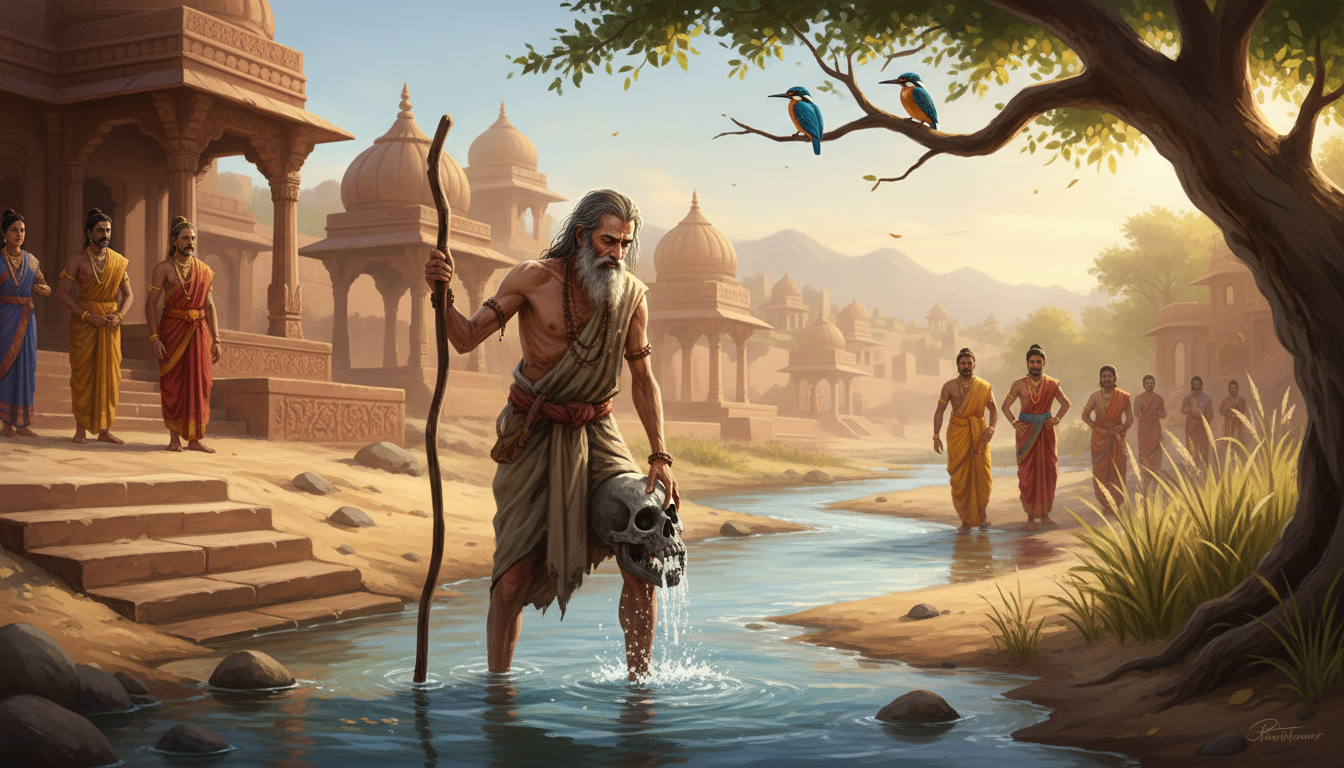
So that foremost of brahmanas repaired to the Usanasa tirtha and bathed in its waters.
And upon this, the rakshasa's head, leaving the thigh, fell into the water.
That is the entire event. There is no god in it, no boon, no voice out of the sky, nobody appearing in his true form, no penance imposed and no fee. A man who had been carrying a thing for a very long time walked down a bank into ordinary water, and the thing came loose and went in. As regards the head itself, says Vaishampayana, it was lost in the waters, and that is the last anybody hears of it. It is not recovered, not enshrined, and not avenged.
Freed from that dead head, the rishi felt great happiness.
He returned cheerfully to his asylum with a cleansed soul and all his sins washed away and success achieved, and when he got there he spoke of what had happened to those rishis of cleansed souls, because he had learned by then that things get told.
And the assembled rishis, having heard his words, bestowed the name of Kapalamochana on the tirtha. They did not name it after Rama, who had shot the arrow, or after the rakshasa, whose skull it was. They named it after the one thing that had happened there, which was a release.
The great rishi Mahodara went back to that foremost of tirthas once more afterwards, and drank its water, and attained to great ascetic success. That is worth noticing. The first visit gave him back his ordinary life. The second one, made freely, by a man with nothing stuck to him, gave him what he had been walking toward the whole time.
Rama Gives Gifts and Goes On
Baladeva heard the story out on the bank where it had happened.
He of Madhu's race gave away much wealth to the brahmanas there and worshipped them, as he had at every ford since he left the army, and then he proceeded to the asylum of Rushangu.
Arshtishena had undergone the austerest of penances in that place in former days. And it was there that the great muni Vishvamitra, who had been born a Kshatriya and had wanted to stop being one, became a Brahmana, which is the hardest crossing in the whole tradition and was made at that spot. The asylum is capable of granting the fruition of every wish, and it is always the abode of munis and brahmanas, and Baladeva of great beauty went to it surrounded by brahmanas.
He went in particular to the spot where Rushangu had cast off his body. Rushangu had been an old brahmana, always devoted to ascetic penances, and when he resolved to cast off his body he reflected for a long while about it, and then summoned all his sons and told them to take him to a place where water was abundant. They knew their sire had become very old. They carried him to a tirtha on the sacred Sarasvati, which contains hundreds of tirthas and on whose banks dwell rishis unconnected with the world, and he bathed there according to due rites, and then, cheerfully, he said to the sons who were dutifully waiting upon him:
"He that would cast off his body on the northern bank of the Sarasvati, where there is much water, while employed in mentally reciting sacred mantras, would never again be afflicted with death."
Baladeva, righteous-souled, touched the water of that tirtha and bathed in it and gave considerable wealth to the brahmanas, being devoted to them. Then he went on north, to the tirtha where the adorable Grandsire created the mountains called Lokaloka, and where Arshtishena of rigid vows had by austere penances acquired the status of Brahmanhood, and where the royal sage Sindhudwipa and the great ascetic Devapi and the illustrious muni Vishvamitra of fierce energy had all acquired the same status.
Four men in one place who had each been born one thing and had made themselves another. It was that kind of river.
Whose Head It Was
Vaishampayana let the story stand and did not draw the moral out of it, which is what the good reciters do, so it is worth saying what is in it.
Mahodara did nothing. That is the first thing. He was not at Janasthana. He had no opinion about rakshasas. He had not shot the arrow and he was not the one it was shot at. He was walking in a wood on his own business when somebody else's violence, travelling at the height of the treetops and a long way from where it had been aimed, came down and went into him and would not come out.
And he was still the one who had to carry it. Nobody argued with him about the injustice of that, and there is no scene anywhere in which he demands an explanation. The head did not care whose it was. It rotted against his leg while he walked, and men on the road stepped away from him, and every morning he got up and went to the next ford.
The second thing is that walking was not enough. He walked the whole earth, and every river of it, and the sea, and it did not work. He did everything his training told him to do, correctly, for years, and the result was that he was in exactly the same condition further along. If the story ended there it would be an accurate description of a great many lives.
What worked was smaller and looks like less. He described his trouble out loud to people who had been to more places than he had, and they knew a name he did not know, and they said it to him. The relief was already there, in a bend of a river, doing nothing, for the whole of the time he was in the ocean looking for it.
And then he went to the water and it came off. Not because he had earned it in that particular bath, and not because that bath was holier than the sea. Because there is, somewhere, a water that takes that particular thing, and finding out where it is turns out to be the whole of the work.
The ford on the Sarasvati kept both names. Usanas, for the teacher who sat there and received the science of statecraft while thinking about a war his side had lost. Kapalamochana, for a man nobody had heard of, who was hit by a war he had never heard of, and who washed off in one afternoon something that was never his and that he had carried across the entire world.
Dharma Lesson
Some consequences are not yours at all and still lodge in you, and there is nobody to argue with about the injustice of it. Mahodara walked every river on earth alone and got nowhere, and was freed only after he described his trouble out loud to men who had been further than he had. The water existed the whole time; what he lacked was a name he could not find by himself.