The Verdict at the Fallen King
Balarama's plough, Duryodhana's indictment, and the flowers that fell from the sky
Fie on Bhima
"Tell me what Baladeva said," Dhritarashtra asked. "He saw the king struck down unfairly. He is skilled with the mace himself and he knows every rule that governs it. Tell me what Rohini's son did on that occasion."
"He became exceedingly angry," said Sanjaya.
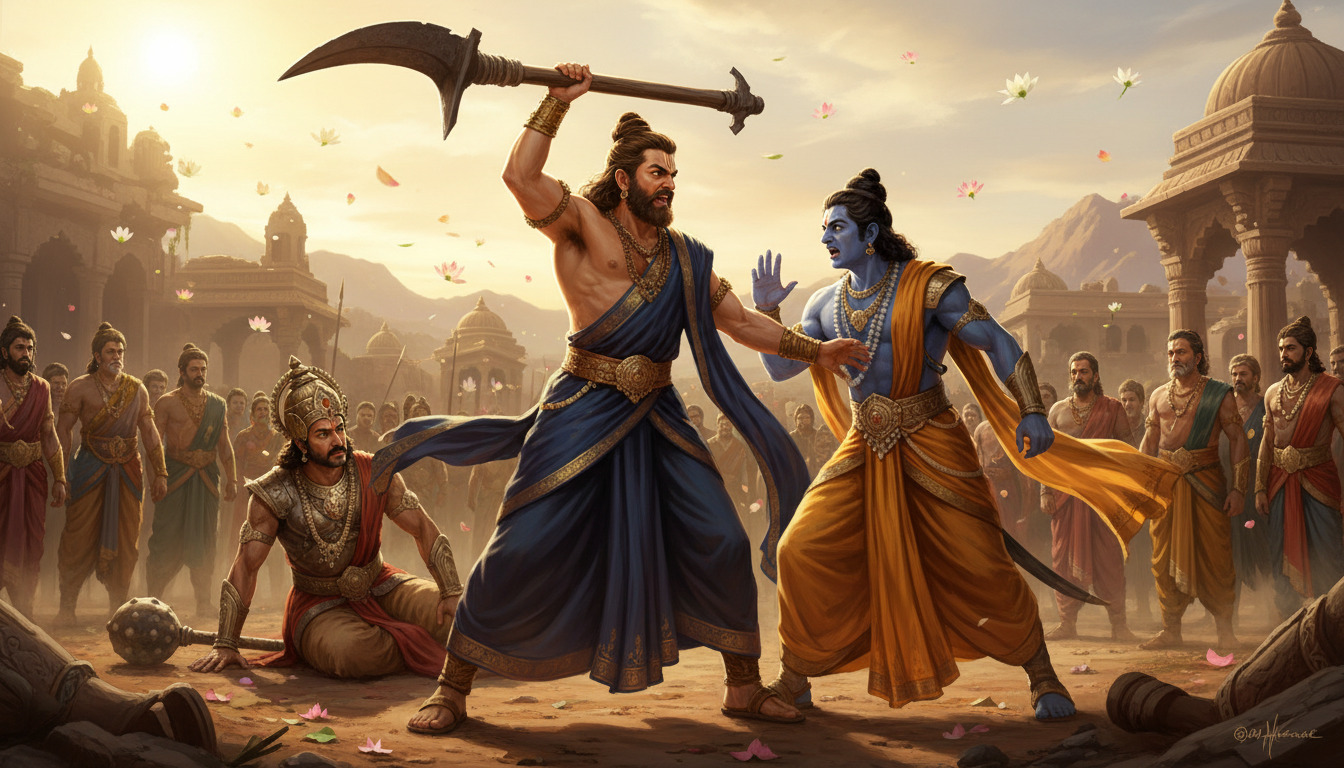
Balarama had been sitting in the middle of that ring of kings, in his blue robes, watching two men he had taught. He stood up with both arms raised over his head, and when he spoke it was in a voice of deep sorrow, and everyone sitting on that ground heard him.
"Fie on Bhima. Fie on Bhima. Fie, that in such a fair fight a blow has been struck below the navel. Never before has such an act as Vrikodara has done been witnessed in an encounter with the mace. No limb below the navel should be struck. That is the precept, laid down in the treatises. This Bhima, however, is an ignorant wretch who does not know the truths of the treatises. He therefore acts as he likes."
Then he took up his plough and went for Bhimasena.
He was a very large man and he was fair-skinned, and standing there with the weapon lifted over his head he looked like the mountains of Kailasa when they are variegated with metals. Nobody on that field could have stopped him. Duryodhana was lying on the ground twenty paces away with both thighs broken, and the man who was about to be killed for it had his back to the plough.
The Arms That Held Him
Krishna, who always bent towards humanity, caught him.
He put his massive well-rounded arms around his elder brother and held him where he stood, and the two foremost heroes of Yadu's race, the one dark and the other fair, looked at that moment like the sun and the moon together on an evening sky.
"There are six kinds of advancement a man can have," Krishna said, holding him. "His own advancement, the advancement of his friends, and of his friends' friends; and the decay of his enemy, and of his enemy's friends, and of his enemy's friends' friends. When reverses come to a man himself or to his friends, he should understand that his own fall is at hand, and he should look at once for the means of applying a remedy.
"The Pandavas of unsullied prowess are our natural friends. They are the children of our own father's sister. They had been greatly afflicted by their foes.
"And the accomplishment of a vow is a duty. Bhima vowed in the middle of that assembly that he would break the thighs of Duryodhana with his mace in a great battle. The great rishi Maitreya also cursed Duryodhana long ago, and the words of the curse were, 'Bhima will break your thighs with his mace.' Because of all that, I do not see any fault in Bhima. Do not give way to wrath, slayer of Pralamva. Our relation to the Pandavas rests on birth and blood and on an attraction of hearts as well. In their growth is our growth."
Morality Afflicted
Balarama listened to the whole of it, and he knew the rules of morality as well as his brother did, and he answered him on the same ground.
"Morality is well practised by the good," he said. "Morality, however, is always afflicted by two things: the desire of Profit, entertained by those who covet it, and the desire of Pleasure, cherished by those who are wedded to it. Whoever follows all three of them, Morality and Profit and Pleasure, without afflicting any two of them for the sake of the third, always obtains great happiness. Here, in consequence of morality having been afflicted by Bhimasena, that harmony has been disturbed. Whatever you may tell me, Govinda, it has been disturbed."
"You are always described as bereft of wrath," Krishna said, "and righteous-souled, and devoted to righteousness. Calm yourself, then, and do not give way to anger. Know that the Kali age is at hand. Remember also the vow made by the son of Pandu. Let the son of Pandu be regarded as having paid off the debt he owed to his hostility and as having fulfilled his vow."
It was a fallacious discourse, and Rama knew it, and it did not dispel his wrath. What it did was make him cheerful, which is a different thing.
The Crooked Warrior
Then he gave his verdict, standing in the assembly, so that every king on that ground would carry it home with him.
"Having unfairly slain king Suyodhana of righteous soul, the son of Pandu shall be reputed in the world as a crooked warrior. The righteous-souled Duryodhana, on the other hand, shall obtain eternal blessedness. The royal son of Dhritarashtra, that ruler of men, who has been struck down, is a fair warrior. He made every arrangement for the Sacrifice of battle. He underwent the initiatory ceremonies on the field. He poured his life as a libation upon the fire that his enemies made for him. He has fairly completed his sacrifice with the final ablutions, and the final ablutions are the attainment of glory."
Having said that, the valiant son of Rohini, who looked like the crest of a white cloud, climbed into his car and drove away towards Dwaraka.
Nobody argued with him and nobody followed him. The Pancalas and the Vrishnis and the Pandavas stood watching the car go, and after Rama had set out for Dwaravati they were all of them rather cheerless, having won the war some minutes earlier.
Why Do You Stand and Watch It
Yudhishthira was standing apart with his head hanging down, filled with anxiety, not knowing what to do. Vasudeva went over to him.
"Why do you sanction this unrighteous act? You allow the head of the fallen and insensible Duryodhana, whose kinsmen and friends have all been killed, to be struck by Bhima with his foot. You are conversant with the ways of morality. Why do you witness this with indifference?"
"It is not agreeable to me, Krishna," Yudhishthira said. "What Vrikodara did from wrath, touching the head of the king with his foot, is not agreeable to me, and I am not glad at this extermination of my race. We were deceived by guile by the sons of Dhritarashtra, again and again. Many were the cruel words they said to us. We were exiled into the woods by them. There is a great grief in Bhimasena's heart on account of all that. Reflecting on it, I looked on with indifference. He has slain the covetous Duryodhana, who was bereft of wisdom and enslaved by his passions. Let the son of Pandu gratify his desire now, whether that is righteousness or unrighteousness."
Vasudeva said, with difficulty, "Let it be so."
And then Bhima came and stood in front of his eldest brother with his hands joined, and saluted him in proper form, with his eyes wide with delight.
"The Earth is yours today, king, with no brawls to disturb her and all her thorns removed. Rule over her and observe the duties of your order. He who was the cause of these hostilities and fomented them with his guile, that wretch fond of deception, lies struck down on the bare ground. All those headed by Duhshasana who used to speak cruel words are dead, and the son of Radha, and Shakuni. Teeming with all kinds of gems, with her forests and her mountains, the Earth comes back to you, and you have no enemy left alive."
"Hostilities have come to an end," said Yudhishthira. "King Suyodhana has been struck down. The earth has been conquered by us, having acted according to the counsels of Krishna. By good luck you have paid off your debt to your mother and to your wrath. By good luck you have been victorious, invincible hero, and by good luck your enemy has been slain."
Bitter Breath on a Piece of Wood
The rest of the army was not so restrained.
The Pancalas and the Srinjayas waved their upper garments in the air and roared like lions when the Kuru king fell, and the Earth herself seemed unable to bear the noise those rejoicing men made. Some stretched their bows. Some drew their bowstrings. Some blew their huge conchs and others beat their drums. Some sported and jumped about. Some among them laughed out loud.
And many of them came up to Bhimasena and said the same things to him over and over.
"Exceedingly difficult and great is the feat you have achieved today, striking down the Kuru king, himself a great warrior, with your mace. All these men regard this slaughter as they regard the slaying of Vritra by Indra himself. Who else but you could have slain the heroic Duryodhana while he was careering in every kind of motion and performing every wheeling manoeuvre? You have reached the other shore of these hostilities, and there is no other man who could reach it. By good luck you have crushed the head of Duryodhana with your foot on the field of battle, like an infuriated elephant. By good luck you drank the blood of Duhshasana, like a lion drinking the blood of a buffalo. The bards applauded Shakra after the fall of Vritra as we are applauding you. Know, Bharata, that the joy we felt at the fall of Duryodhana has not abated in the least."
The slayer of Madhu let it run for a while and then stopped it.
"You rulers of men, it is not proper to kill a dead enemy over again with cruel speeches repeated in his hearing. This man of wicked understanding has already been slain. He was sinful and shameless and covetous, he was surrounded by sinful counsellors, and he was always regardless of the advice of wise friends. He met his death because he refused, though Vidura and Drona and Kripa and Sanjaya urged him again and again, to give the sons of Pandu the paternal share of the kingdom that they asked of him. This wretch is no longer fit to be regarded as a friend or as an enemy. What use is there in spending bitter breath on a man who has become a piece of wood? Mount your cars quickly, kings. We should leave this place."
The Bill Duryodhana Read Out
The piece of wood heard him.
Duryodhana gave way to wrath and tried to get up. He could not stand, because there was nothing left of his thighs to stand on, so he sat back on his haunches and propped himself on his two arms and contracted his eyebrows and turned his eyes on Vasudeva. Half raised off the ground like that, he looked like a poisonous snake with its tail cut off. He disregarded pain that was poignant and unbearable, and he began to speak.
"Son of Kansa's slave, you seem to have no shame. Have you forgotten that I have been struck down most unfairly, judged by the rules that govern encounters with the mace? It was you who caused that act, by reminding Bhima with a hint about the breaking of my thighs. Do you think I did not mark it when Arjuna, acting on your advice, gave him the sign?
"You have caused thousands of kings who always fought fairly to be slain by diverse kinds of unfair means. Do you feel no shame for it, and no abhorrence?
"Day after day, having caused a great carnage of heroic warriors, you caused the grandsire to be slain by putting Shikhandi to the fore.
"Having caused an elephant of the name of Ashvatthama to be killed, you of wicked understanding made the preceptor lay aside his weapons. Do you think I do not know that? And when that valiant hero was about to be slain by the cruel Dhrishtadyumna, you did not dissuade him.
"The dart that Karna had begged of Shakra as a boon for the slaughter of Arjuna was made useless by you, through Ghatotkacha. Who is there more sinful than you?
"The mighty Bhurishrava, with one of his arms lopped off, while he was observing the Praya vow, was caused to be slain by you through the agency of the high-souled Satyaki.
"Karna had done a great feat for the vanquishing of Partha, and you caused Aswasena, the son of that prince of snakes Takshaka, to be baffled in achieving his purpose.
"And when the wheel of Karna's car sank in the mire and he was afflicted and almost beaten on that account, when he had got down and was anxious only to free his wheel, you caused that Karna to be killed then.
"If you had fought me and Karna and Bhishma and Drona by fair means, victory would never have been yours, and there is no doubt about it. By adopting the most crooked and the most unrighteous of means you have caused many kings observant of the duties of their order, and ourselves also, to be slain."
The Answer and the Boast
Vasudeva did not deny one item of it. He simply put the other ledger beside it.
"Son of Gandhari, you have been slain with your brothers and sons and kinsmen and friends and followers only because of the sinful path you trod. Through your evil acts those two heroes Bhishma and Drona have been slain. Karna too has been slain, for imitating your behaviour.
"I asked you myself, fool, and out of avarice, acting on the counsels of Shakuni, you would not give the Pandavas their paternal share. You gave poison to Bhimasena. You tried to burn all the Pandavas with their mother in the palace of lac. At the gambling you persecuted the daughter of Yajnasena while she was in her season, in the middle of the assembly. Shameless as you are, even then you became worthy of being killed. Through Subala's son, who was well versed in dice, you unfairly defeated the virtuous Yudhishthira, who was unskilled at gambling. For that you are slain. Through the sinful Jayadratha, Draupadi was persecuted another time, when her lords had gone out hunting near the hermitage of Trinavindu. You caused Abhimanyu, who was a child and alone, to be surrounded by many, and killed that hero. It is in consequence of that fault, sinful wretch, that you are slain.
"All those unrighteous acts that you say have been perpetrated by us have in reality been perpetrated by you, in consequence of your own sinful nature. You never listened to the counsels of Brihaspati and Usanas. You never waited upon the old. You never heard beneficial words. Enslaved by ungovernable covetousness and the thirst of gain, you did many unrighteous acts. Bear the consequences of them now."
Duryodhana had one thing left to say, and it was not a defence.
"I have studied. I have made presents according to the ordinance. I have governed the wide Earth with her seas. I have stood over the heads of my foes. Who is there so fortunate as myself? That end which is courted by Kshatriyas observant of the duties of their own order, death in battle, has become mine. Who then is so fortunate as myself? Human enjoyments such as were worthy of the very gods, such as other kings could obtain only with difficulty, were mine. Prosperity of the very highest kind was attained by me. Who then is so fortunate as myself? With all my well-wishers and my younger brothers, I am going to heaven. As for you, with your purposes unachieved and torn by grief, live on in this unhappy world."
The Flowers That Fell on Him
When the king of the Kurus had finished speaking, a thick shower of fragrant flowers fell out of the sky on him.
The gandharvas played on many charming instruments. The apsaras sang the glory of king Duryodhana in chorus. The Siddhas cried out, loudly and repeatedly, "Praise be to king Duryodhana." Fragrant and delicious breezes began to blow mildly on every side. All the quarters cleared, and the firmament above that field went as blue as lapis lazuli.
The Pandavas, and Vasudeva with them, stood and watched that worship being offered to the man they had just killed, and they were ashamed.
Then they heard the voices. There were beings they could not see, saying in the air above the field that Bhishma had been slain unrighteously, and Drona, and Karna, and Bhurishrava. The Pandavas heard the list of their own victories read back to them as a list of crimes, and they became afflicted with grief and wept where they stood.
Krishna saw them, and he answered in a voice as deep as a cloud or a drum, and he did not say that the voices were lying.
"All of them were great car-warriors, and exceedingly quick in the use of weapons. If you had put out all your prowess, even then you could never have slain them in battle by fighting fairly. King Duryodhana also could never have been slain in a fair encounter, and the same is true of all those mighty car-warriors headed by Bhishma. From the desire of doing good to you, I applied my powers of illusion again and again and caused them to be slain by diverse means in battle. If I had not adopted such deceitful ways, victory would never have been yours, nor kingdom, nor wealth.
"Those four were very high-souled warriors and were reckoned Atirathas in the world. The Regents of the Earth themselves could not have slain them in fair fight. The son of Dhritarashtra, fatigued as he was, could not have been killed with the mace in a fair fight by Yama himself with his bludgeon in his hand.
"You should not take it to heart that this enemy of yours has been slain deceitfully. When the number of one's foes becomes great, destruction should be effected by contrivances and by means. The gods themselves, in slaying the Asuras, have trod the same road. The road that has been trod by the gods may be trod by anybody.
"We have been crowned with success. It is evening. We had better go to our tents. Let us all take rest, you kings, with our horses and elephants and cars."
And hearing it, the Pandavas and the Pancalas were filled with delight and roared like a multitude of lions, and every one of them blew his conch, and Janardana blew Panchajanya, filled with joy at the sight of Duryodhana struck down in battle. Behind them, on the sandless ground, the flowers went on falling.
Dharma Lesson
A victory that has to be defended in a speech was not a clean one, and pretending otherwise only adds a lie to the list. Krishna takes the honest course instead: he denies nothing on Duryodhana's bill, names the contrivances as contrivances, and says plainly that without them there would have been no kingdom. The shame is allowed to stand next to the winning.