The Errand Before the Grief
Krishna drives to Hastinapura to reach a mother before her curse does
Janamejaya Asks Why He Went Twice
Janamejaya said: "Why did Yudhishthira the just send Vasudeva to Gandhari?
"Krishna had gone to the Kauravas once already, for the sake of making peace, and he did not get what he wanted, and the war happened because of it. Now the war is over. All the warriors are killed. Duryodhana is struck down. My ancestor's empire is without an enemy in it anywhere. The Kuru camp is standing empty because everybody in it has run away. Great fame has been won.
"So what was the reason, holy one, for Krishna to have to go to Hastinapura again? It cannot have been a light one. It was Janardana himself who had to make the journey. Tell me in detail what the cause was."
Vaishampayana said: "The question you ask is worthy of you, king. I will tell you exactly as it happened."
The Chariot That Had Already Burned
On the evening of the eighteenth day the fighting stopped because there was nobody left to do it.
There had been a small thing earlier, at the end, which Arjuna had asked about and been told the answer to only afterwards. He had got down from the car first, as he never did, because Krishna had told him to, and when Krishna stepped down after him the whole vehicle caught and went up and was ashes on the ground in a moment. Arjuna had asked what that was.
"That car had already been consumed," Krishna said, "by the weapons that were used against it. It was because I was sitting on it during the fighting that it did not fall to pieces. It had been burned to nothing by the energy of a brahmastra a long time ago. It stood because I was on it. I have stepped off it, and your objects are attained, so it is ash."
Then, with a little pride, he embraced Yudhishthira.
"By good luck you have won, son of Kunti. By good luck your enemies are beaten. By good luck the wielder of Gandiva, and Bhimasena, and you, king, and the two sons of Madri have all come out of this alive, out of a battle that was so destructive of heroes, and have come out of it having killed every one of your enemies. Now do quickly what has to be done next."
And the hair stood up on Yudhishthira's body, and he answered: "Who else, grinder of foes, not even the thunder-wielder himself, could have stood in front of the brahmastras that Drona and Karna threw? At Upaplavya the great rishi Krishna-Dvaipayana told me that where righteousness is, there Krishna is, and where Krishna is, there is victory."
The Camp and the Night Outside It
They went into the Kaurava encampment then, and took it.
There was the military chest. There were jewels. There was silver and gold, there were gems and pearls, there were costly ordinary things: ornaments, blankets, skins, the plate and the furniture of a court that had gone to war expecting to come home. There were slaves, men and women, standing about among the tents with nobody to give them orders. Everything necessary for sovereignty, said the account, and it had all belonged to Duryodhana at breakfast.
The victors shouted when they saw it. Then they unyoked their animals and rested.
And Vasudeva said: "We should stay outside the camp tonight. As an initiatory act of blessedness."
They said, so be it, which is what men say to Krishna, and the Pandavas and Satyaki went out of the camp they had just won and walked to the bank of the sacred stream Oghavati, and made their quarters on the grass, and did not sleep in the tents of the men they had killed. It is a small piece of ritual scruple at the end of a war in which almost every rule had been broken, and it is the only comfortable thing in the chapter.
And there, on the riverbank, with the field emptied and the treasure counted and nothing left in the world to be afraid of, Yudhishthira found that he was afraid.
One Woman in a House Eighty Miles Away
What he was afraid of was Gandhari.
He had seen how Duryodhana went down. He had been standing there. He had watched Bhima strike below the navel in a mace fight, which every man on that field knew was against the rules of fair combat, and had watched Bhima put a foot on the head of the man on the ground, and had said nothing effective about either. Balarama had gone away in a fury over it. Duryodhana, whatever else he had been, had always fought fairly.
And there was a woman in Hastinapura who had worn a cloth over her eyes for forty years because her husband could not see, and who had spent all of that time in the austerest penances a person can perform, and who did not yet know how her hundredth son had died.
Yudhishthira turned it over for a long while and could not get past it. "She has undergone the severest austerities," he thought. "She can burn the three worlds. When she hears that her son, who always fought fairly, was killed unfairly by us, how is she going to endure it? She will reduce us to ashes with the fire of her mind."
It is worth being clear about what the king of the Pandavas was actually calculating on that riverbank. Not whether the army could be rebuilt. Not whether Ashvatthama would come back. He had won the earth that afternoon and he sat up all night working out how many hours he had before an old blind woman heard a piece of news.
Go Before I Do
So, filled with fear and grief, he said this to Vasudeva:
"Through your grace, Govinda, my kingdom has been cleared of thorns. What we could not have aspired to even in imagination is ours. In front of my eyes, mighty-armed one, and it made my hair stand on end, you took violent blows. In the war between the gods and the Asuras you lent your aid long ago and the enemies of the gods were killed; you have given us the same aid. By agreeing to be our charioteer you have protected us the whole way through. If you had not been the protector of Phalguna in that dreadful fighting, how could this sea of troops ever have been beaten?
"Many were the blows of the mace, and the strokes of spiked bludgeons and darts and sharp arrows and lances and battle-axes, that you endured. For our sake you also had to listen to a great many harsh words, and to stand under the fall of weapons violent as thunder. None of it has been fruitless. Now act again, so that the fruit of all of it is not destroyed.
"Victory is ours and my heart is still trembling. Gandhari's wrath has been provoked. That highly blessed lady is always emaciating herself with the austerest of penances. When she hears of the slaughter of her sons and her grandsons she will burn us to ashes without any doubt. I think it is time, hero, for her to be pacified.
"And except you, who is there who could even look at that lady, with her eyes red like copper in wrath, afflicted as she is by what has happened to her children? You are the Creator and the Destroyer. You are the first cause of all the worlds and you are yourself eternal. With words full of reasons, visible and invisible, that are all the work of time, you will be able to pacify her quickly. Our grandsire, your holy Krishna-Dvaipayana, will be there.
"Go, Madhava. It is your duty to dispel that wrath by every means in your power."
Krishna heard him out. Then he called for Daruka and said four words: "Let my car be equipped."
The Wheels in the Empty Street
Daruka went out in great haste and came back and reported that the car was ready.
It was the second vehicle of the day. The first was ashes on the field. This one had Shaibya and Sugriva and the others yoked to it, the horses that had gone the length of that plain for eighteen days, and as Krishna was about to start the Pandavas came round the car to see him off, and gave him one instruction, and it was not about policy.
"Comfort Gandhari," they said. "She has lost all her sons."
Then the lord Keshava mounted, and Daruka took them out, and they went to the city of the Kurus at great speed through the dark.
He entered the city called after the elephant with the rattle of the wheels sounding off the walls. That was deliberate. He could have come quietly. He came loudly, at night, so that the sound of one chariot arriving would go ahead of him down the streets of a city where nearly every house had lost somebody, and the news that Krishna had come would reach the palace before he did.
He sent word to Dhritarashtra. Then he got down and went in on foot.
And Vyasa was there before him, sitting with the old king. Of course he was. That best of rishis had reached the room ahead of the fastest horses in the world, and neither of them remarked on it.
He Took the Old King by the Hand and Wept
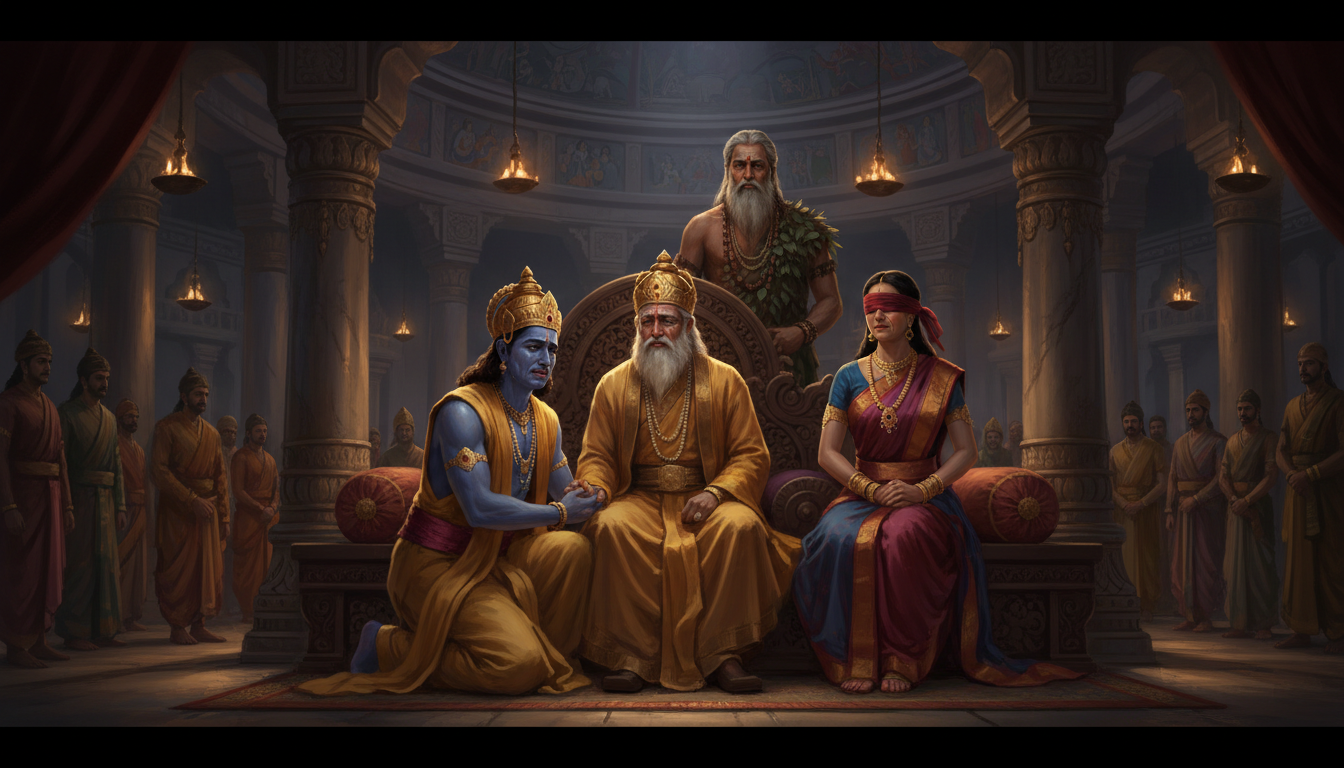
Janardana touched the feet of Vyasa and the feet of Dhritarashtra, and saluted Gandhari quietly, and said nothing at all.
Then he took Dhritarashtra's hand in his and began to weep aloud.
He wept for a while. Nobody in the room stopped him and nobody joined in. Then he let go, and washed his eyes and his face with water according to the rules, and sat down, and spoke, and the words came out softly and did not spare anybody.
"Nothing is unknown to you, Bharata, about the past or about what is coming. You know how time runs. Out of regard for you the Pandavas tried to prevent the destruction of their own race and the extermination of the Kshatriyas. Yudhishthira came to an understanding with his brothers and lived peacefully. He went into exile after being beaten at unfair dice. He lived a year in concealment in disguises. They fell into one trouble after another as if they had nobody in the world.
"On the eve of the battle I came here myself and in the presence of all men I asked you for five villages. Five. Afflicted by time, and moved by greed, you did not grant it.
"Through your fault, king, the whole Kshatriya race has been exterminated.
"Bhishma asked you for peace. Somadatta asked. Valhika. Kripa. Drona and his son. The wise Vidura asked you again and again. You did not follow any of them. Everyone, it seems, is stupefied when time afflicts him, since even you acted so foolishly in this matter. What else can it be? Destiny is supreme.
"So do not impute any fault to the Pandavas. There is not the smallest transgression to be found in them, judged by morality, or by reason, or by affection. Knowing all this to be the fruit of your own fault, it does not become you to carry ill-feeling toward them.
"Your race, your line, the funeral cake, and everything else that depends on offspring, now depend on the Pandavas, both for you and for Gandhari. You should not harbour malice against them and neither should she.
"And you should know what Yudhishthira's devotion to you is, and what his affection is. Having caused the slaughter of enemies who wronged him as they did, he is burning day and night and has not got any peace of mind. He grieves for you and for Gandhari and he cannot be happy. He is too ashamed to come and stand in front of you. That is why I am here and he is not."
Her Own Words Given Back to Her
Then he turned to the woman with the cloth over her eyes, and what he said to her was shorter, and every sentence of it was aimed.
"Daughter of Subala, you of excellent vows, listen to what I say. There is no lady like you in the world.
"You remember, queen, what you said in the assembly, in my presence. Words full of righteousness, words that were good for both parties, and your sons did not obey them. Duryodhana wanted victory and you spoke to him bitterly. You told him: 'Listen, fool, to these words of mine. Thither is victory where righteousness is.'
"Those words of yours, princess, have now been accomplished.
"Knowing that, blessed lady, do not set your heart on sorrow. Do not let your heart incline toward the destruction of the Pandavas. By the strength of your penances you are able to burn the whole earth with everything moving and unmoving on it, with eyes kindled by rage. I know what you can do. I am asking you not to."
There was a silence in that room. Then Gandhari said:
"It is even so, Keshava, as you say. My heart, burning in grief, has been unsteadied. But after hearing your words, Janardana, that heart has become steady again. As for the blind old king, who has now become a child, you and those heroes the sons of Pandu have become his refuge."
And having said that much, and no more, she pulled her cloth over her face and wept aloud, and Krishna sat with her and comforted her with reasons drawn from things she could be shown.
He Stands Up in the Middle of the Audience
And then, in the middle of it, he stopped and rose to his feet.
He had come to know, by no means anybody in that room could see, what was being planned that night at the other end of the world by the son of Drona. He bent his head and worshipped the feet of Vyasa in haste and said to Dhritarashtra:
"I take my leave, foremost of Kuru's race. Do not set your heart on grief. The son of Drona bears an evil purpose. That is why I am getting up so suddenly. It seems to me that he has formed a plan to destroy the Pandavas during the night."
And the two of them, the blind king and the blindfolded queen, whose hundred sons were lying on that field and whose grief had been in the room a moment before, said the same thing at the same time:
"Go quickly, mighty-armed one. Protect the Pandavas. Let me meet you again soon, Janardana."
That is the sentence that the whole errand was for. Two people who had every cause in the world to want the sons of Pandu dead, telling the man who had just made them see it to hurry, and to save them.
Keshava went out and took Daruka and went.
Vyasa stayed behind and began to comfort the old king, because somebody had to, and Krishna, having achieved his mission successfully, left Hastinapura for the camp and the Pandavas, and arrived, and came into their presence and told them everything about the city, and then sat down with them.
What the Errand Bought
Vaishampayana said: "That is the reason, king, and you can see now that it was not a light one."
Janamejaya sat with it.
It bought a night. That is what it bought. The wrath of Gandhari was not removed on that evening, it was steadied, and steadied is not the same as spent. Days later, on the field itself, with the women of the city walking among the bodies and turning them over, she would look at Yudhishthira through the cloth and scorch his nails, and she would look at Krishna and lay on him the ending of his own race and his own solitary death, and there would be nobody in that place who could talk her out of it, because the man who could had already used what he had to say.
But on this night she said her heart was steady, and told him to go and protect the men who had killed her sons.
And the going mattered. While Krishna was on that road, three men were sitting under a banyan tree at the edge of a wood watching an owl kill sleeping crows, and one of them was making a decision. The Pandavas would not be in their camp that night. They would be out on the Oghavati, on the grass, because of a piece of ritual scruple about not sleeping in a dead enemy's tent, and Ashvatthama would come to the camp and find only the ones who had stayed.
So the errand did two things at once, which is how Krishna generally worked. It reached a mother before the news did. And it got the man who could sense what was coming out of the palace and back onto the road in time.
"He wept when he took Dhritarashtra's hand," Vaishampayana said. "That should not be passed over. He had told that king the truth about whose fault it was, plainly and in front of witnesses, and he had cried with him first. The work of peace, when it is done at all, is done by going in person to the person who has the most cause to hate you, and by arriving before the grief does."
Dharma Lesson
The work of peace begins before the grief arrives, and it is done by going in person to the person who has most cause to hate you. Krishna wept with the old king first and only then told him the ruin was his own doing, and he gave the queen back the sentence she herself had spoken in court rather than arguing with her sorrow. A wrath that is steadied is not a wrath that is spent, but the hours it buys are sometimes all that is available.