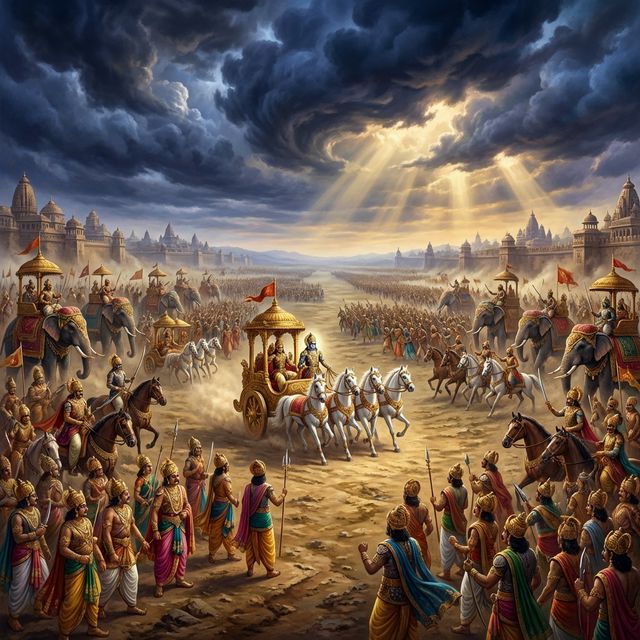
Duryodhana Rises from the Lake
Taunted in the water, the last Kaurava comes up armed and asks for one man at a time
The Water That Had Been Made Solid
Sanjaya was telling it to a blind man in a hall, as he had told all the rest of it, and by this point in the account there was very little left of the Kaurava army to tell about.
The eighteenth day had gone. Shalya was dead, and Shakuni, and the last of Dhritarashtra's hundred sons but one. The camp had emptied. Three men had come away from that field with any fight left in them, Kripa the preceptor, Kritavarma of the Satwata race, and Ashwatthama the son of Drona, and they had gone looking for their king and found him where nobody would have thought to look for the lord of the earth.
He was at the bottom of a lake.
The lake was called Dvaipayana. It was wide as the ocean, Sanjaya said, and agreeable to look at, and its waters were cool and transparent. Duryodhana had fled the field on foot with his mace in his hand and gone into it, and then, by an illusion, by a wonderful method, he had made the water solid over himself and lay down under it to rest.
The three had begged him to come out and fight. He had told them he was mangled, that they were tired, that he would rest this one night and join them in the morning. Then hunters who carried meat to Bhima heard the whole conversation from the bank and went and sold it, and the noise of the Pandava army coming up the road reached the king lying in the water like the roar of clouds.
Kripa and Kritavarma and Ashwatthama heard it too. They said what men say. We will leave this place, let it be known to thee. Duryodhana said, so be it, and did not move, and they rode off far along the bank until they came to a banyan tree and stopped under it, unyoked their horses, and sat down to wonder what was going to happen to the king.
So when the Pandavas came to the water there was nobody at all on the bank.
One Conversant With Illusion
They stood on the bank and looked at it, the whole surviving strength of their side. Yudhishthira, Bhima, Arjuna, Nakula and Sahadeva, Dhrishtadyumna of the Pancalas, Shikhandi, Satyaki, the five sons of Draupadi, what was left of the Somakas, hundreds upon hundreds of foot-soldiers, and Krishna at the head of them. Underneath the calm surface, past the place where the water stopped behaving like water, lay one man with a mace.
Yudhishthira turned to Krishna.
"Behold, the son of Dhritarashtra hath applied his power of illusion to these waters. Having enchanted them, he lieth within them. He can have now no fear of injury from man. By an act of deception, that wight conversant with every deception hath sought this refuge. He shall not, however, escape me with life. Even if the wielder of the thunderbolt himself aid him in battle, people shall yet behold him slain today."
Krishna answered him with a rule and then with a list.
"With thy own powers of illusion, O Bharata, destroy this illusion of Duryodhana, who is an adept in it. One conversant with illusion should be slain with illusion. This is the truth, O Yudhishthira."
Then the list, which was his argument that there was no shame in it, because it had always been done this way.
Indra slew the Daityas and the Danavas with acts and means. Vali was bound by Upendra with the aid of many acts and means. The great Asura Hiranyaksha was slain so, and Hiranyakasipu after him. Vritra also. Ravana of Pulastya's race, with his relatives and his followers, was slain by Rama that way. Taraka and Viprachitti, those two ancient Daityas of great energy. Vatapi and Ilwala. Trisiras. Sunda and Upasunda.
"Indra himself enjoys heaven by the aid of acts and means. Acts are very efficacious, O king, and nothing else so. Do thou take therefore the help of act."
The act Yudhishthira chose was to talk to him.
Where Is That Pride of Thine
He was smiling when he began, which Sanjaya thought worth recording, since the eldest son of Pandu was not a man who enjoyed cruelty and had spent the war apologising for it.
"Why, O Suyodhana, hast thou entered these waters, after having caused all the Kshatriyas to perish and after having caused thy own race to be annihilated? Why hast thou entered into this lake today, wishing to save thy own life? Arise, O king, and fight us.
"Where hath that pride and that sense of honour which thou hadst now gone, since thou hast enchanted these waters and art now lying within them? All men speak of thee in assemblies as a hero. All that, however, is entirely untrue, I think, since thou art now concealed within these waters.
"Arise, O king, and fight, for thou art a Kshatriya born of a noble race. Thou art Kauraveya in particular. Remember thy birth. How canst thou boast of thy birth in Kuru's race when thou concealest thyself within the depths of this lake, having fled away from battle in fear? This is not the eternal duty of a Kshatriya, staying away from battle. Flight from battle is not the practice of those that are honourable, nor does it lead to heaven."
He went at the one place where the man was thinnest, and he went at it again and again.
"Ever boastful of thy courage, thou art, however, not a hero. Falsely dost thou describe thyself when thou sayst in the hearing of all men that thou art a hero, O thou of wicked understanding. They that are heroes never fly away at sight of foes. Or tell us, O hero, about the nature of that courage in consequence of which thou hast fled from battle.
"Relying upon Karna, as also upon Shakuni the son of Subala, thou hadst regarded thyself immortal and hadst, from folly, failed to understand thy own self. Where is that manliness of thine, and where is that pride cherished by thee? Where hath that prowess gone? Where is that accomplishment of thine in weapons? Why dost thou lie within this lake now?
"Either rule the wide earth after vanquishing us, or sleep on the bare ground, slain by us. Even this is thy highest duty, as laid down by the illustrious Creator himself."
The water did not move. Then it answered.
It Was Only Fatigue
The voice came up out of the lake, and the first thing it did was to concede something, which Duryodhana had not done in eighteen days.
"It is not at all a matter of surprise, O king, that fear should enter the hearts of living creatures."
That was all he would grant, and having granted it he took it back at once for himself.
"As regards myself, however, O Bharata, I have not fled from the field of battle actuated by the fear of life. My car was destroyed, my quivers were gone, and my Parshni drivers were killed."
The Parshni drivers are the two attendants who ride at the flanks of a great car-warrior and keep his wheels from being fouled. A king does not fight without them. He was reciting an inventory of what had been taken off him, piece by piece, and the last item on the list was other people.
"I was alone, without a single follower to stand by me in battle. It was for this that I desired a little rest. It was not for the sake of saving my life, it was not from fear, it was not from grief, O king, that I entered these waters. It was only in consequence of fatigue that I did so.
"Do thou, O son of Kunti, rest a while with those that follow thee. Rising from this lake I will certainly fight all of you in battle."
It was the same answer he had given Ashwatthama on that bank an hour before, that he would fight tomorrow, that this was not the time for prowess. But Ashwatthama had come to him as a friend, and this was Yudhishthira, and Yudhishthira had no interest in the morning.
"All of us have rested sufficiently. For a long while we were engaged in a search after thee. Rise then, even now, O Suyodhana, and give us battle. Either slaying the Parthas in battle make this kingdom that swelleth with prosperity thy own, or slain by us in battle, proceed to those regions that are reserved for heroes."
There was nowhere further to put the thing off to. So Duryodhana, from under the water, offered him the earth.
The Widowed Earth
"They amongst the Kurus, O son of Kurus' race, for whose sake I desired sovereignty, that is, those brothers of mine, all lie dead on the field."
It is the only place in the whole of his life where he says out loud what he had wanted it for.
"I do not, again, like to enjoy any longer the earth that is now shorn of wealth and reft of superior Kshatriyas, and that hath therefore become like a widowed lady."
Then, because he was who he was, the boast came up through the grief and stood next to it without either one cancelling the other.
"I, however, still hope to vanquish thee, O Yudhishthira, after curbing the pride of the Pancalas and the Pandus. There is, however, no longer any need for battle when Drona and Karna have been quieted and when our grandsire Bhishma hath been slain.
"This shorn earth now exists for thee. What king is there that would like to rule a kingdom divested of friends and allies? Having caused friends such as I had to be slain, and even sons and brothers and sires, and seeing my kingdom wrested by you, who is there like myself that would like to live?
"Clad in deer-skins I would retire into the woods. I have no desire for kingdom, deprived as I am of friends and allies. Reft almost entirely of friends and allies, of heroes and elephants, this earth exists for thee, O king. Do thou enjoy her now cheerfully. Friendless as I am, I have no desire, O lord, for even life. Go, O monarch, and rule the earth destitute of lords, without warriors, reft of wealth, and without citadels, as thou choosest."
He was offering the Pandavas, from the bottom of a lake, exactly what he had refused them in the hall at Hastinapura, and offering it in the exact costume they had worn out of that hall. Deer-skins. Fourteen years in the woods. He had watched five men walk into exile dressed that way, and now, with nothing left, he proposed to put the clothes on himself and hand over the kingdom, and it does not seem to have occurred to him that anybody standing on the bank would notice.
Yudhishthira noticed.
The Land the Needle Covers
"Do not utter such ravings of sorrow, O sire, from within the waters. I do not, like Shakuni, feel any compassion for thee, O king, for such words as these."
That was the opening, and it was a knife. Shakuni was the one man in the world who had loved Duryodhana enough to ruin the world for him, and he was lying dead on the field behind them, and Yudhishthira was saying that the only ear that speech would have found was the ear of the man who had put him in the water.
Then the refusal, on grounds of law.
"Thou mayest now be willing to make a gift of the earth to me. I, however, do not wish to rule the earth thus given by thee. I cannot sinfully accept this earth from thee. Acceptance of a gift is not the duty laid down for a Kshatriya. I shall, on the other hand, enjoy the earth after vanquishing thee in battle.
"Why didst thou not then give us the earth when we, observant of the rules of righteousness and desirous of the welfare of our race, had begged thee for our portion? Having first refused the request of the mighty Krishna, why dost thou now desire to give away the earth? What is this folly of thine?"
And then the sentence the whole war had been fought over, put back in front of the man who had said it.
"Thou didst not formerly agree to give me even that much of the earth which would be covered by the point of a needle. How then dost thou make me a gift of the whole earth?
"Although thou desirest to give away the earth, thou shalt not yet escape me with life. Thy life, O thou of limited foresight, now depends upon me. If I like, I can suffer thee to live, but thou art not capable of protecting thy own life.
"Thou hadst at one time endeavoured to burn us to death, and to take our lives by means of snakes and other kinds of poison, and by drowning us. We were also wronged by thee by the deprivation of our kingdom, by the cruel words spoken by thee, and by thy maltreatment of Draupadi. For these reasons, O wretch, thy life must be taken. Rise, rise, and fight us. That will benefit thee."
And after that, Sanjaya said, they all did it. The Pandavas, flushed with victory, stood on the bank of that lake and rebuked and mocked him in that strain, repeatedly, one after another, into the water.
A Man Who Could Not Stand in the Shade
Here the blind king in the hall stopped his charioteer and asked a question, and it is the best question Dhritarashtra asks in the whole of the war.
"Thus admonished by his foes, how, indeed, did that scorcher of enemies, my heroic and royal son, who was wrathful by nature, then behave? He had never before listened to admonitions such as these. He had been treated by all with the respect due to a king.
"He, who had formerly grieved to stand in the shade of an umbrella, thinking he had taken another's shelter, he, who could not endure the very effulgence of the sun in consequence of his sensitive pride, how could he endure these words of his foes?
"Thou hast, with thy own eyes, O Sanjaya, seen the whole earth, with even her Mlecchas and nomad tribes, depend upon his grace. Rebuked thus by the sons of Pandu, while lying concealed in such a solitary place after having been deprived of his followers and attendants, alas, what answer did he make? Tell me everything."
A father was explaining his son to the man who had watched him die, and the explanation was a good one. This was a prince who had disliked standing under an umbrella because the shade was somebody else's, and who could not bear the sun on him either, because the sun outshone him. There was no arrangement of the world in which such a man could be comfortable, and there was certainly none in which he could lie underwater and be called a coward by five men in daylight.
Sanjaya answered.
"Thus rebuked, O monarch, by Yudhishthira and his brothers, thy royal son, lying within those waters, heard those bitter words and became very miserable."
He breathed hot and long sighs, one after another, down there in the dark under the solid water. He waved his arms, again and again, like a man arguing with nobody. And then he set his heart on battle, and spoke up through the lake.
The Debt He Meant to Pay
"Ye Parthas, all of you are possessed of friends, of cars, and of animals. I, however, am alone, cheerless, without a car, and without an animal. Being alone and destitute of weapons, how can I venture to fight on foot against numerous foes all well-armed and possessed of cars?
"Do you, however, O Yudhishthira, fight me one at a time. It is not proper that one should in battle fight many endued with courage, especially when that one is without armour, fatigued, afflicted with calamity, exceedingly mangled in his limbs, and destitute of both animals and troops.
"I do not entertain the least fear, O monarch, of either thee, or Vrikodara, or Phalguna, or Vasudeva, or all the Pancalas, or the twins, or Yuyudhana, or all the other troops thou hast. Standing in battle, alone as I am, I shall resist all of you.
"Like the year that gradually meets all the seasons, I shall meet all of you in fight. Like the sun destroying by his energy the light of all stars at dawn, I shall today, though weaponless and carless, destroy all of you possessed of cars and steeds."
Then he named his creditors, and the naming is a roll of the dead of that war spoken by the man they had died for.
"Today I shall free myself from the debt I owe to the many illustrious Kshatriyas that have fallen for me, to Bahlika and Drona and Bhishma and the high-souled Karna, to the heroic Jayadratha and Bhagadatta, to Shalya the ruler of the Madras and Bhurishrava, to my sons, and Shakuni the son of Subala, to all my friends and well-wishers and kinsmen. Today I shall free myself from that debt by slaying thee with thy brothers."
With those words the king ceased speaking, and Yudhishthira gave him what he had asked for, and gave it gladly, four times over.
"By good luck, O Suyodhana, thou knowest the duties of a Kshatriya. By good luck, O thou of mighty arms, thy heart inclineth to battle. By good luck thou art a hero, O thou of Kuru's race, and by good luck thou art conversant with battle, since, single-handed, thou wishest to meet all of us in battle.
"Fight any one of us, taking whatever weapon thou likest. All of us will stand as spectators here. I grant thee also, O hero, this other wish of thy heart, that if thou slayest any of us, thou shalt then become king. Otherwise, slain by us, go to heaven."
He Came Up Like a Prince of Elephants
He had been offered his choice of weapon, and he took the one thing he had left.
"A brave man as thou art, if thou grantest me the option of fighting only one of you, this mace that I hold in my hand is the weapon that I select. Let any one amongst you who thinks that he will be my match come forward and fight with me on foot, armed with mace. Many wonderful single combats have occurred on cars. Let this one great and wonderful combat with the mace happen today. Men while fighting desire to change weapons. Let the manner of the fight be changed today, with thy permission. I do not cherish the least fear, O Yudhishthira, of even Shakra himself."
"Rise, rise, O son of Gandhari, and fight me, Suyodhana. Alone as thou art, fight us, encountering one at a time, thou of great might, armed with thy mace. Be a man, O son of Gandhari, and fight with good care. Today thou shalt have to lay down thy life even if Indra becomes thy ally."
That tiger among men could not bear it. He breathed long and heavy sighs from within the water like a mighty snake from within its hole. Struck repeatedly with such wordy goads, Sanjaya said, he could not endure it at all, like a horse of high breed that cannot endure the whip.
Then the lake broke open.
Agitating the waters with great force, he rose like a prince of elephants coming up out of a pool, breathing hard in his rage, holding the heavy mace that was endued with the strength of adamant and decked with gold. He pierced the solidified water from beneath and came up through it shouldering that iron club, like the sun himself scorching everything with his rays, and standing on the bank he began to handle it, turning the great weapon with its sling in his hands.
They looked at him. A man armed with a mace and resembling a crested mountain, or the trident-wielding Rudra casting angry glances upon living creatures, shedding an effulgence about him like the scorching sun in the sky. All creatures there regarded that mighty-armed chastiser of foes, as he stood shouldering his mace after rising from the waters, as the Destroyer himself with his bludgeon in his hand. The Pancalas saw the thunder-wielding Shakra, or Hara with the trident.
Let Him Take Up the Mace
And then, seeing him actually come out, the Pancalas and the Pandavas began to rejoice and to seize one another by the hands.
Duryodhana watched them do it and understood it as an insult, which it was. He rolled his eyes in wrath. He drew his brow into three furrows and bit his nether lip, and he looked at the Pandavas with Krishna standing in the middle of them as though he could burn them where they stood.
"You Pandavas, you shall have to bear the fruit of these taunts. Slain by me today, you shall, with the Pancalas, have to repair to the abode of Yama."
He stood on the bank with his limbs bathed in blood and drenched with water at once, so that his body looked like a mountain shedding water from within it, and the Pandavas thought he looked like the angry son of Surya armed with the bludgeon called Kinkara. With a voice deep as the clouds, or as a bull roaring in joy, he summoned them again to fight him one at a time, and told them to let the gods in heaven look on.
Yudhishthira answered that with a boy's name.
"How is it, O Duryodhana, that thou hadst not this knowledge when many great car-warriors, uniting together, slew Abhimanyu in battle? If this be your duty, that one should never be slain by many, why is it then that Abhimanyu was slain by many, acting in accord with thy counsels? All creatures, when in difficulty, forget considerations of virtue.
"Put on armour, O hero, and bind thy locks. Except thy life, O hero, tell us what boon we may grant thee."
So they armed him on the bank of the lake he had been hiding in. He cased his body in mail of gold and put on a beautiful head-gear adorned with pure gold, and standing there in bright armour with the mace on his shoulder he looked, Sanjaya said, like a golden cliff.
"Amongst you five brothers, let any one fight me, armed with mace. As regards myself, I am willing to fight either Sahadeva, or Bhima, or Nakula, or Phalguna, or thee today. Today I will reach the end of these hostilities that is difficult to reach, with the aid of my mace wrapped with cloth of gold.
"It is not proper for me to speak such words of pride with respect to my own self. I shall, however, make these words of mine true in your presence. Within this very hour, these words will become either true or false.
"Let him amongst you take up the mace that will fight with me."
Dharma Lesson
Duryodhana goes into the water because he is tired and comes out of it because he is insulted, and the distance between those two reasons is the whole of the man. He can survive the loss of his brothers, his allies and his kingdom, and he cannot survive being laughed at from a bank. Yudhishthira, for his part, refuses the earth at the moment it is finally offered to him, on the ground that a Kshatriya may not accept as a gift what he has not won, and the refusal is honest law and also the surest way to make the last man fight. Each of them chooses the battle over the settlement, and each of them is certain he is choosing duty.