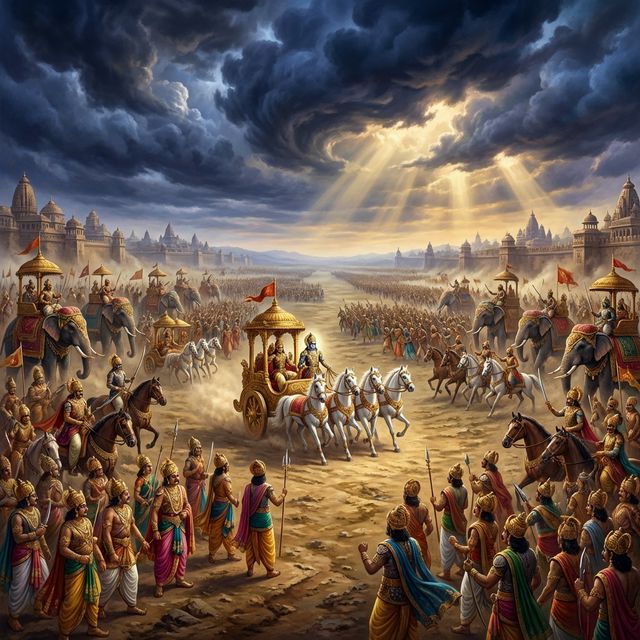
The Last Words of Duryodhana
Broken-thighed on the field, the Kuru king laments his dead, sends his last words home, and names a general with a dying man's hand.
What Duryodhana Said
Dhritarashtra could not see the field, but for the length of the war Sanjaya's eyes had been lent to him, and now the war had all but ended.
"Kicked at the head, his thighs broken, prostrated on the ground, exceedingly proud even in that state," the blind king said, "what, O Sanjaya, did my son then say? King Duryodhana was exceedingly wrathful, and his hostility to the sons of Pandu was deep-rooted. When this great calamity overtook him, what did he say on the field?"
It was the eighteenth day. At Samantapanchaka, where the two armies had gone down at last to a duel of maces between two kings, Bhima had brought his weapon round low and broken the thighs of Duryodhana, in contravention of the rules the mace-fighters swore to, and had set his own heel for a moment on the fallen head. The Kuru king lay where he had fallen, and the field around him, which an hour before had held the last of both armies, was already emptying toward the two camps.
"Listen, O monarch," Sanjaya said, "to what your son said when overtaken by that calamity.
"With his thighs broken, covered with dust, the king gathered his flowing locks and cast his eyes about him on every side. Having with difficulty gathered them, he began to sigh like a snake. Filled with rage, with tears flowing fast, he looked at me. He struck his arms against the earth for a while, like an infuriated elephant. Shaking his loose locks and gnashing his teeth, he began to censure your eldest nephew, and then, breathing heavily, he turned and addressed me."
Dhritarashtra folded his hands in his lap and said nothing more. He had asked for this. Sanjaya went on.
The Foot on His Head
"Alas," Duryodhana said, "I who had Santanu's son Bhishma for my protector, and Karna, that foremost of all wielders of weapons, and Gotama's son Shakuni, and Drona, that first of all wielders of arms, and Ashwatthama, and the heroic Shalya, and Kritavarma -- alas, even I have come to this plight! It seems that Time is irresistible. I was the lord of eleven Chamus of troops, and yet I have come to this. O mighty-armed one, no one can rise superior to Time.
"Those of my side who have escaped this battle with life should be told how I was struck down by Bhimasena in contravention of the rules of fair fight. Many were the unfair and sinful acts done against Bhurishrava, and against Bhishma, and against Drona of great prosperity, and this is another such act, for which I am certain the Pandavas will incur the condemnation of all righteous men. What pleasure can a righteous man take in a victory won by unfair means? What learned man rejoices, as that sinful Vrikodara now rejoices, after winning by unrighteousness? What can be more amazing than this, that Bhimasena in his wrath should touch with his foot the head of one like me, lying with my thighs broken? Is that man worthy of honour who behaves so toward a man of glory and prosperity, living in the midst of his friends?"
He struck the earth again, once, with the flat of his hand, and the dust that had begun to settle over him rose and settled again.
"My parents are not ignorant of the duties of battle," he said. "Instructed by me, Sanjaya, tell them, who are afflicted with grief, these words."
And Sanjaya, sitting where he had been ordered to sit, at the edge of the trampled ground, understood that the king was no longer speaking to him, but past him, toward Hastinapura, toward two old people who could not see this any more than the man to whom he was dictating it could.
Who Is There More Fortunate
What Duryodhana had Sanjaya carry to his parents was not an apology and it was not a complaint, though it had passages that sounded like both. It was an accounting, made aloud by a man doing sums while the light was still in him to do them by.
"I have performed sacrifices," he said, "and supported a great number of servants properly, and governed the whole earth with her seas. I stayed upon the heads of my living foes. I gave wealth to my kinsmen to the extent of my abilities, and did what was agreeable to my friends. I withstood all my foes. Who is there more fortunate than myself?
"I made progresses through hostile kingdoms and commanded kings as slaves. I acted handsomely toward all I loved. Who is there more fortunate than myself? I honoured all my kinsmen and attended to the welfare of all who depended on me. I attended to the three ends of human existence, religion, profit, and pleasure. Who is there more fortunate than myself? I laid my commands on great kings, and honour unattainable by others was mine. I always made my journeys on the very best of steeds. Who is there more fortunate than myself? I studied the Vedas and made gifts according to the ordinance. My life has passed in happiness. By the duties of my own order I have earned many regions of blessedness hereafter. Who is there more fortunate than myself?
"By good luck I have not been vanquished in battle and made to serve my foes as a master. By good luck it is only after my death that my prosperity abandons me, to wait upon another. That which good kshatriyas desire, that death, is obtained by me. Who is there so fortunate as myself? By good luck I did not suffer myself to be turned from the path of hostility and vanquished like an ordinary person. By good luck I have not been vanquished after doing some base act. Like the slaughter of a man asleep, or heedless, or poisoned, so has my slaughter been, unrighteous, in contravention of the rules of fair fight."
He was quiet a moment, gathering breath.
"The highly blessed Ashwatthama," he said, "and Kritavarma of the Satwata race, and Saradwat's son Kripa, should be told these words of mine. You should never repose any confidence upon the Pandavas, those violators of rules, who have perpetrated many unrighteous acts."
The Names He Sent Ahead of Him
Then, to the messengers who had gathered at what safe distance the field allowed, the king spoke a second time, and this speech was for the road, not for the record.
"I have, in battle, been slain by Bhimasena most unrighteously. I am now like a moneyless wayfarer, and shall follow in the wake of Drona, who has already gone to heaven, of Karna and Shalya, of Vrishasena of great energy, of Shakuni the son of Subala, of king Bhagadatta, of Jayadratha the king of the Sindhus, of all my brothers headed by Dushasana and equal unto myself, of Dushasana's son of great prowess, and of Lakshmana my son, and of thousands of others who fought for me.
"Alas, how shall my sister, stricken with woe, live sorrowfully, after hearing of the slaughter of her brothers and her husband! Alas, what shall be the plight of the old king my sire, with Gandhari, and his daughters-in-law and grand-daughters-in-law! Without doubt the beautiful and large-eyed mother of Lakshmana, made sonless and husbandless, will soon meet with her own death. If Charvaka, the mendicant devotee who is a master of speech, learns everything, that blessed man will certainly avenge himself of my death. By dying upon the sacred field of Samantapanchaka, celebrated over the three worlds, I shall certainly obtain many eternal regions."
Thousands of men who had gathered near enough to hear it fled away in all directions, with their eyes full of tears, at these lamentations of the king. The earth, with her forests and her seas, with all her mobile and immobile creatures, was said afterward to have trembled and produced a loud noise as he spoke, and the points of the compass to have gone murky, though Sanjaya, telling it, allowed that a man listening to a king's death-speech is not the most reliable witness of what the sky was doing at the time.
The messengers went, in the end, to the one place the king's words had pointed them: to Drona's son. They found him, and told him everything regarding the mace-encounter and the fall of the king, and having told it they stood a long while in a thoughtful mood, and then went away, grief-stricken, the way they had come.
Three Wounded Men on Fleet Steeds
Ashwatthama had had a hard day already. So had Kripa, who had taught half the warriors on both sides their bows, and so had Kritavarma of the Satwata race, who had led the Bhoja horsemen since morning. All three were among the unslain remnant of the Kaurava army, and all three were exceedingly wounded, with the marks of keen shafts and maces and lances and darts still on them, when the messengers found them and told them Duryodhana had fallen.
They did not wait to be told twice, and they did not wait to have their wounds seen to. They came on their fleet steeds, quickly, to the field of battle, to the place at Samantapanchaka the messengers had named.
They found him there. The high-souled son of Dhritarashtra lay prostrate on the ground, like a gigantic sala tree laid low in the forest by a tempest. He was writhing where he lay, covered with blood, like a mighty elephant felled in the forest by a hunter, weltering in agony, bathed in profuse streams of blood. He lay like the sun dropped upon the earth, or like the ocean dried by a mighty wind, or like the full moon in the firmament with its disc shrouded by fog. Equal to an elephant in his frame, possessed of long arms, the king lay on the earth covered with dust, and around him, drawn already by the smell of blood, were terrible creatures and carnivorous animals, circling the way wealth-coveting dependants circle a monarch still in state. His forehead was contracted into furrows of rage even now, and his eyes still rolled in wrath. He was a tiger among men, struck down like a tiger by hunters.
The three great archers, Kripa and the other two, beholding the king laid low on the earth, became stupefied for a moment where they sat their horses. Then they came to themselves. They alighted from their cars and ran toward him, and all three sat down on the earth around him, the way men sit around a fire that is going out and that they mean, for as long as they can manage it, to keep from going out entirely.
Truly, There Is Nothing Stable
It was Drona's son who spoke first, with tearful eyes, breathing like a snake.
"Truly, there is nothing stable in the world of men," Ashwatthama said, "since thou, O tiger among men, liest on the bare earth, stained with dust. Thou wert a king who had laid thy commands on the whole earth. Why then, O foremost of monarchs, dost thou lie alone on the bare ground, in such a lonely wilderness? I do not see Dushasana beside thee, nor the great car-warrior Karna, nor those friends of thine numbering in hundreds. What is this, O bull among men? Without doubt it is difficult to learn the ways of Yama, since thou, O lord of all the worlds, thus liest on the bare ground, stained with dust.
"Alas, this scorcher of foes used to walk at the head of all kshatriyas whose locks had been sprinkled with holy water at ceremonies of coronation. Alas, he now eats the dust. Behold the reverses that Time brings on its course. Where is that pure white umbrella of thine? Where is that fanning yak-tail, O king? Where has that vast army of thine now gone, O best of monarchs? The course of events is certainly a mystery, when causes other than those relied upon are at work, since even thou, that wert the master of the world, hast been reduced to this plight. Without doubt the prosperity of all mortals is very unstable, since thou, that wert equal unto Shakra himself, hast now been reduced to such a sorry plight."
Duryodhana heard the whole of it. He wiped his eyes with his hands, and shed tears of grief anew, and when Ashwatthama had finished he turned his head, with what effort the watching men could see, and addressed all three of them, Kripa and Kritavarma and the weeping son of his teacher, together.
"This liability to death, of all living creatures, is said to have been ordained by the Creator himself," the king said. "Death comes to all beings in course of time. That death has now come to me, before the eyes of you all. I who reigned over the whole earth have now been reduced to this plight."
Do Not Grieve for Me
"By good luck," Duryodhana went on, "I never turned back from battle, whatever calamities overtook me. By good luck I have been slain by those sinful men by the aid, particularly, of deception. By good luck, while engaged in hostilities, I always displayed courage and perseverance. By good luck I am slain in battle, along with all my kinsmen and friends. By good luck I behold you escaped with life from this great slaughter, and safe and sound. This is highly agreeable to me.
"Do not, from affection, grieve for my death. If the Vedas are any authority, I have certainly acquired many eternal regions. I am not ignorant of the glory of Krishna of immeasurable energy. He has not caused me to fall off from the proper observance of kshatriya duties. I have obtained him. On no account should any of you grieve for me. You have done what persons like you should do. You have always striven for my success. Destiny, however, is incapable of being frustrated."
Having said this much, the king, with eyes laved in tears, fell silent, agitated as he was with agony.
Beholding him in that silence, in tears and grief after such a speech of composure, Drona's son flamed up in anger, like the fire that is seen at the universal destruction. Overwhelmed with rage, he squeezed his hand and, addressing the king in a voice hoarse with tears, said these words.
"My sire was slain by those wretches with a cruel contrivance. That act, however, does not burn me so keenly as this plight to which thou hast been reduced, O king. Listen to these words of mine that I utter, swearing by Truth itself, and by all my acts of piety, all my gifts, my religion, and the religious merit I have won. I shall today, in the very presence of Vasudeva, dispatch all the Panchalas, by all means in my power, to the abode of Yama. It behoves thee, O monarch, to grant me permission."
The Water and the Command
The words were highly agreeable to the Kuru king's heart, and he did not waste breath praising them. He turned instead to Kripa.
"O preceptor," he said, "bring me without delay a pot full of water."
Kripa, that foremost of brahmanas, rose at once and brought a vessel full of water, and came and knelt with it beside the king. Duryodhana looked past him, at Ashwatthama.
"Let the son of Drona," he said, "O foremost of brahmanas -- blessed be thou -- be, at my command, installed as generalissimo, if thou wishest to do me good. At the command of the king, even a brahmana may fight, especially one who has adopted kshatriya practices. Those learned in the scriptures say this."
Hearing these words, Kripa, the son of Saradwat, did what he had been asked. With the water he had brought to comfort a dying man, he installed Drona's son as generalissimo of what remained of the Kaurava host, at the command of the king who no longer had an army to command in any other way.
The installation was over quickly. There was no ceremony left to hold it with, no priests, no horses, no drums -- only three exhausted, wounded men and a fourth who could not rise. Ashwatthama embraced the king where he lay, and then stood, and left the spot, and as he went he caused the ten points of the compass to resound with a leonine roar, the way a man announces to a battlefield that has already gone quiet what he intends to do to it before morning.
Duryodhana, foremost of kings, profusely covered with blood, was left to pass that night, so frightful to all creatures, where he lay. And the three who had found him, Ashwatthama and Kripa and Kritavarma, went away quickly from the field of battle, their hearts agitated by grief, and began, as they rode, to reflect anxiously and earnestly on what they had just sworn themselves to.
Dharma Lesson
Duryodhana's last hours are not a conversion. He does not repent the war or ask forgiveness; he counts up his sacrifices, his gifts, his conquests, and calls himself fortunate to have died undefeated rather than as a suppliant. What the scene actually shows is how completely a man's self-account can survive the wreck of his body, and how a grievance nursed to the very end still has enough strength left in it to command an army. He spends his last free act, not on his family, but on unleashing one more act of vengeance through another man's hand.