What Krishna Had Already Done
Arjuna asks, and gets a list he did not expect
Spend It Now
The night battle had been running for hours when Ghatotkacha's illusions broke the Kaurava center, and the men around Karna stopped fighting and began to beg.
"Kill the Rakshasa with the dart," they cried. "Now, tonight. These Kauravas are on the point of being annihilated. What will Bhima and Arjuna do to us if we are all dead before morning? Use it. Slay this wretch who is consuming us in the dark."
Karna's four horses were already down. A Sataghni thrown out of the sky had taken them together, and they had dropped to their knees in the churned ground with their tongues out and their eyes gone. He stood on the earth beside his own useless car, and he did not lose his head, which was the worst thing he could have done, because it meant he had time to think.
The dart had come from Indra. He had paid for it with the armour that grew out of his own skin and the earrings he had been born wearing, cut away with his own knife while a god stood and watched him do it. It could be thrown once. He had kept it wrapped and oiled and garlanded and worshipped for years, for one man, and every soldier in both armies knew which man.
He looked up at the Rakshasa standing over the tents.
Then he took up Naikartana, that blazing missile twined about with strings, which in the torchlight looked like the tongue of the Destroyer or like the sister of Death, and he threw it.
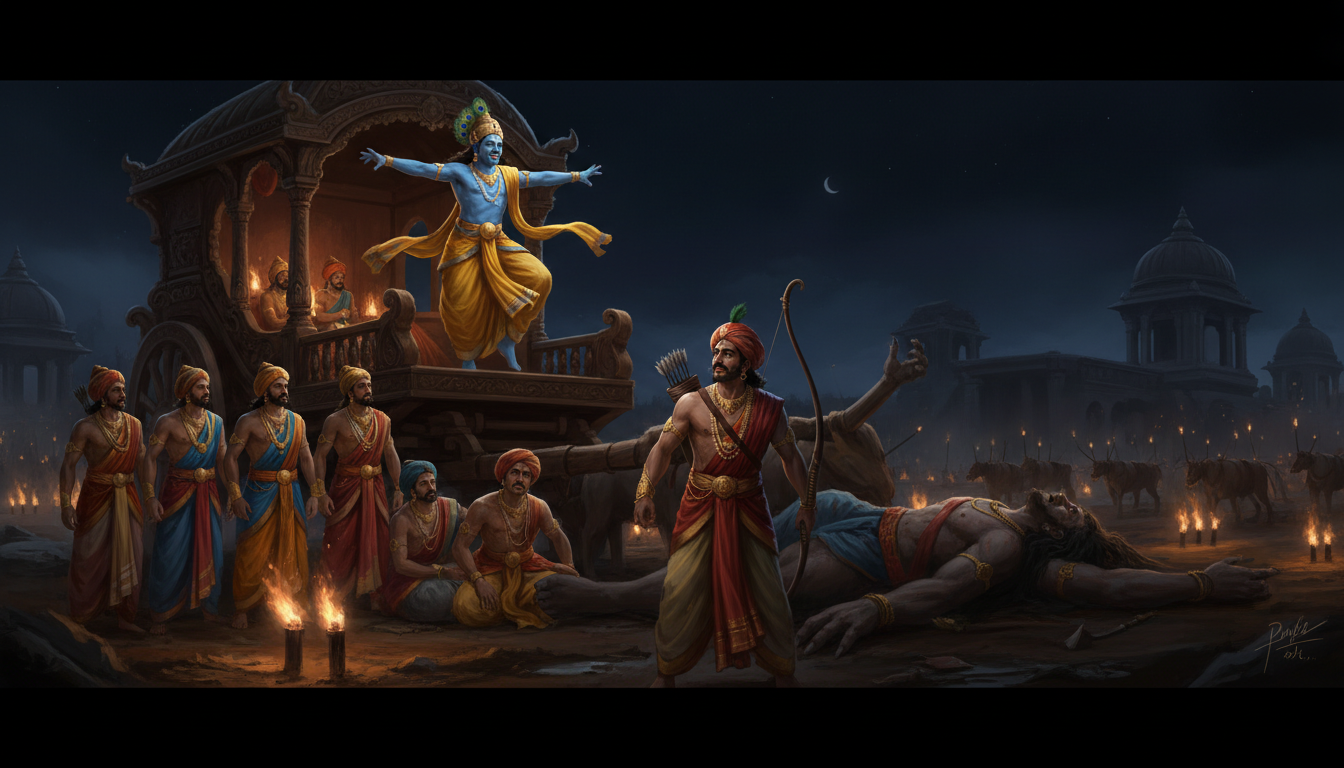
Ghatotkacha saw it coming and ran, swelling as he ran until he was the size of a spur of the Vindhya mountains, and it went through his chest anyway, and out, and up into the night, and lodged among the stars. He fell. Falling, he made himself heavier and wider still and came down deliberately across a full akshauhini of Duryodhana's troops, and killed them all with the weight of his body on his way to being dead.
The Kauravas roared until the plain rang. Karna climbed onto Duryodhana's chariot and was carried through the host like Indra after the killing of Vritra.
The Man Who Danced
"Every one of them wept, king," Sanjaya said. "Hold on to that, because of what comes next. Yudhishthira wept. The Panchalas wept. Bhima, who was the boy's father, went out onto the field to look at what was lying there. And in the middle of all that grief one man on that side was dancing."
Krishna had knotted the reins off and jumped down onto the terrace of the car. He shouted, the long rolling shout men make over a kill, and he caught Arjuna and embraced him, and let go, and shouted again, and slapped his own armpits with his palms the way a wrestler does before he steps into the ring. He was moving like a tree in a high wind. He embraced Arjuna a second time and roared out over the heads of the army where anybody could see him.
Arjuna stood in his own chariot with his bow in his hand and watched him do it.
"Slayer of Madhu," he said at last, "you are showing great joy at a time that is scarcely fit for it. This is an occasion for sorrow. Hidimba's son is dead. Our troops are running because they saw him fall, and we are all of us sick about it, and here you are."
Krishna went on grinning at him.
"The cause must be very grave," Arjuna said, "when at such a time you feel such joy. So tell me truly, since I have asked, and you are the most truthful of men. If it is not a secret, say it. What has taken your gravity away tonight? This lightness in you looks to me like the ocean drying up. It looks like Meru getting up off its base and walking."
Karna Is Already Dead
"Great is the joy I feel," Krishna said. "Listen, and it will take your grief off you in a moment. Karna is dead. He is standing over there in the torchlight with his bow in his hand and he is a dead man, and I am the only one on this plain who knows it."
"He is not dead."
"He is dead. Count with me. He was born inside armour that grew out of his body, and it is gone. He was born wearing those earrings, and they are gone. He held one dart from Indra that could not be turned aside or endured by anything alive, and it is gone, spent at midnight, in the dark, on a Rakshasa. By good luck the armour. By good luck the earrings. By good luck the dart, baffled through Ghatotkacha. He cut the first two off his own body and handed them up, and that is why men call him Vaikartana, the cut one. There is a word for a man who has given away three things he was born with, and the word is finished."
He was not grinning any more.
"Understand what he was, Dhananjaya, because you are going to have to fight what is left. In that mail and those earrings, with his senses under him, he could have taken the three worlds by himself. Not Indra could have gone near him. Not Varuna, lord of the waters. Not Yama. Not you with the Gandiva bent, and not me with the discus up. Tonight he is like a snake full of poison that has been stupefied by an incantation. He is a fire with mild flames. He is a man."
"Then anybody can kill him."
"Nobody can kill him but you, and I will swear that to you if you like. Not even the vanquisher of Vala with the thunderbolt in his fist can kill Karna while he is standing with a weapon in his hand. There will be one moment and it will be short. His chariot wheel will go into the earth and stick, and he will step down to lift it. That is the moment. I will make you a sign beforehand. Watch me, not him."
Arjuna said, "You talk about him as though you admire him."
"I do," Krishna said. "He gives to brahmanas. He does not lie. He keeps his vows and his penances and he is kind even to men he means to kill. That is why they call him Vrisha, and that name is as true as the other one. Both of his names are true. He is going to die anyway."
The Question He Had Never Asked
Arjuna was quiet for a while. Out on the left the Kaurava drums were still going. Somebody was bringing torches out to where the body lay, and the light of them moved across the underside of the smoke.
When he spoke again it was not about Karna.
"How, Janardana," he said, "and by what means, were those lords of the earth killed? Jarasandha and the others. I have never asked you. I am asking now."
"Ask the question the other way round," Krishna said, "and you will see it faster. What would have happened if they had lived? Jarasandha alive. The ruler of the Chedis alive. The mighty son of the Nishada king alive. Every one of them had been our enemy for years, and every one of them would have gone over to Duryodhana the day the heralds rode out, because he takes anyone who hates us, and they all did."
"Three men."
"Four. Put the Suta's son with them. Four bowmen, each one accomplished in weapons and firm in battle, each one able to stand up alone against the whole celestial host with the Regents of the world behind it. Set those four in front of Dhritarashtra's sons and they would not have needed the eleven akshauhinis at all. They would have taken the whole earth first and come to you afterwards, at their leisure, with the world behind them."
"So they were killed."
"So they were killed. And here is the part you will not enjoy, Partha, so hear it standing up. Not one of them was beaten by strength. Without the employment of means the gods themselves could not have conquered those men in battle. Every one of those deaths was arranged. You were told afterwards that they had fallen. You were not told how the ground was prepared. I will tell you now, one at a time, and then we will go back to work."
The Mace and the Woman in the Ground
"Begin with Jarasandha, since you began with him.
"You know he was born in two pieces. Both of his father's queens bore half a child each, and the halves were carried out and thrown away, and a Rakshasa woman named Jara found them in the road and fitted them together for her own amusement, and the thing sat up and lived. They named him for her. Jarasandha: joined by Jara. What nobody in your camp ever thought about is that she stayed. She lived down inside the earth under Girivraja with her son and her kinsmen around her, and while she was there, in the ground under his city, he could not be beaten.
"Then one day he fought Baladeva, and Baladeva pressed him past his patience, and he lost his temper. He had a mace that had been made to kill everything that breathes. He picked it up and threw it at us.
"It came at us across the sky with the splendour of fire on it, dividing the clouds the way the parting line divides the hair on a woman's head, coming with the impetuosity of Sakra's thunder. My brother, Rohini's son, took up the weapon called Sthunakarna and threw it into the mace's path. The force went out of the mace in the air and it dropped. When it struck it split the earth open and made the mountains tremble, and it went down into the split it had made.
"It killed her where she lived. Her, and her son, and every one of her kinsmen, all of them together, by that mace and that weapon.
"And he never picked the mace up again, because it was in the ground and so was she. He was a disarmed man from that hour and he did not know it. That is why Bhimasena was able to hold him and wear him down and tear him in two in front of your eyes, and why you were both able to walk out of Magadha alive. If the valiant Jarasandha had been standing there with that mace in his hand, the gods with Indra at their head could not have killed him in battle, and neither of you would have come home."
The Thumb
"The Nishada," Arjuna said.
"The Nishada. He came to Drona in the school with the rest of you and asked to be taught, and Drona would not have him, on account of his birth. So he went back into the forest and made an image of Drona out of the clay of the riverbank and set it up under the trees and practised in front of it every day, and he taught himself, and what he taught himself was better than what was being taught to you.
"When Drona learned what had grown up out there, he went to him. He stood in front of the boy as his preceptor, which he had refused to be, and asked for the preceptor's fee. He asked for the right thumb. It was done by guile and I will not call it anything else. The boy cut the thumb off and put it in his hand and thanked him and went back to shooting, with his fingers cased in leathern gloves, and he was still splendid to look at, like a second Rama standing there with a bow.
"But he was not what he had been. Understand what was taken, Partha. Undeprived of that thumb, Ekalavya could not have been vanquished in battle by the gods, the Danavas, the Rakshasas and the Uragas together. His grasp never slipped. He could shoot incessantly, all day and all night, without stopping and without tiring, and mere men could not stand to look at him while he did it. That came out of a Nishada village because a teacher said no to it.
"And afterwards, when the thumb was not enough, I killed him myself on the field of battle. For your good."
Arjuna did not say anything.
"You have always been told that Drona took the thumb out of favouritism for you," Krishna said. "Believe that if you want to. He did what was needed and he did not know why he was doing it. Most men never do."
Born to Do It
"The third one you watched," Krishna said. "You were standing in the hall.
"The ruler of the Chedis died in front of your eyes at your brother's sacrifice, in a room full of kings, and not one of those kings moved. He could not have been vanquished in battle by the gods and the Asuras together, and so I did not fight him in battle. I let him talk. I let him go on talking until he had used up the hundred pardons I had promised his mother, and when the hundredth was spent I sent the discus, and the hall was quiet for a long time afterwards.
"Now hear the rest of it, because you have never asked me this either. I was not born and then handed Shishupala to kill. I was born to kill him. Him, and the others like him, the enemies of the gods, and I was born to do it with your help, from a desire to benefit the world. That is the errand. You are the other half of the errand and always were.
"They that are destroyers of righteousness are all slayable by me. That is my vow, and I made it for the establishing of righteousness, not for you and not for your brothers. Where the Vedas are, and truth, and self-restraint, and purity, and modesty, and prosperity, and wisdom, and forgiveness, there I always am. Where they are not, I come, and I am not gentle about it."
Arjuna said, "You are telling me the war was decided before it started."
"I am telling you the war was decided before you were born," Krishna said. "That does not make tomorrow easier. It only means you will not be surprised."
The Rest of the List
"There are more," Krishna said, "and the rest of them are your brother's work, so count them with me.
"Hidimba, in the woods, on the first night you were fugitives with your mother out of a burning house. Vaka, at Ekachakra, while you were living in a brahmana's back room and eating what the town would give you. Kirmira, on the road into the great forest, when you were walking into exile with nothing. Three Rakshasas, all three killed by Bhimasena, all three of them endued with might equal to Ravana's, and all three of them destroyers of brahmanas and eaters of sacrifices.
"Did you think you kept walking into them by accident? Three times, in three different forests, in three different years?"
The torches were nearer now. Somewhere out on the field men were shouting instructions to each other about how to lift what was lying there.
"And tonight," Krishna said, "Alayudha came onto this field. He had more illusion in him than any Rakshasa alive and he came looking for Bhima, and he would have had him. Ghatotkacha met him instead and took his head off an hour before Karna took his. Your nephew did that. Nobody has mentioned it since it happened."
What the Boy Was Spent On
"You have not told me how Ghatotkacha was killed," Arjuna said.
"Karna killed him. With the dart."
"That is what happened. That is not how it was done. You have used the word means eight times tonight. Use it once more."
Krishna did not soften it and did not look away.
"I killed him," he said. "Through Karna, by his dart, by the employment of means. That was the whole purpose of putting a Rakshasa into a night battle against the one man who owns a weapon that cannot miss and can only be used once. Hidimba's son was set in front of Karna and kept there until Karna had nothing left to do with that dart but spend it, and he spent it, and by that act the dart given by Sakra has been made futile. It was in the hand of a man who had been holding it for you for sixteen years. Now it is in the sky."
"He was Bhima's son."
"He was a Rakshasa," Krishna said. "He was inimical to brahmanas and to sacrifices and his soul was a sinful one, and by the vow I have just told you, he was mine to kill whenever I chose to. I did not kill him before now because he was of use to you, and out of a desire to benefit you I let him live and fight and be loved. Understand it exactly, Dhananjaya, and do not make me say it twice. If Karna had not slain Bhima's son tonight with that dart, I would have had to slay him myself."
Arjuna turned and looked back at the torches on the field, where his brother was kneeling in the dust.
"Do not be anxious about Karna's slaughter," Krishna said behind him. "I will tell you the means by which you will kill him. Vrikodara will kill Suyodhana, and I will tell you the means for that as well, when the time comes to know it."
Drona Is Scorching Us
The noise out on the right changed while they were standing there, the way the noise of a field changes when a line stops holding, and both of them heard it at the same moment.
Krishna picked up the reins.
"The uproar of the hostile army is increasing," he said. "Your troops are flying away on all sides. The Kauravas have got what they came out here for and now they are destroying your host in the dark. Drona is out there, that foremost of all smiters, and he is scorching us."
The horses came round. Behind them, on the field, they were still trying to lift the body, and would be at it until dawn.
"That is the whole of it, king," Sanjaya said. "I have given you what was said on that chariot as it was spoken, neither adding to it nor taking anything away."
Dhritarashtra sat with his hands flat on his knees for a while.
"He said he had arranged them," he said. "Jarasandha. The Chedi. The Nishada's son. My charioteer, he stood up in front of Arjuna and counted them out like a merchant."
"He said means, king. He used that word each time."
"And the Rakshasa boy tonight. Fed to Karna's dart on purpose, so that the dart would not be there in the morning for Arjuna."
"Yes, king."
Dhritarashtra was quiet again, and then he asked the question that had been under all of his questions for eighteen years.
"Then what," he said, "has he arranged for my sons?"
Sanjaya did not answer him. Out beyond the walls of Hastinapura it was still the middle of the night, and on the plain at Kurukshetra the fourteenth day had another four hours of dark left to run.
Dharma Lesson
Providence in this epic is not a mood but a campaign, and the people it spends are real. Krishna does not claim that the deaths were deserved or painless, only that each one was arranged, and he says so to the man who loved the boy he arranged last. A protector who works by means owes the people he protects an honest account of the cost.