Three Eyes, Four Arms
In the kingdom of Chedi, in the river city of Shuktimati, a child was born to King Damaghosha and his queen who made every midwife in the birthing room go silent at once. He came into the world with three eyes and four arms, a shape no priest in the kingdom had a ready name for, and the queen's first instinct, before joy, before even fear, was simply to ask what it meant.
The court sages who examined him agreed on the one fact that mattered: the boy would live, and grow, and rule, but the extra eye and the two extra arms would fall away entirely the moment he was held by the very person destined to kill him. Every parent who has ever loved a child heard in that a curse dressed as a prophecy. Damaghosha wanted the boy exposed on a hillside rather than raised to a death foretold in his own nursery. The queen would not allow it.
Word of the strange birth traveled, as such things do, along the roads that connected every royal house of Bharatavarsha to every other, cousins visiting cousins, news carried by merchants and priests alike. It reached Dwaraka, and then Mathura, and eventually a boy not much older than the infant himself, already spoken of as unusual in his own right, decided to come see for himself what a four-armed cousin looked like.
The queen received him politely, the way any mother receives a visiting relative, with no idea yet that she was about to learn, in the space of a single embrace, exactly which of the many hands that might one day hold her son was the hand the prophecy had meant.
The Boon of a Hundred
When the queen finally placed her son in the arms of her young visitor, more out of courtesy than caution, the change was immediate and unmistakable. The third eye closed and vanished from the child's forehead. The extra pair of arms folded inward and disappeared into the ordinary two any human infant is born with. The boy who had been an omen a moment before was, in Krishna's arms, only a baby, small and startled and entirely whole.
The queen understood at once what she was holding proof of, and what it meant. This gentle, laughing cousin from Dwaraka, this boy every kingdom already spoke of with a mixture of affection and unease, was the hand the prophecy had named. She did not scream, or accuse, or try to take her son back by force. She did something harder: she asked Krishna, directly, to spare him.
'I cannot ask you to undo a fate you did not write,' she said. 'But I can ask you for mercy along the way. Grant me this - that whatever wrong my son does you, however many times he wrongs you, you will forgive it, and forgive it again, before the ledger finally closes.'
Krishna considered her, and the child in his own arms, and answered the way he answered most impossible requests: by granting exactly what was asked and nothing more sentimental than that. 'A hundred offenses,' he said. 'I will count them myself, and forgive every one, up to the hundredth. Past that, aunt, the debt is his own to carry, and I will not hold it back from him any longer.'
It was, everyone present understood, the strangest gift a mother had ever been given: not a life spared, but a countdown, generously long and precisely finite, toward a death everyone in the room had just watched confirmed.
A Lifetime Spent Counting
Shishupala grew into a capable king and a committed enemy, and he seemed to understand, better than almost anyone else alive, exactly what kind of gift his mother had won for him. A hundred pardons is not mercy without limit; it is mercy with an exact and countable edge, and Shishupala spent the rest of his life walking right up to that edge and stepping back, again and again, as though testing how close he could come without falling through.
He allied himself with Jarasandha, the tyrant king of Magadha and Krishna's most relentless enemy, joining campaign after campaign meant to humble or destroy Dwaraka. He married into houses that despised the Yadavas. He picked fights at councils where Krishna's name was mentioned with respect, and turned every diplomatic gathering he attended into an occasion for one more insult, delivered publicly, catalogued privately by everyone who kept count on his behalf even if he pretended not to keep count himself.
The deepest of these wounds came when Rukmini, princess of Vidarbha and promised to Shishupala in a match arranged to please both their families, was carried off from her own wedding altar by Krishna before the ceremony could be completed. Shishupala had been the groom left standing at that altar, humiliated in front of every king invited to witness his marriage, and he never spoke of it as anything less than the theft it was.
After that, something in his hatred changed register. It was no longer simple political rivalry between rival houses. It became personal, obsessive, almost devotional in its constancy - a man who thought about his enemy every single day, with an intensity most people reserve for what they love.
Hatred as a Kind of Worship
By the time Yudhishthira held his Rajasuya sacrifice, the great ceremony by which a king declares himself emperor over all the earth's other kings, Shishupala's hatred of Krishna had become something closer to a religious practice than a political grudge. He thought of nothing else in any gathering where Krishna's name might arise. He tallied every honor Krishna received the way a priest tallies the merit of a sacrifice, and every honor felt, to him, like a personal theft.
There is a strange mercy hidden in obsession this total, though Shishupala himself never once understood it that way. A man who thinks about his enemy every day, who structures his embassies and his alliances and even his own wedding plans around one relationship above all others, has made that enemy the center of his life as surely as any devotee makes a god the center of hers. Krishna, watching from a distance he rarely bothered to close, seemed to understand this better than Shishupala did himself - that hatred sustained at this pitch, for this long, is its own kind of unbroken attention, however furious.
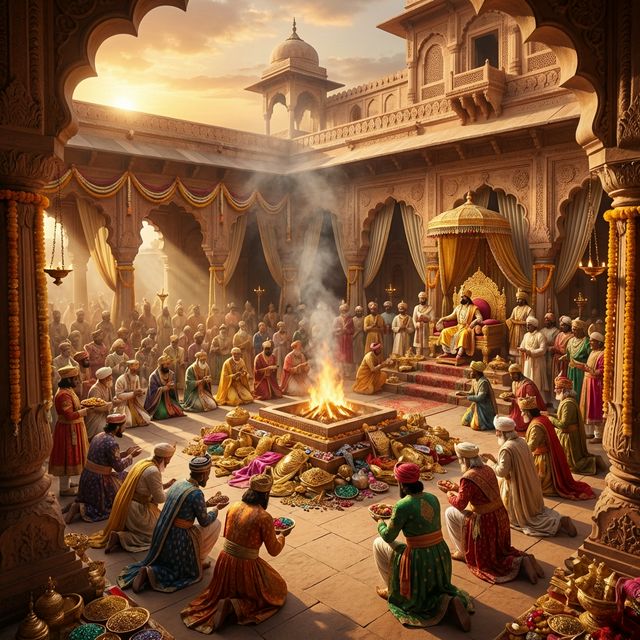
At the Rajasuya, in the assembly hall crowded with every king of the age, Shishupala rose and delivered, in front of that entire audience, the insult that finally closed the ledger his mother had opened at his birth. It was the hundred and first. Krishna's discus left his hand before the court had finished registering what had been said, and the count that had run since a baby's extra arms fell away in a cousin's embrace came, at last, to its promised end.
The Doorkeeper Comes Home
Witnesses at the Rajasuya said that in the instant the discus struck, something visible left Shishupala's body - not smoke, not shadow, but a point of light that rose from the slain king and merged, without hesitation or resistance, into Krishna himself, as though returning to a place it had always belonged.
It had. Long before Shishupala was ever born a four-armed prodigy in Chedi, before Rukmini was ever promised to him, before Jarasandha was ever his ally, the soul now settling into Krishna's radiance had been a doorkeeper of Vishnu's own heaven, cursed for a small offense to live three mortal lives as an enemy of God before earning its post back. This life, the life of hatred perfected into something like devotion, was the last of the three, and the fiercest, because a doorkeeper this close to reclaiming his place has the least distance left to fall and the most desperate need to make the journey count.
What the story of Shishupala leaves behind is not really a villain's ending, however the assembly at the Rajasuya understood it in the moment. It is a story about what mercy actually costs to give, and what it costs to receive. Krishna's promise to a frightened mother of a hundred pardons was not boundless love - it was love with an accountant's precision, generous and exact in the same breath, honoring an old debt without ever pretending the debt could be canceled outright.
And Shishupala's hatred, tested against that limit for an entire lifetime, turned out to be its own kind of road toward the very god he spent his life refusing to honor by any other name. Obsession, held long enough and fiercely enough, arrives eventually at the same door devotion was always headed toward - it simply arrives bleeding, at the hundred and first insult, rather than arriving in peace.
Dharma Lesson
Krishna's boon to Shishupala's mother shows that mercy, to remain honest, cannot pretend to be limitless - it forgives fully, and still keeps count. Shishupala spent a lifetime mistaking that count for an invitation, testing a boundary that had been drawn in love rather than weakness. His hatred, sustained with such total attention across an entire life, became in the end its own distorted form of devotion, proving that the road of obsession and the road of worship can lead to the very same door.