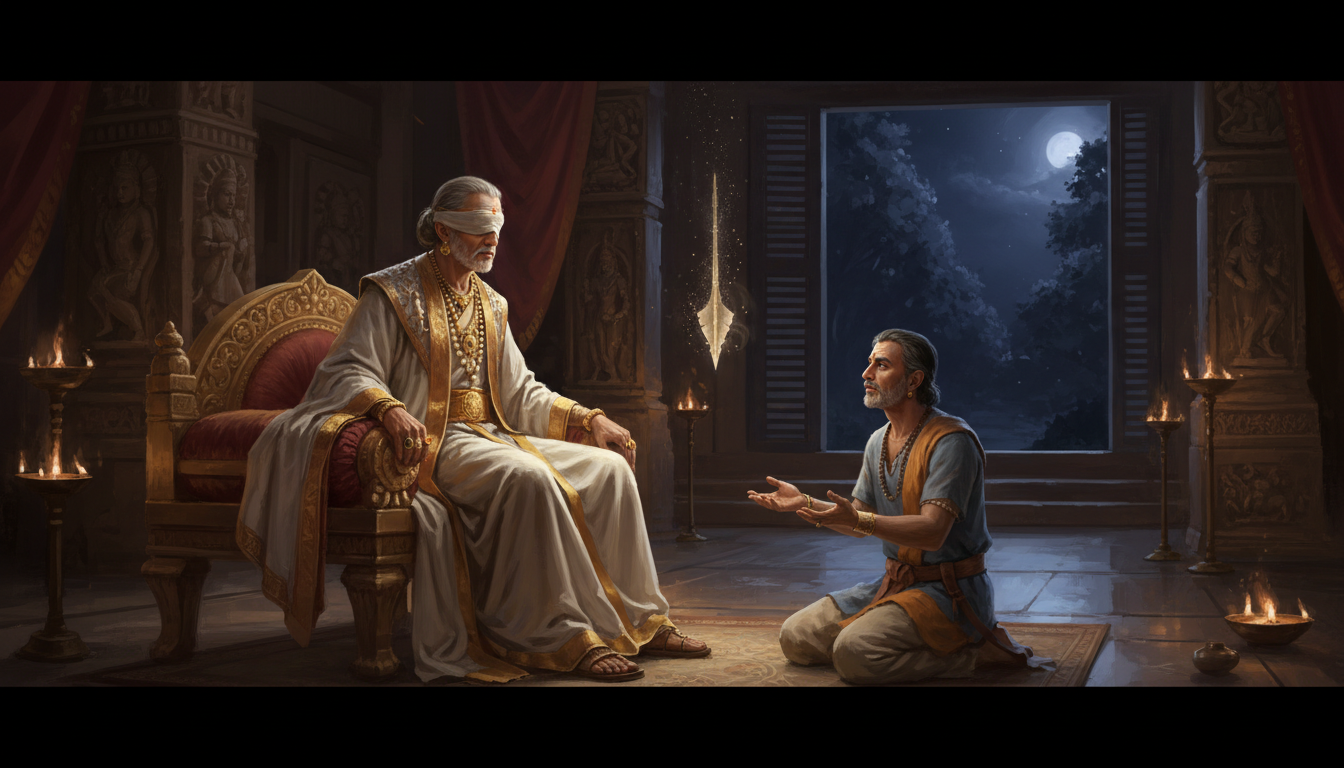
The Dart That Was Never Thrown
A blind king asks the only question that mattered
The Only Question He Had Left
The night battle was still going on when the old king stopped his charioteer in the middle of an account of it.
"Wait," Dhritarashtra said. "Go back."
"King."
"When the Suta's son had a dart in his hand that was certain to slay one person, why did he not hurl it at Partha, to the exclusion of all others?"
Sanjaya said nothing, because there was no answer that would not hurt.
"Answer me. Upon Partha's slaughter by means of that dart, all the Srinjayas and the Pandavas would have been slain with him. Upon Phalguna's death, why should the victory not have been ours? Arjuna has made a vow that when he is summoned to battle he will never refuse to accept the challenge. It is a public vow. The Suta's son had only to summon him. Why did Vrisha not engage Phalguna in single combat and slay him with that dart that Sakra gave him?"
Still nothing.
"Without doubt my son is destitute of both intelligence and counsellors," the king said. "That sinful wretch is constantly baffled by the foe. How should he ever succeed in vanquishing his enemies? Here was a mighty weapon on which his whole victory rested, and it has been made fruitless through a Rakshasa. It has been snatched out of Karna's hand the way a strong man snatches a fruit out of the hand of a cripple with a withered arm."
"That is a fair description of what happened, king."
"It is more than that. As in a fight between a boar and a dog, whichever of the two dies, the hunter is the party who profits. I think that Vasudeva was the hunter in the battle between Karna and Hidimva's son. If Ghatotkacha had killed Karna, that would have been a great gain for the Pandavas. If Karna killed Ghatotkacha, that too would have been a great gain for them, because of the loss of the dart. He reflected in that way, and for doing what was good for the Pandavas he caused Ghatotkacha to be slain by Karna in battle."
"That," said Sanjaya, "is exactly what happened. Knowing the feat that Karna desired to achieve, Janardana commanded the prince of the Rakshasas to engage in single combat with him, for the express purpose of rendering the fatal dart fruitless. And all of it, O perpetuator of Kuru's race, is the result of your own evil policy. We would certainly have achieved success if Krishna had not rescued Partha out of Karna's hands. Partha would have been destroyed, with his steeds and standard and car, if that lord of Yogins had not saved him."
Why Did You Not Remind Him
"My son is fond of quarrel," Dhritarashtra said. "His advisers are foolish. He is vain of his own wisdom. It is for that reason that this certain means of Arjuna's death has been baffled."
And then, because he had gone through everybody else, he arrived where he always arrived, which is at the man reporting to him.
"Why did Duryodhana not hurl that fatal dart at Dhananjaya? Or Karna, that foremost of all wielders of weapons, possessed of great intelligence? And you, son of Gavalgana. Why did you forget this great object, possessed as you are of great wisdom? Why did you not remind Karna of it?"
There was a pause then, king, of the kind that happens when a man who has spent eighteen days describing other people's failures is asked about one of his own.
"I did not forget it," Sanjaya said.
"Then."
"Every night, O king, this formed the subject of deliberation. Duryodhana, and Sakuni, and Duhsasana, and myself. Every single night. It was not an idea somebody had once. It was the standing business of that tent."
The Root, the Trunk, the Branches, the Leaves
"And we said to Karna, 'Excluding all other warriors, O Karna, slay Dhananjaya. We would then lord it over the Pandus and the Panchalas as if they were our slaves.'
"And then one of us would go further, because there was always one who went further, and say, 'Or if, upon Partha's fall, he of Vrishni's race appoints another among the sons of Pandu to carry on the fight, then let Krishna himself be slain.'
"And then we would set it out for him the way you set out a thing for a man who has to do it at a distance of half a mile with one throw and no second chance.
"Krishna is the root of the Pandavas. Partha is like their risen trunk. The other sons of Pritha are the branches. The Panchalas may be called the leaves. The Pandavas have Krishna for their refuge, Krishna for their might, Krishna for their leader; he is their central support even as the moon is of the constellations. Therefore, O son of a Suta, avoid the leaves and the branches and the trunk, and slay that Krishna who is everywhere and always the root.
"That was the counsel, king, and it was correct. If Karna had slain him of Dasarha's race, that delighter of the Yadavas, the whole earth would without doubt have come under your control. If that illustrious one could have been made to lie down on the earth deprived of life, then the entire earth with its mountains and its forests would have owned your supremacy. We knew it. He knew it. He agreed to it and said, 'So be it.'"
"Then what happened?"
"Morning happened," said Sanjaya. "We rose every morning, having formed such a resolution in respect of that Lord of the very gods, Hrishikesa of immeasurable energy. And at the time of battle we forgot our resolution."
He Never Placed Arjuna Before Him
"You forgot," the king said. "All of you. Every day for seventeen days."
"I have thought about that word a great deal, king, and I no longer think it is the right one. Consider what a day of this war actually is. There is a field two yojanas across with eleven armies in it. A man in a chariot sees what is within four hundred paces of him and hears almost nothing. Where he goes is decided by where the pressure is, and the pressure is decided by somebody.
"Kesava always protected Arjuna, the son of Kunti. He never once placed Arjuna in front of the Suta's son in battle. Not once, in all the days that Karna was on the field. Achyuta always placed some other foremost of car-warriors before Karna. Samsaptakas one day. A Rakshasa another. Bhimasena. Yuyudhana. Whoever it needed to be, and always somebody worth Karna's whole attention, and always somewhere else.
"He was doing it in order that our fatal dart might be made fruitless by ourselves. We would come off the field at evening with the dart still in the quiver and the day gone, and we would sit down and resolve again.
And count the days with me, king, because they are few and they are all accounted for. Ten of them Karna spent in his tent and never came out, because Bhishma would not have him on the field. Four more he spent under Drona, who never once put him where the fighting was thickest and never once sent him at Arjuna. On the fourteenth day the Sindhu king was the whole business of the army and Karna was set to protect him, and while he was doing it Arjuna was three yojanas away cutting his road. And when the sun went down on the fourteenth day and the lamps went up and there was nothing left to interpose, a Rakshasa came out of the dark at him with a chariot drawn by things that were not horses, and would not be got rid of, and had to be killed with the only weapon that would kill him.
That is not forgetfulness, king. That is a schedule."
Dhritarashtra said, "And Krishna himself? He was standing in the open on that car for eighteen days with no armour and no bow. Why did nobody kill him?"
"When the high-souled Krishna protected Partha in this manner from Karna," Sanjaya said, "why, O monarch, would that foremost of beings not protect his own self? Reflecting well on it, I see that there is no person in the three worlds who is able to vanquish that chastiser of foes, that hero bearing the discus in his hand. That is my whole answer and I have no better one."
The Same Question, Asked From the Other Side
And here, king, is a thing you should know: that same night, on the other side of the plain, a man asked exactly the question you have just asked me, of the only person alive who could answer it properly.
Satyaki went to Krishna.
"O Janardana. This had been Karna's firm resolution, that he would hurl that dart of immeasurable energy at Phalguna. Everybody knew it. Why then did the Suta's son not actually hurl it at him?"
And Vasudeva told him.
"Duhsasana and Karna and Sakuni and the ruler of the Sindhus, with Duryodhana at their head, debated this frequently. They used to say to him, 'O Karna, O great bowman, O you of immeasurable prowess in battle, this dart should not be hurled at anyone other than Kunti's son. He is the most celebrated among them, as Vasava is among the gods. He being slain, all the other Pandavas with the Srinjayas will be heartless, like celestials without fire.' And Karna assented to it and said, 'So be it,' and from that hour the desire of slaying the wielder of Gandiva was never once absent from his heart.
"I, however, always used to stupefy the son of Radha. It was for that reason that he did not hurl the dart at Pandu's son of the white steeds."
Satyaki said nothing to that, so Krishna told him the rest, which was not a matter of strategy.
"As long as I could not baffle that means of Phalguna's death, I had neither sleep nor joy in my heart. Beholding that dart rendered futile through Ghatotkacha, I regarded Dhananjaya today as having been rescued from within the jaws of Death."
I Do Not Regard My Own Life So Worthy
"I do not regard my sire," Krishna said, "nor my mother, nor yourselves, nor my brothers, nor my very life, as so worthy of protection as Vibhatsu in battle.
"If there is anything in existence more precious than the sovereignty of the three worlds, I do not desire to enjoy it without Pritha's son to share it with me.
"Beholding Dhananjaya today like one returned from the dead, these transports of delight have been mine. It was for this that I despatched the Rakshasa to Karna for battle. None else was capable of withstanding Karna, at night, in battle."
So now, king, put the two accounts side by side, since I have given you both.
In your son's tent, night after night: a correct plan, agreed by everyone present, aimed at the right target, never once carried out.
On the other side, night after night: one man arranging, every single day, that the two men should not meet, and losing his sleep over it, and finally sending a boy he had watched grow up to spend himself against Karna in the dark so that the thing in Karna's hand would be gone by morning.
Your son called it destiny afterwards. Bhimasena's son was fourteen days in the field and is buried nowhere.
And notice what is not in either account. There is no moment anybody can point to. There is no single order given, no messenger, no ambush laid, nothing that a herald could announce or a bard could set to music. The whole of it consists of a meeting that was prevented from taking place, eighteen days running, by a man holding reins. If Karna had thrown that dart on any one of those mornings, every child in this country would know the name of the morning. Because he did not, there is nothing to know. The move that decided your war leaves no monument at all, and the men who made it were the ones who never got to do the thing they had agreed on the night before.
Destiny Is Supreme
The king turned it over for a while and then came back at it from the other side, the way he does.
"I see, sire, that this act of Karna and Duryodhana and Suvala's son Sakuni, and of yourself in especial, has been very much against the dictates of policy. You knew that dart could always slay one person in battle. You knew it was incapable of being borne or baffled by the very gods with Vasava at their head. Why then was it not hurled by Karna at Devaki's son, or at Phalguna, while he was engaged with him in battle before?"
"Returning from battle every day," Sanjaya said, "all of us used to debate in the night and say to Karna, 'Tomorrow morning, O Karna, this dart should be hurled at either Kesava or Arjuna.' When the morning came, through destiny, both Karna and the other warriors forgot that resolution.
"I think destiny to be supreme, king, since Karna, with that dart in his hands, did not slay in battle either Partha or Devaki's son. Because his understanding was afflicted by destiny itself, stupefied by the illusion of the gods, he did not hurl that fatal dart of Vasava, though he had it in his hand, either at Krishna for his destruction or at Partha endued with prowess like Indra's."
"Destiny," said the old king.
"It is the word we have been using in the tent, king. I am aware of what else it might be called."
Ye Are Destroyed
And then he worked his way to the end of it, as he always does, and the end of it is always the same two sentences in the same order.
"Ye are destroyed by destiny," Dhritarashtra said, "by your own understanding, and by Kesava.
"Vasava's dart is lost, having effected the slaughter of Ghatotkacha, who was as insignificant as straw. Karna, and my sons, and all the other kings, through this highly impolitic act, have already entered the abode of Yama."
That is the son blamed, king, and the counsellors, and the weapon, and the fate. And then, when there was nobody else in the sentence, he heard what he had just said about a boy who had been killed the same evening and had done nothing to him, and he did not take it back, and he did not defend it, and he went quiet.
And then he said, "Tell me now how the battle raged after the fall of Hidimva's son."
That is how he ends every one of these. He asks about the next thing. He has never once told me to stop.
But he had said one other thing first, king, and I set it down because it is the nearest that old man has yet come to it. He said that the act had been Karna's, and Duryodhana's, and Sakuni's, and mine in especial. He did not leave himself out of the list of the guilty and he did not put himself at the head of it either. He put himself in the middle, among the counsellors, which is where he has always preferred to stand, and where nobody can be blamed alone.
By Good Luck
There is a coda to it, king, and you should have it, because it settles the argument.
When Ghatotkacha fell, Yudhishthira sat down on his car with a wet face and could not fight. Krishna told him to rise. And the son of Dharma answered that the boy had come to him at Kamyaka while Arjuna was away getting weapons, and had stayed with them, and had carried the princess of Panchala on his own back over fastnesses she could not walk across, and that his affection for that prince of the Rakshasas was twice what he naturally bore towards Sahadeva.
He said other things too, sitting there with his eyes wet, that were harder to hear. He said that when Abhimanyu was killed, Arjuna had not been on the field and the rest of them had been held in check by the ruler of the Sindhus; that Drona with his son had been the cause of it; that it was the preceptor himself who told Karna how to do it, and the preceptor himself who cut the sword out of the boy's hand while he was fighting with it. And then he said the thing that had been sitting under the whole of the fourteenth day: that for a little offence, the Sindhu king had been slain by the wielder of Gandiva, and that act had not given him great joy; that if the slaying of foes was just and ought to be done by the Pandavas, then Drona and Karna should have been slain before this; that those two were the root of their woes, and Suyodhana was confident because he had obtained them; and that when it was Drona who should have been killed, or the Suta's son with his followers, Dhananjaya had gone and killed the Sindhu king, whose connection with the affair was very remote.
Then he took up his bow and blew his conch and went off to kill Karna himself, in a temper, with Sikhandin and a thousand cars behind him, and Krishna said to Arjuna, "It is not proper that you should rely upon him in this," and urged the horses after him.
And Vyasa came out of the field and stood in front of the king's car and stopped him.
"By good luck, Phalguna lives still, although he encountered Karna in battle. Karna had kept his dart, desirous of slaying Savyasachin. By good luck Jishnu did not engage in single combat with him. Each of them in that case, challenging the other, would have shot his celestial weapons on all sides. The weapons of the Suta's son would have been destroyed by Arjuna, and the Suta's son, afflicted, would certainly have hurled Indra's dart in that battle. And then, O foremost one of Bharata's race, great would have been your grief.
"By good luck the Rakshasa has been slain in battle by the Suta's son. Ghatotkacha has been slain by death himself, making the dart of Vasava an instrument only. Do not yield to anger and do not set your heart on grief. This is the end of all creatures in this world. On the fifth day from this, the earth will be yours. Always think of virtue. Practise kindness, penances, charity, forgiveness and truth. Victory is there where righteousness is."
And having said that, king, he made himself invisible then and there, and left the son of Dharma standing on the field understanding, for the first time, what his ally had spent that night doing on his behalf, and how the bill had been paid, and by whom.
Dharma Lesson
The decisive moves in a long war are the ones that were prevented from happening, and they leave no monument. Krishna won an argument that was never held by making sure the two men who would have settled it never stood opposite each other. Vigilance that succeeds looks, from outside, exactly like luck, and the men it defeats will call it destiny because there is nothing else to call it.