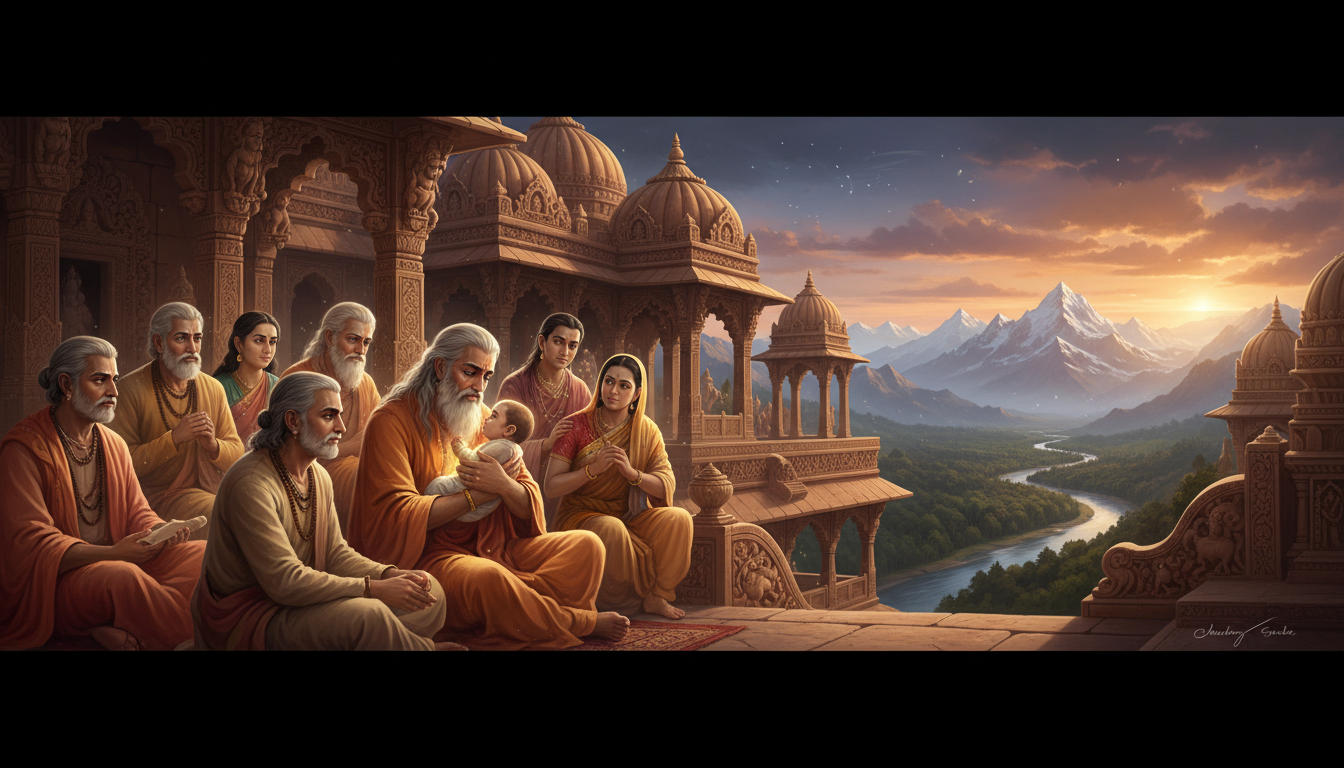
The Gift Ebbing at the End
Before the eighteenth day of the war at Kurukshetra broke, Vyasa had given Sanjaya a gift no ordinary charioteer's son could have earned on his own merit: divyadrishti, a divine eye that let him see the whole battle unfolding from wherever he stood, so that a blind king far away in Hastinapura might still, through Sanjaya's voice, know exactly what was becoming of his sons (that gift and its granting belong to their own telling). What is less often told is what it cost Sanjaya to keep using it until the very end.
By the eighteenth day the great armies that had covered the plain were almost gone, and what remained of the war had narrowed to a single grudge: Bhima hunting Duryodhana, the last Kaurava brother left standing, through the reeds of a lake where he had hidden himself beneath the water to buy one more night of life. Sanjaya's eye followed him there as it had followed everything else, into the taunting exchange that drew Duryodhana back onto dry land, into the mace duel that followed, into the blow below the waist that broke both of Duryodhana's thighs and ended, in one stroke, the war and the entire line of Dhritarashtra's sons.
Sanjaya saw it all, and then, as suddenly as it had come, the sight left him. Vyasa's gift had been bound to the war's own span; once there was no war left to see, there was no more use for an eye that saw across any distance, and Sanjaya was left standing on an emptied field with only his ordinary vision, alone among the dead, having watched more of his own age's ruin than any other living man.
Seized on an Empty Field
With the divine eye gone dark, Sanjaya was only a suta again, unarmed and unremarkable, picking his way across a field littered with broken chariots and the bodies of men he had spent eighteen days describing to their king. It was there, among the last wreckage of the war, that Satyaki found him.
Satyaki was a Vrishni warrior and Krishna's own kinsman, and grief and battle rage had not yet drained out of him; he had lost kin and comrades in the fighting, and unwilling in that raw hour to see anything but a man who had served Dhritarashtra's court and Dhritarashtra's cause, he seized Sanjaya and made ready to kill him where he stood, as one more debt the day still owed.
Sanjaya had no weapon and no army behind him, only the plain fact that he had ridden onto that field to watch and to report, never to fight. He might have died there, the war's very last casualty, a witness put to death after the witnessing was already finished, if Vyasa had not appeared and spoken. The sage's word alone was enough: Sanjaya was a noncombatant, sacred to his office, protected under the law that even Kurukshetra had kept for eighteen days, and Satyaki, checked by a sage he could not refuse, let him go.
Sanjaya walked off the field alone after that, the last noncombatant left to leave it, carrying nothing home with him but the memory of everything he had seen and no longer had the god given eye to soften with distance.
The Walk to Tell a Father
The road from Kurukshetra to Hastinapura was not long in miles, but Sanjaya had never walked it under a weight like this one. He had spent eighteen days narrating the deaths of Dhritarashtra's sons one by one from a safe chamber, softened by his king's not being present to see any of it directly. Now there was no chamber and no distance left between the news and the man who had to receive it; Sanjaya himself would have to stand in front of Dhritarashtra and say the words.
He found the blind king waiting, as he had waited every day of the war, for word of his hundred sons. Sanjaya had rehearsed nothing, because nothing could be rehearsed for this. He told him plainly, the way he had always told him things, without cruelty and without softening: that Duryodhana was dead, and Dushasana was dead, and every one of the hundred was dead, that the Kaurava line that had filled Hastinapura's halls for a generation had ended on a field two days' walk from the palace, and that he, Sanjaya, was the one who had watched it happen from beginning to end.
Dhritarashtra's grief, when it came, came the way a wall comes down, all at once, and Sanjaya stood through it because there was no one else left whose task it was to stand through it with him. He had carried the sight of the whole war inside himself for eighteen days; now he set the heaviest part of it down, in the one place it had always been going, at the feet of the father who had to hear it.
Fifteen Years, and a Fire
What Sanjaya did after that day was not written as a single dramatic act but as fifteen years of small, unglamorous faithfulness. He stayed in Hastinapura and served the broken couple, Dhritarashtra grieving a hundred sons and Gandhari grieving a hundred sons and a lifetime of blindfolded silence, guiding the old king through halls that echoed with absences, reading him the state of a kingdom now ruled by his nephew Yudhishthira, sitting with him through the long nights when grief came back with no warning.
When Dhritarashtra finally could not bear to live any longer inside a palace built on that much loss, he retired with Gandhari and with Kunti to a forest hermitage to spend his last years in austerity (a retreat that has its own telling). Sanjaya went with him there too, still serving, still the voice at an old blind man's side.
It was in that forest, years later, that a fire swept through the hermitage while Dhritarashtra sat deep in meditation. Sanjaya could see the flames spreading and moved to help him, but Dhritarashtra, calm in a way he had rarely managed to be calm in his ruling years, gave his last command instead of accepting rescue: he told Sanjaya to save himself and live, that his own time and Gandhari's had come and should not be resisted. Sanjaya obeyed a king one final time, and walked out of the burning hermitage alone, the last of the household to survive a fire that took the two people he had spent fifteen years serving.
The Long Walk North
There was nothing left in Hastinapura or in any forest hermitage that Sanjaya's dharma still bound him to. He had carried the war for a blind king with a borrowed god's eye, had been the last noncombatant to leave the field where it ended, had walked the road home to deliver the worst news a father can hear, and had served fifteen years at that father's side until fire took him too. He had outlived everything he had been given to witness.
So Sanjaya did what a man does when a long task is finally, completely finished: he let it go. He turned away from every court and every household that had ever claimed him and walked north, toward the high, cold slopes of the Himalaya, to live out whatever remained of his life as a renunciant with no further news to carry and no further king to serve.
No story tells of his death, only of that last direction, north, away from every field and every palace he had known. It is fitting that it ends that way. A witness's dharma is not only to see clearly and speak truly, though Sanjaya had done both, through a war and through a father's grief and through a fire; it is also to know when the seeing is finished, and to lay the burden of it down rather than carry it forever. Sanjaya watched the world end once, at Kurukshetra, and then he watched himself, quietly, walk out of the story altogether.
Dharma Lesson
Sanjaya's dharma was never to fight but to see truly and to speak what he saw, first through a war he narrated for a blind king and then through fifteen years of grief he simply stayed present for. A witness who survives what he has seen owes something more than memory to the years that follow: faithful service until the task is finished. When it finally was, Sanjaya did not cling to what he had witnessed, but turned and walked away from it, which is its own kind of truth telling.