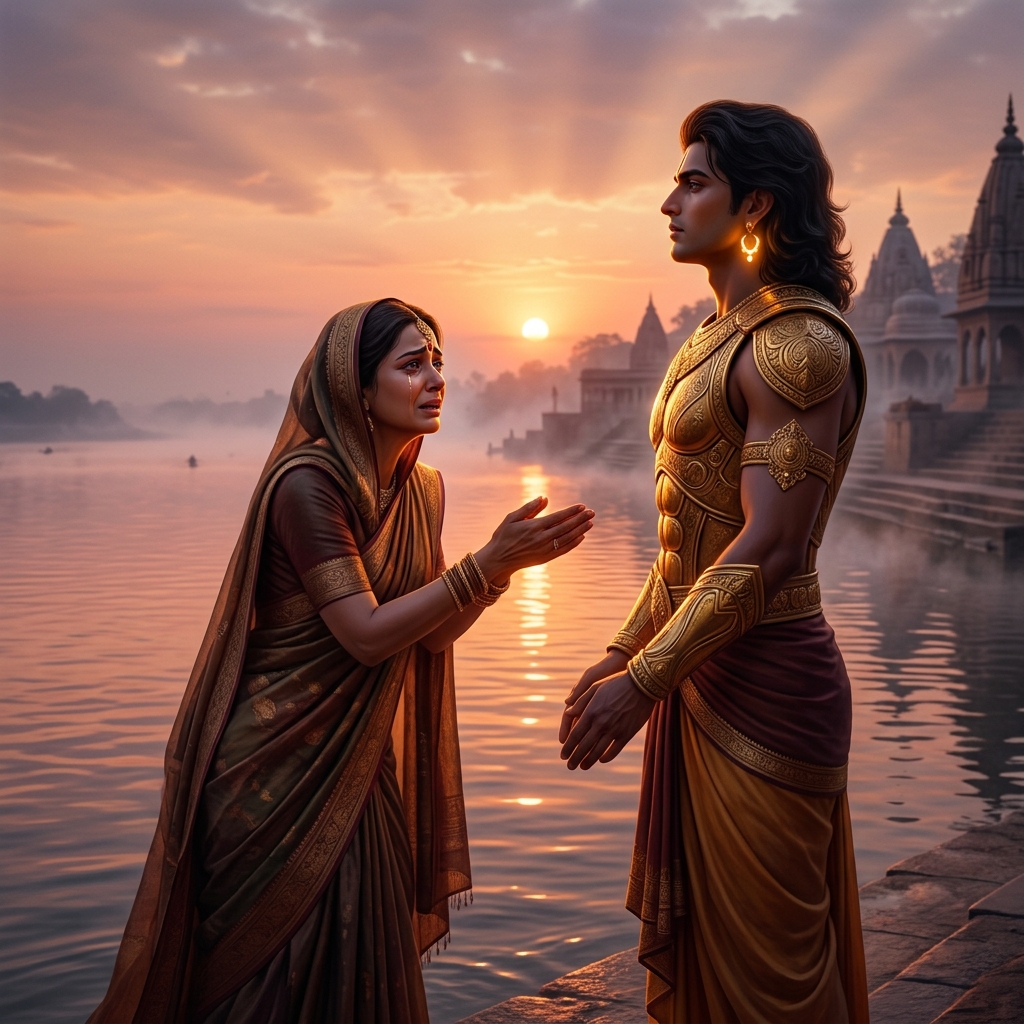
The Throne She Had Won
Hastinapur had its king again. The white parasol stood over Yudhishthira in the great hall, the ministers came and went, and the granaries filled as they had filled in Pandu's day. Yet the palace was quieter than any battlefield. Whole wings of it were shut. The women who had once filled them were widows now, and the widows had gone down to the river.
Kunti walked those corridors in a plain white cloth. She had wanted this. She had wanted it through every year of the forest and every day after the lac house, had held it in her mind the way a swimmer holds the memory of air. Five sons on the throne of Bharata. She had bargained and begged and endured for it. Now it was hers, and she found she could not eat in that hall.
'Mother,' Yudhishthira said one evening, finding her at a dark window, 'the rites are finished. The kingdom is at peace. Ask me for anything.'
'You are a good son,' she said. 'You were always the one who asked.'
She had raised five boys in a forest on borrowed rice. She had taught them that a mother's word was law, and once, carelessly, that they should share among themselves whatever they had brought home. She had never in her life been able to afford weakness. The court called her the iron mother and meant it kindly, and she had never told anyone what the iron cost.
Below the window the funeral fires along the Ganga had burned down to gray. Eighteen days of war had eaten a generation. Somewhere in those ashes lay a man whose armor she had recognized from the city wall, a man she had spoken with once at the water's edge and failed to keep.
'Ask me,' Yudhishthira said again.
'Not tonight,' said Kunti. 'There is something you must be told first, and after I tell it you will not want to give me anything at all.'
The Son She Did Not Name
The water rites for the dead of both houses were being performed on the bank of the Ganga. Yudhishthira had named them kinsman by kinsman, uncles and cousins and sons, when Kunti came down to the water and said, in a voice the priests could hear, 'Offer for Karna also. Offer as a brother offers.'
Yudhishthira turned. 'Karna was a charioteer's son.'
'Karna was my son,' she said. 'He was born to me before I was given to your father. He was the eldest of you.'
The silence that followed was longer than any speech in that war. Yudhishthira did not weep at once. He asked how, and she told him of a mantra granted by a sage and a god who could not refuse and a basket of reeds set upon a river; and she told him, because she would not lie to him twice, that she had gone to Karna herself at the water's edge on the eve of the battle and asked him to come over to her sons, and that he had refused her everything but one mercy.
Then Yudhishthira looked down at his own hands, which had given the orders that killed his brother, and spoke the bitterest words of his life. 'You could have said this in the sabha. You could have said it at Upaplavya. You could have said it on any one of thirteen years of days.' And he laid a curse upon all the women of the world, that no woman from that hour should ever be able to keep a secret hidden.
Kunti bore it and did not answer. She had been cursing herself nightly since Kurukshetra and had no room for more. Later, when the court had settled into its peace, she watched Yudhishthira seat Karna's one surviving son Vrishaketu at his own right hand and keep him there like a wound he wished to tend. She said nothing about that either. She had learned exactly what her speech cost.
The King Asks Leave
Fifteen years turned. Yudhishthira ruled, and in every particular he honored the blind old king as though nothing had happened. Dhritarashtra was consulted, seated first, given the courtesies of a reigning man. Only Bhima could not manage the pretense, and would say loudly, in the next room, whose arms it was that had broken a hundred sons.
At last Dhritarashtra came into the hall on Gandhari's shoulder and said the thing he had been shaping for a year.
'Child, let me go. The kings of our house end their days in the woods. I have eaten your rice and heard your kindness long enough. Let me take Gandhari and go, and wear bark, and find out whether penance will burn what I have earned.'
Yudhishthira wept and refused, and was refused in turn. Vidura, who had never once in his life given the king wrong counsel, said quietly that this counsel at least was good. Gandhari, blindfolded still, said nothing at all. She had bound herself long ago to whatever her husband's feet chose.
Then Kunti spoke.
'I will go with them.'
The hall did not understand her. Yudhishthira asked her to say it again. She said it again.
'My husband's brother is blind and my sister is blindfolded, and there will be nobody in the woods to set food into their hands. I will serve them.'
Vidura looked at her a long moment and inclined his head. He alone in that room seemed to have expected it. The rest saw only what the whole city saw: that Gandhari's son had fired the lac house, had dragged Draupadi into court by the hair, had demanded the deaths of Kunti's children openly for thirteen years, and that Kunti, who had lost more to that house than any living woman, was proposing to spend her last strength carrying water for its king and queen.
Bhima's Protest
Bhima found her tying a single bundle and could not hold it in.
'For whom did we fight?' he said. 'Say it plainly, mother. Whose voice came to us at Upaplavya with the story of Vidula and her son, telling us that a kshatriya woman would rather bear a lion for one day than a jackal for a lifetime? Yours. We carried that word into the field. I broke my cousin's thigh on that word. And now the kingdom is won and swept and lit, and you walk out of it to carry Dhritarashtra's water? Then tell me what we killed them for.'
'You have not understood me once in your life,' Kunti said, 'and I have loved you for it.'
She set the bundle down.
'I sent that message so that your father's name would not die a coward's death, and so that you would not stand before the world as men who had been spat upon and had swallowed it. I did not send it so that I could eat sweets in a hall. The kingdom is yours. Its fruit is yours. I want no share of food bought at that price. It would not go down. What is left to me is penance, and there is no penance lighter to describe or heavier to perform than serving the two people I have most reason to hate.'
Bhima had no answer. He had never had one for her.
She went to Yudhishthira last, and gave him the only instruction she left behind. 'One thing. Watch Sahadeva. He is the youngest, he says the least, and of all of you he is the most attached to me. He will not tell you when he is unhappy. Do not wait to be told.'
Then she walked out of Hastinapur behind a blind man and a blindfolded woman, and did not turn her head to look at the throne she had spent her whole life winning.
The Fire by the River
They settled at a hermitage on the bank of the Ganga, and the years there were the plainest of Kunti's life. She rose first. She ground the wild rice, gathered the fruit, warmed the water, and set it into two pairs of groping hands. Gandhari, who had never in her life asked a servant of her own house for anything, learned to be served by her. Neither woman spoke of their sons. That was the discipline they kept, and they kept it perfectly.
Vidura went first, wasting on air alone, walking the woods with nothing on him until his body would not carry him further; Yudhishthira came out from the city and was with him at the end.
Then a dry summer came, and the fire that Dhritarashtra had kindled for his own worship and left burning among the leaves took the forest.
It came at them along the wind, and they were three old people, and the king had been fasting until he could not stand. Sanjaya begged them to run for the river.
'Go, child,' Dhritarashtra said. 'Save yourself. We will not run.'
'This is our good fortune,' said Gandhari. 'This is the death that ascetics are given, by fire and water and wind. Do not grieve for us.'
Kunti said nothing that anyone recorded. She sat down between them, facing east, and turned her mind where their minds had already gone, and let the fire come.
When Narada carried the news to Hastinapur, Yudhishthira cried out that his mother, who had slept on stone in the forest so that her sons might be kings, had burned like a common woman of the woods. Narada answered that she had not been consumed at all. She had gone to the worlds she had chosen, which were her husband's, and where the wife of Pandu had wished to be since the day the throne was won and she discovered that she did not want it.
Dharma Lesson
Kunti's last years answer the question of what a victory is for. She endured every humiliation to seat her sons on the throne, and when the throne was finally theirs she found she could not eat from it, because the price had been paid in her own blood. Her choice to spend her old age serving the parents of her enemies is one of the epic's hardest teachings: penance is not withdrawal from the world but the deliberate service of those we have most reason to hate. The goal won, the winner walks away.