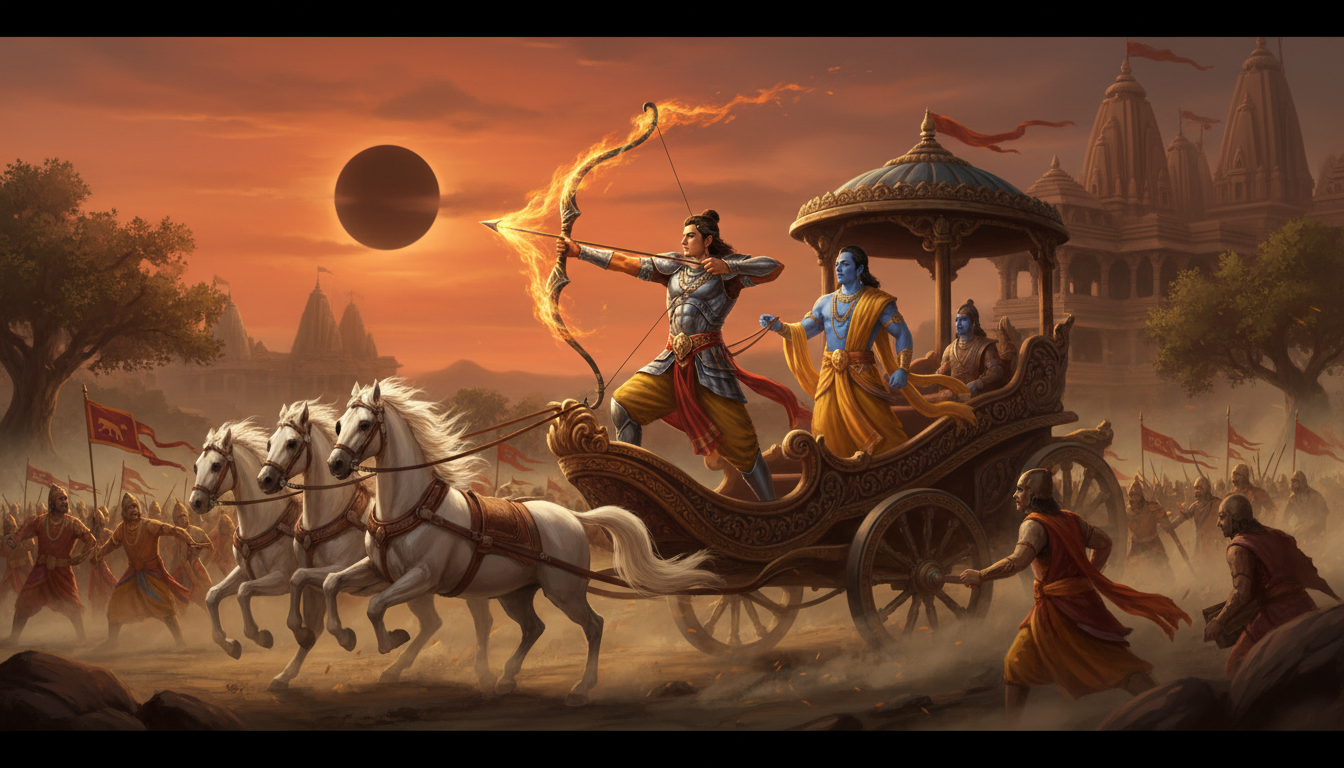
Kurukshetra Day 14: The Longest Day
Sunset Vow, False Dusk, and a Battle That Would Not Stop at Nightfall
The Array Built Around One Man
Nobody in either camp had slept, and at sunrise the fourteenth day began with the two armies looking at what the old teacher had spent the night building.
Drona had not arrayed his host to win a battle. He had arrayed it to keep one frightened king alive until dark. There were three formations set one behind another with the ruler of the Sindhus at the back of all of them, and around Jayadratha himself, in a ring, stood eight great car-warriors: Bhurishravas, Sala, Karna, Vrishasena, Kripa, Shalya the ruler of the Madras, Drona's own son, and Jayadratha in the middle of them.
The standards over that ring were the finest things on the field and everyone on both sides spent a moment looking at them. Drona's son carried a lion's tail with the effulgence of the rising sun. Karna's bore an elephant-rope worked in gold. Kripa, that Brahmana given to penance, had a bovine bull, and looked, with it, like the destroyer of the three cities. Vrishasena had a peacock of gold set with jewels, standing as if in the act of crowing. Shalya had the presiding goddess of corn, producing every seed. Jayadratha had a silver boar decked with golden chains, of the splendour of white crystal. Somadatta's son had a sacrificial stake of gold, like the tall stake erected at a Rajasuya. Duryodhana had an elephant adorned with gems that tinkled with the sound of a hundred bells.
And opposite them was the tenth standard, which was an ape.
"Never, king," said Sanjaya, "had such an array been formed before as the one Drona formed on the day of Jayadratha's slaughter. The gods and the Charanas who came to watch said to each other, 'This muster will be the last of its kind on earth.' They were not speaking of that day only."
Then Kunti's son blew Devadatta and Kesava blew Panchajanya, and the sound went out over the plain and filled the sky and the earth, and your host, hearing it, became anxious and afraid and looked like an army of sick men.
What Happened to the King Before Noon
Arjuna went into the first line and did not come out of it again all day, and the moment he was gone Drona went for the thing he had sworn to take.
Yudhishthira met him at the head of his own division and put ninety straight shafts into his vital parts, and Drona answered with five and twenty in the centre of the chest and twenty more through the steeds and the driver and the standard together. Then he cut the king's bow at the handle and covered the bowless man with thousands of shafts until he could not be seen, and half the Pandava army began shouting that the king was dead.
He was not. He took up a tougher bow and cut every one of those shafts out of the air, and then, with his eyes red, he took up a dart with a golden staff and eight bells on it, and when he lifted it every creature on that field said with one voice, 'Good be to Drona.'
Drona met the dart with the Brahma weapon and ground it to dust in the air. Yudhishthira met the Brahma weapon with his own. Then Drona threw a mace and Yudhishthira threw a mace and the two of them struck each other above the ground, made sparks, and fell.
After that it went the way it always went. Drona killed the horses with four shafts, cut the bow, cut the standard, and Yudhishthira jumped down off a dead car and stood on the ground with his arms up and nothing in his hands, and the old man came at him through the dust like a lion at a deer. Cries of Oh and Alas went up out of the Pandava host. The king got onto Sahadeva's chariot and was carried off the field by fast horses.
That was the morning, king. Before anything else happened that day, everyone on both sides had already seen exactly what Drona could do to Yudhishthira the moment he was left unguarded.
Like the Sun by Rahu
Satyaki had been sent in on the flank and got as far as Drona's own car, and Drona took him apart in front of everybody. Five golden-winged arrows went through his armour, drank his blood and went into the earth beyond him like hissing snakes, and the grandson of Sini, who had never in his life been at a loss, knew not what to do, and his face went cheerless, and your sons began to roar.
"That foremost one among the Vrishnis," Yudhishthira said, "is about to be devoured by Drona, like the sun by Rahu. Go, all of you, to the spot where Satyaki is battling." And to Dhrishtadyumna: "Rush at Drona with speed. Why do you tarry? He is sporting with Yuyudhana like a boy with a bird bound on a string."
So the whole center went at one man, and Drona received all of them smiling, like a householder receiving guests who have come of their own accord, with seats and water; and they were gratified with the shafts of his bow as guests are gratified in the houses of good hosts. Five and twenty Panchala Maharathas died there in one encounter. A hundred Kekayas after them.
And it was in the middle of that, with his own line bending, that Yudhishthira heard Panchajanya blowing hard out in the distance and could not hear Gandiva anywhere behind it. He swooned, and came up, and swooned again.
So he sent Satyaki after Arjuna, over Satyaki's own objection, which was that Arjuna had charged him in Krishna's hearing with the one task of guarding the king, and that Drona was waiting for exactly this. He was overruled. He went. That argument is a story of its own and it deserves the telling separately; what belongs to the day is that from that hour the son of Dharma was standing in the open with Drona in front of him and the man Arjuna had posted three yojanas away.
Three Yojanas of Army
What Satyaki did between the two ends of that day is one of the things men will still be counting up in a hundred years.
He went in on the same track Arjuna had cut and it had closed behind Arjuna. Jalasandha went down. Sudarsana, that king conversant with all modes of warfare, matched him shaft for shaft until Satyaki cut off his driver's head and then his own, decked with ear-rings and radiant as the full moon. Duhsasana came at him with a throng of cars behind him and was left bowless, carless, steedless and driverless, and Satyaki pursued him a moment, and then restrained himself and did not kill him, because Bhimasena had vowed in the assembly to kill every one of your sons himself and it was not Satyaki's to take.
Three thousand Trigartas swore not to retreat and encircled him; five hundred of the foremost of them fell in the front rank alone, like tall trees uprooted off a mountain top, and the rest went back toward Drona's car like snakes making for their holes from fear of the prince of birds.
Drona came across his road himself and taunted him, saying that his preceptor had gone away like a coward, avoiding him by the flank, and that if the disciple did not do the same he would not leave the field alive.
"At the command of king Yudhishthira the just," Satyaki said, "I shall follow in the track of Dhananjaya. Blessed be you, O Brahmana. I would lose time. A disciple should always tread in the way trodden by his preceptor."
And he went around him, and told his driver to take the horses at a tolerable speed through the gap between the Valhikas and the Southerners toward Karna's division, and Kritavarman came at him and lost his charioteer and had to hold his own horses. And Drona, having put his troops in order and handed their protection to the ruler of the Bhojas, turned his car and went after Satyaki, which was precisely what Satyaki had said he would do.
Then Whom Shall I Send After Him
By the middle of the afternoon Yudhishthira had lost sight of both of them, and could hear neither the Gandiva nor Satyaki's conch, and stood in the middle of an army that was being pushed backwards, doing arithmetic that had no answer in it.
"I had only one source of anxiety before," he said, "and now I have two. Having despatched Satyaki to follow in the track of Arjuna, whom shall I now send in the track of Satyaki? If I enquire only after my brother and not after Yuyudhana, the world will reproach me and say that the son of Dharma left the Vrishni hero to his fate."
So he had his car taken to where Bhima was, and Bhima looked at his face and said, "Never before did I see, or hear your words, afflicted with such cheerlessness. Formerly, when we were smitten with grief, it was you who were our comforter. Rise. Say what I am to do."
And the king, with his eyes bathed in tears, sighing like a black cobra, said that Panchajanya was being blown wrathfully and that it seemed from that that Dhananjaya was lying on the field deprived of life, and that without doubt Arjuna had been slain and Janardana was fighting.
"I do not see his standard. For this I am stupefied with sorrow. Go where Dhananjaya is, and Satyaki also. Remember that I am your eldest brother. And when you have seen the two Krishnas and the Satwata sound and whole, send me a message, son of Pandu, by uttering a leonine roar."
So the third of them went in, and the king was left with Dhrishtadyumna and the Panchalas and his own division, and Drona somewhere in the dust looking for him.
The Roar That Was a Message
Karna heard Bhima coming before he saw him, because Bhima announced himself with the twang of the bow and the sound of his palms, and Karna could no more brook that than one rutting elephant can brook the roars of another.
They fought until Bhima cut the bowstring, killed the four horses, sent the charioteer to Yama's abode with a broad-headed arrow, and Karna had to jump down off his own dead car and get up onto Vrishasena's. And Bhima, having done that, roared, and Yudhishthira far away heard the roar and knew Karna had been beaten, and the Pandava conchs went up all along the line.
Then Duryodhana told his brothers to go and get Karna out, and seven of them went, and encircled Bhima, and covered him like clouds pouring rain on a mountain.
Bhima drew the bow with a firm grasp, knowing his foes were only men, and aimed seven shafts, and sent them at those sons of yours as if to extract the life out of the bodies. They went through the princes and out and up into the sky still golden, still covered over with blood, looking like birds of excellent plumage. Satrunjaya. Satrusaha. Chitra. Chitrayudha. Dridha. Chitrasena.
And Vikarna.
And of the seven, king, it was for Vikarna that Vrikodara grieved, standing over him in the middle of a battle with the arrows still in the air.
"Even thus was the vow made by me, that all of you should be slain by me in battle. It is for that, Vikarna, that you have been slain. My vow has been accomplished. You came to battle bearing in mind the duties of a Kshatriya. You were ever engaged in our good, and especially in the good of the king, our eldest brother. It is scarcely proper for me to grieve for your illustrious self."
Then he uttered the leonine roar he had been told to utter, and three yojanas away the son of Dharma heard it and was glad, and had the drums beaten to answer it, and went back at Drona.
And Duryodhana, counting one and thirty of his brothers dead, remembered what Vidura had said to him years ago in a hall, and could not do what a king should do next.
The Arm With the Sword Still In It
Late in the afternoon Satyaki came within sight of Arjuna's car with his weapons spent, his horses spent, his driver spent, having crossed an entire army to get there, and Bhurishravas, who was fresh and had supporters behind him, came out to meet him.
Arjuna saw it and it frightened him more than anything else that day. "The sun hangs low," he said to Krishna. "Satyaki is tired and his weapons are exhausted. Bhurishravas is not tired. Having crossed the very ocean, will he now drown in the print of a cow's foot?"
They fought first with arrows, then with swords, and cut each other's shields, decked with a hundred moons, to pieces. Then they threw the swords away and closed, and wrestled up and down that ground with their arms like spiked maces, striking with their arms and their heads, intertwining their legs, slapping their armpits, gripping and rolling and rising and leaping, going through all two and thirty of the manoeuvres that are named in that art, while both armies stood and watched them.
And the older man won. Bhurishravas brought him down, dragged him along the earth by the hair the way a lion drags an elephant, set his foot on his chest and drew his sword.
"Behold," Krishna said. "Your disciple, not inferior to yourself in bowmanship, has succumbed to Somadatta's son. The very name of Satyaki is about to be falsified."
"My eyes were on the Sindhu king," Arjuna said. "I could not see Satyaki. I shall, however, for the sake of that Yadava, achieve a most difficult feat."
The razor-headed arrow came out of the crowd like a meteor and took the arm off at the shoulder with the sword still gripped in the hand, and the arm fell on the ground, still wearing its Angada, like a snake with five heads.
"A cruel and heartless act," Bhurishravas said, from where he stood. "You struck a man who was otherwise engaged and who was not looking at you."
"All the kings know my vow," Arjuna said, "that no one on our side shall be slain while he is within range of my shafts. But what righteous man, sir, would applaud the slaughter of Abhimanyu, a mere child, unarmed, deprived of his car, with his armour fallen off?"
Bhurishravas touched the ground with his left hand, and with it spread himself a bed of arrows, and sat down on it facing the sun with his heart set on the moon and the great Upanishad in his mind, and stopped speaking. Both armies began cursing Krishna and Arjuna and praising him, and Arjuna sent him to the region of the righteous, where Sivi the son of Usinara is.
And then Satyaki got up off the ground, took his sword, and cut the head off a man sitting in Praya with one arm, while Krishna and Arjuna and Bhima and Kripa and Karna and Ashwatthaman and Jayadratha himself were all shouting at him not to. Nobody applauded it. Not one man on either side.
A Sun That Was Not There
The light was going and Jayadratha was still alive behind six great car-warriors, and Arjuna had sworn to enter a fire at sundown if he failed.
"Without vanquishing those six you will never reach him," Krishna said, "even if you exert yourself without intermission. I shall therefore resort to Yoga and shroud the sun. Then the ruler of the Sindhus will believe it has set. Desirous of life, that wicked wight will stop concealing himself, out of joy, for his own destruction. Take that opportunity and strike. Do not give up the enterprise thinking the sun has really set."
"Let it be so," said Arjuna.
The darkness came down. Your warriors, not seeing the sun, were filled with gladness at the prospect of Partha laying down his life, and stood there with their heads thrown back looking up, and Jayadratha stood in the same attitude with them.
"He is looking at the sun," Krishna said. "He has cast off his fear of you. This is the hour. Cut off the head and make your vow true."
But there was one thing more, and Krishna said it fast, because there was no time.
"His father is Vriddhakshatra. At his son's birth a voice out of the air said that this child would be one of the foremost of Kshatriyas, and that some bull among the Kshatriyas would one day cut his head off while he struggled in battle. Hearing it, the father summoned his kinsmen and declared that the man who caused his son's head to fall on the earth would have his own head crack into a hundred pieces. Then he made the boy king and went into the woods, and he is doing penance to this day just outside Samantapanchaka.
"So do not let it fall. Take it with your celestial weapon and throw it into his father's lap. And do it in such a way that the old man does not know it has been done."
Arjuna licked the corners of his mouth and shot the arrow he had kept for this: inspired with mantras, of the touch of Indra's thunder, worshipped for years with incense and garlands. It took the head away like a hawk taking a small bird off the top of a tree, and then he kept it up in the air, shooting at it again and again to carry it, and sent it out beyond the limits of Samantapanchaka.
Vriddhakshatra was sitting at his evening prayers. The head, dark-haired and wearing its ear-rings, dropped into his lap while he sat, and he did not feel it. When he had finished and stood up, it rolled off onto the ground.
And his own head cracked into a hundred pieces.
Then Vasudeva withdrew the darkness, and the sun was where it had always been, low but not down, and your sons understood what had been done to them.
The Day That Would Not Stop
Kesava blew his conch, and Arjuna blew his, and away across the field Bhimasena filled the sky with a leonine shout that was meant as a message and was understood as one, and Yudhishthira knew from it that Jayadratha was dead. He had the drums beaten and gladdened his men and turned his division toward Drona, wanting more.
And here is what makes the fourteenth day the fourteenth day, king, and not simply the day the Sindhu king died.
The sun set, and nobody stopped.
After the sun had gone down, a fierce battle commenced between Drona and the Somakas that made the hair stand on end. Both hosts had been fighting since sunrise. Both had lost their commanders' plans in the middle of the afternoon. And instead of drawing apart and going back to their fires, they stayed on that field in the dark and went on killing one another by touch and by voice.
When it became so black that no man could tell a friend from an enemy, your son gave the only order left to give. He told the foot-soldiers to lay aside their great weapons and take blazing lamps in their hands, and they did it joyfully. Five lamps were set on every car and three on every infuriated elephant and one large one upon every horse. Within a short time that host was lit from end to end, and the light came back off the golden ornaments and the cuirasses and the bows and the well-tempered weapons, and off the maces and the darts as they went past, so that every whirled scimitar and every yak-tail made myriads of lamps out of itself.
They said the gods and the Rishis and the Gandharvas and the Vidyadharas and the Apsaras and the Nagas and the Yakshas took up lamps in the sky as well, and that lamps filled with sweet-scented oil were seen falling from the Regents of the points of the compass, and that Narada and Parvata in especial sent many, for Duryodhana's sake.
So the fourteenth day did not end at its ending. It went on under lamplight into a night in which Ghatotkacha would die and a dart that had been kept for Arjuna for eighteen years would be spent on him, and the men who had risen at dawn to see a vow kept before sundown fought on past midnight with oil lamps burning on the backs of their horses.
The Ledger of One Day
"Add it up for me," Dhritarashtra said.
"Jayadratha," said Sanjaya, "who had caused eight akshauhinis to be slaughtered, is dead, and his father with him, and neither of them by any means that his father foresaw. Bhurishravas is dead, in Praya, with one arm, and both armies are ashamed of how. Seven more of your sons are dead in one place, and Vikarna among them, who was the only one of them who ever stood up in that hall and said the dicing was wrong. That makes one and thirty. Sudarsana is dead, and Jalasandha, and five and twenty Panchala Maharathas, and a hundred Kekayas, and I cannot count the rest.
"And your commander spent the whole of the day arranging an army so that one man would live until dark, and the man died in the light, and now the army is fighting in the dark anyway with lamps tied to its horses."
"And Arjuna?"
"Arjuna kept a vow, king, that no reasonable man thought could be kept, and he did it by having the sun taken away from the sky for a few moments by his charioteer. There was a rule about fighting after sunset. There was a rule about striking a man who is not looking at you, and a rule about killing one who has laid down his weapons. All three of those rules were broken today, twice by us and once by them, and by tomorrow morning nobody will be counting.
"That is what the fourteenth day was. Not a battle that was won. A day on which both sides discovered, at about the same hour, that the rules were not going to save anybody, and then simply kept fighting because there was no longer any agreed moment at which to stop."
The old king sat with that a while.
"Tell me about the night," he said.
Dharma Lesson
A day that refuses to end is what a war looks like once both sides have stopped believing the rules will save them. Three of the agreed limits were broken before that sun went down, and by morning nobody on either side was counting. Rules of restraint hold only while both parties still expect to be alive to be judged by them.