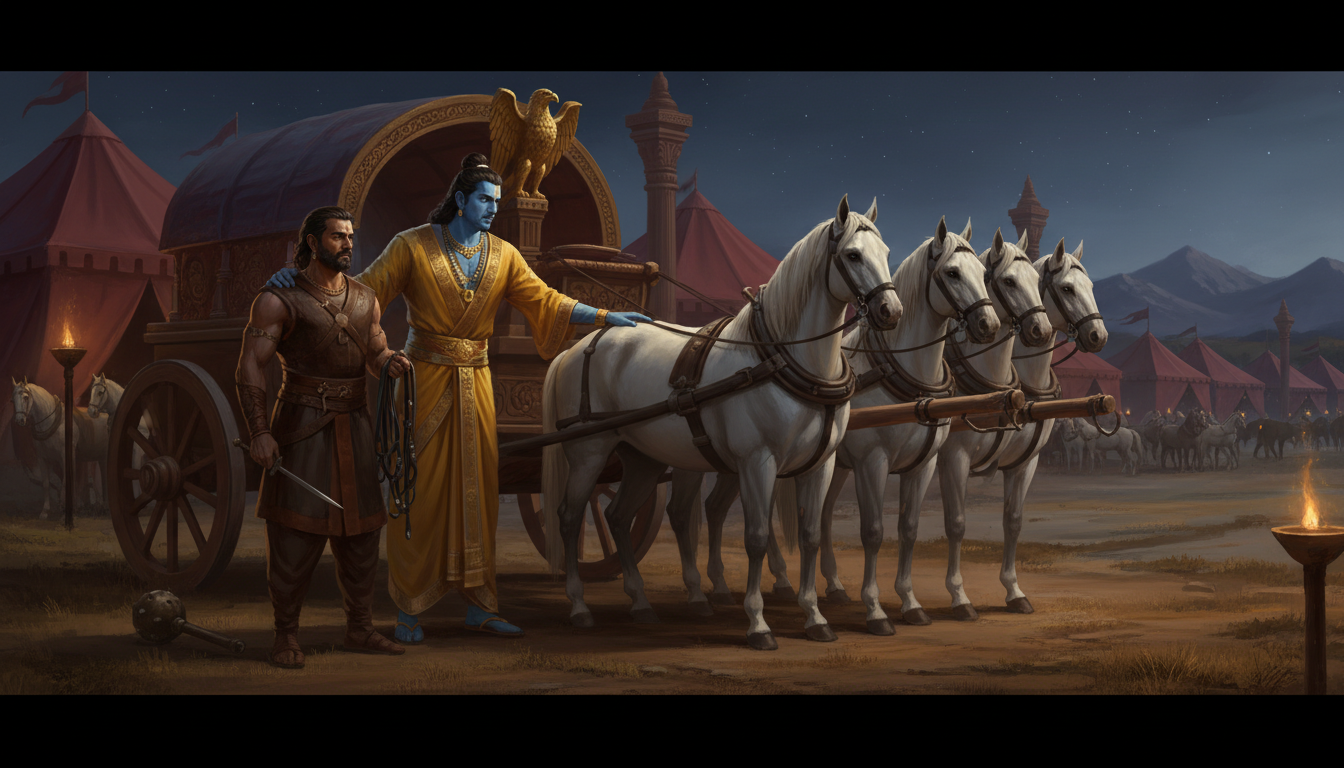
What Krishna Told His Charioteer
The night Krishna decided to break his own vow
The Bed He Made With His Own Hands
"He made it himself, king," Sanjaya said. "That is the part the camp talked about afterwards. There were attendants standing in the doorway the whole time with nothing to carry."
Krishna came into Arjuna's tent late, after Subhadra had been quieted and Draupadi had taken Uttaraa away and the kings had gone back to their own quarters. He touched water first, the way a man does before anything that matters. Then he went to the level place in the middle of the floor and began to lay a bed there with his own hands, handful by handful: kusa grass, the good kind, dark as lapis lazuli, spread even and thick, the way it is spread for a sacrifice and not the way it is spread for sleep.
Around the bed he set weapons. The best in the tent, laid at the head and along both sides in the old manner, because a man who had sworn in public what Arjuna had sworn that afternoon would sleep inside a ring of iron or would not sleep at all.
Then the flowers. Then fried paddy scattered over the blades, and perfumes, and the other auspicious things, one after another and in order, until what lay on the floor was less a bed than an altar with a man's night set in the middle of it.
Arjuna touched water too. The attendants brought in the evening offering for the Three-eyed god, and Arjuna took up the perfumes and smeared Madhava with them, and hung the garlands about him, and with a cheerful face, which cost him something, made the nightly offering to Mahadeva with Krishna standing in front of him wearing the flowers.
That is what the two of them did on the night before the fourteenth day, king. A father who had watched six men kill his son that morning, and the lord of the worlds, in a tent, doing small correct things in the correct order.
Then Govinda smiled at him, faintly.
"Blessed be you, Partha," he said. "Lie down. I am leaving you."
Daruka
He put doorkeepers on that tent before he left it, and behind the doorkeepers sentinels, well armed, chosen and not merely detailed off. Then he walked back through the lines to his own quarters, and Daruka walked behind him with the lamp.
There is a man in this war that nobody has written down, king, and it is time somebody did.
Daruka was Krishna's charioteer. That is a plain sentence and it contains an absurdity, because for eighteen days the most famous pair of hands on the Vrishni side had been holding another man's reins, and Daruka had spent the whole war at the horse lines with four of the finest animals alive, keeping them fed and their hooves clean and their harness soft, waiting to drive nobody. He had never once asked about it. He greased the axles of a car that did not go out. He kept the discus wrapped and the mace in its case in a wagon under canvas because those were the things he had been given to keep, and a man keeps what he is given to keep.
He put the lamp down where his master could reach it, and went out.
Krishna lay down on his white bed and did not sleep. He was looking for means. He turned the day over and then the next day, and where other men would have prayed he did the thing he does instead, which is to sit still with his whole soul folded into itself and go looking. Of all the beings awake in the two camps that night, the one lying flat and motionless with his eyes shut was working hardest.
Nobody Slept
There was not a man asleep in the Pandava camp that night. Wakefulness had got into the whole of it, from the tents of the kings down to the soldiers lying under the baggage carts, and up and down the lines the same conversation was going on in a thousand different mouths.
"He has vowed the slaughter of the Sindhu king before tomorrow's sun goes down. Before sundown. He stood up and said it in front of everybody with the boy's blood still wet on him."
"How is a thing like that to be done? Jayadratha is a king of mighty energy, and Dhritarashtra's son has assigned him every man he owns for a protector."
"Duryodhana's brothers are not nothing either. And his forces are countless. They have only to keep one man alive until the light goes."
"The son of Pandu has made a most difficult resolve."
"He has made a resolve with a fire at the end of it. If he fails he goes into blazing fire, he said so, he will have it built and walk into it, and that one does not falsify an oath, not for anybody, not ever."
"And if Arjuna burns, then what? Where does the kingdom come from then? Where does anything come from? The son of Dharma has reposed every hope of victory he has on that one archer, and he has not slept either, look, there is a light in his tent as well."
And late, when the arguing had worn itself out and the fires were low, the same thing was said again in the older way, by men sitting up with their knees pulled to their chests and their blankets round them.
"If we have achieved any merit at all. If any one of us has ever poured clarified butter into a fire and meant it. Let it go to him. Let Savyasachin have the whole of it tomorrow, and let him vanquish every foe he has."
So the long night passed, king, in your enemies' camp, and your son's camp was not quieter.
At the Middle of the Night
In the middle of the night Janardana came up out of his meditation, remembered Partha's vow, and said one word into the dark.
"Daruka."
"Here, lord."
"Come and sit down. I am going to tell you what tomorrow is."
Daruka sat on the floor beside the white bed with the lamp between them.
"Arjuna, in his grief for the death of his son, has vowed that before tomorrow's sun goes down he will kill Jayadratha. That is the whole of the vow. There is no clause in it and no escape written into the end of it."
"The whole field heard it, lord."
"Then think about what Duryodhana is doing at this hour, in his own tent, with his counsellors around him. They are not discussing how to win the battle. They have given up on that question for the day. They are discussing one thing only: how Partha may fail to achieve his object. How to keep a single man alive and out of reach until the light goes. That is a far easier problem, Daruka, and they will solve it before the sun is up."
"Akshauhinis," Daruka said.
"Several of them, one behind the other, standing between him and one frightened king. And Drona will array them, who is fully conversant with the ways of applying all weapons, with his son beside him." Krishna let that sit. "Understand what that sentence means. The Thousand-eyed himself, the crusher of the pride of the Daityas and the Danavas, with the thunderbolt in his fist, cannot venture to slay in battle a man who is protected by Drona. That is what my friend has promised to walk into and come out the other side of by sundown."
Half of Myself
"I will therefore do that tomorrow," Krishna said, "by which the son of Kunti kills Jayadratha before the sun sets. I have not decided yet what it will be. I have decided that it will happen."
Daruka waited. He had been driving horses since he was nine years old, and one of the things the work teaches is when a man is coming round to the sentence he actually got you out of bed for.
"My wives," Krishna said. "My kinsmen. My relatives, the whole house of them. There is not one among all of those dearer to me than Arjuna."
"Lord."
"I could not cast my eyes on this earth for the space of a single moment if Arjuna were not somewhere on it. I am telling you this the way I would tell you a fact about a horse. The earth shall not be bereft of Arjuna."
The lamp did what lamps do at that hour and went smaller.
"You have intelligence, so hear the rest of it and keep it. Arjuna is half of myself. That is not fondness and it is not a compliment. He who hates him hates me. He who follows him follows me. There is no version of this in which I am on one side of a field and he is on the other, and no version in which I outlive him and go on with my business."
Daruka looked at the floor for a while.
"They say in the camp that you love him," he said. "They say it the way men say a small thing."
"Let them keep saying it that way," Krishna said. "It will be easier for them."
What He Would Do If Driving Was Not Enough
"Now the part I want you to hear properly," Krishna said, "because if it happens you will be standing next to it.
"If tomorrow goes the way they intend it to go, if the arrays hold and the sun comes down and my friend is still cutting his way through the fourth line of them, then I will vanquish them all myself. All of them, with their steeds and their elephants, putting out my own strength for Arjuna's sake, and I will kill them, and Karna with them, and Suyodhana with them.
"Let the three worlds tomorrow behold my prowess in great battle. Thousands of kings and hundreds of princes, with their cars and their horses and their elephants, will fly away off that field. You will see that army of kings overthrown and crushed with my discus, by me, in wrath, for the son of Pandu's sake. And tomorrow the worlds, with the gods in them and the Gandharvas and the Pisachas and the Snakes and the Rakshasas, will know me for exactly one thing: a friend of Savyasachin."
Daruka did not answer at once. When he did, he said the thing that a servant is allowed to say once in his life and had better be right about.
"Lord. Before this war began you stood up in front of both houses and said you would carry no weapon in it. You said you would hold reins and give counsel and nothing else, and every king on that field has been fighting for eighteen days inside that promise. Twice already I have watched you come off a chariot with your hand going up and be talked back onto it."
"I know what I said."
"And you will break it."
"If the choice tomorrow is between my word and an earth with Arjuna burnt off it," Krishna said, "then I will break it in front of everyone, and men can say afterwards what they like about the value of my promises. The vow is a thing I made. He is not a thing I made."
The Order for the Chariot
"So. When morning comes, at the expiry of this night, you will equip my car according to the rules of the science, and bring it, and follow me with it carefully.
"On it: my celestial mace, the one called Kaumodaki. My dart. The discus. Bow and arrows. Every other thing that is necessary, and nothing that is not, because I do not want the terrace crowded.
"Make room on the terrace for my standard, and for the heroic Garuda upon it that adorns my umbrella. Set him where he can be seen from a distance. Tomorrow it matters who is seen.
"Yoke the four. Valahaka. Meghapushpa. Saivya. Sugriva. Case them in golden mail of the splendour of the sun and of fire, all four, no shortcuts on the near side because nobody looks at the near side. Then put your own armour on, Suta, and stand on that car, and stay on it carefully."
Daruka had been listening the way a man listens who is already making a list. He had not moved.
"How will I know when, lord?"
"You will hear Panchajanya," Krishna said. "Not the ordinary calls. I will blow the Rishava note out of it, the loud and terrible one, the shrill note, and there is nothing else on that plain that sounds like it. When you hear it you will come to me quickly. You will not wait to be sent for a second time and you will not stop to ask anyone's leave to cross the field."
"And if I do not hear it?"
"Then Arjuna has done it himself," said Krishna, "which is what I would prefer, and you will have oiled a chariot for nothing, which is what a charioteer's life mostly is."
In the Course of a Single Day
"In the course of a single day, Daruka," Krishna said, "I will dispel the wrath and the diverse woes of my cousin, the son of my father's sister. In one day. By every means I have, I will strive, so that Vibhatsu slays Jayadratha in the very sight of Dhritarashtra's sons, where they can all see it happen and none of them can stop it.
"And I tell you as his driver, since you are a driver: he will succeed in slaying every one of those for whose slaughter he strives tomorrow. Every one. Not because a vow was made, and not because the gods are fond of us. Because I will be standing on the yoke pole of his chariot from the first hour of the morning to the last of the light, and I do not intend to give an inch of that day to anybody."
Daruka got to his feet. What he said then was remembered afterwards by men who never met him, and it was not clever, and it was not meant to be.
"He is certain to have victory," he said, "whose charioteership has been taken by you, tiger among men. Where would defeat come to such a man from? There is no road for it to arrive by."
"That is a driver's answer."
"It is the only one I have, lord. As for myself, I will do exactly what you have commanded me to do." He picked up the lamp. "This night will bring the auspicious morning of Arjuna's victory in on its back. Sleep if you can. I am going to the horses."
The Last Watch
So while the camp lay awake talking about merit and clarified butter, one man went out to work.
Daruka woke the grooms and had the four brought out and stood in a line, and went over them by lamplight from the ears down: Valahaka first, then Meghapushpa, then Saivya, then Sugriva, each one checked for heat in the legs and grit in the hoof and a rub under the collar. He had the golden mail carried out of the wagons and fitted, plate by plate, and the buckles tried, and where a strap had gone stiff he had it worked with oil until it lay flat.
He had the car itself brought round and got underneath it with a lamp. He greased the axles. He put on the standard and set Garuda up above the umbrella and stood back to look at the height of it against the sky, and had it lifted a hand's breadth higher.
Then he went to the wagon that had been standing under canvas for eighteen days, and took out the mace called Kaumodaki, and unwrapped it, and cleaned it, and laid it on the terrace of the chariot where a man standing in the middle of that car could put his hand on it without looking down.
He put the dart beside it. He put the discus beside that.
And then, because he was a careful man and it was still dark, Daruka put on his own armour, and climbed up, and stood there in the empty horse lines listening for a conch that did not come yet, while over in the other tent the son of Kunti slept on a bed of kusa grass inside a ring of weapons, and was taken up in the night to a mountain, on an errand that belongs to another telling.
The King Asks
"And that is what was said in the tent, king," Sanjaya said, "at the middle of that night, between a man and his charioteer, with nobody else awake to hear it."
Dhritarashtra had his head turned a little, the way he did when he was listening to a thing he did not want to have heard.
"Did he mean it?" he said.
"Which part, king?"
"The discus. The mace. Thousands of kings running off the field. He is under an oath, Sanjaya. He gave his word before the whole assembly that he would not lift a weapon in this war, and my son has been counting on that word since the day it was spoken. It is one of the few things I have been able to hold on to."
Sanjaya said, "He had the mace brought out of the wagons before first light, king, and cleaned, and laid where his hand would fall on it. I do not know how else to answer you."
Dhritarashtra sat with that.
"Then it was never eleven akshauhinis against seven," he said at last. "It was eleven akshauhinis against one man's fondness for another man."
"He did not use the word fondness, king. He said half of myself."
"And Jayadratha?"
"Jayadratha," said Sanjaya, "was asleep, and had been given, by your son, every soldier that your son had left to give. Shall I tell you about the fourteenth day now, or would you rather I stopped?"
The old king did not tell him to stop. He never once told him to stop.
Dharma Lesson
Love is measured by what a person is willing to give up of himself, including a vow he made in public. Krishna had promised both armies he would carry no weapon, and he told his charioteer that night that he would break it rather than watch Arjuna burn. A promise is a thing a man makes; the friend it would cost him is not.