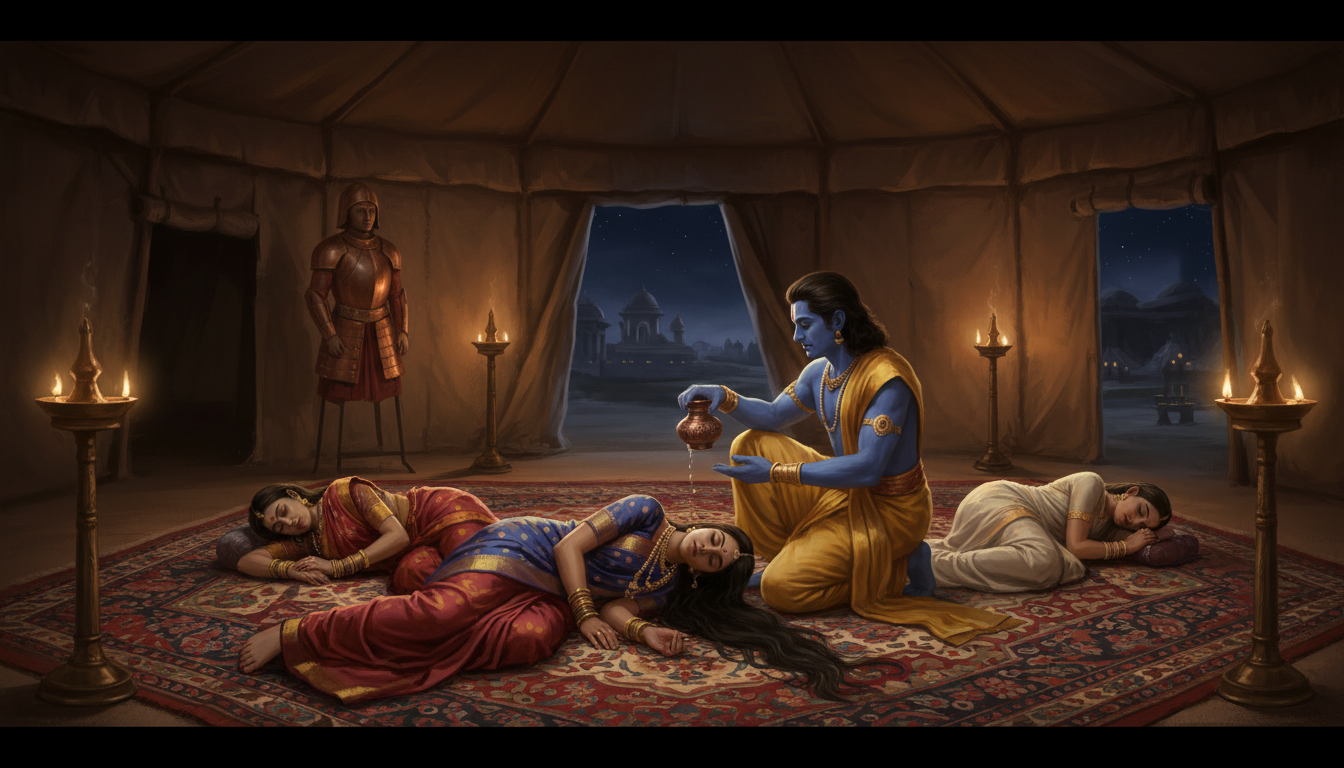
The Women in the Tent
Subhadra, Draupadi and Uttaraa on the night Abhimanyu died
Go and Comfort Thy Sister
"There was a wind that evening, king," Sanjaya said, "that came dry off the field and had no weather in it. It was the wrong wind for the season and it blew from the wrong direction, and men stood outside their tents and watched it move the standards and said nothing."
Dhritarashtra turned his face toward the sound of the voice. "You are telling me about omens."
"I am telling you what your own warriors saw, because they were frightened by it and their fright is part of the account. A headless trunk was seen on the disc of the sun, and a mace beside it. The sky was cloudless and it thundered anyway, again and again, with lightning in it. The earth shook with her mountains and her waters and her forests. The seas swelled. The rivers ran backwards along their own beds. The lips of the horses trembled, and the lips of the men."
"Because of one boy."
"Because of what the boy's father had sworn an hour earlier, in front of everybody, with the boy's blood still on him. Both armies had heard the vow. Both armies had also just watched Nara and Narayana lose their tempers on the same afternoon, and the gods themselves, with Vasava among them, were said to be sitting up asking each other what would come of it."
Inside the tent it was quieter, and worse.
Arjuna had stopped weeping some time before. He sat with the Gandiva across his knees and did not put it down, and when he spoke he spoke about arrangements, because that was all that was left to him.
"Go," he said to Krishna. "Go to my wife's mother, your sister. Comfort Subhadra. Comfort her daughter-in-law also, and the women who are with her. Speak to them gently, and speak to them truthfully, and do not choose one over the other."
It was, king, the hardest errand given to anyone in either camp that day, and it was given by a man who had just been given a harder one by himself.
Vasudeva Goes Across the Camp
So Vasudeva went out of Arjuna's tent with a cheerless heart and walked across the camp to the quarters where the women of the house were kept.
They were not far. That is a thing people forget about that war. The wives and the mothers and the young widows were not away in some safe city with the news reaching them a month later by a rider; they were within earshot. They had heard the drums go out that morning. They had heard the sound change in the middle of the afternoon. They had heard men riding in and had watched, from the shadow inside a doorway, which litters were carried past at a walk and which were carried at a run.
Subhadra had known since noon. Nobody had told her. She had known the way women in a camp know, which is by the shape of the silence that arrives before the messenger does.
She was of the Vrishni race, sister to Krishna and Balarama both, and she had been given in marriage to Arjuna in a manner that half of Dwaraka had considered an abduction and the other half a wedding. Her son was sixteen years old. He had been born in Dwaraka and reared partly there and partly in the woods, and he had married the daughter of Virata a few months earlier, in a hall at Upaplavya, with everyone alive who was now dead.
There was a lamp burning in there and very little else. The bed she had not lain down on. A chest with the boy's spare bowstrings in it, which somebody had brought over from his own tent that afternoon and then not known where to put, and which was still standing in the middle of the floor where it had been set down.
Krishna lifted the flap and went in.
One End Ordained by Time
"O lady of Vrishni's race," he said, "do not grieve for your son. Not you and not your daughter-in-law. All creatures have but one end ordained by Time."
She did not answer him.
"The end your son has met is the one that becomes a hero of proud lineage, and especially a Kshatriya. By good luck that mighty car-warrior of great wisdom, whose prowess was equal to his father's, met after the Kshatriya custom with an end that heroes covet. He vanquished numberless foes and despatched them to Yama's presence and himself went to the eternal regions, the ones that grant the fruition of every wish, that are kept for the righteous. He has attained the end that righteous men attain by penance, by Brahmacharya, by knowledge of the scriptures, by wisdom. He got it in one afternoon."
Still she said nothing.
"The mother of a hero," Krishna said, "the wife of a hero, the daughter of a hero, the kinswoman of heroes. Do not grieve."
"You are naming me," Subhadra said, "instead of him."
He did not deny it. He went on to the only other thing he had brought with him, which was the promise.
"The wretched ruler of the Sindhus, that murderer of a child, that perpetrator of a sinful act, will obtain the fruit of this arrogance of his on the expiry of this night. He and his friends and his kinsmen together. If he enters the abode of Indra himself he will not escape from the hands of Partha. Tomorrow you will hear that the head of the Sindhu king has been cut off from his trunk to roll on the outskirts of Samantapanchaka. That which Partha has vowed must be accomplished. It cannot be otherwise. Even if all human beings and snakes and Pisachas and all the wanderers of the night and the birds, and all the gods and the Asuras together, help the ruler of the Sindhus on the field, he will still cease to exist tomorrow."
Then he stopped, because he had run out, and what was in front of him had not moved.
O Son of My Wretched Self
Then she began, and once she had begun she was not stopped by anybody, and nobody in that tent tried.
"O son of my wretched self. O you that were equal to your father in prowess. O child, how could you perish, going to battle?
"Your face was like the blue lotus. It was graced with beautiful teeth and with excellent eyes. How does it look now, covered with the dust of a battle? They are all looking at you out there. So brave, and never turning back, and fallen on the field, with your beautiful head and your neck and your arms, your broad chest, your low belly, your limbs still decked with the ornaments I put on them, your eyes, your body torn open with weapons. Every creature out there is looking at you as men look at the rising moon.
"Your bed used to be spread with the whitest and the costliest sheets. You deserved every luxury there is. How do you sleep tonight on the bare earth with your body full of arrows?
"That hero of mighty arms, who used to be waited on by the foremost of beautiful women. How does he pass his time now, in the company of jackals?
"He who used to be praised in hymns by singers and bards and panegyrists, he is greeted tonight by fierce yelling cannibals and beasts of prey."
Fie on the Bowmanship of Partha
"By whom, alas, have you been helplessly slain, when you had the Pandavas for your protectors, my lord, and all the Panchalas?
"Fie on the strength of Bhimasena. Fie on the bowmanship of Partha. Fie on the prowess of the Vrishni heroes and the might of the Panchalas. Fie on the Kaikeyas, the Chedis, the Matsyas, the Srinjayas, every one of them, that could not protect you while you were engaged in battle.
"I am not yet gratified with looking at you, O sinless one, and it is plain that I shall have to go to Yama's abode. When shall I cast my eyes again on that face of yours, with the large eyes and the beautiful locks, that smooth face without a mark on it, out of which sweet words and a sweet fragrance were always coming?
"I look at the earth today and it is vacant and cheerless. Without seeing my Abhimanyu my eyes are troubled.
"You were the sister's son of Vasudeva. You were the son of the wielder of Gandiva. You were yourself a hero and an Atiratha. How am I to look at you slain?
"You have been to me like a treasure seen in a dream, and lost when I woke. Everything human is as lasting as a bubble on water.
"Your young wife is overwhelmed with grief for the evil that has fallen on you. How am I to comfort her, who is like a cow without her calf? You have fled from me before your time, when you were about to bear the fruit of greatness, and I am still longing for the sight of you.
"The conduct of the Destroyer cannot be understood even by the wise. You had Kesava for your protector and you were killed anyway, as though you were perfectly helpless."
Krishna, king, stood where he was and let that one go past him without answering it.
Let That End Be Yours
And then the lament turned, and became the thing that is remembered about it, which is not the reproach but what came after the reproach. Having found nobody left to blame, Subhadra began instead to give her son away, item by item, into every good death she could think of.
"O son, let that end be yours which belongs to those who perform sacrifices, and to Brahmanas of purified soul, and to those who have practised Brahmacharya, and to those who have bathed in the sacred waters, and to those who are grateful, and charitable, and devoted to the service of their preceptors, and to those who have made sacrificial presents in profusion.
"That end which is theirs who are brave and do not retreat while engaged in battle, or theirs who have fallen in battle having slain their foes, let that end be yours.
"That auspicious end which is theirs who have given away a thousand kine, or given away in sacrifices, or given houses and mansions that pleased the men who received them, that end which is theirs who give gems and jewels to deserving Brahmanas, or theirs who are punishers of crime, let that end be yours.
"That end which is attained by Munis of rigid vows through Brahmacharya, and that which is attained by those women who adhere to one husband only, let that end be yours.
"That eternal end which kings attain by good behaviour, and which is theirs who have cleansed themselves by living, one after another, all four of the modes of life; that end which is theirs who are compassionate to the poor and the distressed; theirs who divide sweets equitably between themselves and their dependants; theirs who are never addicted to deceit and wickedness, let that end be yours.
"That end which is theirs who keep their vows, theirs who are virtuous, theirs who serve their preceptors, theirs who have never sent a guest away unentertained, let that end be yours.
"That end which is theirs who, in distress and in the most difficult straits, succeed in keeping their souls even, however much they are scorched by the fire of grief, let that end be yours.
"Let that end be yours which is theirs who are always devoted to the service of their fathers and their mothers, and theirs who are devoted to their own wives only, and theirs who, keeping themselves from the wives of others, seek the companionship of their own wives in season.
"Let that end be yours which is theirs who look upon all creatures with an eye of peace, and theirs who never give pain to another, and theirs who always forgive.
"Let that end be yours which is theirs who abstain from honey and meat and wine and pride and untruth, theirs who have refrained from giving pain to others.
"Let that goal be yours which they attain who are modest, who are acquainted with all the scriptures, who are content with knowledge, and who have their passions under control."
That is a list, king, of everything she could not give him. He was sixteen. He had done almost none of it. She was asking that the arithmetic be waived.
The Princess of Panchala and the Girl
While she was still speaking, the flap moved again, and the princess of Panchala came in, and she had Virata's daughter with her.
Draupadi had five sons on that field and had been at war a long time before this war, and she came in the way a woman comes in who has already worked out what she will say and knows it will not be enough. She was leading Uttaraa by the hand. The girl had been a wife for something under a year. She was carrying a child that nobody in the tent yet knew about, and she did not know herself with any certainty, and she would not be told what it meant until much later, in a different room, with a different set of people standing around her.
The three of them looked at one another.
Then there was no more speech from anybody. They wept, all of them together, and their weeping was of the kind that has no shape to it and does not stop where it should, and it went on until, like people whose reason has been taken away by sorrow, they fainted where they stood and fell down on the earth.
Outside, the sentries stayed at their posts and looked straight ahead, because there was nothing whatever they could do.
It is worth saying, king, who was on that floor. The sister of the lord of the worlds. The daughter of Drupada, who was born out of a fire. The daughter of the king of the Matsyas, in whose father's house the five of them had hidden for a year and whose brother had been killed on the first day of this war. Between them those three women were tied to every army on that plain, and not one of them had ever been asked a single question about whether any of it should happen.
He Was Holding the Water Himself
Now here is the detail, king, that the men who were near that tent remembered afterwards and repeated, and it is the reason this is told at all.
He was already holding the water.
He had not called for a servant to bring it and he did not hand it to anybody. Krishna, who is the lord of the worlds, stood there deeply afflicted, with the vessel in his own hands, having fetched it himself while the lament was going on, because he had seen what was coming before it came. And when his sister went down he knelt and sprinkled it over her; over a weeping, unconscious, trembling woman, pierced in her very heart, who was his sister, and whose son he had loved.
Then he brought her round and said what should be said on such an occasion, which is never very much.
"Grieve not, Subhadra."
And then, because the other two were also on the floor and he could only hold one of them, he gave the second one a task, which is the oldest kindness there is.
"Panchali. Console Uttaraa."
And then, to all three at once, the lotus-eyed one said the only thing he had that was true.
"Abhimanyu, that bull among Kshatriyas, has obtained the most laudable goal. O you of beautiful face, let all the other men still alive in our race obtain the goal that Abhimanyu of great fame has obtained. We ourselves, with all our friends, wish to achieve in this battle the feat that your son, that mighty car-warrior, achieved without any assistance whatever."
He did not say that it was worth it. He did not say that the Sindhu king would pay for it, though he had said that an hour before and it was true. He said that her boy had gone where every man in the family was still hoping to get, and that they were all, at that moment, trying to do the thing he had already done.
Back to Partha's Side
Having consoled his sister and Draupadi and Uttaraa in that manner, the chastiser of foes went out again.
He saluted the kings who were standing about outside, one after another, in order, as though it were an ordinary evening and there were forms to be kept. He saluted the friends. He saluted Arjuna last. Then he passed into the inner apartments of Arjuna's tent, and the kings went away to their own quarters, and the camp settled into the night that nobody in it slept through.
Sanjaya stopped there.
"And the women?" Dhritarashtra said.
"They were still in the tent, king. There was nowhere for them to go. Your daughter-in-law Duhsala is the wife of the Sindhu king, and by this hour tomorrow she will be in the same condition, and there will be no one holding a water vessel for her, because the man who does that on our side is the man who is arranging it."
The old king was quiet for a while.
"Nobody ever lets them speak," he said. "In all of this. Somebody always comes and tells them afterwards."
"On that one evening," said Sanjaya, "somebody let a woman speak until she was finished, and then knelt down on the floor of a tent with the water in his own hands. It is the only comfort anybody in either army has yet managed to offer to anybody, king, and it consisted of listening to the whole of it without once saying that it was enough."
Dharma Lesson
Grief given room to be spoken aloud is the only comfort anyone can honestly offer. Krishna does not correct Subhadra, argue with her reproaches, or tell her the death was worth its price; he lets the whole lament run and then kneels with the water himself. Consolation is not the answer supplied at the end but the willingness to hear the question through.