The Night the Sindhu King Asked to Leave
Jayadratha wants his horses saddled, and Drona tells him the truth
Cheering on the Wrong Side of the Field
The thirteenth day had ended badly for everyone. Six men had held a boy in a wheel of chariots and killed him, and the boy had been Arjuna's son, and the sun had gone down on it. In the Kaurava camp men were being quiet in the way men are quiet when they have won something they do not want to discuss.
Then, across the dark ground between the two camps, the Pandava lines began to make a noise.
It was not the noise of grief. That had been going on since dusk, and everyone in both camps had been listening to it, and one or two of the Kuru captains had found reasons to walk away from their fires while it lasted. This was different. Drums. Conches. Thousands of instruments at once, and under them the long rolling shout of an army that has heard something it likes.
Jayadratha, king of the Sindhus, came out of his tent and stood in the cold and listened to it with his arms at his sides.
His attendants waited for him to say something. He did not. He had already worked out the arithmetic, standing there in the dark, and it did not need saying: an army that has lost the best boy it had does not cheer at midnight unless it has been given something in exchange, and there was only one thing on that field worth that exchange, and he knew what it was because he had been at the mouth of the formation all afternoon, holding the door shut on the boy while five other men worked inside.
"Send for whoever we have over there," he said at last. "I want the words. Not the sense of it. The words."
What the Spies Brought Back
The spies came in before the noise had finished and repeated it as nearly as they could, and they were careful, because the man they were repeating it to had gone the colour of ash.
Arjuna had stood up in front of his brothers and Krishna and the kings and had sworn that tomorrow he would kill the man who had held the door.
He had gone further than that. He had listed the hells. If he failed, he said, let him go to the regions kept for men who kill their fathers, for men who violate their preceptor's bed, for betrayers of trusts, for men who insult brahmanas, for men who eat sweetmeats in front of their own children and servants without sharing. He had gone through the catalogue like a man reading out an inventory, and every item of it he had put on his own head as the price of failure.
And then the second oath, which was shorter. If tomorrow's sun sets and that wretch is still alive, I will enter the blazing fire myself, on that same field, in front of you all.
"He said," one of the men reported, "that if the man goes down into the nether region, or up into the sky, or to the gods, or to the realms of the Daityas, he will still take his head off with a hundred arrows when this night is over."
Then Gandiva had been drawn, and the sound of the bowstring had gone up past the shouting and touched the sky, and Krishna had blown Panchajanya until the quarters of the earth shook, and Arjuna had blown Devadatta, and that was the noise the Sindhu king had been standing in the dark listening to.
Jayadratha thanked them. He was, whatever else he was, a courteous man. Then he sat down on the edge of his own couch and found that he could not feel his hands.
A Long Reflection, and a Walk
He sat there a long while, sinking, as a man sinks in a sea that has no bottom to it.
He thought about the boon. He had gone into the forest years ago after the Pandavas had caught him carrying their wife off in a chariot, after Bhima had beaten him and left five tufts on his shaved head to walk home with, and he had stood in cold water and starved himself until a god was satisfied, and what the god had given him was not what he had asked for. He had asked to beat all five brothers in battle. He had been told he could hold four of them off for a single day, and that Arjuna was not included and never would be.
He had been very pleased with that boon at the time. He had used it that afternoon and it had worked exactly as promised. The four had come at the mouth of the formation and he had held them, and behind him the wheel had closed on a sixteen-year-old.
Now the one who was not included had made a vow about him by name.
He thought about Sindhu. The river country, the horses, the flat light on the water in the early part of the year, the hall his father had sat in. Eleven days' hard riding if the roads were dry. He could be gone before the sun came up and there was not a man in this camp with the authority to stop a king from leaving his own tent.
Then he thought about what he would be for the rest of his life if he did it, and he stood up, and put on the clothes a king wears in council, and went out through the lanes of tents toward the assembly of the kings, and his face by then had nothing on it at all.
The Request Made in Front of Everyone
They were all there, those gods among men, sitting late over the day's business. He came in and stood among them and reflected for a moment more, and then he said it, in front of every ruler in that army, and he was covered with shame while he said it, and he said it anyway.
"He who was begotten in Pandu's field by Indra, out of desire, that wicked wretch means to send me to Yama's house tomorrow."
Nobody spoke.
"Blessed be you all," Jayadratha said. "I am going home. I would like to live."
Somebody moved on a bench. He kept going.
"Or protect me by the force of your weapons, you bulls among Kshatriyas. Partha means to kill me. Make me unafraid. Drona is here, and Duryodhana, and Kripa, and Karna, and the ruler of the Madras, and Valhika, and Dussasana, and others, and any one of you is able to protect a man whom Yama himself has come for. When it is only Phalguna threatening me, will all of you together not be able to keep me alive?"
He stopped, and then he told them the true thing, which was harder.
"When I heard those shouts of joy my fear became very great. My limbs have gone powerless, lords of earth, like the limbs of a man at the point of death. There is no doubt in me: the wielder of Gandiva has sworn my death. That is why the Pandavas are shouting for joy on a night when they should be weeping. Let alone the rulers of men, the gods and the Gandharvas and the Asuras and the Uragas and the Rakshasas together cannot make a vow of Arjuna's come to nothing.
"So give me leave to go. I want to make myself scarce. Let them look for me tomorrow and not find me anywhere on this field."
Duryodhana Counts Names
Duryodhana had a gift, and it was this: he could always see what his own business required, and he could produce whatever tone that business needed at a moment's notice. He got up while the silence was still fresh and came and put his hand on the Sindhu king's shoulder as if the two of them were alone.
"Do not be afraid, tiger among men. Who is going to come at you in battle while you are standing in the middle of these Kshatriya heroes?"
Then he began to count, and he did it slowly, so that every name would land.
"Myself. Vikartana's son Karna. Chitrasena. Vivinsati. Bhurisravas. Sala. Salya. Vrishasena, who has never been beaten. Purumitra. Jaya. Bhoja. Sudakshina, who rules the Kambojas. Satyavrata of the mighty arms. Vikarna. Durmukha. Dussasana. Subahu. The ruler of the Kalingas, with his weapons already up. Vinda and Anuvinda of Avanti. Drona. Drona's son. Suvala's son." He let a beat pass. "And these are the ones I have named. There are numberless other kings who will face that battle standing around you on every side with their forces.
"So let the fever go out of your heart. You are yourself among the foremost of car-warriors, O king of the Sindhus. You are a hero of immeasurable splendour. Being what you are, where is the cause of fear? Eleven akshauhinis are mine, and every one of them will fight carefully tomorrow for the purpose of protecting you."
It was well done. The kings agreed with it aloud, and there was a general movement of confidence around the hall, and the thing was settled, and everyone went to bed.
Jayadratha listened to the list and heard what was in it and what was not. Bhishma's name was not in it, because Bhishma had been lying on his bed of arrows for four days with the whole plain between him and this hall. Drona's name was in it, but Drona had stood at the mouth of that same wheel formation all yesterday afternoon and had not thought it necessary to come and say any of this himself. And the number, eleven akshauhinis, was the number Duryodhana had started the war with, and it was not the number he had that night, and every man in the room knew the difference and none of them mentioned it.
Jayadratha thanked him, and was comforted, in the sense that he stopped asking.
And then, because being told that twenty-two men will stand in front of you is not the same as being told what you are worth, he waited until the assembly had emptied, and asked Duryodhana to take him to the preceptor.
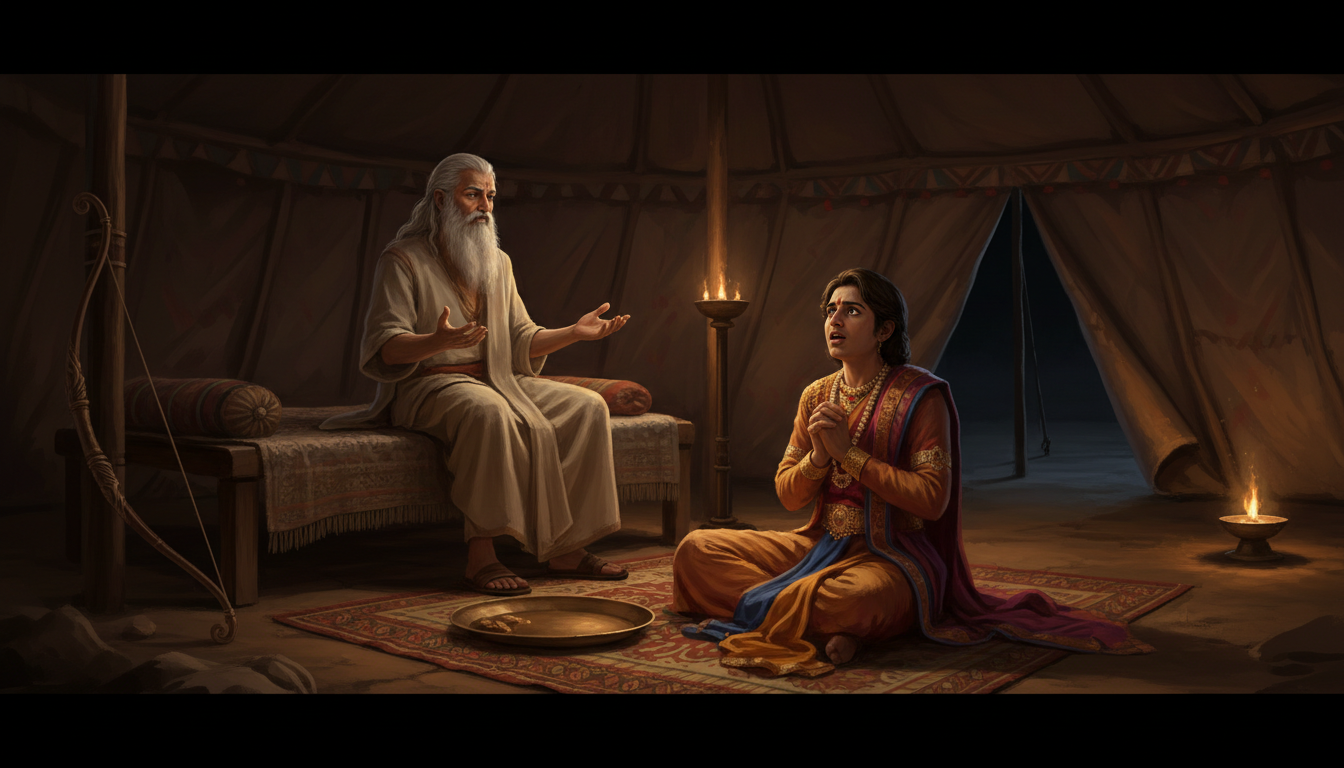
The Old Man's Tent, Very Late
They went that same night, the two of them, through a camp that had gone quiet at last. Past the surgeons' fires. Past the elephant lines, where the animals were shifting and grumbling in their chains the way they had done every night for thirteen nights. Past men asleep on the ground beside their cars with their arms around their weapons.
Drona was awake. Drona at that hour of the war was usually awake. He was eighty-five years old, dark-skinned, his white hair down over his ears, and he had spent the day generalissimo of an army that had just killed a child he himself had taught to shoot.
Jayadratha did what a man of the Sindhus does. He touched the old brahmana's feet with reverence, and then he sat down, low, with his hands in his lap, and waited to be told he could speak.
"Ask," said Drona.
"I want the truth," Jayadratha said, "and I want it in the terms of our trade, not in the terms of comfort. In hitting the mark. In hitting the mark at a distance. In tightness of hand. In the force behind the stroke. Tell me the difference between myself and Phalguna. I wish to know it accurately, illustrious one, the whole difference between us in the science of arms. Say it to me truly."
It was, Drona thought, an unusual question to be asked at that hour by a man who had every reason to want to be lied to.
Equal Teaching, Unequal Lives
"Of tutorial instruction," said Drona, "the two of you have had exactly the same measure. Not nearly the same. The same. Whatever I gave him, I gave you, and you took it well, and I have never had cause to complain of you as a pupil."
Jayadratha waited.
"In consequence, however, of yoga, and of the hard life he has led, he is superior to you, my son."
That was all of it. There was no softening around it and no second clause. The Sindhu king sat with it for a moment. It was, in its way, the only kind thing anyone had said to him that night, because it was the only thing said to him that had been true.
"You should not, for any reason whatever, cherish fear of Partha," Drona went on. "Without doubt I will protect you from this fear. The gods themselves do not prevail against a man who is protected by my arms." The old man's voice did not rise at all. "I will form an array tomorrow which Partha will not succeed in piercing. Stand in the battle, then, and do not be afraid, and observe the duties of your own order. Walk in the track your fathers and grandfathers walked in, mighty car-warrior. That is what is asked of you. Nothing more than that is asked of you."
"You have told me he is the better man," Jayadratha said, "and in the next breath you have told me to stand in front of him."
"I have told you he is the better archer," said Drona. "Those are two different accounts and I keep them apart. He is superior because of what he did with his years, not because of what he was given. You had the same hands and the same teacher, and the two of you spent your youth differently, and it is late now to spend it again. That is not a thing to be ashamed of at this hour of the night. It is only a fact about you, and a man can stand on a fact."
All of Us Are Short-Lived
And then Drona said the thing that actually worked, which no one else in that camp would have thought to say to a frightened man.
"You have duly studied the Vedas. You have poured libations into the fire according to the ordinance. You have performed many sacrifices. Death, therefore, cannot be an object of terror to you. If you die, you will attain that great good fortune which vile men can never reach. You will get all those regions in heaven that are won by the might of a man's own arms.
"Think of this, besides. The Kauravas and the Pandavas and the Vrishnis and all other men, and myself also, with my son, are mortal and short-lived. Every one of us. One after another, all of us, slain by Time, which is stronger than any of us, will go to the other world, and we will carry nothing out of this one except what we have done in it.
"Those regions that ascetics win by severe penances, those same regions are won by heroic Kshatriyas who keep the duties of their order. That is the whole of the account, my son. You have asked me what the difference is between yourself and Arjuna, and I have told you honestly, and now I will tell you the other half. In the matter that finally decides everything there is no difference between you and Arjuna and me at all."
Jayadratha sat in the lamplight in the tent of the man who had taught them both and understood that he had been given something better than reassurance. He had been given a size for the thing he was afraid of. It was not larger than the size of any other man's death, and it was going to happen to everybody in both camps in any case, and there was a way of walking into it that left something behind.
He banished his fear of Partha, and set his heart on battle.
The Camp Hears About It
Word of it went through the Kuru lines before dawn the way such things do, without anyone being told to spread it: the Sindhu king had gone to the preceptor at midnight and had asked to be measured against Arjuna to his face, and had been measured, and had gone back to his tent and slept.
So the troops, who had been very quiet at midnight, felt great delight. Musical instruments began to sound out along the lines while it was still dark, mixed with leonine shouts, so that the two camps ended the night as they had begun it, each of them roaring across the field at the other for its own reasons.
Drona did not sleep. He stayed up with his officers and drew the array he had promised, and it was an enormous one, a wheel within a lotus with a needle at its heart, and it would take Arjuna the whole of the next day and every weapon he had to get through it, and it very nearly held.
And Jayadratha, who had asked at midnight for permission to run and had walked out of the assembly without it, stood the next morning at the back of that array with the whole army arranged in front of him like a wall, and waited, and did not run.
He had been a coward at the door of the wheel formation and he was going to be remembered for that. But a man who is frightened and asks to be told the truth about himself has done a harder thing than a man who is frightened and asks to be told he has nothing to fear, and the difference between those two men is worth as much as the difference between two archers, and it is not always the archery that gets recorded.
Dharma Lesson
A frightened man asking for the truth about himself is braver than the same man being told he has nothing to fear. Duryodhana gives Jayadratha twenty-two names and a number of divisions he no longer has; Drona gives him one honest sentence and the size of his own death. Only the second one lets him stand in the line the next morning.