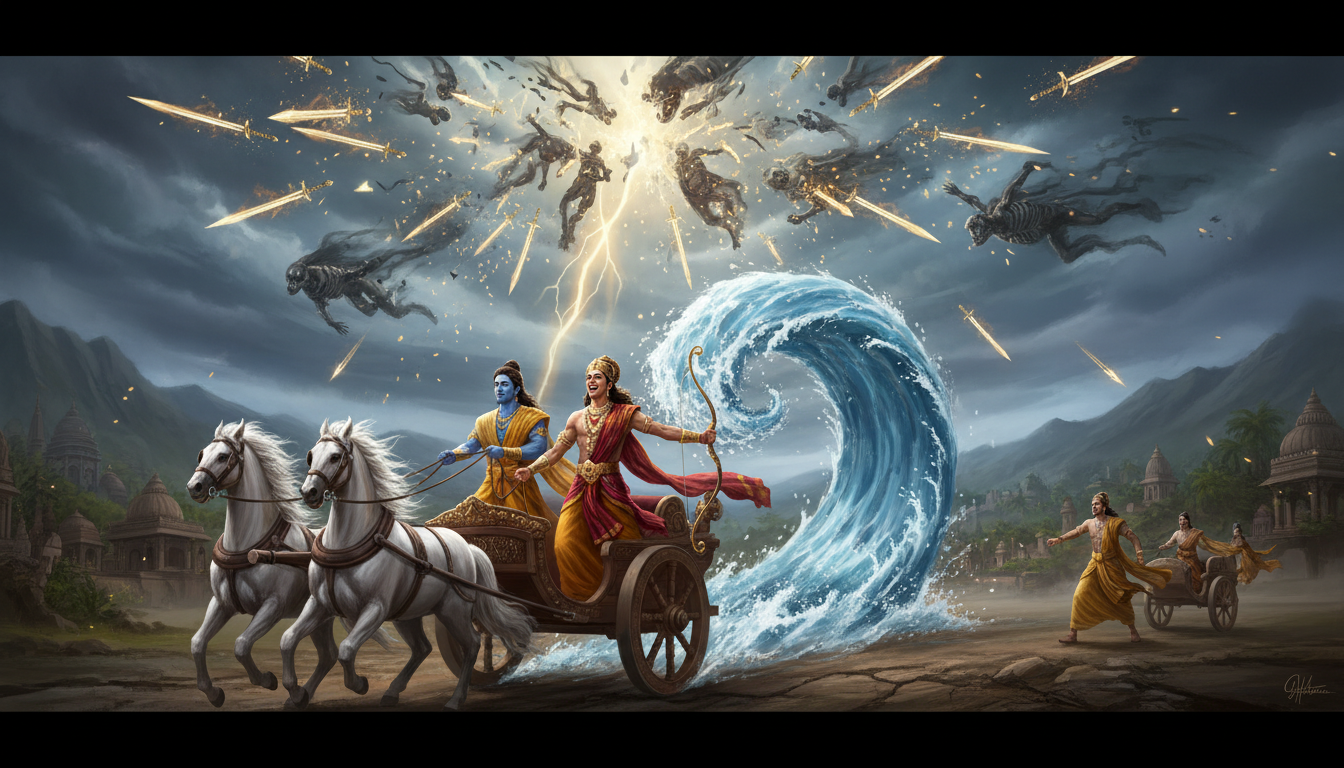
The Gandhara Brothers and the War of Illusions
Shakuni fights the only battle he ever fought himself
After Bhagadatta
"The elephant went down first," Sanjaya said. "He put one long arrow between its frontal globes and it split the beast the way lightning splits a hill, and it went in to the very wings of the shaft. The king shouted at it and it would not obey him. Then it fell, and struck the earth with its tusks, and cried once, and died. And the crescent-headed shaft took Bhagadatta through the chest, and he threw down his bow and arrows, and the cloth he wore for a turban came loose off his head and fell the way a petal falls when somebody strikes the stalk."
Dhritarashtra said nothing. The old king of the Pragjyotishas had been Indra's friend, and older than that friendship, and there had been a time when he sat in the Hastinapura court and put his hand on the heads of the boys.
He had not gone easily. He had turned his elephant hook into the Vaishnava weapon with mantras and hurled it at Arjuna's breast, and Kesava had leaned across and taken it on his own chest, where it became a garland of victory and hung there. Arjuna had been furious about it. 'You said you would only guide the horses. Why do you not keep your word? If I am sinking, if I cannot resist a foe or a weapon, then do it, but not while I am standing.' And Krishna had told him a thing about four forms and a boon given long ago to the Earth for her son Naraka, and finished with the plain fact of it, which was that no one in the worlds could survive that weapon, including him, and so the promise had been broken on purpose.
"Partha walked his car around the body," Sanjaya went on. "He did not gloat. He went round it once, the way you go round a thing you are honouring, and then he came back to the line, and that was when your brothers-in-law found him."
"Which of them."
"Both. Vrishaka and Achala, the two sons of the king of Gandhara. Your sons called them uncle. Subjugators of hostile towns, both of them, and neither had ever taken a backward step in his life, and I want you to hear how they died, because of what came after it."
From the Front and From Behind
They came at him from two sides at once, and they had clearly agreed on it beforehand.
Vrishaka took the front. Achala went wide and came up on the rear, and between them they had Arjuna's car in a bracket, and they were both good enough that the bracket held. Whetted shafts of great impetuosity, and not one of them wasted on the horses or the flagstaff: they were shooting for the man. He was pierced deeply from the front and pierced deeply from behind, and for a while there was nothing elegant about it at all, only a man taking hits from two directions and refusing to turn his car to make either of them easier.
Behind the two brothers the Gandhara troops came on in a mass, headed by the sons of Suvala, and the noise they made was the particular noise of men fighting on their own account, in their own tongue, for their own family, in the middle of somebody else's war.
"You will say they were reckless," Sanjaya said. "They were not. They had watched him kill Bhagadatta and they knew exactly what he was, and they attacked him anyway, together, from two sides, because they had decided between them that he could be taken by two men who did not care what happened to either of them."
"And could he."
"No. But understand what they cost him. He had already fought Bhagadatta from noon, and taken the Vaishnava weapon, and gone through a division of elephants to get to him. He was not fresh. And these two were not tired at all, and they were fighting for a mother and a brother rather than for Duryodhana, which is a different fuel altogether and burns longer."
Cut to Atoms
Arjuna dealt with the front of the bracket first, and he did it with the thoroughness of a man taking a machine apart to see how many pieces it will make.
With sharp shafts he cut off Vrishaka's steeds. Then the driver. Then the bow in his hands. Then the umbrella over his head, then the standard, and last the car itself, into atoms, so that there was no whole plank left of it on the ground and the prince of Gandhara was standing in the wreck of his own equipment in the middle of a field with nothing.
Then he turned on the troops behind him. Clouds of arrows and other weapons besides, poured into the Gandhara divisions until they came apart, and when they still came he grew angry, and five hundred of them went to Yama's house in the time it takes to say it, every one with his weapon still raised.
"Five hundred," said Dhritarashtra.
"Five hundred heroes. They were not running. They were coming forward with their arms up when he sent them."
And Vrishaka, on foot, unhurt, with nothing left to fight from, did the one thing available to him. He went to his brother's car, and got up on it, and Achala reached down and pulled him aboard, and somebody handed him another bow.
Two Brothers on One Car
So they stood on the same floor, shoulder against shoulder, and began again.
And this, said Sanjaya, was the part that no one who saw it forgot. Two men on one car, taking turns at the same enemy, shooting without a pause between them so that the arrows never stopped coming, incessantly, in showers. High-souled princes, both of them, and your relations by marriage, and they struck Partha very severely, the way Vritra and Vala struck Indra long ago and made him feel it. They were of unfailing aim. Neither of them took a wound. They were like the two months of summer working on the world together, the sort of heat that makes a man sweat standing still.
On the Pandava side Krishna held the horses steady and said nothing, because there was nothing to say to a man who is being shot at from a range of thirty paces by two brothers who never miss.
They had one advantage that no other pair on the field had, which was that neither of them needed to be told anything. They had learned the bow in the same courtyard from the same man. When one drew, the other was already drawing. When one shifted his aim to the horses, the other went to the man, without a signal, without a shout, and every archer watching understood that he was seeing something that could not be taught and could only be grown up into.
"He was hurt," Dhritarashtra said, and there was something in the question that was not quite grief.
"He was hurt. They hurt him more than Bhagadatta had. And then he took one arrow out of the quiver."
One Arrow
One arrow, for both of them.
They were standing side by side on the one car when it came, tigers among men, with red eyes and the look of lions, and it took them where they stood and they went down together. Uterine brothers, born of the same mother, so alike in the face that men who had known them for years had to look twice at close quarters, and they fell in the same instant off the same floor with the same expression.
They had been born to a king, and had taken towns, and had ruled districts, and the whole of that was ended by one shaft loosed by a man who did not know their names and would not have stopped if he had.
Their bodies lay on the earth where they landed. They had been dear to their friends, and Sanjaya said it plainly, that lying there they spread a sacred fame all around them, which is the only wage that field ever paid.
Dhritarashtra put his hand over his eyes.
"Gandhari's brothers," he said. "Both of them. In one afternoon, by one arrow, and I have to be told about it by a man in a chariot."
"Your sons saw it," Sanjaya said. "They saw their maternal uncles killed in front of them, brave men who had never retreated from anything, and they rained weapons on him for it, all of them at once, and it did not slow him down by a breath."
"And Shakuni."
"Shakuni saw it too."
The Uncle Comes Forward
Consider what the son of Suvala had been for eighteen years.
He had been the voice behind the chair. He had been the hand that suggested the game and let another man throw. He had worked through Duryodhana, through Dushasana, through the men who came to him because he was clever and went away thinking the clever idea had been theirs. In all that time nobody could name a field on which he had personally stood and taken a wound, because there had not been one. He was a man who had won an entire kingdom without ever once being in danger of being killed for it.
Now his two brothers were on the ground in front of him, side by side, sharing an arrow between them.
He did not run at Arjuna. He was not a fool, and he was not a coward in the simple way. What he did was reach for the one thing he had never yet spent, which was the hundred kinds of illusion he was said to know, and which everyone had always assumed he kept for the dice and the marked hall and the long game.
He stood up on his car and began to work, and for the first and only time in the whole war Shakuni fought with his own hands.
His own men watched him do it with something close to fright. They had followed him from Gandhara because he was the king's brother and because he was lucky, and none of them had ever seen him lift anything heavier than a handful of dice. Now he was standing upright in the open with his arms out and his mouth moving, and the air above the enemy's chariot was going wrong.
The Rain Out of Empty Air
The sky over Arjuna's car filled with weapons that nobody had thrown.
Clubs came down, and iron balls, and rocks. Sataghnis. Darts and maces. Spiked bludgeons. Scimitars, lances, mallets, axes, Kampanas, swords, iron nails, short clubs, battle-axes, razors. Broad-headed arrows and Nalikas and calf-tooth headed shafts and shafts with heads of bone. Discs turning as they fell. Snake-headed arrows. Spears. Every weapon a man of that age had ever been killed by, and a good many that had gone out of use, all of it falling on the two Krishnas from every side at once out of a clear afternoon.
Sanjaya said: I have described a great deal of this war to you and I have never described that sound. It was not the sound of a battle. Nothing was being aimed. It was weather.
And Arjuna, who had spent five years in his father's house learning weapons from the gods and had come down with the whole armoury of heaven in his memory, looked up at it and shot clouds of arrows into it, and the falling things came apart in the air.
The Beasts and the Cannibals
When the weapons had failed, the animals came.
Asses and camels and buffaloes. Tigers, lions, deer, leopards, bears, wolves. Vultures. Monkeys. Reptiles of every kind pouring over the churned ground, and cannibals walking upright among them, and swarms of crows over the whole of it, and every one of these things was hungry and every one of them was in a rage, and they ran at Arjuna together.
The illusion had not even been aimed at him alone. Sauvala, who knew a hundred kinds, had made it for the confounding of the two Krishnas together, Nara and Narayana on one floor, on the theory that a mind can be broken where a body cannot.
He was conversant with celestial weapons. That is the phrase, and it is worth pausing on, because what it meant in practice was that a man who had received arms from Indra and from Rudra himself now stood in his chariot shooting excellent strong shafts into a stampede of illusions as calmly as a farmer shooting birds off a field.
They cried out, loudly, all of them, in the voices of the animals they were pretending to be. And then they fell down deprived of life, which is a strange thing to say about creatures that had never been alive, and lay there, and were not there any more.
"He was laughing," Sanjaya said. "I want you to understand that. He destroyed them speedily, by the force of his weapons, laughing the while."
The Darkness and the Flood
Then the son of Suvala stopped trying to kill him and tried to unmake the world around him instead.
A thick darkness came down and covered Arjuna's car. Not shadow, and not smoke: a gloom that took the field away and left one chariot standing in nothing. And out of the middle of that darkness harsh voices began to speak to him, rebuking him, and they knew what to say, because they said the things a man says to himself at three in the morning.
Arjuna took up the weapon called Jyotishka, and the darkness went off the field like a cloth pulled off a table, and the sun was where it had been.
What was there instead was water. Frightful waves of it, rising, coming across ground where an army was standing, the kind of flood that ends a story. He applied the weapon called Aditya, and the waters dried up almost to the last of them, and the mud steamed.
One after another the illusions of Sauvala went up, and one after another he took them down, and he was still laughing.
"There is a thing about tricks," Sanjaya said. "They work on men who do not know what is being done to them. He knew exactly what was being done to him. He had learned the counter to every one of these in a house in the sky, from the beings who invented them."
Aided by His Fleet Steeds
When the last of them was gone, Shakuni had nothing left, and Arjuna's shafts were beginning to find him.
So he ran. Unmanned by fear, afflicted, his own illusions lying broken all around him and his brothers on the ground behind him, he turned his car and fled the field, aided by his fleet steeds, in the manner, Sanjaya said, of a vulgar wretch.
After that it was not a battle. Partha showed the army the lightness of his hands and poured clouds of arrows into it until it split, the way the Ganga splits when a mountain stands in her, one stream running toward Drona and the other running with loud cries toward Duryodhana. Dust came up so thick that nobody could see him at all. What we heard from the field, said Sanjaya, was the twang of Gandiva, above the conchs and the drums and every other instrument, and we knew where he was only by that.
His arrows, winged with the feathers of the Kanka bird, went into every body they touched and came out and went on, and they fell over the whole field like flights of locusts. They pierced horses and car-warriors and elephants and foot-soldiers and went into the earth afterwards, the way a snake goes into an ant-hill, and men afterwards dug them out of the ground by the handful.
He never shot twice. One arrow to an elephant, one to a horse, one to a man, and each of them fell down deprived of life. Dogs and jackals had come already and were calling from the edges, and the field where they lay had the variegated and awful look of a thing put together by nobody.
"On the southern part of the ground there was a fierce fight," Sanjaya said, "many of our foremost against him alone, and I did not see the end of it, because I followed Drona. What I could see was the divisions of Yudhishthira smiting your men on every part of the field at once, and Arjuna going through your son's divisions the way the summer wind goes through clouds, and leaving as little behind."
And men who had been an army in the morning went to pieces in the particular way that Sanjaya would not soften for the blind king: a father left his son where he lay, and a friend his friend, and sons left their fathers, every one of them intent on the protection of his own self, and many threw themselves off the animals that were carrying them and ran on foot.
Dharma Lesson
A trick works only on someone who does not know what is being done to him. Shakuni had spent eighteen years winning through other men's hands and other men's ignorance, and when he finally stood in the open against a man who had learned the counter to every illusion from the gods who invented them, the whole method was worth nothing. What a man wins by cleverness he keeps only until he meets someone who is not confused.