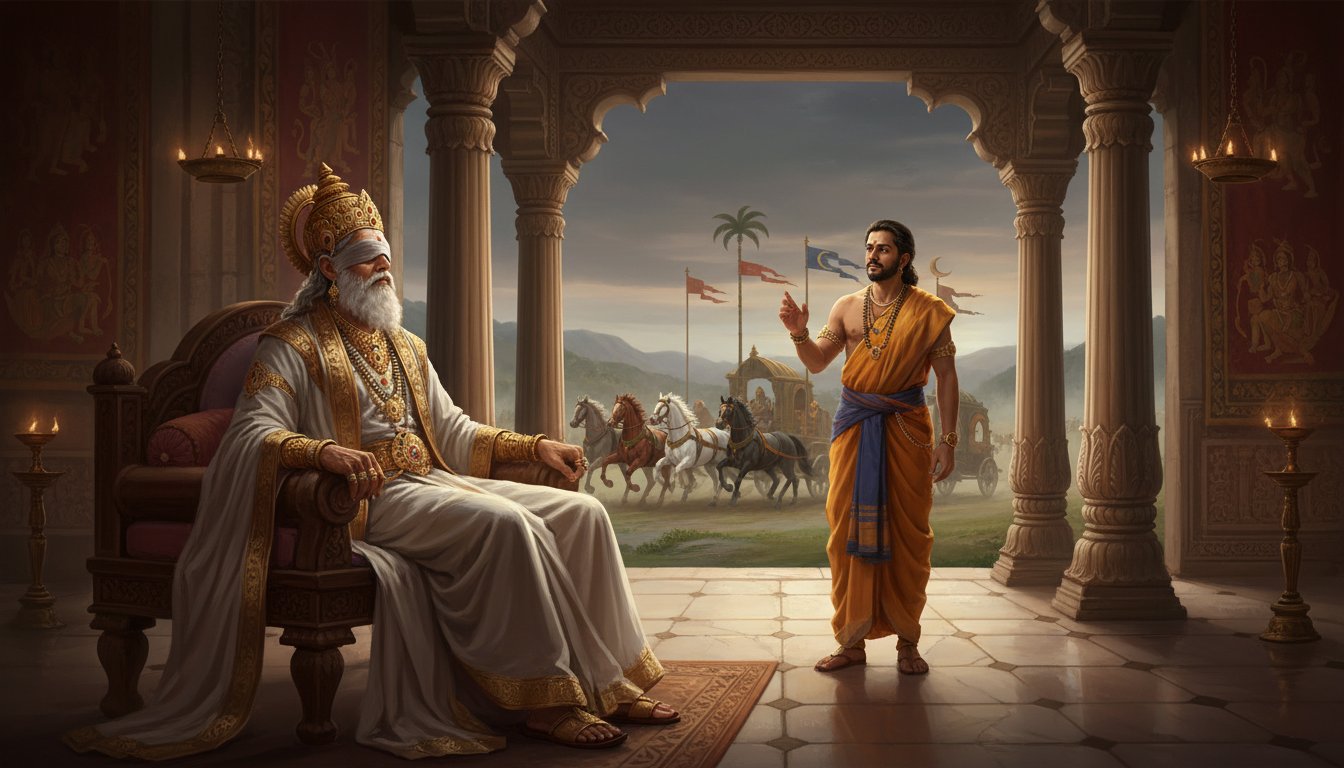
A Blind Man Asks About Colours
Sanjaya had been giving the old king numbers for eleven days. So many elephants lost, so many divisions broken, so many kings dead before noon. That morning he had begun in the same way, with the shape of the array Drona had made and the vow Drona had sworn in front of Duryodhana to take Yudhishthira the Just alive, and the old king lifted a hand off the arm of his seat and stopped him.
"No," Dhritarashtra said. "Not the numbers."
"What then, O king?"
"The cars." The blind man turned his face toward the voice as though it were a window. "Tell me the distinctive marks of the chariots of every one of them who went against Drona with Bhimasena at their head. What is on their standards. What colour their horses are. Which bow is in which hand. I want to know how they looked coming."
Sanjaya was quiet a moment. He had the sight Vyasa had given him, and with it he had watched the whole of that advance from where he stood, and he understood what he was being asked. A man who wanted to know how many enemy cars were left wanted a report. A man who wanted to know the colour of the horses wanted to see the thing itself, and no one asks to see a thing unless he is trying to measure it against something in himself.
"They came in the order of a bride's assembly," Sanjaya said, "where each suitor is announced by name and lineage as he steps forward. That is what it sounded like, O Bharata. Herald after herald, all of them shouting toward one old brahmana in one chariot."
"Begin with the horses," said Dhritarashtra.
The Horses of the Brothers
"Vrikodara went first," said Sanjaya, "drawn by steeds of the dappled hue of the antelope. Seeing him go, the grandson of Sini came up on his flank behind horses of a silvery colour, and Yudhamanyu, who is not a patient man, drove out in a rage on horses of mixed and variegated hue.
"Dhrishtadyumna came next, the son of the Panchala king, on very swift horses of the colour of pigeons in trappings of gold. He is the one who took Drona as the victim allotted to his own share, and he drives as a man drives who has been told from birth what he is for. His son Kshatradharman went out beside him to guard his father, on red steeds, a boy of regulated vows. Shikhandin's son Kshatradeva urged well-decked horses the colour of lotus leaves, with eyes of pure white, and handled them himself.
"Nakula's horses were of the Kamboja breed, and they had been decked with the feathers of the green parrot, so that the whole team came at us shimmering. Uttamaujas was borne by horses dark as clouds. Sahadeva's were variegated and fleet as the wind, and his weapons were already raised before he was within range of anything.
"And Yudhishthira, that tiger among men, was drawn by horses of the ivory hue with black manes lying along their necks, of great impetuosity, quick as wind. Behind him rode a great many warriors on horses decked in trappings of gold, all of them fast, all of them keeping station on the king."
"They put the king in the middle," Dhritarashtra said.
"They put the king in the middle," Sanjaya agreed, "because your preceptor had announced to your son what he intended to do with him. Every man on that field knew where Drona would be looking. So they arranged themselves around the thing he wanted, and came at him with it."
Behind the King
"Behind Yudhishthira," Sanjaya went on, "came the royal chief of the Panchalas himself, Drupada, with a golden umbrella held above his head and the whole of the king's guard closed around him. After him Sautabhi, that great bowman among kings, whose horses have been trained to bear any noise whatever without shying, so that drums and conches and screaming are all one to them.
"Virata followed with all his car-warriors. His horses were of the pale red of trumpet flowers, and I will say that they were beautiful. The Kekayas and Shikhandin and Dhrishtaketu came after the ruler of the Matsyas with their own troops around them. Virata's son rode with him on yellow horses decked in chains of gold.
"The five Kekaya brothers came on horses of a deep red, and they themselves had the splendour of gold about them, red standards, gold chains, mail on every one of them, and they showered arrows as they advanced the way clouds shower rain.
"Shikhandin's horses were the gift of Tumvuru, and they are the colour of unbaked earthen pots. Twelve thousand car-warriors of the Panchala race went out on that ground, O king. Six thousand of them followed Shikhandin alone.
"The son of Shishupala rode on sportive horses dappled like the antelope. Dhrishtaketu, that bull among the Chedis, came on Kamboja horses of variegated hue. Vrihatkshatra the Kekaya prince had horses of the Sindhu breed, fine-limbed, of the colour of the smoke of burning straw. Senavindu's horses were the colour of red silk and very quiet in the traces. The son of the king of the Kasis, a delicate youth, came on horses the colour of cranes. Prativindhya was drawn by white horses with black necks, obedient to the smallest movement of the rein, and quick as thought."
"You are naming children to me," Dhritarashtra said.
"I am naming the men who came at your preceptor," said Sanjaya. "That some of them are children is not a thing I put there."
The Sons of Draupadi, and One Son of Yours
"Sutasoma came on horses of a whitish yellow, which Arjuna had of Soma himself. He was born in the Kuru city they call Udayendu, and he has the effulgence of a thousand moons, and because he won renown besides in an assembly of the Somakas they gave him that name and it stuck.
"Satanika, Nakula's son, worthy of every praise, rode behind horses of the colour of sala flowers, or of the sun when it is just up. Srutakarman, whom Draupadi bore to Bhima, had horses in gold trappings of the hue of a peacock's neck. Srutakirti, Arjuna's son, who is an ocean of learning as his father is, came on horses the colour of kingfishers.
"The youthful Abhimanyu was borne by tawny horses. I have heard men in both camps say of that boy that he is reckoned one and a half times the better of Krishna or of Partha in battle, and I set the saying down as I heard it."
Sanjaya paused there, and the pause was long enough that the old king turned his head.
"There is one more in that column," Sanjaya said. "Gigantic horses bore Yuyutsu to the battle. He is the only one of your sons, O monarch, who left his brothers and went over to the Pandavas, and he was in the advance against Drona this morning with the rest of them."
Dhritarashtra said nothing at all for a while. Then he said, "Go on. The Panchalas next. There are always more Panchalas."
The Long Roll of the Panchalas
"Plump and well-decked horses of the colour of dried paddy stalk bore Vardhakshemi. Sauchitti's horses had black legs and gold breastplates and answered the rein perfectly. Srenimat's were the colour of red silk with golden armour over their backs and chains of gold at their necks. Satyadhriti, who knows both the science of arms and the divine Vedas, came on red horses.
"Behind Dhrishtadyumna rode Satyadhriti and Sauchitti and Srenimat and Vasudana and Vibhu the son of the ruler of the Kasis, all on the best Kamboja horses in chains of gold, each of them looking like Yama or the lord of wealth. And with them the Prabhadrakas of the Kamboja country, six thousand of them, weapons raised, bows drawn, on gold-decked cars, resolved to die together. That is what is said of them, O king, and they have not so far been proved liars.
"Chekitana's horses were the colour of tawny silk with beautiful chains of gold on them, and they went cheerfully. Purujit, whom men call Kuntibhoja, Arjuna's own maternal uncle, came on horses of the colour of the rainbow. King Rochamana's were the colour of a sky full of stars. Singhasena, the son of Gopati, rode behind red deer-coloured horses with white streaks along their bodies. Janamejaya of the Panchalas had horses the colour of mustard flowers.
"The ruler of the Panchalas himself was borne by huge dark blue horses in gold chains, their backs the colour of curd and their faces the colour of the moon, and they came very fast.
"Dandadhara's horses were white as reed stalks. Vyaghradatta's were light brown with backs the colour of a mouse and their necks drawn proudly up. Sudhanwan the Panchala prince had dark-spotted horses. Chitrayudha's were the colour of Indragopaka insects with variegated patches, and they came with the impetuosity of thunder. Sukshatra, son of the ruler of the Kosalas, had horses whose bellies were the hue of the chakravaka bird.
"Sukla advanced with standard and armour and bow and horses all of one white. King Nila advanced with standard and armour and bow and banner and horses all of one blue. Chandrasena, son of Samudrasena, had horses born on the sea coast and white as the moon. Saiva's were the colour of the blue lotus and wore floral wreaths. Rathasena's were the colour of kalaya flowers with white and red streaks. Hemavarna, son of Rochamana, had horses the colour of the lotus. Dandaketu's chargers had spines the colour of reeds and the colour of a hen's egg over the rest, and they would carry any weapon a man cared to put on that car."
"Enough of the horses," Dhritarashtra said. "Who is the Pandya?"
The King Who Gave Up His Revenge
"Sarangadhwaja," said Sanjaya, "king of the Pandyas. He came against Drona on horses the colour of moonlight, in armour set with stones of lapis lazuli, with his bow already stretched. A hundred and forty thousand principal car-warriors follow him on horses all of the colour of the atrusa flower.
"His country was invaded when he was young and his kinsmen ran. His father was killed in battle by Krishna. So he went and got weapons, O king, from Bhishma and from Drona, and from Rama of the axe and from Kripa, and he learned until he was the equal in arms of Rukmi and Karna and Arjuna and Achyuta himself. And then he made his plan, which was to burn the city of Dwaraka off the coast and subjugate the whole world after it."
"And?"
"And wise friends, wishing him well, talked him out of it. They sat with him and argued, and he listened, and he gave up all thought of revenge, and he went home and has been ruling his own dominions ever since."
The old king's hands moved on the arms of the seat.
"He gave it up," Dhritarashtra said.
"He gave it up, O Bharata."
"Then why is he on that field this morning, if he gave it up?"
"Because Yudhishthira asked him," said Sanjaya, "and he came. A man who lets his friends take his own quarrel away from him is not the same as a man who cannot fight. He is only a man who fights when the reason is worth it."
Dhritarashtra did not ask him to repeat that, and Sanjaya did not offer to.
"After him," Sanjaya said, "came Ghatotkacha on horses of all colours and shapes at once, with forces of every kind behind him. And after him Vrihanta of the red eyes on great horses of the Aratta breed on a golden car, that prince who threw over the opinion of all the Bharatas and went across to Yudhishthira alone, out of reverence, abandoning everything he had wanted for himself. And behind Yudhishthira at the last, on horses of the colour of gold, the Prabhadrakas again in numbers, with standards of gold, keeping pace with Bhimasena, so that the whole column looked like the dwellers in heaven with Indra at their head."
What Was Flying Over Them
"Now the standards," said Dhritarashtra.
"Then I will begin with the man they were riding at," said Sanjaya, "because Bharadwaja's son surpassed every warrior on that field for splendour, and he did it with the plainest device on it. A black deerskin waving at the top of the staff, and below it a water pot. That is the standard of the preceptor of both your houses, O king, and it looked exceedingly beautiful above all that gold.
"Bhimasena's standard bears a gigantic lion made of silver with its eyes made of lapis lazuli. In sunlight the eyes are the part you see first.
"Yudhishthira's bears a golden moon with the planets set around it. Two large kettle-drums are tied to that standard, and they are named. Nanda and Upananda. They are played by machinery as the car moves, and the sound they make is not a war noise at all. It is music, and men who hear it are glad, which is a strange thing to say of anything on that ground.
"Nakula's car carries a tall and fierce standard with the device of a sarabha on it, its back made of gold, and it is set there to frighten. On Sahadeva's there is a silver swan hung with bells, terrible to look at, and it enhances the grief of whoever is looking.
"The five sons of Draupadi carry the images of Dharma, of Marut, of Sakra, and of the twin Aswins.
"On the car of the youthful Abhimanyu is a golden peacock, bright as gold that has been heated in the fire. And on Ghatotkacha's standard a vulture shines out, and his horses can go anywhere at all that they are asked to go, as Ravana's could in the old days."
"And my son's men," said the old king. "What did they see, when all that came at them?"
"Countless standards rising together until they seemed to shut out the sky," said Sanjaya, "so that the host Drona commanded, in which there is not a single coward, looked out at the enemy and saw what looked like painted images on a canvas, all in a row, none of it moving quite as it should. And we heard the names and lineage of the warriors rushing at Drona called out one after another, exactly as they are called at a self-choice."
The Bows, Each One Named
"There is one more list, O king," said Sanjaya, "and it is shorter and worse.
"In Yudhishthira's hands is the celestial bow called Mahendra. In Bhimasena's hands is the celestial bow called Vayavya. For the protection of the three worlds Brahman once made a bow, indestructible, and that bow is held by Phalguni. Nakula holds the Vaishnava. Sahadeva holds the one called Aswina. Ghatotkacha holds the terrible bow called Paulastya.
"The five sons of Draupadi hold five jewels of bows between them: the Raudra, the Agneya, the Kauverya, the Yamya and the Girisa.
"And that best of bows, the Raudra, which Rohini's son once obtained for himself, Rohini's son did not keep. Being pleased with a pupil, Balarama gave it away to the high-souled son of Subhadra, and Abhimanyu had it on his car this morning."
"He gave the boy his own bow," Dhritarashtra said.
"He was gratified with him," said Sanjaya. "That is the whole of the reason recorded. There are men, O king, who give away what they love best to the young, and it does not seem to cost them anything, and I have never understood how it is done."
He let the silence sit.
"You have asked me for colours and devices for the length of a morning," Sanjaya said, "and I have given you every one I saw. But you did not want the colours, O Bharata. A man asks what is painted on the enemy's flags when he wants to know whether they can be beaten and cannot bring himself to put the question in those words. So I have answered it in the same way you asked it. That is what was coming at Drona. That is what it was carrying."
And Then They Met
"Then royal Drupada advanced against him at the head of a mighty division," said Sanjaya, "and the meeting of those two old men in front of their own armies was like two leaders of elephant herds with the temple-juice running down their faces. They have been at each other since they were boys in the same hermitage, and neither of them has ever once let it go.
"Vinda and Anuvinda of Avanti went at Virata. The Matsyas and the Kekayas came together in a way that horses and elephants and car-warriors could not be pulled apart from afterward.
"Bhutakarman, whom some call Sabhapati, tried to keep Nakula's son Satanika off the preceptor, and Satanika took his two arms and his head with three broad-headed shafts and went on. Vivinsati stood in front of Sutasoma, and Sutasoma pierced his own uncle with straight arrows and stood there in his mail, ready for more of it. Bhimaratha sent Salwa to Yama's abode with six iron shafts.
"Your grandson met your grandson: Chitrasena's son against Srutakarman, each of them fighting for the object his father wanted, both of them hard to beat.
"Ashwatthama, who bears the device of a lion's tail, stood in front of Prativindhya for the honour of his father, and the eldest son of Draupadi scattered arrows over Drona's son the way a sower scatters seed at sowing time.
"Duhsasana's son went for Srutakirti, and Srutakirti, who is Arjuna's equal, cut off his bow and his standard and his charioteer with three arrows and kept going toward Drona.
"Vikarna stood in front of Shikhandin. Angada took Uttamaujas. Durmukha went at Purujit and got a long shaft between the eyebrows for it, so that his face afterward looked like a lotus on its stalk.
"Karna took all five Kekaya brothers at once, and they covered him, and he covered them, and for a while no one on that part of the field could see either Karna or the five of them, nor their horses, nor their drivers, nor their standards, nor their cars.
"Kripa met Vardhakshemi of the Vrishnis, and the two of them became so absorbed in each other that neither could attend to anything else in the world.
"And Ghatotkacha came for Drona with maces and spiked bludgeons and swords and axes and stones, short clubs and mallets and discs, battle-axes, dust and wind, fire and water, ashes and brickbats, straw and trees, afflicting and breaking and routing and hurling men bodily back onto their own ranks. Alambusha met him, and those two foremost of Rakshasas fought as Samvara and the chief of the celestials fought in the old days."
The old king sat with his face turned toward the window he could not see out of.
"Such a battle," Sanjaya said, "was never seen or heard of before, O lord, as the one fought that day between the men who wanted Drona dead and the men who wanted him alive."
Dharma Lesson
A blind man asking for the devices on the enemy's flags is asking, without saying so, whether his own side can win. The answer is in the list itself: an army that carries named bows, kept vows and borrowed sons is not a thing that can be counted down to a number.