Gandhara, Land Beyond the Indus
The kingdom that sent a queen and a gambler
A Bride Beyond the Indus
Far to the northwest of the Kuru lands, past the Indus, in the shadow of mountains that led on to lands the Kurus knew only by rumor, lay the kingdom of Gandhara, ruled from the ancient city of Takshashila by King Subala. It was a proud house, old and learned, its capital famous for scholars as much as for soldiers, and when word reached it that the blind prince of Hastinapura, Dhritarashtra, required a wife, Subala's court weighed the match with more calculation than sentiment: an alliance with the Kurus was worth almost any price.
The bride chosen was Subala's own daughter, Gandhari, celebrated even as a girl for a discipline that unsettled everyone who witnessed it. When she learned that the husband her family had settled on her was blind from birth, she did not protest the marriage, nor did she ask that it be reconsidered. Instead she took a strip of cloth and bound it permanently over her own eyes, choosing to share her husband's darkness rather than see a world he could not, a vow she would keep unbroken for the rest of her life.
Gandhara sent her south to Hastinapura with the honor and wealth suitable to a king's daughter, and with her came her brother, a prince of the same house named Shakuni. He was meant, by every ordinary expectation, to stay only long enough to see his sister settled and then return north to his father's kingdom and whatever throne might one day be his there. He never went home. Whether it was love for his sister, ambition at the greater court of the Kurus, or something colder that later tradition would insist on, Shakuni made Hastinapura his permanent residence, and the fortunes of a small mountain kingdom were, from that day, bound to the fate of a much larger and more dangerous one.
The Uncle Who Stayed
Later tradition, less certain than the epic's spine but too persistent to ignore, gives a harder reason for Shakuni's long residence at Hastinapura. In these tellings, Bhishma, uneasy at ill omens that greeted Gandhari's wedding, had Subala and all his sons seized and imprisoned, left to starve on a single handful of grain passed daily into their cell, enough to keep one man alive rather than many. The dying king, so the story goes, ordered his sons to combine their shares and feed only Shakuni, judging him fittest to survive and avenge them, and made his son swear from that dying breath to bring down the whole house of the Kurus by whatever means a small, defeated kingdom's cunning could still supply. Shakuni is said to have carved dice from his father's bones, weighted with a will only he could command, and carried that grim inheritance into every game he ever played at the Kuru court.
Whatever the truth buried beneath the legend, what is certain is this: Shakuni stayed at Hastinapura for the rest of his days, styled himself uncle and counselor to his nephew Duryodhana, and became, in time, the sharpest mind steering the eldest Kaurava toward a throne he coveted and a war he could not survive without help. He was courteous to Dhritarashtra, indulgent toward his nephews, and careful never to let his counsel look like anything other than a loyal uncle's affection, so that few at court ever guessed how much of Duryodhana's worst thinking had first taken shape in Shakuni's quiet company. Gandhari, veiled and silent behind her own blindfold, raised a hundred sons in the same palace, seemingly unaware of, or unable to check, the quiet architecture her own brother was building around her family's ambitions, a blindness that was, for once, more than a figure of speech.
Dice and a Kingdom's Loyalty
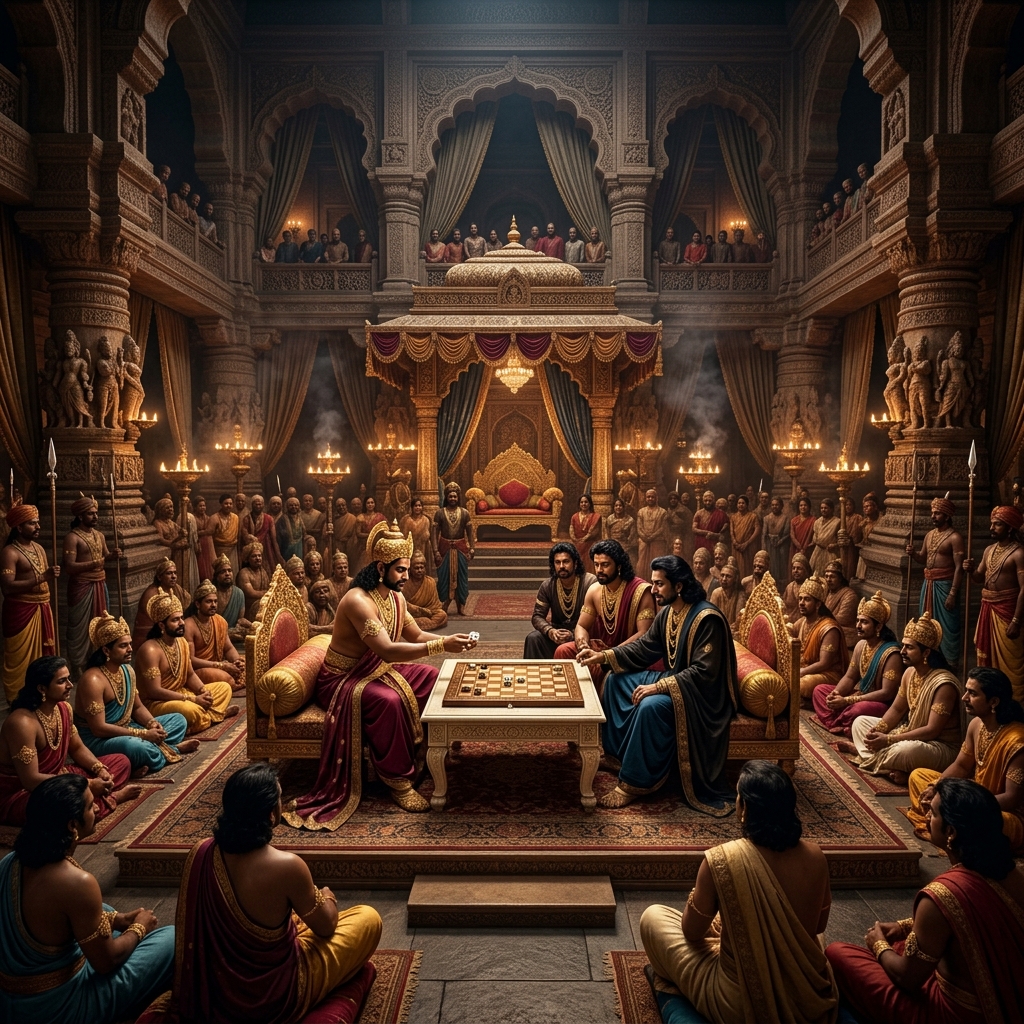
It was at the gaming hall of Hastinapura that Shakuni's peculiar gift found its most famous use. When Duryodhana, consumed with envy at the Pandavas' newfound wealth and unable to defeat them by any honest means, cast about for a way to ruin them without open war, it was his uncle who supplied the instrument: a game of dice that Shakuni would play by proxy in Yudhishthira's place, using those same weighted dice that never fell by chance. Kingdom, brothers, and finally Draupadi herself were staked and lost in a single ruinous sitting, an episode told in full elsewhere, but one that could not have happened without a Gandhara prince's steady hand and stranger patience for the game. Shakuni never wagered a coin of his own that day; the losses piling up across the cloth belonged entirely to the family whose ruin he had waited years to arrange, and by every account he never once let his composure slip while collecting them.
When the dice game's consequences finally ripened into open war, Gandhara did not stand apart from what its prince had set in motion. Horsemen from the far northwest, riders trained on mountain terrain and famous for their skill and daring, rode south under Shakuni's own command to fight for Duryodhana, and they did not falter. Through all eighteen days of the war at Kurukshetra, the Gandhara cavalry held its place in the Kaurava ranks, one of the few contingents that neither broke early nor deserted as the tide of the war turned against Duryodhana's cause. Shakuni fought among them himself, his gambler's cunning translated now into a soldier's stubbornness, unwilling to abandon the war his own scheming had done so much to bring about.
The Eighteenth Day
By the war's final day, almost everything Shakuni had built toward was in ruins. Bhishma, Drona, Karna, and countless kinsmen were dead; Duryodhana's army, once vast, had thinned to a fraction of its first strength, and the Gandhara contingent that had ridden south so proudly had bled itself down through seventeen days of unbroken fighting. Shakuni fought on regardless, his son Uluka beside him, both men committed past any possibility of turning back, as though the mountains they had left behind so many years before were already too far away to matter.
It fell to Sahadeva, youngest of the Pandavas, to end what the dice game had begun so many years before. In the fighting of that last day, Sahadeva killed Uluka first, and then turned on Shakuni himself, cutting down the uncle whose loaded dice had cost his sister's family a kingdom and very nearly their lives. The manner of that killing, and the long account it settled, belongs to its own telling; it is enough to record here that Gandhara's prince, who had outlived his sister's wedding by decades and shaped the fortunes of two dynasties from behind a gaming cloth, did not outlive the war he had done so much to summon. With him died any hope Gandhara's royal house had of ruling anything beyond its own mountains again, its brightest and most dangerous son buried on a battlefield hundreds of miles from Takshashila, far from the halls of Takshashila where he had once been simply a princess's brother rather than a kingdom's downfall.
The Horse Returns to Gandhara
Years after the war ended, when Yudhishthira sought to cleanse the guilt of Kurukshetra and confirm his sovereignty through the ancient rite of the ashvamedha, the consecrated horse was released to wander wherever it pleased, with Arjuna following at a distance to defend it and, where necessary, subdue any kingdom that dared to stop it. In the course of that long circuit the horse crossed the Indus and wandered back into Gandhara itself, the same country that had sent Gandhari south a generation before.
There the throne had passed, after Shakuni's death at Kurukshetra, to his surviving line, and it was Shakuni's heir who rode out to challenge the horse rather than let it pass unopposed through his ancestral land. What followed was fierce fighting between the Gandhara forces and Arjuna's small guard, a battle that went hard against the northern kingdom, as battles against Arjuna generally did. The young ruler was beaten, his army broken, and by every custom of the rite Arjuna would have been within his rights to end the line of Gandhara entirely, in payment for a grandfather's dice and an uncle's long war.
He did not. For the sake of Gandhari, still living in Hastinapura as the Kuru queen mother, mourner of a hundred sons lost to the very war her brother had helped ignite, Arjuna spared the defeated king, restored him to his throne, and let the ashvamedha horse continue on its way unhindered. It was, in its quiet way, the last transaction of the marriage that had first joined the two kingdoms: a debt of blood, incurred at a gaming table decades earlier, forgiven at last for the sake of the woman who had bound her own eyes rather than see any of it happen.
Dharma Lesson
Gandhari's vow shows that grief and loyalty can be carried with total discipline and no harm to anyone but the self; Shakuni's long revenge shows the same emotions curdled into a scheme that harmed everyone, including the family he claimed to serve. A single kingdom, a single wedding, produced both paths, proof that dharma is a choice remade daily and not a fixed inheritance of blood or birth. Even at the end, mercy shown for one blindfolded queen's sake outweighed every debt a war had left unpaid.