The Land the Rains Forgot
On the eastern reaches of the Ganga, where the great river slows and widens before its final run to the sea, lay the kingdom of Anga, ruled in its old age of legend by King Lomapada from a capital called Champa. Anga enters the memory of the epic long before its most famous king ever set foot there, through a drought so total that the land nearly emptied of life, and a king so desperate that he turned to a solution few would have dared: bringing the innocent young hermit Rishyasringa, raised in the forest without ever seeing a woman, into his kingdom by trickery, in the belief that only such pure innocence could persuade the rain to return. It did. Rishyasringa's arrival, and the strange, gentle courtship that brought him out of the forest, is a story told in full elsewhere; what matters here is its result, that Anga became, in the oldest layer of its legend, a kingdom saved by innocence rather than by arms, its rivers full again and its capital prosperous for generations after.
That first fame settled into ordinary history. Anga remained a modest, respected kingdom on the empire's eastern edge, known for its river trade and its old temples, ruled by kings whose names the wider epic mostly forgets. It would take many generations, and a single humiliating afternoon in a tournament ground far to the west at Hastinapura, before Anga's name entered the story again, this time bound permanently to one of the most consequential men the age would produce.
A Crown for an Insult
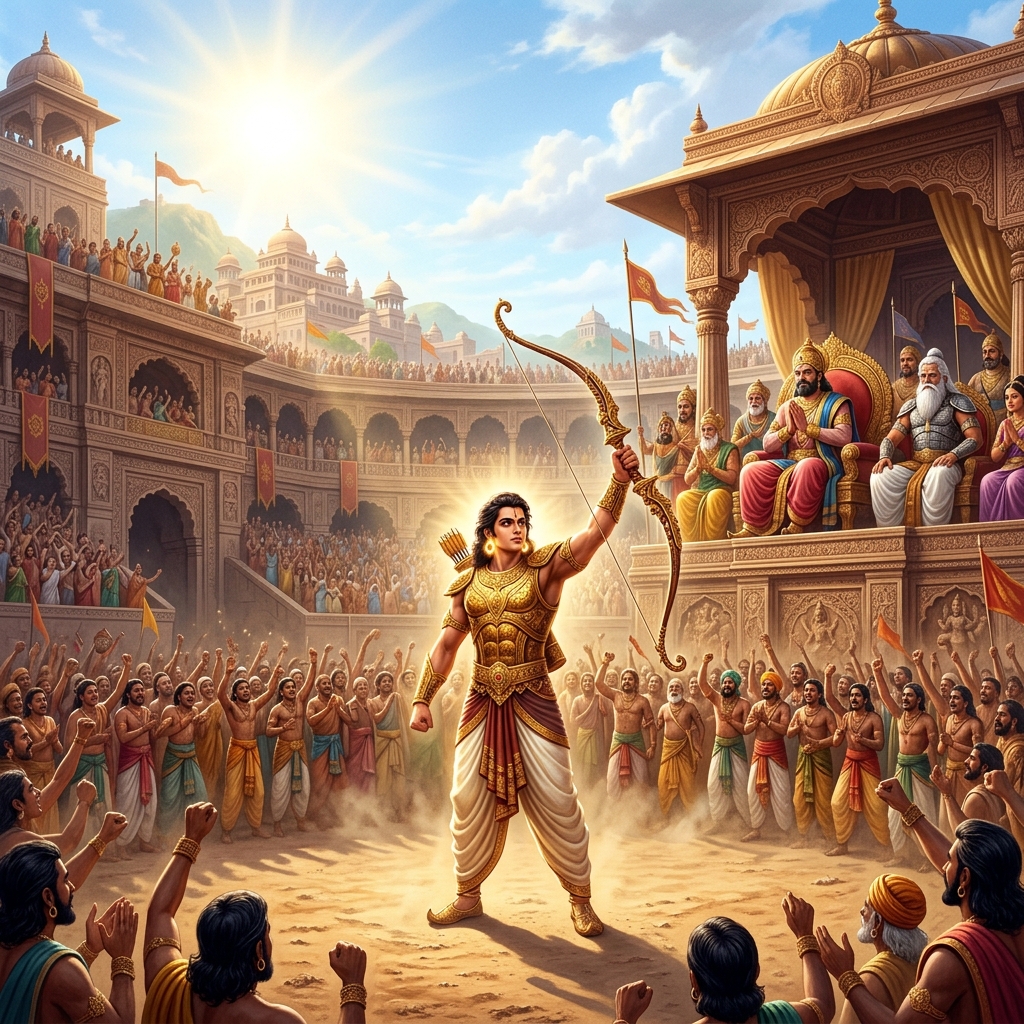
The tournament held at Hastinapura to display the martial skill of Bhishma's grandsons and their cousins was meant to end with young Arjuna crowned its unrivaled champion. It very nearly did, until a stranger walked onto the field uninvited: a young warrior of extraordinary bearing who matched, and by some accounts equaled, every feat Arjuna had just performed, and then demanded a duel to settle who was truly greatest. The crowd, delighted and unsettled in equal measure, wanted to know who this newcomer was before the two men crossed weapons.
It was Kripa, the royal preceptor, who asked the question plainly: a duel between princes required that both combatants be of matching rank, and no one in the assembly knew this stranger's father, his kingdom, or his right to stand where he stood. The stranger, whose name was Karna, had no answer that satisfied the court's rules of birth; he had been raised by a charioteer named Adhiratha and his wife, and by every mark of lineage that Hastinapura's nobility recognized, he was no prince at all, but a suta, unworthy of contesting with a prince regardless of his skill. The humiliation that followed, jeering laughter from a crowd that had been in awe of him moments before, would mark Karna for the rest of his life.
Duryodhana alone saw an opportunity rather than a disgrace. Already resentful of his cousins and searching for any weapon against them, he stepped forward before the assembly and did what no rule of birth could undo by half measures: he crowned Karna, on the spot, king of Anga, granting him a throne and a lineage of rank in the same breath, so that no one could any longer say he was unfit to face a prince. Adhiratha arrived on the field soon after, breathless and uncertain of his welcome, and Karna, to the crowd's fresh astonishment, left the newly won throne to touch his adoptive father's feet in full view of the court, claiming him as father before kings and commoners alike, whatever the cost to his own new dignity. Duryodhana had bought a friend's loyalty with a kingdom; he had, without quite meaning to, also given a humiliated man back his name.
The King Who Ruled from Elsewhere
Karna wore the crown of Anga for the rest of his life without ever quite living the ordinary life of a king. His days were spent almost entirely at Hastinapura, in the service and friendship of the man who had made him a king, and Anga itself he governed mostly from a distance, through officers and tribute, visiting his own capital at Champa only rarely. Yet the kingdom prospered under his name and, more than that, it became famous through him for a single quality: an open-handed generosity that Anga's court made a point of upholding, so that travelers passing through Champa spoke less of its temples than of the reputation its absent king had made for it.
Karna had made a vow early in his life never to refuse anyone who came to him with a request, whatever the cost to himself, and the stories that grew up around that vow, of his charity tested by gods in disguise and paid regardless of the danger it invited, belong to the fuller telling of his own life. It is enough to say that Anga's name, once known mainly for a drought broken by an innocent hermit, came in Karna's time to be known instead for a king who would rather impoverish or endanger himself than turn away a single petitioner, a reputation that outlasted every battle he ever fought and that Duryodhana, whatever his own motives in crowning him, could take some credit for having made possible. Kings far greater than Anga's own modest neighbors came to envy a virtue that no army could win and no dice game could take away.
Anga's Banners at Kurukshetra
When war finally came between the cousins Karna had chosen between so decisively at that tournament years before, Anga's soldiers marched with the rest of Duryodhana's alliance, their king leading troops raised from his own kingdom into a fight that was never, in truth, Anga's quarrel at all. Karna held back from the field for the war's early days, honoring an old vow not to fight while Bhishma commanded, but once Bhishma fell and later Drona too, command of the entire Kaurava army passed to the king of Anga himself, the suta's son the court had once refused to duel now leading kings who had once refused to acknowledge him as one of their own.
His time as supreme commander was brief and costly. Fierce fighting against Arjuna, the very rival whose contest at Hastinapura had first won him his crown, ended with Karna's death on the field, struck down at last while his chariot wheel was caught fast in the mud and his old teacher's curse and Kunti's long-hidden secret converged on him at once. The full account of that fall, and everything that led to it, is a story that belongs elsewhere; what Anga lost that day was not merely a king, but the one man who had ever turned the humiliation of an unknown birth into a throne, a friendship, and a command over armies far greater than his own small eastern kingdom could ever have raised on its own. Champa, so far from the battlefield, learned of its king's death only after the war had already been decided against the cause he had served to the end.
A Kingdom Passed to the Son
Karna left behind more than one son, and the war that killed him claimed most of them as well, cut down defending their father's cause or their own on the same field. One son survived the slaughter, a young man who inherited nothing of his father's kingdom by conquest or by right of birth so much as by the sheer exhaustion of a war that had run out of enemies to punish. He came to his father's throne not as a conqueror but as the last name left standing in a line that a tournament crowd had once refused even to recognize.
The Pandavas, once the fighting ended and Yudhishthira's guilt over the scale of the killing had settled into a colder accounting of what remained, chose not to erase Anga along with the rest of the defeated Kaurava alliance. Karna's surviving son was permitted to keep his father's throne, and in the years that followed, as Arjuna's ashvamedha horse made its long circuit of the world to confirm Yudhishthira's sovereignty, that same son is remembered in later tradition as riding alongside the Pandavas themselves rather than against them, a final, quiet reversal of the fortune that had first made Anga's throne a prize handed out to settle a stranger's humiliation. The kingdom that had once been thrown at Karna like a challenge ended, after his death, folded gently and without more bloodshed into the protection of the very family his life had been spent fighting, its crown finally resting on a head no assembly would think to question.
Dharma Lesson
Duryodhana's crown for Karna looks like manipulation, and in part it was, yet it also did what no law of birth would allow: it restored dignity to a man the assembly had just humiliated, and earned a loyalty that held to the very last day of Karna's life. Karna's own vow of unrefusable charity meant that a throne handed to him in calculation was ruled, in practice, by radical generosity. Anga shows that dharma and self-interest are not always opposites; a gift given for the wrong reason can still become a rightful kingship, if the man who receives it lives up to it.