The Tournament of Champions
The Rise of Arjuna and the Arrival of Karna
The Arena Rises
For many years the princes of the Kuru house had trained in secret, deep within the precincts of the palace, under the watchful eye of Drona. Now the great teacher judged that their education in arms was complete, and he went before the blind king Dhritarashtra to say so. "The princes have mastered the four kinds of weapons," Drona told him. "Let the people see what they have learned. Grant me leave to hold a tournament of arms, that the city may witness the fruit of their labor."
Dhritarashtra was pleased, for nothing delighted a father more than the prowess of his sons, and even a sightless king could drink in such glory through the praise of others. He summoned Vidura, his wise half-brother and minister, and commanded that everything be made ready.
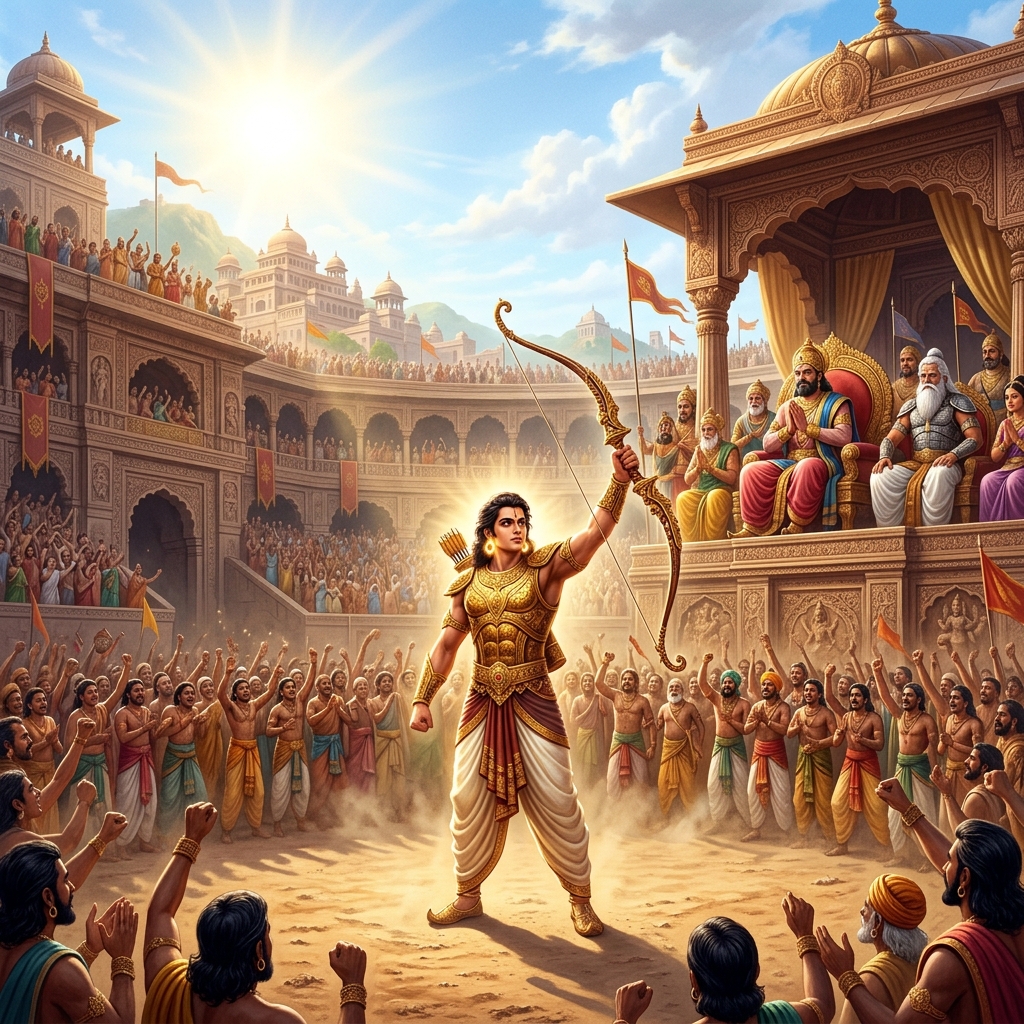
Upon a level stretch of ground outside Hastinapura, the royal builders raised a vast arena. They measured the field by the rules of the sacred texts, facing it to the proper quarters, and around it they built tiers of seats and tall pavilions hung with banners. Pillars of gold gleamed in the sun, and awnings of bright cloth shaded the galleries. For the king and the women of the household they prepared chambers screened with lattice and perfume, so that the queens and noble ladies might watch in comfort.
When the appointed day dawned, the whole of Hastinapura emptied itself toward the field. Citizens came in their thousands, dressed in their finest, and the roar of the gathering crowd rolled across the plain like the sound of the sea.
The Elders Take Their Seats
The blind king Dhritarashtra was led to his high seat, with Vidura at his side to describe to him all that the eyes could not. Bhishma, the white-haired grandsire who had given his life to the throne, took his place among the elders, and Kripa the teacher sat near him. The instruments of music sounded, conches were blown, and the trumpets of the city answered from the towers.
In the screened pavilions sat the women of the royal house. Among them was Kunti, mother of the elder Pandavas, her heart already swelling with a mother's hope. Beside her sat Gandhari, the queen who had bound her own eyes in loyalty to her blind husband, her hundred sons her pride. The galleries hummed with anticipation, citizens pointing out this elder and that prince to one another, marvelling at the splendor of it all.
When the assembly was settled, Drona came forward into the open arena. He was dressed in white, his hair and beard white as well, his sacred thread bright against his breast. With him walked his son Ashwatthama, born to share his father's skill. Drona offered the proper prayers and worship to the gods of the field, and then he gave the signal.
A hush fell over the multitude. Every face turned to the gateway from which the princes would come, and the long-awaited spectacle was about to begin.
The Princes Display Their Arms
The princes entered in order of age, the eldest leading, the rest following like the days of a waxing moon. Yudhishthira came first, calm and upright, the very picture of a future king. Behind him strode Bhima, broad as a hill, and then the others, all clad in their armor with their bows and quivers, their swords belted at their sides.
Mounted upon horses and then upon swift chariots, they showed the crowd the arts of the charioteer. They wheeled and turned, drove straight and circled back, and loosed their arrows at marks set up across the field, striking them again and again. The people gasped to see iron heads sink into targets of clay and wood, each prince surer than the last.
Then the princes took up the sword and the buckler, and fought mock combats up and down the sand. They leaped and parried, advanced and gave ground, so swift and graceful that the watchers could scarcely follow the flash of the blades. Some among the crowd grew uneasy, fearing the play would turn to true wounding, but the masters watched closely and the contests broke off cleanly.
Next came the great mace, the heavy weapon that few could even lift with ease. And it was here, with the mace in their hands, that two of the princes turned the harmless display into something that smelled of real war.
The Mace Duel of Bhima and Duryodhana
Two figures stepped into the cleared center of the arena, each shouldering a great iron mace. One was Bhima, mightiest of the sons of Pandu, whose strength was already a legend among the boys of the house. The other was Duryodhana, eldest son of the blind king, whose pride was as great as his cousin's strength. They had hated one another since childhood, and now the crowd saw that hatred laid bare.
They circled like two maddened elephants in the season of rut, their maces raised, their eyes fixed on one another. The blows when they came rang out across the field, iron upon iron, sparks leaping where the weapons met. This was no longer a courteous show of skill. The watchers could see it in the set of their shoulders and the fury on their faces. Each meant to bring the other low.
The crowd split in its sympathies. Some shouted the name of Bhima, others the name of Duryodhana, until the galleries themselves seemed to take sides and the noise rose to a din. The very air grew thick with the threat of bloodshed, and the elders leaned forward in alarm. What had begun as sport was sliding swiftly toward a feud fought in the open, before the eyes of all Hastinapura.
Drona saw the danger plainly. If these two were allowed to finish what they had begun, the festival of arms would end in the death of a prince, and the seed of war would be sown that very day before the people.
Drona Parts the Cousins
Drona turned at once to his son Ashwatthama, who stood ready at his side. "Go quickly," he said, "and part these two tigers before they tear at each other. Hold them back, for their anger has passed beyond all sport."
Ashwatthama hurried into the arena and threw himself between the cousins, his arms outstretched, his words sharp and commanding. With great effort he held them apart, as a man might hold back the swollen waters of two rivers meeting in flood. Bhima and Duryodhana, breathing hard, their maces still raised, slowly lowered their weapons, though the wrath in their eyes did not cool.
Drona then stepped forward himself and ordered the music to cease. When the trumpets and drums fell silent, his voice carried across the whole field. He praised both warriors but commanded that their duel go no further, and the elders, glad of the teacher's firmness, nodded their approval. The two princes withdrew, glaring still, the old grudge between them deeper than ever, now witnessed by thousands.
The crowd settled uneasily, the joy of the day briefly clouded. But Drona meant to end the festival on a note of wonder, not of dread. He raised his hand for silence, for the moment had come to bring forward the pupil in whom he had invested all his art and all his pride.
Arjuna, Hero of the Day
Drona summoned forward the dearest of his students, the one he had sworn to make the first archer in all the world. "Behold now," he called to the assembly, "a warrior dearer to me than my own son, mighty as Indra himself. Behold Arjuna."
Arjuna came into the arena clad in golden mail, his bow gleaming, his quiver heavy with arrows. He bowed to his teacher and to the elders, and then he began. With weapons charged by sacred chants, he called fire from his bow that leaped and danced across the field. With another he brought a sudden rush of water that hissed where the flames had been. He raised mountains of mist and made them vanish; he conjured clouds and dispersed them; he made the ground seem to open and close at his will.
He shot arrows that struck a moving iron boar through the heart, and others that passed cleanly through the hollow of a swinging cow's horn, five at a time. He loosed his shafts so swiftly that the eye could not count them, now from a standing chariot, now from horseback, now leaping upon the ground, until he seemed to be everywhere at once.
The whole multitude rose to its feet with a single great roar. They clapped and shouted his name, and the noise was like thunder rolling around the field. Drona's heart was full, for his promise was fulfilled before the eyes of the world. Kunti, watching from her screened seat, wept tears of joy to see her son hailed as the hero of the day.
The Stranger at the Gate
The cheering for Arjuna was at its height, and the sun seemed to shine for him alone, when a sound like the splitting of a mountain rang out from the gateway of the arena. The crowd's voice died in their throats. Every head turned toward the entrance, where a tall figure now stood framed against the light.
He was a young warrior radiant as the sun, and indeed he seemed almost made of sunlight. Golden armor clung to his body as though it had grown there, part of his very skin, and from his ears hung shining ornaments that cast a soft divine glow about his face. He carried himself with the ease of one who feared no man living, and his gaze swept across the arena as if measuring it and finding it small.
With long, unhurried strides he walked into the open field and came to a halt before Drona and Kripa, scarcely bending his proud neck to greet them. Then he turned his eyes upon Arjuna, and there was no warmth in them, only challenge.
"What you have done here," he said, his voice carrying to the farthest seat, "is no great matter. Whatever feats you have shown, Arjuna, I shall now perform before all these people, and I shall perform them better. Do not be so swollen with pride. There is one here who is your equal, and more."
Karna Matches Every Feat
The assembly stirred in astonishment, and Duryodhana, who had sat sullen since his parted duel, felt his heart leap with sudden hope. Here, perhaps, was the rival who could humble the favored Pandava.
With Drona's grudging leave, the stranger took up his bow. One by one, he performed every wonder that Arjuna had shown. He called fire and water, raised mists and scattered them, struck the moving marks and threaded the swinging horn, all with such ease and such grace that the watchers could find no fault in him. Where Arjuna had been brilliant, the stranger seemed effortless, as though these miracles cost him nothing at all.
The crowd, which had so lately roared for Arjuna, now fell into a confused murmur of wonder. Duryodhana sprang up and rushed to embrace the newcomer. "Welcome, mighty hero," he cried. "You have done me and all the Kurus great honor. Ask of me whatever you will, for everything I have is yours."
The stranger answered, "I ask only for two things. First, your unbroken friendship. And second, a single combat with Arjuna here and now, that all may see who is the better." Duryodhana, delighted, granted both at once.
Arjuna, stung to the heart, stepped forward with his face dark. "Uninvited one," he said, "the death that comes to those who thrust themselves forward unbidden shall now be yours. Prepare to face me."
Kripa Demands the Lineage
The two warriors faced one another, bows in hand, the air between them taut as a drawn string. The crowd held its breath, and Kunti in her high seat went suddenly pale, for she alone knew a secret that pressed upon her heart like a stone. Before a single arrow could fly, Kripa the teacher stepped forward and raised his hand, for he was learned in the rules that bound such combats.
"Hold," Kripa said. "By the ancient law, a duel must be fought between equals. This is Arjuna, son of Pandu of the Kuru line, third among the sons of Kunti, a prince of the royal house. The rules require that you, stranger, now declare your own name, your father, and the kingdom from which you spring. Only if your birth is the equal of his may this combat go forward."
These were words spoken without malice, the plain demand of custom, yet they fell upon the stranger like a blow. He stood in the center of the arena with all eyes upon him, and the radiant face that had shown no fear before an armed foe now drained of its color. He had no royal lineage to name, no kingdom to claim. He hung his head, and for a long moment the proud warrior could not speak at all.
A whisper ran through the galleries, and then, cruelly, the whisper grew into laughter. The crowd that had marvelled at his skill now smelled his shame, and a wave of jeering began to rise, sharp and unkind, beating down upon the silent figure in the golden mail.
Duryodhana Crowns the King of Anga
Duryodhana saw the stranger's humiliation and felt it as if it were his own, for he had already claimed this hero as his friend and his weapon against the hated Pandavas. He sprang up from his seat, his eyes blazing, and his voice cut through the laughter of the crowd.
"Enough," he cried. "If the rule is that only a king may stand against Arjuna in the field, then I shall make this warrior a king before you all this very hour, and let any man who dares dispute it stand forth."
He gave swift orders, and his servants brought sacred water in golden vessels, parched rice and flowers, and a crown and a royal umbrella. There in the arena, before the whole assembly of Hastinapura, with priests chanting the sacred verses, Duryodhana poured the consecrating water upon the stranger's brow and proclaimed him King of Anga. The umbrella was raised above his head, and the fans of office were waved beside him, so that the suta's son stood crowned and royal in the sight of all.
The newly made king turned to Duryodhana, overcome. "You have given me a kingdom where I had nothing," he said. "What can I ever do to repay so great a gift?"
"Nothing," Duryodhana answered, taking his hand, "but that you remain my friend so long as we both shall live." And so the two clasped hands in the arena, and from that hour the bond between Karna, King of Anga, and Duryodhana, son of Dhritarashtra, was sealed and would never break.
The Charioteer Father and the Mockery
Even as the crown was settled upon Karna's head, a stir came from the edge of the field. An old man pushed his way forward through the crowd, leaning upon a staff, his garments those of a charioteer, his body trembling with age and haste. This was Adhiratha, the suta who had raised Karna from infancy, drawn to the arena by the tumult and the rumor of his son's glory.
When Karna saw him, the new king, still wet with the water of his crowning, set aside his pride and bowed his head, the wreath upon it, to the humble old man. Adhiratha, weeping with joy, embraced his son and called him by his childhood name, and so before the whole assembly the truth of Karna's birth was laid bare. He was no prince and no son of kings, but the foster child of a charioteer.
A fresh ripple of scorn passed through the crowd. Bhima, never one to swallow his thoughts, laughed aloud and called out across the field. "So this is the son of a charioteer. You are not worthy to die at Arjuna's hand, suta's boy. Take up the whip and the reins, for that is your inheritance. A dog has no business at the sacrifice, and a charioteer's son has no business craving a kingdom."
The cruel words struck Karna, and his lips trembled, and he looked up at the setting sun without a word, his eyes bright with a pain too deep for answer.
Friendship Sealed, the Rivalry Deepened
Duryodhana rose in fury at Bhima's mockery, and his voice shook the galleries. "It is not for such as you to speak so. A hero's birth is hard to trace, and worth is not measured by the womb that bore a man. Heroes and rivers spring from secret sources. Look upon him. He wears the natural armor and the divine earrings of one born to greatness. Is he less a warrior because an old charioteer calls him son? If any here grudges him the kingdom of Anga, let that man string his bow and contest it."
A murmur of approval answered Duryodhana, for many in the crowd were moved, and no one came forward to challenge the gift. The blind king said nothing, and Bhishma and Drona held their peace, troubled in their hearts, for they could not bless this friendship and yet had no cause in law to undo it.
The sun had now sunk low, painting the great arena in red and gold, and the long day of arms drew toward its close. Duryodhana took Karna by the hand and led him from the field, the two of them shoulder to shoulder, a king and a king, bound now by gratitude on one side and ambition on the other.
Kunti watched them go, her secret locked within her breast, knowing what no other knew of the sun-born warrior's true blood. Arjuna watched too, his triumph soured, for he had found at last a rival worthy of his fear. The festival that had begun in splendor ended in a deeper division than before. The tournament was over, but in the dust of the Hastinapura arena a far longer contest had only just begun.
Dharma Lesson
Character and skill are not defined by birth or lineage. Karna's arrival challenged the rigid social hierarchies of the time. While Duryodhana's crowning of Karna was politically motivated, it also demonstrated that true merit should be recognized regardless of origin. However, Karna's gratitude to Duryodhana would later blind him to the path of righteousness, showing that even noble virtues like loyalty can be misdirected.