The Cart, the Lotus and the Needle
Drona builds an array forty-eight miles deep to hide one man
The Army That Had Not Slept
It was still dark enough for the fires to show when Drona began to move.
All along the Kaurava line the men were awake, and it was not the noise of an army being woken but of one that had never gone down. Some stood stretching their bows. Some rubbed the strings between their palms, feeling for damp. Others threw their naked swords up into the grey air and caught them again by the hilt, blades the colour of the sky, unyielding, well tempered, sharp, with beautiful hilts, and the trick of it was so old in their hands that they did not need light to do it.
"Where is that Dhananjaya?" a man shouted, drawing a deep breath first so that the whole line would hear him.
Others took it up. "Where is Arjuna? Where is that Govinda? Where is proud Bhima? Where are those allies of theirs?" Men whirled maces hung with little bells, smeared with sandal paste and worked with gold and diamonds, and asked the morning where the sons of Pandu had got to. Men with heavy arms and too much strength in them lifted their spiked clubs until the sky above the camp was crowded, the way it is crowded with the tall staffs raised in honour of Indra at the festival. Thousands of them, garlanded with flowers, moved through the evolutions of swordsmen and of bowmen on the open ground, cutting the air with skill that had cost them years.
Into the middle of this came Bharadwaja's son. He blew his conch and urged his own horses to speed and went up and down the forming host at a pace no man of his years had any business keeping, and wherever he passed the shouting turned into ranks.
Thirteen days he had commanded. On the thirteenth his students had killed a boy inside a wheel, and the boy's father had sworn before both armies that he would kill the ruler of the Sindhus before the sun went down on the fourteenth, or walk into fire himself.
Drona had until sunset to make that oath impossible.
Twelve Miles Behind Me
When the divisions that loved battle had taken their stations, Drona sent for Jayadratha.
The ruler of the Sindhus came, and it was plain to everyone who watched him come that he had not slept either. He had held a gate shut with his arms and his bow for one afternoon, and five brothers had not been able to get past him, and a boy had died on the other side of him because of it. Now the whole of the coming day was arranged around the question of whether he would still be breathing at dusk.
Drona did not offer him comfort. He offered him numbers.
"Yourself," he said. "Somadatta's son. Karna. Ashwatthama. Shalya. Vrishasena. Kripa. A hundred thousand horse. Sixty thousand cars. Fourteen thousand elephants with their temples running. Twenty-one thousand foot in mail. You will take your station behind me at a distance of twelve miles."
He let that sit.
"At twelve miles, with that in front of you, the gods themselves with Vasava at their head could not come at you. What is there to say, then, of the sons of Pandu? Take comfort, ruler of the Sindhus."
And Jayadratha, who had come to that tent expecting to be told to be brave, was comforted, because he had been told instead exactly how many men stood between himself and Arjuna's oath, and the number was very large.
He went out to the place Drona had marked for him. Many Gandhara warriors went with him, and behind them the great car-warriors whose names had just been read out, and foot-soldiers in mail carrying nooses. His horses were the best thing about him and he knew it: seven thousand of them, trained to draw and to bear, every one decked with yak-tails and ornaments of gold, and three thousand more of the pure Sindhu breed, which is a horse that does not tire.
Who Stood at the Front
At the very head of the whole host, where the first blow would land, Drona put a son of Dhritarashtra.
Durmarshana asked for the place and was given it. He had fifteen hundred elephants of awful size, infuriated, clad in mail, every one of them ridden by a man who had trained on that animal and no other, and he set them across the front of the army like a wall built of moving hills.
Behind him, in among the advance divisions, Drona placed two more of the king's sons, Dushasana and Vikarna, and their orders were not to win anything. Their orders were the accomplishment of the objects of Jayadratha, which meant standing in a place and staying there while the day burned down.
Vikarna took his station without argument. He had argued once, in a hall, in front of everyone, about a woman and a dice game, and had been shouted down by his own family, and had not argued since. He was where his brothers were because that was where he had always been going to be.
Behind them the ground rose slightly and then fell away, and along the fold of it the mass of the army began to take the shape their commander had chosen for it, which was a shape no one on that field had seen before. Men in the third and fourth ranks could not see the front. Men at the front could not see where the rear ended, because the rear did not end anywhere they could see. Drivers walked their horses forward twenty paces and were waved further forward, and further, and the line kept accepting them.
The sun came up on a formation still growing at both ends.
The Cart
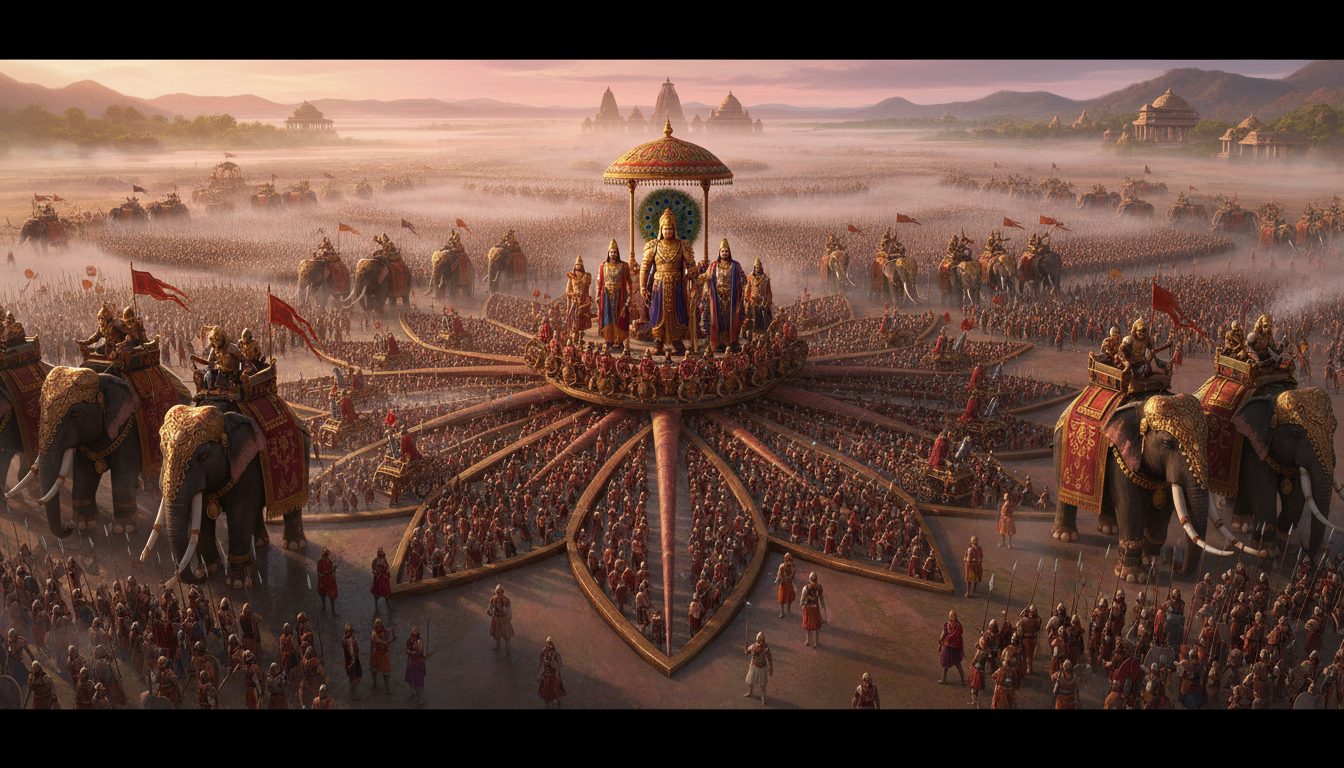
What Bharadwaja's son built that morning was part Sakata and part circle: a cart, with a wheel folded into the back of it.
From the mouth of the cart to the rear of it measured a full forty-eight miles. Across the back, where the load would ride, it measured twenty. Numbers like that are easy to say and impossible to look at. A man standing at the mouth of it and a man standing at the tail of it were not in the same country that morning. Messengers were given fresh horses simply to carry an order the length of the thing.
Into it Drona set countless kings, and the cars and horses and elephants and foot that had come with them out of every quarter of the world, and he set them not in a crowd but in an order, so that each contingent had another behind it and a third behind that, and the depth was the whole point. A wall can be broken by one great blow. A cart forty-eight miles long has to be walked through, and walking takes daylight, and daylight was the only thing Arjuna had sworn against.
Every man in it understood what he was for. He was not there to kill Arjuna. Better men than he had already tried. He was there to cost him an hour.
Somebody in the second rank worked out the arithmetic aloud and was told to be quiet. If a man on a fast chariot could make four miles in an hour through open country, and if this country was not open but packed shoulder to shoulder with armed men for its whole length, then the day did not contain enough hours, and the oath would fail of itself, and Arjuna would walk into his own fire at sunset without anyone on the Kaurava side having to kill him at all. That was the design. It was not a battle plan. It was a clock.
The old teacher rode the length of the mouth once more, looking along it the way a carpenter looks along a joint, and where a division sat crooked he straightened it himself, and did not raise his voice.
The Lotus Inside the Cart
That would have been enough for most commanders. It was not enough for this one.
In the rear of the cart, inside the twenty miles of its load, Drona folded a second array altogether, impenetrable, in the form of a lotus. It closed the way a lotus closes, petal overlapping petal, each rank of it curved so that a man cutting into one file found himself with two more on his flanks and his back to nothing.
And inside the lotus he folded a third, dense and narrow, and this one was called the needle.
Three arrays, one within another, like a puzzle box brought out at a feast. To reach the needle a man had first to cross the cart, and to cross the cart he had first to cross forty-eight miles of standing spears, and after the cart he had to open the lotus, which was built to be opened by nobody.
When it was done Drona took up his own station, and the last of the shouting died away along the line as the men saw the thing they were standing in.
Somewhere behind all of it, at one side of the needle, surrounded by a vast force, the ruler of the Sindhus sat on his chariot with his gold-decked horses and waited for a day to pass over his head.
The Order of the Needle
The order in which men stood inside the needle was a statement about who Duryodhana valued, and everyone who could read it read it.
At the mouth of the needle, first, where anything that got through the lotus would arrive, stood Kritavarma, the great bowman of the Bhojas, who had come to this war with an army because he had been asked and who had never yet failed to hold a place he was set in.
Next to Kritavarma stood the ruler of the Kambojas, and beside him Jalasandha.
Next to those two stood Duryodhana and Karna.
Behind them were hundreds and thousands of men who had agreed among themselves that they would not come back, and their business was the head of the cart, which they were to protect with their bodies for as long as their bodies lasted.
And behind all of them, last, deepest, with a whole force wrapped around him like packing round something breakable, was Jayadratha.
A man could stand at the mouth of the needle and count the layers between the open field and the ruler of the Sindhus and lose count. The king of the Kurus had put himself and his dearest friend in front of the man he was protecting, which was a generous thing, and he had also put five thousand strangers in front of himself, which was a prudent one.
No one said aloud what the arrangement admitted: that the whole army had been rebuilt overnight into a container for one frightened man, and that if the container failed there would be nothing else left to try.
The Mouth of the Cart
At the entrance of the Sakata, in front of everything, alone where the first arrow would come, stood Bharadwaja's son himself.
He was in white armour. His head-gear was the good one, the one he wore when he meant to be seen. He was an old man with a broad chest and heavy arms, and he stood in his car drawing that enormous bow of his out to its full length, the way he had drawn it in a courtyard at Hastinapura for a row of boys with their mouths open, and there was nothing left of the courtyard in him now. He looked like the Destroyer in a temper.
Behind him, at his back, the chief of the Bhojas took station to protect him, because even the mouth of the cart was to be defended in depth.
His car was easy to find on any field. It carried a beautiful standard, and on it the red sacrificial altar and the black deer-skin, the marks of the brahmana who had spent the first half of his life eating what people gave him and the second half breaking kingdoms. The Kauravas looked at that standard at the head of the array and were filled with delight, and the delight was not entirely rational, and they knew it, and they cheered anyway.
He had one instruction for the whole of the forty-eight miles behind him.
"Nobody moves toward him. Let him come to you. Every man who leaves his station to look for glory takes an hour off the day, and the hour is not yours to spend."
What the Siddhas Saw
The Siddhas and the Charanas, who watch these things from the air and have watched a great many of them, looked down on what Drona had made and were filled with wonder.
It resembled the ocean when the ocean is agitated. It had that quality of moving everywhere at once while going nowhere, of light running along it in lines, of a sound coming off it that was not made by any one thing in it. And the creatures who saw it thought, without any of them saying it first, that this array would devour the whole earth, with her mountains and her seas and her forests and everything else that is in her.
Duryodhana rode out a little way to look at his own army from the front, which is a thing kings should perhaps do less often.
He saw the cart teeming with carts and men and horses and elephants, roaring, dreadful, wonderful in its form, made to rive the hearts of enemies, and he began to rejoice. Not the sour satisfaction he had lived on for thirteen years. Actual joy. He had been given a thing beautiful enough to look at and vast enough to hide behind, and for one morning of his life the two were the same object.
He went back into the lines with his face lit up, and men who saw him pass took it as a good omen, and it was the last one they got.
The Hour Called Rudra
Then the drums and the mridangas started, and the noise of the warriors under the noise of the instruments, and the conchs went up one after another until the sound made the hair stand on the arms of men who had heard it for thirteen mornings running. The field filled slowly with the heroes of the Bharatas, all of them wanting the fight.
And when the hour called Rudra had come, Savyasachin made his appearance.
Many thousands of crows and ravens came with him, sporting in the air in front of his car and going where it went. On the Kaurava right, as they moved up, animals with terrible voices cried out, and jackals of the kind nobody wants to see howled at nothing. Thousands of blazing meteors came down with a noise. The earth shook. Dry winds got up in every direction at once, thundering, driving hard pebbles and gravel into the faces of the men who had to stand and watch Kunti's son arrive.
On the Pandava side, Satanika the son of Nakula and Dhrishtadyumna the son of Prishata arrayed their own divisions with the calm of men who had been given only one thing to do that day and knew what it was.
And Arjuna came on in white robes and white flowers, in mail, with a sword at his side and the golden diadem on his head, Angadas on his arms and good ear-rings in his ears, the man who had killed the Nivatakavachas, standing in his own foremost of cars with Krishna at the reins. He put that car at the very front of his army, in the place where the arrows would fall thickest, and stood there so that everyone could see where he was.
Like the Continent Resisting the Sea
Durmarshana had a thousand cars, a hundred elephants, three thousand heroes and ten thousand foot, and the ground he covered measured fifteen hundred bows from end to end, and he stood at the van of everything and made his speech.
"Like the continent resisting the surging sea, I will today resist the wielder of Gandiva. Let people behold Dhananjaya collide with me as one mass of stone collides with another. You who want a battle, stay and watch. Alone I will fight all the Pandavas assembled together, for my honour and my fame."
The great bowmen around him approved. It was a good speech, and it had the advantage of being made twelve miles from Jayadratha.
Then Arjuna blew his conch. And Krishna, without hurry, blew Panchajanya.
And along forty-eight miles of the finest army ever assembled on that plain, men who had been shouting at dawn stopped shouting. The hair rose on them as it rises at thunder. Some were seized with dread and some simply went away inside themselves and could not be recalled. The animals fouled the ground where they stood. On Arjuna's banner the ape opened his mouth wide and the creatures on the staff with him screamed, and the whole vast contrivance of cart and lotus and needle heard it.
Horns and cymbals and anakas were beaten again at once, to cheer the men, and under the din the challengers slapped their arms and roared to be answered.
Arjuna said, "Urge the horses, Hrishikesa, to where Durmarshana is standing. I will pierce that elephant division, and go in."
And Kesava urged the horses, and the fourteenth day began forty-eight miles from where it had to finish.
Dharma Lesson
Engineering can buy a man time, and time is a real thing to buy, but it cannot buy him a place among people who have already priced him. Jayadratha was defended by the deepest formation of the war and defended by nobody in it. An army built around one man's fear is still an army spending its life on a debt it did not incur.