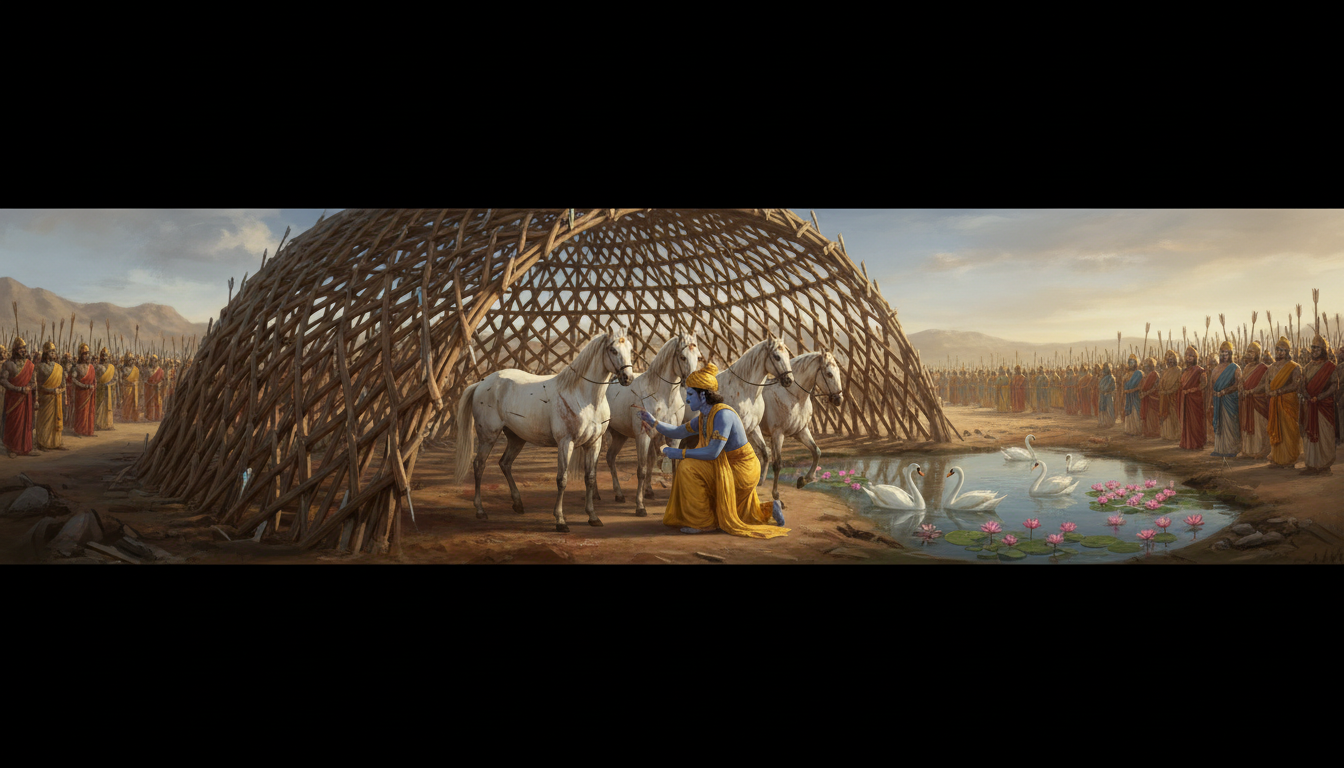
The Lake and the Hall of Arrows
Krishna unyokes the horses in the middle of the battle
The Way Made Wide
The sun had turned in his downward course toward the summit of the Asta hills. The sky was full of dust, the heat had gone out of the light, and the day was failing fast, which mattered on that particular afternoon more than it had ever mattered on any afternoon before it.
Some of the soldiers had stopped to rest. Some were still fighting. Some, hopeful of winning, had turned around and gone back into the press. And through the middle of all of it a single car was moving toward the place where the ruler of the Sindhus stood.
Arjuna was not looking for a road. He was making one. His shafts went out ahead of the horses, engraved with his own name, well tempered, tied round with catgut, of straight joints, thick and far-reaching, some shafted with bamboo and some wholly of iron; and they flew a full two miles ahead of the car, so that the men they killed were already dead by the time the wheels came up to them. Where that car went the Kuru troops broke and yielded a way, and behind it the birds of prey came down.
Krishna drove. He drove the way a man drives who is showing something to people who will talk about it afterwards, wheeling the team in circles, cutting back across their own tracks, taking the car over the bodies of dead horses and over broken cars and over elephants lying like small hills, and never once slowing.
The car of Surya does not go so fast. Nor the car of Rudra, nor the car of the lord of wealth. No vehicle had ever moved in battle at that speed, which was the speed of a wish crossing a mind.
And inside that throng of cars the four white horses carried it with difficulty, because they were hungry, and thirsty, and had been running since the morning, and were full of the weapons of men who liked fighting.
The Brothers of Avanti
The two heroic brothers of Avanti, Vinda and Anuvinda, saw the state of those horses and were delighted, and came at him at the head of their forces.
They shot well. They put sixty-four shafts into Arjuna and seventy into Krishna and a hundred into the four white horses, and roared like lions when they had done it.
Arjuna, who knew where the vital parts of a man are, answered with nine straight shafts, every one of them capable of going into a place a man does not recover from. Then he cut off both their bows with two broad-headed arrows, and their two standards after that, bright as gold as they were. They took up other bows. He cut those as well. Then he killed their horses and their drivers and the two men who guarded their rear and the men behind those, and with one more arrow, sharp as a razor, he took the head off the elder brother, and Vinda came down out of his car like a tree the wind has broken.
Anuvinda got down from a car that had nothing to pull it, and took up a mace, and came forward with it as though he were dancing, which is what men look like when they have decided not to survive their brother.
He reached the car. He struck Vasudeva on the forehead with that mace, a blow that would have gone through a wall.
Krishna did not move. He stood in the car holding the reins the way the mountain Mainaka stands.
Then Arjuna, with six arrows, took off the man's neck and his two legs and his two arms and his head, and the pieces came down separately, like a range of little hills. Their followers, seeing both brothers finished, threw hundreds of arrows and came on in a rage, and Arjuna killed them too, and looked, in the middle of it, like a fire in a forest at the end of winter.
What the Wisest of Persons Thinks
He got through the Avanti troops with some difficulty, and came out of them the way the sun comes out of the cloud it had been hidden in, and the Kauravas who saw him coming were frightened.
Then they looked again. They had been watching those horses all day, the same as everyone else, and they understood two things at once: that the man was tired, and that the ruler of the Sindhus was still a long way off. So they came around him from every side, roaring, and settled in to spend the rest of the afternoon.
Arjuna was angry, and being angry he smiled, and he spoke to Krishna in the soft voice he used when he had thought of something he did not like.
"Our steeds are afflicted with arrows and they are tired," he said. "The ruler of the Sindhus is still at a distance. What do you think is the best thing to be done now? Tell me truly, Krishna. You are always the wisest of persons. The Pandavas, having you for their eyes, will beat their enemies in battle."
Then, because he had already decided and was only being polite about it, he said the rest.
"What seems to me should be done next, that I shall truly say to you. Unyoke the steeds and put them at their ease, and pluck the arrows out of them, Madhava."
A man was proposing, in the fourteenth hour of a day he had sworn to end alive or in a fire, to take the horses out of the harness in the middle of the enemy.
"I am also of the opinion which you have expressed," said Kesava. He said it without an argument and without a caution, which from him was itself an answer: the man who knew the hour of every death on that field had been asked whether there was time to stop, and had said there was.
"Then I will hold the whole army in check," Arjuna said. "You do properly what should be done next."
A Man Standing on the Ground
He came down off the terrace of the car with Gandiva in his hand and stood on the earth, and did not move again, like a hill that has no intention of going anywhere.
The Kshatriyas saw him standing on the ground and thought, reasonably, that this was the best thing that had happened to them all day. They shouted, and came at him from every direction with a great throng of cars, all of them stretching their bows at once, and covered him with shafts the way clouds cover the sun. They brought out every kind of weapon they had between them. Infuriated elephants came at that one man the way elephants come at a lion.
What we saw then of the might of Partha's arms, O king, was very great, because alone, on foot, in a temper, he held all of them off.
He baffled their weapons with his own and covered every one of them with arrows nobody could count. Up in the air over that place, where the two showers of shafts were striking each other, a fire was generated, and it went on throwing off sparks.
The air there became hot to breathe. There were too many great bowmen in one spot, all furious, all wanting the same thing, and their horses were blowing hard and covered in blood, and their elephants were screaming.
It was an ocean of cars, uncrossable and wide and with no bottom to it. Arrows were its current, standards its eddies, elephants its crocodiles, foot-soldiers its countless fish. The conches and the drums made its roar. The cars themselves were the waves, the head-gear of the fighting men the tortoises in it, the umbrellas and banners the froth on top, and the bodies of the dead elephants the rocks under the surface.
And Partha stood in front of that sea with his arrows and did what a coastline does.
He received hundreds of arrowy showers and maces and lances coming at him the way the ocean receives hundreds upon hundreds of rivers, and with the force of his own weapons and the strength of his own arms he took the best shafts of the best kings there and turned them aside. Staying on the ground, alone, he baffled all those kings on their cars, the way one fault, avarice, will destroy a whole host of accomplishments in a man who otherwise had everything.
He felt no anxiety about it at all. That was the part the Kurus found hardest to look at.
There Is No Well Here
In the middle of that, Janardana spoke to him. He did it without any hurry at all, the way a man mentions a difficulty to a friend he has known a long time.
"There is no well here in the field of battle, Arjuna, for the steeds to drink from. The steeds want water for drink, but not for a bath."
It was, on the face of it, an absurd thing to say. They were standing in the fourteenth day of a war, on ground that had been fought over since sunrise, with an ocean of cars closing on them from every side, and the driver was raising the question of a drinking trough.
Arjuna answered cheerfully. He said, "Here it is."
Then he turned and pierced the earth with a weapon.
What came up was a lake. Not a spring and not a hollow with rainwater in it: a lake, wide, and so deep no one found the bottom of it, full of clear water, with swans on it and ducks among the swans and chakravakas ornamenting the edges. Full-blown lotuses of the finest species stood on the surface. There were fish of many kinds in it. It became at once the resort of a number of Rishis, the way water always does, as though it had been there since the world was made and the battle had merely been going on above it.
The horses were not the only creatures on that field who had been thirsty since the morning. But they were the ones who had been asked about.
Narada Comes to Look
The celestial Rishi Narada came down to have a look at it.
He had seen the making of a good many things. He had been present at sacrifices that lasted years and at the births of men whose names outlast their kingdoms, and he had watched a great deal of this particular war from a distance without saying much. He came now because a lake had appeared in the middle of Kurukshetra in the space of a breath, and he wanted to see it with his own eyes.
What he saw was a sheet of transparent water with the lotuses already open on it, and two armies standing around it in a ring, and a man on foot at the edge of the ring keeping the whole of one army off with a bow.
Both hosts had stopped to look. That was the strangest part of the afternoon, stranger than the water. Men who had been trying to kill each other since the sun came up were standing in their cars with their bows lowered, watching, because something was being done in front of them that had not been done before and might not be done again.
The Siddhas and the Charanas up in the air said so out loud. Loud uproars of applause were heard from them, and from the warriors of both sides mixed in with them, and nobody on the Kuru side gave any order to stop it.
Mighty car-warriors by the throng were unable to resist the son of Kunti even when he fought on foot, and that, to men who had spent their lives learning what a car is for, was the greater wonder rather than the lotuses. Throngs upon throngs of cars came at him, and myriads of elephants and horses, and he felt no fear and went on prevailing over all of them. The hostile kings shot showers of shafts at him and he stood in the middle of it unhurried, as though the afternoon belonged to him and he had lent it to them.
A Hall With Arrows for Its Roof
Then Partha, who could make things the way Tvashtri the celestial artificer makes them, built a hall.
He built it out of arrows, standing on the ground, with the enemy still coming at him. Arrows for its beams. Arrows for its rafters. Arrows for the pillars that held it up, and arrows laid across the top of it for a roof, driven and locked into one another so that the thing stood by itself in the open field with walls a spear could not get through.
Govinda looked at it and smiled with pleasure, and said, "Excellent. Excellent."
Then he did the part that the Kurus talked about for the rest of the war.
He got down from the car, in front of everybody, and unyoked the horses. He took the harness off four animals that were pierced and mangled with arrows, in the middle of a battlefield, with his back to an army, and led them into the arrowy hall in the sight of all those troops.
And Krishna, who was well skilled in grooming horses, groomed them.
He took away their fatigue and their pain. He wiped off the froth. He steadied the trembling in them and saw to their wounds. He plucked the arrows out one at a time with his own hands and rubbed the animals down where the shafts had been, and then walked them, making them trot properly until their breathing came back, and only then let them drink.
He was not doing a thing beneath him and he was not doing a thing above him. He was a driver, and those were his horses, and they had been carrying a vow all day.
What the Kauravas Said About It
The Kauravas praised it. They could not help themselves.
"What more wonderful incident has ever taken place in this world, or will ever take place," they said to each other across their own lines, "than this: that Partha and Govinda, in the course of a battle, have unyoked their steeds? Displaying that kind of energy on a field, and that much assurance, those best of men have put great thoughts into us."
And Hrishikesa, with eyes like lotus petals, went about it smiling with the coolest assurance imaginable, as though he were standing in the middle of an assembly of women and not of armed men who wanted him dead.
When the animals had drunk and rested he yoked them again to that foremost of cars, carefully, checking each buckle. Then Sauri mounted with Arjuna and the car went forward at great speed.
Seeing it come on again with those four horses in it, their thirst slaked, the foremost men of the Kuru army became cheerless all at once. They began to sigh, O king, like snakes whose fangs have been pulled out.
"Fie on us," they said. "Fie. Both Partha and Krishna have gone, in the very sight of all the Kshatriyas, riding on the same car, clad in mail, killing our troops as easily as boys playing with a toy. Those two have gone away in front of all the kings, and our shouting and our struggling did not hinder them."
Others were shouting the practical thing: "Speed, you Kauravas, for the slaughter of Krishna and the diadem-decked one. He of Dasarha's race yoked his steeds to his car in the sight of every bowman here and is proceeding toward Jayadratha, killing us as he goes."
And some of the lords of earth said quietly to one another what men say when it is much too late. "Alas. Through Duryodhana's fault these warriors and these Kshatriyas and the whole earth have fallen into great distress and are being destroyed. The king does not understand it."
The Sun Toward the Western Hills
The son of Pandu looked at the sun, which was well down toward the western hills by then, and went on faster.
The Kuru warriors could not resist him. He went through them like a lion going through a herd of deer, and the army moved when he touched it the way a herd moves. Krishna urged the horses into the hostile host and blew Panchajanya, which is the colour of clouds, and the sound of it went out over that whole plain and told every man on it exactly where they were.
The shafts Arjuna had shot before began, curiously, to fall behind the car, because the horses were now outrunning the arrows.
Many kings surrounded him, furious, and Duryodhana himself came up quickly and followed the car in that great battle. Warriors who saw the vehicle whose rattle was like the roar of clouds, and the terrible standard on it with the ape, and the banner floating on the wind, became exceedingly cheerless. Then the dust rose until it had almost put the sun out, and the Kuru soldiers, afflicted with shafts, could no longer even look at the two Krishnas.
The rest of that afternoon is known: the false dusk, the head lifted off the shoulders of the ruler of the Sindhus and thrown into the lap of his father, the vow kept by a margin that nobody has ever been comfortable with.
What is less often told is the halt in the middle of it. A man with a burning oath and a running clock stopped, in front of two armies, because four animals were thirsty. He put up a wall of arrows so nobody would be shot while it was done, and stood outside it alone against everything the Kurus had, and inside it the lord of the universe pulled arrowheads out of horses and rubbed them down and would not let them drink until they had walked properly first.
The vow was kept before sunset in any case. The horses were watered first.
Dharma Lesson
Even in the middle of a vow that must be kept by sunset, the creatures carrying you deserve to be cared for first. Arjuna stops the clock rather than run four animals into the ground, and Krishna, who is lord of the universe and also a driver, kneels in the dust to pull arrowheads out of them. Nothing is beneath a person who understands what he is responsible for.