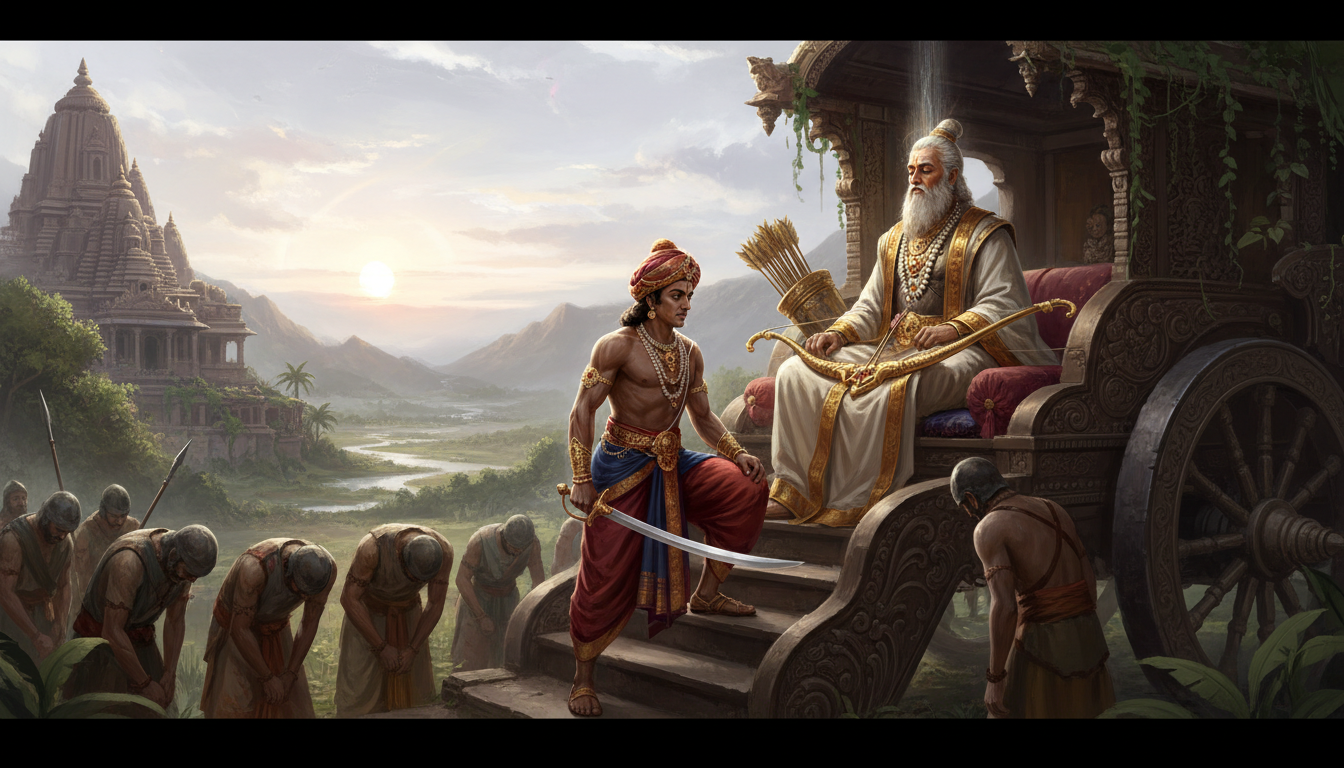
Kurukshetra Day 15: The Day the Teacher Died
From the Dawn Prayers to the Half-Truth at Noon
I Will Doff My Armour
The quarrel that decided the fifteenth day happened in the dark, some hours before it, with both armies lying on the field where they had dropped.
Duryodhana had gone to his commander and said the thing he had been holding back for four days.
"Neither the Pandavas, nor ourselves, nor any other bowmen in the world can be a match for you while you are engaged in battle. You are acquainted with all weapons. Without doubt, by means of your celestial weapons you are capable of destroying the three worlds with the gods and the Asuras and the Gandharvas. The Pandavas are all afraid of you." And then: "You, however, forgive them, remembering that they were your pupils. Or perhaps it is owing to my ill luck."
Drona did not answer that quickly.
"Although I am so old," he said, "I am still exerting myself in battle to the utmost extent of my might. All these men are unacquainted with weapons. I am well versed in them. If, from a desire of victory, I slay these men, there can be no more ignoble act for me to do.
"That, however, which is in your mind, be it good or bad, I will accomplish at your command. It will not be otherwise.
"Putting forth my prowess in battle and slaying all the Panchalas, I will doff my armour, O king. I swear this to you truly."
And then, because the insult was still in him, he told his king exactly what he thought of him. He recited Arjuna's deeds at Khandava and against the Gandharvas and the Nivatakavachas, and asked what Kshatriya was going to slay that man. He said, 'You are sinful and cruel and suspicious of everybody. Even those employed in your welfare you rebuke in this way. You are the root of this hostility. Why do you cause all these unoffending Kshatriyas to be slain? Go yourself against the son of Kunti. Your slaughter at the hands of Jaya would be worthy of every praise. You have practised charity. You have eaten. You have obtained wealth to the measure of your wish. You have no debts. Do not fear. Fight now with the son of Pandu.'
Those words being said, king, the battle recommenced.
The Prayers Both Armies Said
When three-fourths of that night had worn away, they were still at it, and both sides were somehow elated with it.
Then Aruna, the charioteer of Surya, came up and weakened the splendour of the moon and made the whole sky coppery, and the east reddened with rays like a circular plate of gold.
And this is the moment, king, and there is nothing else like it in the eighteen days.
All the warriors of the Kuru host and all the warriors of the Pandava host got down. They came off the cars and off the horses and out of the vehicles borne by men, on both sides, at the same time, in a field they had been killing each other in without pause since the previous sunrise. They stood facing the sun with their hands joined. And they uttered the prayers of the twilight of dawn.
Together. In hearing of one another. The same words.
Then they got back on and Drona divided the Kuru army into two bodies and came on with Duryodhana in front of him against the Somakas and the Panchalas, and Madhava said to Arjuna, 'Keeping your foes to your left, place this division to your right,' and Arjuna moved to the left of Drona and Karna both.
And Bhima, seeing it, said to his brother the only thing anybody said that morning that was not a prayer.
"O Vibhatsu, listen to these words of mine. The time for that object for which Kshatriya ladies bring forth sons has now come. If at such a time you do not strive to win prosperity, you will act meanly, like a veritable wretch. Pay the debt you owe to Truth, to Prosperity, to Virtue and to Fame. Pierce this division."
Drupada and Virata
Drona moved away from the fighting toward the north and took up his station there, and stood like a smokeless fire, and the Pandava troops looking at him began to tremble.
Some of them became perfectly cheerless. Some grew angry instead. Some were simply filled with wonder. Some of the kings squeezed their hands together, and some, deprived of their senses by rage, bit their lips, and some whirled their weapons and some rubbed their arms. And then they went at him.
The three grandsons of Drupada came first. He killed them with three sharp shafts, one each, and they fell off their cars deprived of life. Then he vanquished the Chedis, and the Kaikeyas, and the Srinjayas, and all the Matsyas.
Then the two old men came, the two who had every reason to.
Drupada, king of the Panchalas, who had been Drona's friend when they were boys studying together, and had told him at the gate of his palace years later that friendship between a king and a beggar was impossible, and had been made to pay for it, and had then obtained a son out of a fire for the express purpose of this. Virata, king of the Matsyas, in whose kitchens and cattle-sheds the Pandavas had hidden for their thirteenth year, whose son had been killed on the first day, whose daughter was a widow in a tent behind the lines.
They came together and shot showers of shafts at him.
Drona baffled the shower and covered them both. Then, filled with wrath, he cut off both their bows with two broad-headed shafts. Virata sent ten lances and ten shafts at him from desire of slaying him. Drupada hurled a terrible dart of iron, decked with gold and with stones of lapis lazuli, that looked like a large snake.
He cut the ten lances out of the air with broad-headed arrows and the dart with another. And then, with a couple of well-tempered broad-headed shafts, he despatched Drupada and Virata both to the abode of Yama.
Dhrishtadyumna saw his father go down, and his three nephews, and swore aloud in the middle of all the car-warriors:
"Let me lose the merits of all my religious acts, and my Kshatriya energy, and my Brahma energy, if Drona escapes me today with his life, or if he succeeds in vanquishing me."
Stand There and Watch, Then
But swearing was one thing and doing was another. Duryodhana and Karna and Sakuni and the uterine brothers took station around Drona according to their precedence and protected him, and the Panchalas, struggling vigorously, could not even gaze at him.
And Bhimasena became highly angry with Dhrishtadyumna and pierced him with words instead of arrows.
"What man is there who, being regarded as a Kshatriya, and taking his birth in the race of Drupada, and being the foremost of all persons possessing a knowledge of weapons, would only stand and look at his foe stationed in front of him?
"What man, having seen his sire and his son slain, and having sworn such an oath in the midst of the king, would be indifferent to his enemy?
"Yonder stands Drona like a fire swelling with its own energy. With bow and arrows for his fuel he is consuming all the Kshatriyas. Soon he will annihilate the Pandava army.
"Stand there as spectators and behold my feat. I will proceed against Drona myself."
And Vrikodara went into that array and began to rout it, and Prishata's son came in after him, and the two of them got in among the red horses of Drona's car; and such a fierce encounter took place at sunrise of that day, king, as we had never seen or heard of before.
A Dust That Everyone Took for Night
By full morning nobody could see anything.
The dust went up off that field and was not laid, and thick showers of arrows fell into it, and the noise, growing every minute, reached the heavens. Many of the men had fought all night and were weak with hunger and thirst and had gone past their senses. Steeds of the noblest breed, resembling elephants for size, trembled with the effort of dragging vehicles whose wheels had sunk into the earth. There was no path for a car anywhere on that ground because of the carnivorous animals and the dead and the dying.
And the dust made a night out of the morning. Neither Karna, nor Drona, nor Arjuna, nor Yudhishthira, nor Bhimasena, nor the twins, nor the Panchala prince, nor Satyaki, nor Duhsasana, nor Drona's son, nor Duryodhana, nor Suvala's son, nor Kripa, nor the ruler of the Madras, nor Kritavarman, nor I myself, king, nor the earth, nor the points of the compass, could be seen. All of us were shrouded.
Warriors, desirous of victory, killed friends and foes alike, whoever they could reach with the touch of their hands.
Then the wind came and took the dust away, and the blood that had been shed laid the rest of it, and everything was suddenly visible again and drenched. Elephants and steeds and car-warriors and foot-soldiers, bathed in blood, looked like a forest of Parijata trees in flower.
And in the clear, four pairs found each other. Duryodhana and his brothers took the twins. Nakula placed the king on his right and shot hundreds of shafts and was cheered for it, and Duryodhana turned on him from that very side and drove him back, and Nakula, recollecting every one of his woes, said only, 'Wait. Wait.' Radha's son engaged with Vrikodara. And Arjuna engaged with the son of Bharadwaja, and both armies stopped to watch that one.
The Rishis Standing at His Wheel
Then Drona set about keeping the oath he had sworn in the night, and did it with nothing held back.
He had recourse to the Brahma weapon for the extermination of the Kshatriya race. Twenty thousand Panchala car-warriors covered him with shafts and he dispelled all of them. He killed twenty thousand of them. He killed five hundred Matsyas and six thousand elephants and ten thousand steeds. He killed four and twenty thousand Kshatriyas and then despatched ten times ten thousand more with shafts of keen points. Of a dark complexion, with his gray locks hanging down to his ears, that man of five and eighty years careered on that field, for your son's sake only, with the activity of a youth of sixteen.
And then, king, the sky above his chariot filled up.
Viswamitra came, and Jamadagni, and Bharadwaja who was his own father, and Gautama, and Vasishtha, and Kasyapa, and Atri; and the Srikatas and the Prisnis, and Garga, and the Valkhilyas, and the Marichis, and the descendants of Bhrigu and of Angiras, and diverse other sages of subtle form, with the Bearer of sacrificial libations at their head. They had come to take him to the region of Brahman and they told him so.
"You are fighting unrighteously. The hour of your death is come. Lay aside your weapons in battle, O Drona, and behold us stationed here.
"After this it does not behove you to perpetrate such exceedingly cruel deeds. You are versed in the Vedas and their branches. You are devoted to the duties enjoined by truth. Especially, you are a Brahmana. Such acts do not become you.
"Lay aside your weapons. Drive away the film of error that shrouds you. Adhere now to the eternal path. The period for which you were to dwell in the world of men is now full. With the Brahma weapon you have burnt men on earth who were unacquainted with weapons. That act is not righteous. Do not wait longer on earth."
He heard them. He did not stop.
But something else had begun. He had been shooting ceaselessly for four days and one night without ever coming to the end of his arrows, and on the expiry of the third part of that fifth day, his arrows became exhausted. And the celestial weapons, when he called them, no longer came at his bidding.
Falsehood Is Better Than Truth
By then the Pandavas had stopped talking about winning.
"Is it not evident," they were saying to each other, "that Drona will consume us all like a raging conflagration consuming a heap of straw in the spring? There is none competent even to look at him. And Arjuna, who alone is a match for him, is conversant with the ways of morality and will not fight him."
So Kesava said what he said.
"This foremost of all bowmen is incapable of ever being vanquished by force in battle, by the very gods with Vasava at their head. When, however, he lays aside his weapons, he becomes capable of being slain on the field even by human beings.
"Casting aside virtue, you sons of Pandu, adopt now some contrivance for gaining the victory, so that Drona of the golden car may not slay us all in battle.
"Upon the fall of his son Aswatthaman, he will cease to fight, I think. Let some man therefore tell him that Aswatthaman has been slain in battle."
Dhananjaya did not approve of it. The others did. Yudhishthira accepted it with great difficulty.
Then Bhima went and found a mighty elephant belonging to Indravarman, the chief of the Malavas, standing in his own army: a huge foe-crushing beast, terrible, like the elephant of Sakra himself. Its name was Aswatthaman. He killed it with his mace.
And then he went to Drona with some bashfulness on his face and exclaimed aloud, "Aswatthaman has been slain."
Hearing those highly disagreeable words and reflecting on them, Drona's limbs seemed to dissolve like sand in water. And then he remembered the prowess of his son, and came to regard the intelligence as false, and did not become unmanned by it, and recovered, and rushed at Prishata's son with a thousand shafts.
But he had heard it. And there was one person on that field whose word he would take.
Four Fingers' Breadth
He asked Yudhishthira. Not anybody else. He asked Yudhishthira because he firmly believed that Yudhishthira would never speak an untruth even for the sovereignty of the three worlds, and because he had hoped for truth from him since the man was an infant in his schoolroom.
Govinda, knowing that Drona was capable of sweeping the Pandavas off the face of the earth, was much distressed, and came to the king and said:
"If Drona fights, filled with rage, for even half a day, I tell you truly, your army will then be annihilated. Save us from Drona. Under such circumstances falsehood is better than truth. By telling an untruth for the saving of a life, one is not touched by sin. There is no sin in an untruth spoken to women, or in marriages, or for saving a king, or for rescuing a Brahmana."
And Bhimasena came up while they were talking and said, "As soon as I heard of the means by which Drona might be slain I killed that elephant and went and told him, and the preceptor did not believe in the truth of my words. Desirous of victory as you are, accept the advice of Govinda. Tell Drona, O king. Told by you, that bull among Brahmanas will never fight. You are reputed to be truthful in the three worlds."
So Yudhishthira, fearing to utter an untruth and earnestly desiring victory, made up his mind and said it.
He said distinctly that Aswatthaman was dead.
And he added the word elephant after the name, indistinctly.
Up to that moment, king, the car of Yudhishthira the just had always stayed at a height of four fingers' breadth above the surface of the earth, and every man in both armies had seen it and none had remarked on it because it had always been so.
After he had said that, his vehicle and his animals came down and touched the ground, and stayed there afterwards.
He Laid Aside His Bow
Drona was already carrying too much. The Rishis had told him he was an offender against the high-souled Pandavas. His arrows had run out. His weapons would not come when he called them. And now the one man he trusted had told him his son was dead.
Dhrishtadyumna came at him and Drona took his bow and his shield and his mace and his sword away one after another, and Satyaki cut the killing shaft out of the air at the last moment; and while that was happening Bhima took hold of Drona's own car and spoke to him from a foot away.
"If wretches among Brahmanas, discontented with the avocations of their own order but well versed in arms, did not fight, the Kshatriya order would not have been thus exterminated. Abstention from injury to all creatures has been said to be the highest of all virtues, and the Brahmana is the root of that virtue. You are the foremost of all persons acquainted with Brahma.
"You are slaying all these Mlecchas and these warriors, who are at least engaged in the proper avocations of their own order, moved by ignorance and folly and by the desire of wealth for the benefit of sons and wives. Indeed, for the sake of one son, why do you not feel ashamed?
"He for whom you have taken up weapons, and for whom you live, lies today on the field deprived of life, unknown to you and behind your back. King Yudhishthira the just has told you this. It does not behove you to doubt it."
Thus addressed by Bhima, Drona laid aside his bow.
And then, desirous of laying aside all his weapons also, the son of Bharadwaja of virtuous soul said aloud, so that they could hear him across the noise:
"O Karna, Karna, O great bowman. O Kripa. O Duryodhana. I tell you repeatedly, exert yourselves carefully in battle. Let no injury happen to you from the Pandavas. As regards myself, I lay aside my weapons."
Then he began, loudly, to take the name of his son. He sat down on the terrace of his car and devoted himself to Yoga, assuring all creatures and dispelling their fears; bending his face slightly down, heaving his breast forward, closing his eyes, resting on the quality of goodness, thinking on the syllable Om.
Dhrishtadyumna laid his bow down on the car with the arrow still fixed on the string, took a sword, jumped down, and ran.
Every creature there cried out. Arjuna got off his own car and ran toward Prishata's son with his arms upraised, calling out, 'You who are acquainted with the ways of morality, do not slay the preceptor. Bring him alive. He should not be slain.' All the troops were shouting the same thing. Dhrishtadyumna seized the head by its white hair and cut it off, and his foe remained speechless the while, and he threw it down in front of your army, and your army ran.
Five of us saw what the rest could not. Myself; Dhananjaya; Drona's son; Vasudeva of Vrishni's race; and king Yudhishthira the just. We saw him go up out of that field rapt in Yoga, like a smokeless brand of blazing splendour, into the stellar path, and for a moment it seemed to us there were two suns in the sky.
A Weapon That Cannot Be Used Twice
The Kuru army went off that field in every direction at once, throwing away its coats of mail, urging on fathers and brothers and uncles and sons, and the soldiers called out, 'Wait, wait, do not fly,' and none who said it stood still himself.
Ashwatthaman, who had been elsewhere, came against the current of it like an alligator, found Duryodhana, and asked why the troops were running. Your son could not get the words out. He sat on his car and wept, and finally asked Kripa to say it before others, and Kripa told him how his father had died.
Then Drona's son blazed up like a fire fed with a large quantity of fuel, squeezed his hands, ground his teeth, breathed like a snake, and swore in your son's hearing: since Kunti's son, assuming only the outward garb of virtue, had caused the preceptor to lay aside his weapons while he was righteously engaged, he would rout and destroy that army in his very sight.
And he invoked the weapon called Narayana.
Thousands of arrows with blazing mouths appeared in the sky, and iron balls, and Sataghnis, and the more the Pandavas resisted the stronger it grew. Krishna understood it at once and told every man in that host to get off his car and lay his weapons down on the ground and not think of fighting, because that weapon feeds on resistance. They all did it. Bhima would not. He stood on his car in the middle of the fire, and Arjuna covered him with the Varuna weapon, and finally Nara and Narayana themselves got down and walked into that energy and dragged Bhimasena off his own chariot by force while he roared at them. And when he was down and his weapons were down, the weapon became pacified, and the winds turned sweet, and the birds and the animals became quiet.
Duryodhana told Ashwatthaman to use it again.
"That weapon cannot be brought back," he said. "It cannot be used twice."
So he used the other one. Stung past bearing by harsh words from Arjuna, whom he loved and who had never spoken to him that way before, he touched water, invoked the Agneya weapon, and let it off on all sides. A thick gloom shrouded the host. Meteors flashed down. The sun gave no heat. Clouds roared and rained blood, and the very waters heated, and the elephants ran breathing heavily and looking for protection. When Arjuna dispelled it with the Brahma weapon and the wind came clean again, a full akshauhini of the Pandava host was lying there burnt, and the forms of the slain could not be told apart.
And on that field, twice in one evening, Vyasa stopped a man and told him what he was actually looking at. To Drona's son he said that Krishna and Arjuna are Narayana and Nara, older than the oldest gods, born in every age for the purposes of the world, and that Ashwatthaman himself is a portion of Rudra. To Arjuna he named the blazing figure with the lance that had been walking in front of his chariot for a week without touching the ground.
Then the son of Drona, having bowed to the great Rishi, looked at what was left of your army and had it withdrawn for the night; and the Pandavas withdrew theirs.
"Having fought for five days," said Sanjaya, "and caused an immense carnage, that Brahmana well versed in the Vedas, Drona, repaired to the region of Brahma."
Dharma Lesson
A man goaded into abandoning his own restraint has already lost the day on which he will die. Drona knew that a Brahmana slaying men who could not answer him was the most ignoble thing he could do, said so aloud, and did it anyway because his king had questioned his loyalty. The insult that makes a good man prove himself is the weapon that kills him.