The Charge Against Him
It had been said in the Kuru camp for four days, and on the fourteenth night it was said to his face.
The words were always the same, whoever carried them. He teaches them still. He has the Pandavas in front of him every morning and every evening they are alive. He drew the circle of the formation on the ground and left a gap in it wide enough for a boy to walk through. He loves Arjuna more than he loves this house. An old brahmana with a bow does not stop being a teacher merely because someone has paid him.
Drona heard it out. He was past eighty and had been the finest archer alive for fifty years, and the accusation was not entirely false, and that was the part that could not be borne.
"Very well," he said. "You have never seen me try."
He made the vow in front of them, in the flat voice of a man setting down a burden he does not intend to pick up again. He would not leave the field. He would not unbuckle his armour, nor eat, nor sleep, nor rest the horses until the army that faced him was broken or he was dead in front of it. He would use every weapon he knew, including the ones that are given to a brahmana on the understanding that he will never need them.
Then he went and sat alone until the sky greyed. Somewhere across the plain the drums of the other camp were being tightened for the morning. He thought about a boy who had learned to shoot at a wooden bird in a courtyard, and about who that boy was now, and then he stopped thinking about it, because he had promised, and because a teacher who is told often enough that his mercy is treason will one day cut the mercy out and hand it over to be counted.
Nothing Held Back
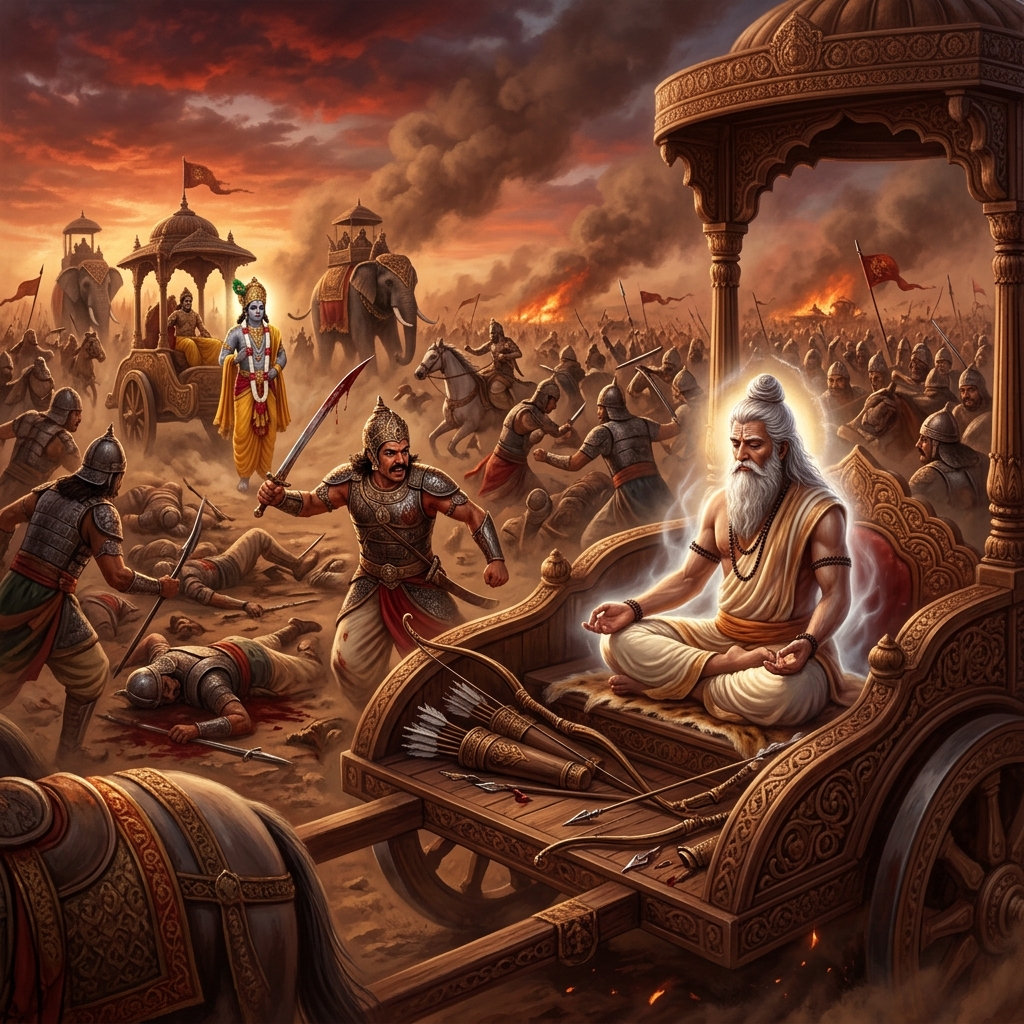
He took the field at first light in a chariot with a golden altar on the standard, and by the time the sun was properly up the Pandava left had ceased to exist as a shape on the ground.
He did not fight the way an old man fights, choosing his ground and letting others come to him. He went forward. Wherever his wheels turned the line in front of them stopped being a line, and men found that the arrows arriving among them came from a direction nobody could point at, four and five at a time, from a bow whose string was never seen to be still. Then he began to use the weapons that are called down rather than shot. The Agneya went out and a whole squadron of Panchala chariots burned where they stood. The Vayavya lifted horsemen off the earth and set them down broken. He loosed the Brahma weapon at soldiers who had no more answer to it than grass has to a scythe, and divisions that had held for a fortnight went backward across their own dead.
By the middle of the morning nobody would stand in front of him. The Srinjayas would not, the Matsyas would not, the Kekaya divisions would not. Men rode along the line looking for someone to give an order that would let them stop.
Arjuna was far off on the southern flank, dragged there again by the samsaptakas, who existed for that purpose and were spending themselves gladly to keep him there.
"There is no man alive who can beat him while he holds a bow," Krishna said quietly, watching the dust move.
Bhima said nothing and turned his mace over in his hands. Yudhishthira watched his own army come apart in front of him and understood, for the first time in fifteen days, that they might simply lose.
Drupada
Then an old king turned his chariot out of the wreck of the Panchala centre and drove at him, and the two of them had known each other for seventy years.
They had been boys together in Bharadvaja's ashram, sharing a mat and a begging bowl, and the prince had said what princes say to friends who own nothing: when I am king, what is mine is yours. Long afterwards a poor brahmana with a starving son had walked to the gate of Kampilya and repeated the sentence back to him, and had been told that friendship exists between equals, that a king has no friend who is a beggar, and that he might take a meal at the door if he liked. Everything after that came out of that morning. Drona had gone to Hastinapura, taught the sons of two houses to shoot, and asked as his fee that they bring him the king of Panchala with his arms tied, and had given him back half his kingdom and kept half, which is a worse thing to do to a man than kill him. Panchala had then spent a generation making a son out of fire for one purpose.
Now the two of them met in the open with nobody between them.
Drupada was old and his hands were not what they had been, and he shot as well as he was able, and his arrows came in and were cut in the air. Drona answered without hurrying: the bowstring, the standard, the horses, the driver, and then the man. It took very little time. The friend of his boyhood and the enemy of his middle years went down in his own chariot, and Drona rode on through the gap he had made and did not look back at the body, because he had promised in front of witnesses that today he would hold nothing back from anyone at all.
The Same Hour
Virata came into the same hour, and it was the last of him.
The king of Matsya was an old man too, and he had done the Pandavas a service that nobody else in Bharatavarsha had been willing to risk: for the thirteenth year he had housed them under his roof without knowing it, a cook in his kitchens, a groom in his stables, a dancing master among his daughter's women, and when the cattle were driven off his fields it was his own son who took the fifth of them out to the fight and came back alive by a miracle he did not survive long enough to enjoy. He had given a daughter to Abhimanyu, and Abhimanyu was eleven days dead. He rode at Drona for all of it and lasted about as long as Drupada had.
The two bodies were carried out of the field in the same part of the morning, the father-in-law and the father of the bride, the two old kings who had made the alliance possible before the alliance had a name.
Their sons watched it happen, and their grandsons watched it happen. Shikhandi saw his father fall. The sons of Draupadi, who had Drupada's blood and Pandu's both, saw their grandfather go down and their mother's house left standing without its head in the middle of a field it could not leave. In the Pandava lines the Panchala and Matsya divisions began to come apart at the seams, not from fear now but from grief, which moves faster.
Yudhishthira did not weep where his men could see it. He stood in his chariot and looked at the place where the golden altar on the standard was still moving forward, unhurried, into the eighteenth division of the day, and he asked aloud whether anything in the world was going to stop it.
The Man Born From Fire
Something did come forward, and it was the thing that had been made for exactly this.
Dhrishtadyumna had come out of a sacrificial fire full-grown with armour on his back and a bow in his hand, and a voice out of the sky had said, in front of witnesses, that this one was born for the destruction of Drona. He had lived his whole life inside that sentence. Now his father lay in the dust behind him and the man named in the prophecy was two hundred paces away and killing his people at leisure.
He drove straight at him. He fought better than anyone had a right to expect, and it made no difference at all. Drona took his bow, took his horses, took the chariot out from under him, and Dhrishtadyumna came down off the wreck on foot with a sword and would not go back, and the Panchalas closed around their prince and dragged him clear and re-horsed him and he came again. He did not break. That was the whole of what he achieved that morning, and it was more than anyone else had achieved, and by the afternoon the Panchala survivors were forming on him rather than on any king.
In the shade of the standards behind the line, the commanders came together and said the thing out loud that all of them had been circling since dawn. No ordinary means would take him. While Drona held a bow, no one on that field could kill him, and the vow he had made meant he would not put it down for hunger or thirst or nightfall or the sun.
"He would put it down for one thing," Krishna said.
Nobody answered for a moment. Then Bhima looked out across the churned ground to where the Malava contingent was bringing up its elephants, and someone in the group remembered that one of those animals had been given a name.
Dharma Lesson
A man can be goaded into his own destruction by an accusation he was strong enough to bear. Drona had held something back out of love for his pupils, and when that mercy was named as treason he burned it out of himself. The morning he stopped sparing anyone was the morning he could be killed. Restraint is not weakness, and it is the last thing a warrior should let himself be shamed out of.